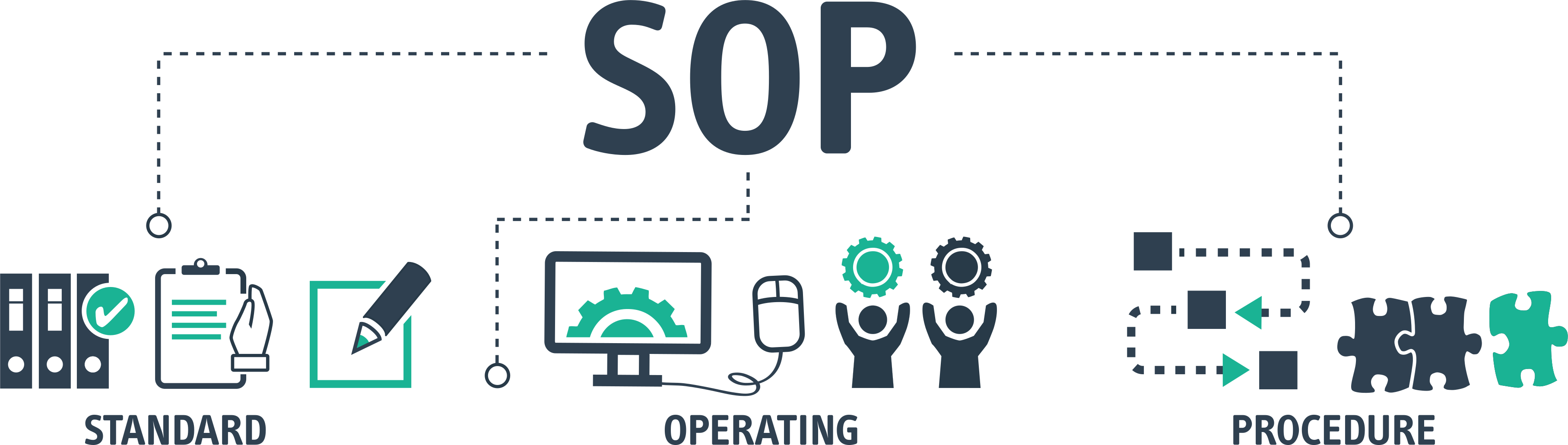
Writing standard operating procedures is the work of turning how your team actually does something into an agreed, written, testable set of instructions that anyone qualified can follow and get the same result. One SOP is a document. A set of SOPs that share a style, have named owners, get tested before release and are reviewed on a schedule is a programme — and it is the programme, not any single document, that decides whether your procedures get used.
This guide is for the operations, IT, HR or team lead at a 10–500 person company who has been asked to "sort out our SOPs" and has more than one procedure to write. If you need to write a single procedure well, our step-by-step guide to writing an SOP covers the nine-step method for one document, from shadowing the practitioner to publishing. This article sits one level up. It covers how to plan, write, test and roll out a whole set of procedures without producing a library nobody trusts.
The spine is sixteen steps grouped into four phases: Plan, Write, Test and Roll out. By the end you will be able to build a prioritised SOP inventory, choose a format for each procedure, run a pilot before release, and set up the version control and review cadence that keeps the set alive after the launch enthusiasm has worn off.
What an SOP Is, and Why the Programme Is the Unit of Success
A standard operating procedure is a documented set of instructions for carrying out a recurring task: who does each step, in what order, with what inputs, and what a correct outcome looks like. The point of writing one is to remove the dependence on whoever happens to know the process. If the person who normally runs month-end close is off sick, the SOP is what lets someone else close the books without guessing.
Most organisations already have some SOPs. Walk through a typical 80-person company and you will find an onboarding procedure in Confluence written by a former HR manager, a patching runbook in a Google Doc, a client offboarding checklist in someone's email drafts, and a set of finance procedures in a Word file with "FINAL v3 (2)" in the name. Each was written in good faith. Together they form a library, not a programme.
The difference matters because SOPs fail as a set. Staff distrust the whole collection when three of the documents they open are out of date. Auditors ask how procedures are controlled, not whether one is well written. New starters cannot tell which of two overlapping procedures wins. A programme fixes these problems at the level where they occur.
Document versus programme
An SOP document answers "how do we do this task?". An SOP programme answers "which tasks have procedures, who owns each one, what format and style do they share, where do they live, how do we know they are followed, and when are they reviewed or retired?". The second set of questions is what auditors, new managers and your future self will actually ask.
A working programme has six parts. An inventory of the procedures that exist and the ones still to be written. A named owner for the programme and for every SOP in it. One agreed template and house style. A single place where the current version of each procedure lives. A test-before-release rule. And a review cadence with a retirement path, so procedures that no longer describe reality are withdrawn rather than left to mislead.
None of this requires a quality department; a 25-person MSP can run all six parts from a spreadsheet, a shared template and a monthly half-hour review. It does require treating the set of procedures as one thing with one owner, which is the decision most teams never make. It is also the foundation for process standardisation: you cannot standardise work you have not first defined.
Before You Start: Objectives, Owners, Scope and the SOP Inventory
The sixteen steps below assume four things have been done first. Skipping them is the most common reason SOP programmes stall at the fifth document: nobody agreed what the programme was for, so nobody could say what to write next or when the job was done.
Set the programme objective
Write one sentence that says why the programme exists. The honest reasons are usually one of five: an audit is coming (ISO 9001, ISO 27001, SOC 2, a client due-diligence questionnaire); onboarding takes too long because knowledge sits in people's heads; the company is opening a second site or team; a key person is leaving or might; or an incident showed that a critical process was being done from memory. Each implies a different order of work. An audit objective means starting with the procedures the auditor will sample; an onboarding objective means starting with the procedures a new hire touches in their first month.
Name the owners
The programme needs one owner with the authority to set the template, approve formats and chase reviews: usually the operations lead or head of IT, never a committee. Every SOP then needs its own owner, accountable for its accuracy, normally the team lead closest to the work rather than the most senior person in the department. The programme owner keeps the inventory; the SOP owners keep their documents true.
Define the scope
Decide which teams and which categories of work the programme covers in its first pass. "Everything" is not a scope. "All recurring IT and HR procedures that touch a new starter or a leaver" is, and so is "every finance process that runs monthly or more often". A tight first scope lets you finish, learn and expand. A broad one produces twelve half-written documents and a lost year.
Build a prioritised inventory
List every recurring process in scope, whether or not a procedure for it exists. Ask each team lead for the tasks they would need to hand over if they left tomorrow. Then score each one on four factors so the order of work is a decision rather than an argument.
| Factor | Score 1 | Score 3 | Score 5 |
|---|---|---|---|
| Frequency | Runs a few times a year | Runs monthly or weekly | Runs daily or many times a day |
| People involved | One person, always the same one | Two or three people, or rotates | Several roles across teams or sites |
| Cost of error | Minor rework, no external impact | Customer-visible delay or cost | Security, safety, legal or financial exposure |
| Regulatory pull | No external requirement | Contractual or client expectation | Required by a standard, regulator or auditor |
Multiply the four scores and sort. The top of the list is where the programme starts; the bottom may never need a formal procedure. A weekly plant-watering rota scores 3 × 1 × 1 × 1 and can stay a note on the wall. Employee offboarding, which spans HR and IT and carries real security exposure, scores something like 3 × 5 × 5 × 3 and belongs in the first batch.
Worked example: a 30-person MSP
The operations lead listed 41 recurring processes across service desk, projects, finance and HR. After scoring, the first batch was six: client onboarding, client offboarding, patch deployment, backup verification, P1 incident response and monthly invoicing. Two of the six lived only in the heads of the two senior engineers. The other 35 were scheduled across three further batches, and nine were marked "no SOP needed — a task list is enough". The inventory took a fortnight of part-time work and ended the "where do we even start?" conversation for good.
Phase 1: Plan (Steps 1–5)
The planning phase makes decisions once, at programme level, so that each individual SOP does not have to relitigate them. The writers of the twentieth procedure inherit a template, a style, a set of formats and a home for the document instead of inventing their own.
Choose how SOPs will be presented and where they will live
Decide, for the whole programme, the medium your procedures will exist in. There are three realistic options: a document library (Word or Google Docs in a controlled folder), a wiki (Confluence, Notion, SharePoint pages), or a process platform where each SOP is a runnable checklist template. Each can work. What does not work is all three at once, which is what most companies have by accident.
The choice depends on how the procedures will be used. Reference material read occasionally suits a wiki with good search. Work that happens weekly and involves several people needs to run as a checklist with assignments and a completion record, because a static page tells you what should happen but never whether it did. Many programmes settle on a hybrid: narrative and screenshots in a document, executable steps as a checklist template that links back to it. Our comparison of the best SOP software sets out the trade-offs between document-first and execution-first tools.
Whatever you choose, write it down as a programme rule with one canonical location per SOP. Two copies of a procedure will diverge within a quarter.
Set up collaboration between writers, practitioners and approvers
SOPs written by managers from memory describe how the process is supposed to work. SOPs written with the people who do the work describe how it actually works, including the workaround for the CRM field that does not save and the step everyone does out of order because the official order is wrong. The second kind gets used.
Set the collaboration model up front. For each SOP, name a writer (often the SOP owner), one or two practitioners who perform the task, and an approver who signs it off. Agree how they will work: a 45-minute observation session, a draft within a week, comments back within another. Put those sessions in diaries now for the first batch; a programme that relies on people "finding time" produces its first draft in month four.
Give everyone the same shared template and a single comment channel. Five reviewers emailing tracked changes to a Word file is how "FINAL v3 (2)" happens.
Define the objective of each SOP
The programme has an objective; so does each procedure. Before anyone writes a step, state in one or two sentences what the SOP is for and what "done correctly" means. "This procedure provisions a new starter's accounts and equipment so that they can work productively from 9am on their first day, with access limited to what their role requires" gives the writer a test for every step. Does this step help the person work from 9am? Does it keep access to what the role requires? If not, it does not belong.
Where the SOP is an improvement to an existing process, the objective should name the pain point: "reduce month-end close from nine working days to five" or "stop leavers retaining access to client systems after their last day". Measure the current state before you write. The definition of a process is a useful test: if you cannot name the trigger, the inputs, the outputs and the owner, the objective is not yet clear enough to write against.
Pick a format for each SOP
Formats are chosen per procedure, from a small menu the programme has agreed in advance. The four that cover almost every case are simple sequential steps, hierarchical sections with sub-steps, flowcharts for branching logic, and checklists for routine work by experienced staff. The comparison table further down sets out when each fits.
The programme's job is to stop the menu growing. Without a rule, IT writes in a runbook style, HR writes in prose, and finance produces a spreadsheet with a column of instructions, and every reader learns a new layout for every document. Agree the four formats and a template for each; if someone needs a fifth, they make the case to the programme owner.
A useful default: hierarchical for anything with more than fifteen steps or more than one role, checklist for anything that runs weekly or more often, a flowchart embedded in either where there is a real decision point, and simple sequential steps for the rest.
Define the scope and limits of every procedure
Every SOP needs a boundary: the trigger that starts it, the state that ends it, and what it deliberately excludes. "Starts when HR submits the new-starter form; ends when the hiring manager confirms the starter has logged in and completed security training; does not cover contractors (see SOP-IT-009) or transfers between offices (see SOP-HR-012)." Boundaries stop two procedures overlapping and stop one procedure trying to be the whole employee lifecycle.
The rule of thumb is one process, one performer group, one SOP. If work crosses teams, write a procedure per team and define the hand-off precisely: what is handed over, in what form, and how the receiving team knows it has arrived. Client onboarding, for example, is usually best expressed as a short parent procedure that names the hand-offs and links to three or four child procedures, one per team. Record the scope, trigger, end state and exclusions in the SOP header block so a reader can tell in ten seconds whether this is the procedure they need.
Start From a Template, Not a Blank Page
CheckFlow's template library includes ready-made procedures for onboarding, offboarding, IT operations, finance and compliance. Copy one, adjust the steps to match how your team works, and your first SOP is running as a checklist the same day.
Browse Free TemplatesPhase 2: Write (Steps 6–10)
The writing phase is where most guides spend all their time, and where this one deliberately does not. The mechanics of writing one good procedure — observing the practitioner, drafting in numbered steps, adding screenshots, reviewing with the people who do the work — are covered in full in how to write an SOP. The five steps here are the programme-level decisions that keep every one of those documents consistent.
Agree a house style and apply it everywhere
Style is not a matter of taste when forty documents share it. A reader who has followed three of your SOPs should open the fourth and know, without thinking, where the purpose statement is, what a step looks like, how warnings are marked and how a decision is written. Agree the rules once, write them on one page at the front of the template. The rules that earn their place are short and mechanical, the kind that survive being applied by a busy team lead at 5pm on a Friday.
- Every step starts with a verb: "Create", "Verify", "Send", "Record". Never "The account should be created".
- One action per step. "Click Save, then open the Review tab" is two steps.
- Name the system, screen and field: "In Entra ID, open Users, then Add user", not "set up the account".
- Write for the newest qualified person on the team, not the most experienced.
- Put the reason next to any step where skipping it causes damage: "Export as PDF — the portal rejects .docx silently".
- Mark decisions explicitly: "If the starter is a contractor, stop here and use SOP-IT-009."
- State what correct looks like at every checkpoint: "The user appears in the Finance group within 15 minutes."
These are the same rules that make a checklist usable, which is not a coincidence. Our guide to creating checklists that get used covers the same discipline from the execution side.
Use consistent company notation
Notation is the set of labels, identifiers and symbols the programme uses so that documents can refer to each other and to the systems they describe without ambiguity. At minimum, agree a document ID scheme (SOP-IT-004, SOP-FIN-011), a version scheme (v1.0, v1.1 for corrections, v2.0 for a rewrite), the canonical names of your systems (is it "the CRM", "HubSpot" or "Hub"?), and the canonical names of roles (is the person who approves invoices "Finance Manager", "FM" or "Sarah"?). Roles beat names: people leave, roles stay.
If you already use a formal modelling notation such as BPMN for process diagrams, use it in SOP flowcharts too. If you do not, do not adopt one for the sake of it. A handful of flowchart symbols — start and end, process box, decision diamond, arrow — is enough for the vast majority of procedures, and everybody already reads them. Our explainer on process flowcharts covers the symbols and when to reach for them. The test of good notation is that a step written by IT can be read by HR without a glossary.
List the process steps with the people who do the work
This is the step that produces the actual procedure, and it should be done the same way for every SOP in the programme: watch the practitioner do the task, write the skeleton of steps, then flesh each one out with the system, the inputs, the checkpoint and the hand-off. Run at least two observation sessions for anything complex; the difference between two runs shows you what is discretionary and what is always required.
Two programme-level rules. The practitioner, not the manager, is the source. And the skeleton comes before the detail: get the ten to twenty top-level steps agreed and in order before anyone writes a sub-step. Where a step is itself a small procedure (configure MFA, reconcile a bank account), write it as a linked sub-procedure rather than inflating the parent; a 60-step flat list is unreadable, a 12-step parent with four sub-procedures is not. The full drafting method is in the single-SOP guide.
Brainstorm failure scenarios before the first test
Once the steps are drafted and before anyone runs them, sit down with the practitioners for thirty minutes and ask, step by step: what happens if this fails, is skipped, or produces the wrong result? What if the bank feed has not updated when the reconciliation step runs? What if the P1 incident occurs at 2am and the named escalation contact does not answer?
You are looking for three kinds of gap. Missing decision points, where the procedure assumes the happy path and offers no branch. Missing prerequisites, where step 6 needs access or data that nothing earlier provides. And missing escalation, where a failure at step 9 leaves the performer with no instruction except "ask someone". Each becomes either a new branch in the procedure, a prerequisite added to the header, or a named escalation with a time limit.
This is where a procedure with real branching stops being a linear list. If more than two or three branches emerge, the flowchart format or a checklist with conditional logic that shows the right steps for each path will serve the reader far better than nested "if" clauses in prose.
Define how each SOP will be measured
A procedure with no measure cannot be improved, only argued about. For every SOP, define before release two or three numbers you will collect: usually one for adherence (how many runs were completed, with every step done, versus how many should have happened), one for speed (cycle time from trigger to end state), and one for quality (errors, rework, exceptions or incidents traceable to this process).
Then define how the numbers will be collected, which is the part most programmes skip. "We will track onboarding cycle time" means nothing unless something records when the new-starter form arrived and when the manager confirmed the login. If the procedure runs as a checklist, the run itself produces the timestamps. If it lives in a document, someone has to keep a log, and within three months nobody will. Write the measures and the baseline in the header block; they are what Step 13 and the review cadence will use to decide whether the procedure is working.
Phase 3: Test (Steps 11–13)
An untested SOP has an unknown number of errors; a tested one has a known, smaller number. The testing phase is short, usually a week or two per batch, and it separates programmes whose documents are trusted from programmes whose documents are ignored.
Run practical tests
Two tests, in this order. First, the cold read: give the draft to someone qualified but unfamiliar with the task and ask them to perform it, without coaching, while the writer watches and says nothing. Every hesitation, question or step performed differently from what was written is a defect in the document, not in the reader. Fix them and repeat with a second person if the first run found more than a handful.
Second, the pilot: run the procedure for real, with the people who will normally perform it, for a defined number of runs. Three onboarding runs, one month-end close, two weeks of the daily backup check. Measure the numbers from Step 10 during the pilot so you have a like-for-like comparison with the baseline.
Where the SOP runs as a checklist, each pilot run shows who did each step and when, which steps were skipped or took longest, and where the performers left comments. Where it is a document, the writer should sit in on at least one run in person; nothing else reliably surfaces the step everyone quietly ignores.
Collect feedback and get sign-off
Feedback comes from two directions. Practitioner feedback is about accuracy and usability: is anything wrong, missing or in the wrong order, and is anything so laborious it will be skipped? Collect it during the pilot and again a week after, because the second week surfaces the problems the first week's novelty hid.
Approver feedback is about fitness: does the procedure meet its objective, satisfy any regulatory or contractual requirement, and fit with the procedures around it? The approver is the SOP owner's manager, the compliance lead, or for high-risk procedures both. Record the sign-off — name, date and version in the revision history — because it is exactly what an ISO 9001 or SOC 2 auditor asks to see when checking that procedures are controlled.
Do not release a procedure that has practitioner objections outstanding. Either fix the step or write down why it stays as it is. An unaddressed "this step is pointless" comment is a promise that the step will not be done.
Make the optimisation path clear
Every SOP will be wrong eventually, because tools, teams and regulations change. The programme needs a defined way for the person who notices to get the document changed, or they will simply start ignoring it. Write the path into the template: how to propose a change (a comment on the checklist run, a message to the owner), who decides (the owner for corrections, the approver for anything that changes the outcome or the controls), how quickly, and how the change is versioned and communicated.
Then make the data from Step 10 part of the path. If cycle time has crept up or a step is skipped in most runs, that is a change request the numbers raised. This is how an SOP programme becomes a continuous improvement loop rather than a documentation project: the procedure is run, the run produces data, the data changes the procedure. Tell the team the path exists and show them the first change that came through it. A procedure people can change is one they will keep using.
Phase 4: Roll Out (Steps 14–16)
Rolling out is more than publishing. It is the point at which the old way of doing the task is withdrawn, the new procedure becomes the only way, and the people who perform it know that and know how.
Run a risk assessment on the final procedure
Before release, walk the final version step by step and ask what could go wrong for the performer, the company or a third party if the step is done as written, done wrongly, or not done. Check five categories: safety, security (does any step grant access, handle credentials or move data?), data protection (does any step touch personal data?), financial (does any step move money or commit spend?), and compliance (does the procedure implement a control that a standard or contract requires?).
For each risk found, add a control to the procedure: a second-person check before the payment step, a required field that records the ticket number before access is granted, a hard stop where the performer must confirm the leaver's last day before revoking anything. The output is a short risk register attached to the SOP. This step is mandatory in regulated work and worth ten minutes in all the rest; the offboarding procedure nobody risk-assessed is the one that revokes email before the manager has retrieved the client files from the leaver's mailbox.
Draw a flow diagram for the visual readers
A proportion of every team reads a diagram faster than a list. For any procedure with more than one role or more than one decision, add a one-page flowchart or swimlane diagram that shows the whole shape: who does what, in what order, where the hand-offs are, and where the path splits. Keep it to a single page; if it does not fit, the procedure's scope is probably too wide.
The diagram is a companion to the written procedure, not a replacement. It answers "where am I in this and what happens next?"; the text answers "exactly how do I do this step?". Put it at the top of the document or as the first screen of the checklist, with each box carrying the same step number as the text. Drawing it late, after testing, is deliberate: a diagram drawn before the steps are agreed becomes an argument about boxes rather than about the work.
Implement, train and withdraw the old way
Publish the procedure in its single canonical location as version 1.0. Then do the three things publishing on its own does not. Train the performers: a 20-minute walkthrough of the diagram and the checkpoints is enough for most procedures, a supervised first run for high-risk ones. Withdraw the old way: archive the previous document, mark it superseded, delete the stale copy from the shared drive, and retire the spreadsheet or email template the process used to run from. And start the measures from Step 10 on day one, so the first review has data.
Where the SOP will run as a checklist, build the template properly rather than pasting the steps in: assign each step to a role, set due dates relative to the trigger, add required fields at the control points, and set the schedule if the procedure recurs. A template designer that does this without code turns the roll-out from a communications exercise into a change in how the work is done. From this point the document describes the process and the checklist is the process, the distinction our guide to recurring checklists explains in full. Finally, tell the wider team what changed and put the first review date in the owner's diary before you close the batch.
SOP Formats Compared
Step 4 asked you to pick a format per procedure from a menu of four. Here is the menu, with where each fits and where each fails. Most programmes use all four; most individual procedures use one, with a flowchart embedded where a decision needs it.
| Format | Best for | Steps and roles | Weakness | Typical example |
|---|---|---|---|---|
| Simple sequential steps | Short linear tasks with no branching, one performer | Up to about 15 steps, one role | Becomes unreadable past 15–20 steps; hides decisions in prose | Creating a user account; running a weekly report |
| Hierarchical (sections and sub-steps) | Long or multi-stage procedures, several roles, phases that span days | 15+ steps, two or more roles | Needs discipline to keep sections balanced; easy to over-nest | Employee onboarding; IT change management; month-end close |
| Flowchart | Procedures whose next step depends on an outcome | Any length; shows roles as swimlanes | Weak on the detail of how to do each box; needs text alongside | Incident triage and escalation; approval routing; troubleshooting |
| Checklist | Frequent, routine work by trained people who need a prompt and a record | 5–30 items, one or several roles | Explains nothing; poor for training a newcomer on its own | Daily backup verification; shift handover; pre-release checks |
Two notes. The checklist row describes the document format; a checklist that runs in software with assignments, due dates and a completion record is a different thing from a printed list, and our guide to creating checklists covers what makes one work. And hybrids are normal: a hierarchical onboarding procedure with an embedded flowchart for "contractor, permanent hire or transfer?" and a checklist for the day-one verification steps is the right tool for each part, not three formats badly mixed.
Three Worked Examples
Here is how three common procedures come out the other end of the sixteen steps, described as the header block and outline a reader would find rather than the full text.
Example 1: IT onboarding SOP
Objective: every new starter can work productively from 9am on day one, with access limited to what their role requires. Owner: IT team lead. Format: hierarchical, run as a checklist. Trigger: HR submits the new-starter form, at least five working days before the start date. End state: the hiring manager confirms the starter has logged in, completed security awareness training and can reach their team's systems. Excludes: contractors and transfers, which have their own procedures.
The outline runs in four sections. Pre-arrival: create the identity in the directory, assign role-based groups, order or reassign the laptop, enrol it in device management, create the mailbox. Day one: hand over equipment, walk through MFA enrolment, confirm the starter can log in to each system on their role's list, issue the security training. Week one: the manager confirms access is sufficient and not excessive. Close: record completion, file the asset assignment. The failure-scenario session added a loaner branch for "laptop not delivered by day minus two" and a hard stop before any group assignment if the role on the form does not match the role list.
Measures: percentage of starters with full access by 9am on day one; number of access-related tickets in the first week; cycle time from form to close. The step-level detail for the technical section lives in a separate new-hire IT setup checklist, and the day-to-day operational reference for the systems involved sits in the team's IT runbook rather than in the SOP.
Example 2: Month-end close SOP
Objective: close the books within five working days of month end with no unreconciled balances and a signed management pack. Owner: finance manager. Format: hierarchical, run as a recurring checklist on the first working day of each month. Trigger: the calendar. End state: the finance director signs the pack. Excludes: year-end adjustments and audit preparation, which are separate procedures.
The outline groups around twenty-five steps into days. Day one: lock the sales ledger, chase missing supplier invoices, post the payroll journal. Day two: bank and credit card reconciliations, accruals and prepayments. Day three: fixed-asset register and depreciation, VAT review. Day four: management accounts draft and variance commentary. Day five: review, sign-off, distribution. Each step names the role, the system, and the report or reconciliation that proves it is done. The risk assessment added a second-person check on any manual journal above an agreed threshold.
Measures: working days to sign-off; number of post-close adjustments; number of steps completed late. Because the procedure runs on a schedule with named owners per step, the finance manager can see on day three which reconciliations are done and which are blocked without asking. A fuller step list is in our month-end close checklist.
Example 3: Incident response SOP
Objective: restore service and contain impact for a P1 or P2 incident within the agreed targets, with a complete timeline for the post-incident review. Owner: head of service delivery. Format: flowchart for triage and escalation, embedded in a hierarchical procedure, run as a checklist with conditional branches. Trigger: a monitoring alert or a user report classified as P1 or P2 by the service desk. End state: service restored, customer informed, post-incident review scheduled. Excludes: security incidents, which invoke the security incident procedure at the first branch.
The outline is short at the top level because the branches carry the weight. Classify and declare: severity criteria, who declares, who is paged. Communicate: initial customer notice within a defined time, then an update cadence. Investigate and contain: assign an incident lead, open a bridge, log every action with a timestamp. Resolve or escalate: escalation contacts with time limits, vendor escalation path. Close: confirm with the customer, record the timeline, schedule the review. The failure-scenario session produced the two branches that matter most: "primary escalation contact does not answer within 15 minutes" and "incident is suspected to be a security event".
Measures: time to acknowledge, time to first customer update, time to restore, and whether the review happened within five days. The written procedure and the checklist share step numbers so the incident lead can follow the flowchart on a second screen while working the checklist.
Common Mistakes in SOP Programmes
These are the failures that show up at programme level and sink whole sets. The document-level mistakes — vague verbs, no owner, never tested — are covered in the single-SOP guide.
Mistake: starting to write before building the inventory. The team writes the procedures that are easiest or most annoying first, runs out of energy after six, and the high-risk processes that actually needed documenting are still in someone's head. The fix is the scoring exercise above: an afternoon of listing and ranking before any drafting, so the first batch is the batch that matters.
Mistake: trying to document everything in one push. Forty procedures launched in one quarter means forty reviews due in the same month a year later, a training burden nobody can absorb, and a programme owner who burns out in month three. Work in batches of five to eight, finish each through roll-out before starting the next, and let the second batch benefit from what the first taught you about the template.
Mistake: letting every team pick its own format and home. IT in a wiki, HR in Google Docs, finance in a spreadsheet, each with its own layout. Each document may be fine; the set is unusable, because nobody can find or navigate procedures outside their own team, and the programme owner cannot tell what exists. Decide the presentation method and the format menu once, in Phase 1, and enforce them.
Mistake: measuring that SOPs exist rather than that they are followed. The programme reports "38 of 41 procedures documented" and calls it done. Nobody knows whether any of them are used. Define adherence measures per procedure, and prefer a presentation method that produces a completion record as a by-product of doing the work, so "was this followed?" has an answer that does not depend on asking.
Mistake: no retirement path. Procedures are added but never removed, so the library grows to include three overlapping onboarding documents and a backup procedure for a system decommissioned two years ago. Staff cannot tell which is current and stop trusting all of them. Every review should ask "does this still describe real work?", and "no" should lead to a marked, archived, superseded document rather than a quietly stale one.
Keeping SOPs Alive: Version Control, Review Cadence and Retirement
Launch is the easy part. An SOP programme is judged eighteen months later, when the tools have changed, two SOP owners have left and an auditor asks for the current access-review procedure.
Version control
Every procedure carries a version number and a revision history: date, version, what changed, who changed it, who approved it. Minor corrections increment the minor version; anything that changes a step, a control or the outcome increments the major version and goes through the approver. There is one current version in one place, and superseded versions are archived with a "superseded by v2.0 on [date]" note rather than deleted, because an auditor may want to know what the procedure said at the time of an event. If the SOP runs as a checklist template, the template's version history does most of this for you, and every run records which version it ran under.
Review cadence
Set the cadence by risk, not by a blanket annual rule that never happens. Procedures that implement security, safety or compliance controls: every six months. Standard operational procedures: every twelve. Rarely-executed procedures such as disaster recovery: every twelve months and after every real execution. Any procedure whose underlying tool changes: immediately, triggered by the change record rather than the calendar. Make the review itself a recurring task assigned to the SOP owner, with a due date and a recorded outcome, so it cannot silently not happen. A recurring checklist with a single task, "Confirm SOP-IT-004 still reflects current practice; update or retire", is the simplest reliable mechanism.
A lightweight alternative for 10–100 person companies is a quarterly SOP health check: each owner answers one question per procedure — "does this still describe what we actually do?" — with yes, needs a change, or retire. Twenty minutes per owner per quarter keeps a forty-procedure set honest.
Retirement
A procedure is retired when the process it describes no longer runs, has been merged into another procedure, or has been replaced by automation. Retirement is a deliberate act with a record: the document is marked retired, archived, removed from the inventory's active list, and any procedures that linked to it are updated. The failure mode is the undead SOP — officially current, actually irrelevant, still findable — which does more damage to trust than a missing document ever could.
What a healthy programme looks like at the twelve-month review
Every active procedure has been reviewed within its cadence. The inventory matches what is published. A few procedures carry a change in their revision history that came from a practitioner, not the owner. Two or three have been retired. Adherence and cycle-time measures exist for the high-risk procedures and have been looked at. And someone who joined last quarter can find and follow the procedures for their role without being told where they are.
Free SOP Templates
The fastest way to start a batch is with a procedure someone else has already structured. These three CheckFlow templates match the worked examples above; each is a runnable checklist you can copy, edit to your own steps and roles, and use as the executable half of the SOP.



The full template library covers onboarding, offboarding, IT operations, compliance, finance, HR and more, with each template organised the way a hierarchical SOP is: sections, steps, roles and checkpoints.
How CheckFlow Fits an SOP Programme
CheckFlow is SOP software built around the idea that a procedure should be run, not just read. Each SOP becomes a template: the sections and steps from your hierarchical procedure, with each step assigned to a role, given a due date relative to the trigger, and carrying the required fields that capture evidence at the control points from your risk assessment.
Conditional logic handles the branches from your failure-scenario session, so a contractor sees the contractor steps and a permanent hire does not, and an incident suspected to be a security event routes to the right procedure at the first decision. Recurring schedules run month-end close on the first working day and the backup verification every morning without anyone remembering to start them; the same mechanism runs your SOP reviews on their cadence. Dynamic due dates set each step's deadline from the start date of the run, so "day minus two" and "within 15 minutes of declaration" mean something.
Every run produces an audit trail: who completed each step, when, with what evidence, under which version of the template. The real-time dashboard shows every active run across the programme, which is how the finance manager sees the state of close on day three and the programme owner sees which reviews are overdue. Zapier and the REST API connect the runs to the systems around them, so a new-starter record in your HR system can start the onboarding template automatically and a completed step can update a ticket.
Pricing starts from $10 per user per month, with a 14-day free trial and no credit card required. The templates above are included, and the template designer lets you build the rest of your inventory without code.
Turn Your SOP Programme Into Running Procedures
Write the procedure once, then run it every time with the right people, the right order and a complete record. Start your free trial and build your first SOP template today.
Start Your Free TrialFrequently Asked Questions
What are the steps to writing a standard operating procedure?
For a single procedure: define its purpose and boundaries, identify the reader, observe the person who does the task, choose a format, draft in numbered steps with one action each, review with practitioners, test it with someone unfamiliar, publish it in one place, and assign an owner and a review date. Our single-SOP guide walks through each of those in detail.
For a set of procedures, the sixteen steps in this article add the programme layer: an inventory, a shared presentation method and style, per-SOP objectives and measures, failure-scenario planning, pilots and sign-off, a risk assessment, a flow diagram and a proper roll-out that withdraws the old way of working.
What format should an SOP be in?
It depends on the procedure. Simple sequential steps suit short linear tasks with one performer. A hierarchical format with sections and sub-steps suits anything over about fifteen steps or involving more than one role. A flowchart suits procedures where the next step depends on an outcome, such as incident triage or approvals. A checklist suits frequent routine work by trained people who need a prompt and a completion record.
Most real procedures are hybrids: a hierarchical document with an embedded flowchart for the decision points and a checklist for the verification steps. What matters at programme level is that every SOP uses one of a small set of agreed formats, so readers are not learning a new layout each time.
How many SOPs does a company need?
As many as there are recurring processes where the cost of doing the work inconsistently is real, and no more. The inventory exercise in this guide answers the question for your company: list every recurring process, score each on frequency, number of people, cost of error and regulatory pull, and write procedures for the ones that score high. A 30-person company typically finds somewhere between fifteen and forty processes that justify a formal SOP.
Low-scoring processes can stay as a short task list or a note. Writing a full procedure for everything produces a library nobody maintains, which does more harm to trust in the set than leaving simple tasks undocumented.
Who should write SOPs?
The person who owns the procedure should write it, working directly with the people who perform the task. The owner is usually the team lead closest to the work. The practitioners are the source of truth for the steps, because they know the workarounds, the real order and the edge cases that a manager describing the process from memory will miss.
A separate approver, typically the owner's manager or the compliance lead, signs the procedure off for fitness and records that sign-off. The programme owner sets the template, the style and the format menu so that every writer produces a document that looks and reads like the others.
How often should SOPs be reviewed?
Set the cadence by risk. Procedures that implement security, safety or compliance controls should be reviewed every six months. Standard operational procedures every twelve. Rarely-run procedures such as disaster recovery every twelve months and after every real execution. Any procedure whose underlying tool or regulation changes should be reviewed immediately, triggered by the change rather than the calendar.
The review must be a scheduled task with an owner and a recorded outcome, or it will not happen. Running it as a recurring checklist task, or as a quarterly health check where each owner confirms "yes, change or retire" for each of their procedures, keeps the set honest with very little effort.
What is the difference between an SOP and a checklist?
An SOP is the documented procedure: it explains the steps, the roles, the reasons behind critical steps and what a correct outcome looks like. It is written to be read and understood. A checklist is the execution tool: it lists the steps drawn from the SOP and provides a way to confirm each was done. It is built to be used while doing the work, and it produces a record of the run.
The two work best together. The SOP is the source; the checklist is the SOP in action. When a procedure runs as a checklist with assignments, due dates and required fields, the completion record becomes the evidence that the SOP was followed, which a document alone can never provide.
How long does it take to set up an SOP programme?
The planning phase — objective, owners, scope, inventory, presentation method, template and style — takes a 10–100 person company two to four weeks of part-time effort from the programme owner. The first batch of five to eight procedures then takes roughly six to eight weeks from observation sessions through pilot and roll-out, with most of that time being calendar time waiting on pilots rather than writing time.
Subsequent batches go faster, because the template, style and collaboration model are settled. A forty-procedure inventory is typically complete within six to nine months if batches run back to back, and the programme is judged not by that date but by whether the set is still accurate and used a year later.