Most agency clients who leave do so in the first 90 days. A structured onboarding process is how you stop it.
Signing a new client is the beginning, not the end. The first 90 days are where the relationship is won or lost — and where most agencies lose it. Slow starts, unclear expectations, missing access, and campaigns that take weeks to launch because nobody collected the right assets in time: these are the reasons clients leave, and every single one of them is preventable. This free marketing agency client onboarding checklist gives account managers and agency teams a structured, repeatable framework for every new client — covering post-contract preparation, welcome and intake, kickoff, access and asset collection, strategy and campaign setup, first deliverable delivery, and the 30-day review.
Why Your Agency Onboarding Process Is Worth Taking Seriously
Agencies with 80% or higher annual client retention share one consistent trait: they treat onboarding as a product, not a process. They design it deliberately, test it, and refine it after every client. Agencies that replace most of their growth with replacement clients almost always lose those clients not because of poor strategy or weak execution, but because the client never felt properly oriented, informed, or valued in those first critical weeks.
The most common causes of early agency client churn are not about results — it is too early for results. They are about the experience: how long it took to get started, whether the client knew what to expect and when, whether the agency felt organised and confident, and whether communication was proactive or reactive. A structured onboarding checklist eliminates every one of these failure points — and it signals to the client, from day one, that your agency runs a professional, organised operation.
What the Marketing Agency Client Onboarding Checklist Covers
This checklist is structured across seven phases that take a new client from contract signed to first deliverable delivered — and from first deliverable to a stable, reporting-driven long-term relationship.
Phase 1
Post-Contract Preparation (Internal — Before the Client Hears From You)
The first thing the delivery team should do is read the proposal and SOW in full — not a summary from the sales team. Misaligned expectations between sales and delivery are the single most common source of early churn.
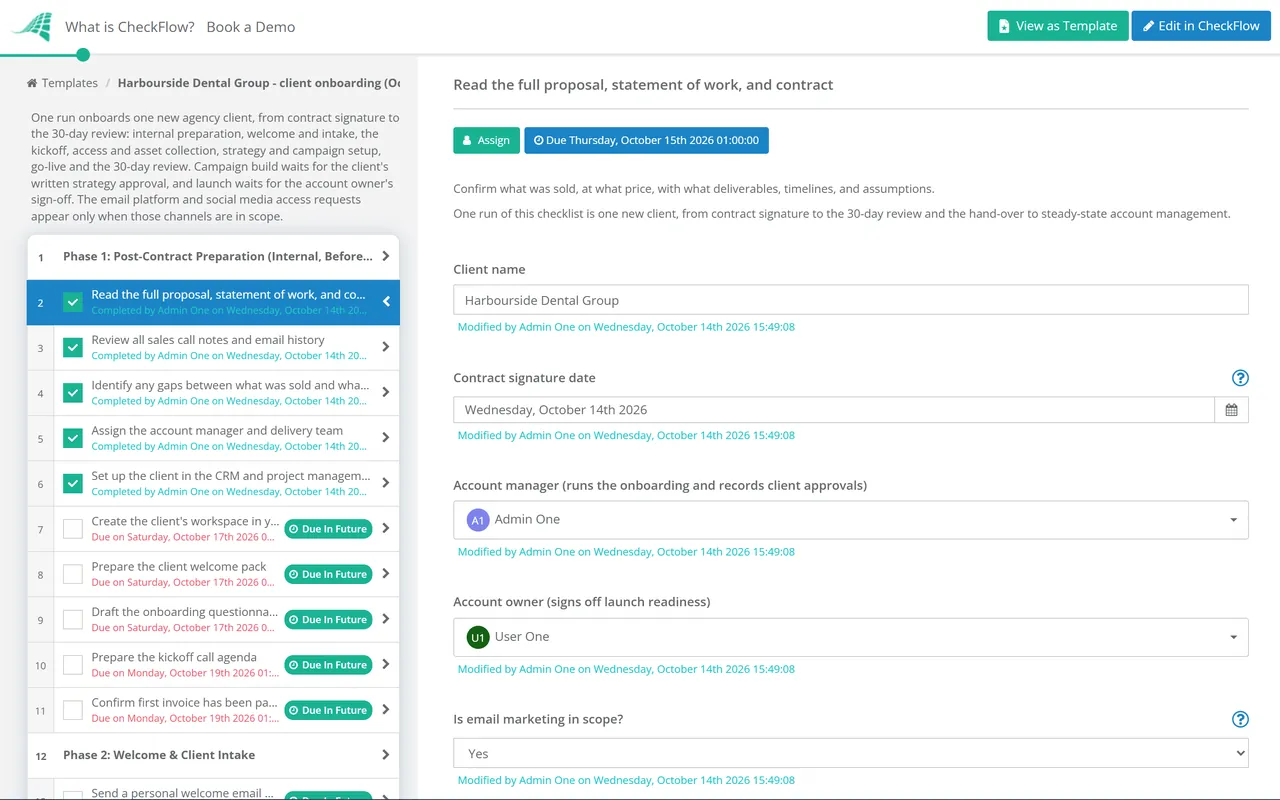
Read the full proposal, statement of work, and contract — confirm what was sold, at what price, with what deliverables, timelines, and assumptions
Review all sales call notes and email history — understand the client’s goals, concerns, and any commitments made during the sales process
Identify any gaps between what was sold and what can realistically be delivered — raise with the account owner before the kickoff
Assign the account manager and delivery team — confirm roles and responsibilities for the account
Set up the client in the CRM and project management system — confirm all team members have the correct access and context
Create the client’s workspace in your internal tools — folders, shared drives, project boards
Prepare the client welcome pack — agency introduction, key contacts, communication norms, what happens next, and what you need from them
Draft the onboarding questionnaire — confirm it covers goals, current marketing activity, brand assets, competitors, and any relevant context the team needs before kickoff
Prepare the kickoff call agenda — share it with the client at least 24 hours in advance
Confirm first invoice has been paid before scheduling the kickoff — do not begin delivery without payment confirmed
Phase 2
Welcome & Client Intake
Send a personal welcome email within 24 hours of contract signature — introduce the account manager, confirm what happens next, and set the tone for the relationship
Send the welcome pack — agency overview, key contacts, communication channels, response time expectations, and reporting cadence
Send the client onboarding questionnaire — request completion before the kickoff call
Confirm the questionnaire has been completed and review responses before the kickoff
Collect signed contract, agreed SOW, and initial invoice payment — confirm all three are in place before proceeding
Set up a shared communication channel (Slack, Teams, or email thread) — confirm all relevant contacts on both sides are included
Confirm the client’s preferred communication style, frequency, and escalation path
Send calendar invites for the kickoff call and the first four weekly or fortnightly check-in calls
Introduce the account manager to the client’s key stakeholders — confirm who the day-to-day contact is and who has final approval authority
Confirm the client’s reporting preferences — format, frequency, and who receives reports
Phase 3
Kickoff Meeting
Conduct the kickoff call with all key stakeholders on both sides
Confirm the client’s primary business goal and the specific marketing outcomes they are hiring the agency to deliver
Review the onboarding questionnaire responses together — clarify any ambiguities before strategy development begins
Agree on success metrics — define exactly how both parties will measure whether the engagement is working
Review the SOW and timeline in detail — confirm the client understands what is and is not included in scope
Set expectations for the first 30, 60, and 90 days — what will be delivered and when, and what realistic results look like at each milestone
Confirm the approvals process — who reviews creative and copy, what the turnaround expectation is, and what happens if approvals are delayed
Identify any potential blockers — access issues, brand restrictions, competitor sensitivities, or internal processes that could slow campaign launch
Agree on the access and asset collection requirements — confirm what you need, from whom, and by when
Send a kickoff summary within 24 hours — document agreed goals, success metrics, responsibilities, and timeline
Phase 4
Access & Asset Collection
Access collection is the most commonly delayed phase in agency onboarding — and the one most likely to delay campaign launch. Assign every access request to a named client contact with a specific due date.
Request access to the client’s advertising accounts — Google Ads, Meta Business Manager, LinkedIn Campaign Manager, and any other relevant platforms
Request access to analytics and tracking — Google Analytics 4, Google Search Console, and any other performance tracking tools
Request access to the website CMS or hosting environment — confirm access level required (editor, admin, or developer access) for the scope of work
Request access to email marketing platform where applicable — Mailchimp, Klaviyo, HubSpot, or equivalent
Request access to any social media business profiles being managed
Collect brand assets — logos in all required formats, brand colour palette, typography guidelines, and brand guidelines document
Collect creative assets — approved photography, video content, product images, and any existing ad creative
Collect copy assets — approved messaging, product descriptions, tone of voice guidelines, and any existing content the agency can reference
Confirm all tracking is correctly installed and firing — verify GA4, pixel, and conversion tracking before campaigns launch
Document all credentials and access levels granted — confirm in writing with the client what access has been provided
Phase 5
Strategy Development & Campaign Setup
Conduct a full audit of the client’s current marketing performance — ads, SEO, analytics, and any channel in scope
Audit existing campaigns and accounts — identify what is working, what is not, and what immediate optimisations can be made before new campaigns launch
Research the competitive landscape — confirm positioning, messaging, and any differentiation opportunities
Develop the initial strategy document — channel mix, messaging framework, targeting approach, and budget allocation
Present the strategy to the client for review and approval — walk through it live, allow time for questions, and document any changes
Obtain written strategy approval before beginning campaign build
Build campaign structures, ad sets, and content calendar in line with the approved strategy
Develop initial creative and copy — confirm it meets brand guidelines and has been reviewed against the onboarding questionnaire responses
Submit creative and copy for client approval — confirm the approvals process from the kickoff is being followed
Confirm all campaigns are set up, reviewed internally, and ready to launch before go-live
Phase 6
First Deliverable & Go-Live
Conduct a pre-launch quality check — confirm tracking, budgets, targeting, and creative are all correct before going live
Launch campaigns or deliver the first agreed deliverable
Notify the client of go-live — send a brief confirmation with what went live, when, and what to expect in the first 7–14 days
Monitor closely in the first 48–72 hours — check for any technical issues, tracking problems, or unexpected performance anomalies
Send a 7-day early performance update — a brief, proactive communication showing early data even if it is too early for conclusions
Confirm the reporting dashboard is set up and the client has access to it
Address any client questions or concerns about the launch promptly — the first week sets the tone for how responsive the agency is
Confirm go-live with the client in writing — document what was delivered, when, and what comes next
Update the CRM and account records to reflect active delivery status
Confirm the schedule for the 30-day review
Phase 7
30-Day Review & Ongoing Client Relationship
Conduct the 30-day performance review — present early results against agreed success metrics
Set clear expectations for the 30-day review — this is early data, not a performance verdict
Identify and resolve any outstanding issues from onboarding — confirm all access, assets, and approvals processes are fully in place
Gather formal client feedback on the onboarding experience — what went well, what could have been better
Confirm the ongoing communication and reporting cadence is working for both sides
Identify any expansion opportunities — additional channels, increased budget, or adjacent services the client has not yet engaged
Conduct an internal onboarding retrospective — what did the agency team find worked well and what needs to improve for the next client
Update the onboarding template based on retrospective findings
Archive the onboarding record — document the full onboarding journey for future reference
Mark onboarding complete and transition to the steady-state account management rhythm
This checklist is available as a free, runnable template in CheckFlow — with tasks assigned to account managers and shared directly with client contacts via a branded checklist link, so both sides see exactly what is outstanding and who needs to act.
The Bottleneck That Kills Agency Onboarding Timelines: Access Collection
Ask any agency account manager what causes the most delays in new client onboarding and the answer is almost always the same: waiting for access. Google Ads, Meta Business Manager, GA4, the CMS, the email platform, the brand asset folder — collecting all of this from clients who are busy, have internal approval processes, or simply forget to action the request, can delay campaign launch by weeks.
The problem is not that clients don’t want to provide access. The problem is that the request arrives as an email that gets buried, or a verbal ask in the kickoff call that nobody wrote down. Without a structured, trackable access checklist — one that assigns each request to a named client contact with a specific deadline and sends automatic reminders — access collection becomes an ongoing chase that consumes account manager time and delays the start that would otherwise generate goodwill.
CheckFlow lets you share the access collection phase of the onboarding checklist directly with the client — they see exactly what they need to provide, complete it as items are granted, and your team sees updates in real time. No more access chase emails.
Without a structured checklist, onboarding quality depends on who runs the account and how busy the agency is that week. A new client signed during a busy month gets a worse start than one signed in a quiet period. CheckFlow gives every client the same structured, thorough onboarding regardless of workload — and signals to the client from day one that your agency is organised, experienced, and in control.

2
Involve the client without losing control
Client-facing tasks — completing the questionnaire, granting access, approving creative — are the most common onboarding delays. CheckFlow lets you assign those tasks directly to client contacts via a shared checklist link. Your client sees exactly what they need to do; your team sees it the moment they complete it. No more chasing access by email. No more wondering if the questionnaire was read.
3
Manage multiple clients simultaneously
Agencies run multiple new client onboardings at once — and the account manager needs to know, at any given moment, which clients are on track and which have a blocked task holding everything up. CheckFlow’s grid-based dashboard shows every active onboarding in one view — which phase each client is in, what is overdue, and where to focus today. Without it, the answer to “where are we with Client X?” is always “let me check my emails.”
Marketing agencies managing multiple client relationships simultaneously use CheckFlow for the same structured approach across all recurring client processes — not just onboarding. Monthly reporting, campaign reviews, and account management check-ins can all run from the same platform. Learn more about recurring checklists in CheckFlow →
What should a marketing agency client onboarding checklist include?
+
A comprehensive marketing agency client onboarding checklist should cover seven phases: post-contract internal preparation (reviewing the SOW and briefing the team), welcome and client intake (questionnaire, welcome pack, and payment confirmation), kickoff meeting (goal alignment, success metrics, and expectations), access and asset collection (ad accounts, analytics, CMS, creative assets, and tracking verification), strategy and campaign setup, first deliverable delivery, and the 30-day review. The access collection phase is the most commonly delayed and should be structured as a separate, tracked set of tasks assigned to named client contacts with specific deadlines.
How long does marketing agency client onboarding typically take?
+
Core onboarding activities — kickoff, access collection, strategy approval, and first campaign launch — typically take two to four weeks from contract signature. The full onboarding period, including the 30-day, 60-day, and 90-day reviews, spans three months. The most common cause of onboarding delays is access collection — agencies frequently wait one to two weeks for client access to advertising and analytics platforms, which delays strategy development and campaign launch. A structured checklist with assigned deadlines and automatic reminders is the most effective way to compress the timeline.
Why do marketing agency clients churn in the first 90 days?
+
Early agency churn is almost never about results — it is too early for meaningful results. It is about the experience of the first few weeks. The most common reasons are: slow start (clients expected campaigns to be live within days, not weeks); poor communication (reactive rather than proactive updates); misaligned expectations (what was promised in the sales process does not match what delivery is doing); and the client not feeling involved or informed. A structured onboarding checklist addresses all of these — it enforces a fast start, builds in proactive communication milestones, ensures expectations are explicitly aligned at kickoff, and gives clients visibility into their own onboarding progress.
How do I collect client access and assets without endless chasing?
+
The most effective approach is to turn the access collection phase into a structured checklist with tasks assigned to specific client contacts, clear deadlines, and automatic reminders. Rather than sending an email listing everything you need, assign each access item as a separate task — “Grant Google Ads access to [email] by [date]” — so the client can work through the list at their own pace and you can see exactly what has and has not been completed. CheckFlow’s secure sharing feature lets you share this checklist directly with the client, with tasks assigned to their specific contacts, without requiring them to create an account.
Should clients be involved in the onboarding checklist or is it an internal tool?
+
The most effective agency onboarding checklists have both internal and client-facing elements. Internal tasks — team briefing, CRM setup, strategy development — are for the agency team only. Client-facing tasks — completing the questionnaire, granting account access, approving creative, and confirming information — should be visible to and actionable by the client. Giving clients a structured, professional view of their own onboarding — what has been done, what is outstanding, and what they need to act on — significantly reduces delays, increases client engagement, and signals that the agency is organised and transparent.
How do I make onboarding consistent across multiple account managers?
+
Build the onboarding process as a structured template and run every client from that template — not from the account manager’s memory or personal preferences. When the checklist defines every phase, task, owner, and milestone, the quality of onboarding is determined by the template, not by who happens to be managing the account. New account managers can run a full professional onboarding from day one without learning the process informally from a colleague. CheckFlow lets you build that template once and run it for every client with automatic task assignments and notifications.
Is CheckFlow free to use for this template?
+
You can start a free 14-day trial with no credit card required, giving you full access to all features including this template. The Business plan is $10 per user per month after the trial. Full details at checkflow.io/pricing.
Start Running Consistent Client Onboarding at Your Agency
Free trial — no credit card required.
Do you like cookies? 🍪 We use cookies to ensure you get the best experience on our website. Learn more