Most overdue invoices aren’t disputed. They just haven’t been chased, or they’ve been chased by someone who wasn’t sure it was their job, until the debt is ninety days old and much harder to collect.
Cash that customers owe you is the cheapest financing a business has, and it is the easiest to lose through inattention. Collections rarely fail because of one difficult customer. They fail because unapplied cash sits unresolved, disputes wait for someone in sales to respond, and nobody works the ageing report on the same day every week. This free accounts receivable checklist gives credit controllers, AR teams and finance managers a weekly collections cycle and a month-end review. The weekly cycle applies cash, works the ageing report bucket by bucket, logs every customer contact and routes disputes to the people who can fix them. An escalation phase appears only when an account passes your overdue threshold. At month end, the checklist reconciles the ledger, reviews the bad debt provision and puts every write-off through an approval.
Collections Is a Weekly Cadence, Not a Month-End Scramble
Accounts receivable sits between billing and cash. Billing raises the invoice; AR makes sure it is paid, applied to the right customer account and, when it can’t be collected, provided for and written off properly. It is the mirror image of accounts payable, and it needs the same discipline pointed in the other direction.
The most effective AR teams split the work in two. A weekly cycle keeps the ledger clean and the collection calls going. A month-end review deals with the accounting: reconciling the subledger, updating the provision for doubtful debts and approving any write-offs. Running both from the same checklist means the month-end review can see exactly what was done to collect each balance before it was written off.
Weekly collections cycle
Owned by the credit controller or AR team
Covers: cash application, the ageing report, customer contact by bucket, promises to pay and disputes.
Cadence: the same day every week.
Output: a clean ledger, a contact log and a shorter list of overdue accounts.
Month-end AR review
Owned by the finance manager or controller
Covers: subledger reconciliation, the bad debt provision, write-off approvals and KPIs such as DSO.
Cadence: monthly, as part of the close.
Output: a reconciled balance, an approved provision and a collections forecast for the cash flow model.
What the AR & Collections Checklist Covers
Four weekly phases keep cash applied and customers contacted. Phase 5 appears only when an account passes your escalation threshold, and Phase 6 is the month-end review.
Phase 1 — Weekly
Phase 1: Apply Cash & Update the Ledger
An overdue report built on unapplied cash chases customers who have already paid. Clean the ledger before anyone picks up the phone.
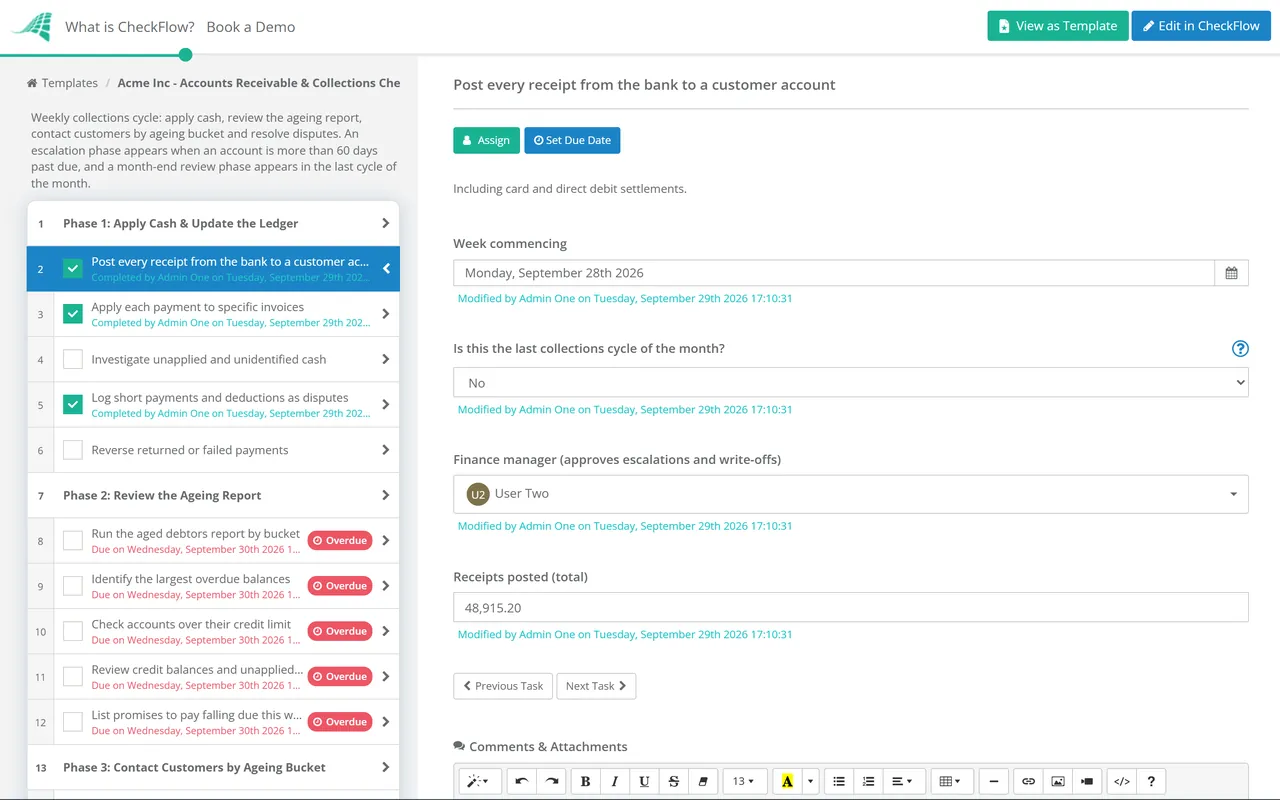
Post every receipt from the bank to a customer account — including card and direct debit settlements
Apply each payment to specific invoices — not left “on account”, using the remittance advice
Investigate unapplied and unidentified cash — contact the payer for a remittance within two working days
Log short payments and deductions as disputes — not as write-offs; each one goes to Phase 4
Reverse returned or failed payments — reopen the invoice and note it on the customer account
Phase 2 — Weekly
Phase 2: Review the Ageing Report
Run the aged debtors report by bucket — current, 1–30, 31–60, 61–90 and over 90 days past due
Identify the largest overdue balances — the top 10 or 20 accounts usually hold most of the overdue value
Check accounts over their credit limit — and tell sales before new orders are accepted
Review credit balances and unapplied credits — apply them to open invoices or arrange refunds
List promises to pay falling due this week — so broken promises are followed up the next day
Phase 3 — Weekly
Phase 3: Contact Customers by Ageing Bucket
Send pre-due reminders for large invoices — confirm the invoice has been received and approved before the due date
1–15 days overdue: reminder email — with a copy of the invoice and your payment details
16–30 days overdue: phone the customer’s AP contact — confirm the invoice is approved and agree a payment date
31–60 days overdue: send a statement and involve the account manager — agree whether new work or deliveries should continue
Log every contact and promise to pay — with the date, the person spoken to and the next action
Phase 4 — Weekly
Phase 4: Resolve Disputes & Deductions
Record each dispute with a reason code — pricing, quantity, quality, missing PO, not received or duplicate
Route the dispute to the owner who can fix it — sales, operations or billing, with a response date
Approve any credit note before it is issued — by someone other than the person who requested it
Reissue corrected invoices promptly — and restart the collection timeline from the corrected date
Review the age of every open dispute — escalate any that have been open longer than your target
Phase 5 — If Needed
Phase 5: Escalate Seriously Overdue Accounts
Shown only when an account is more than 60 days past due. Change the threshold to suit your terms and customers.
Place the account on credit hold — approved by the finance manager and confirmed to sales in writing
Send a formal demand letter — stating the amount, the deadline and any statutory late-payment interest or compensation you are entitled to claim
Agree a payment plan where appropriate — documented, signed by the customer and approved internally
Decide on referral to a collection agency or legal action — approved by the finance manager, with the full contact history attached
Phase 6 — Month End
Phase 6: Reconcile, Provide & Report
Shown in the last collections cycle of each month. Assign it to the finance manager or controller.
Reconcile the AR subledger to the general ledger control account — investigate and clear any difference
Review the provision for doubtful debts — using the method your accounting framework requires
Approve write-offs under the authority matrix — only after the collection history shows the debt is uncollectable
Claim VAT or sales tax bad debt relief where eligible — the conditions and time limits depend on the jurisdiction
Report DSO, the ageing trend and expected collections — and send the collections forecast to whoever owns the cash flow forecast
The matrix sets out who does what at each stage of overdue. Agree it with sales before you use it, so account managers know when they will be asked to step in and when an account will go on hold. The day counts assume 30-day terms. Tighten them for customers with a poor payment record, and loosen them where a large customer’s approval cycle is slow but reliable.
Days past due
Action
Owner
Escalate if
Not yet due
Pre-due reminder on large invoices; confirm the invoice is approved for payment
Credit controller
The customer says they haven’t received it
1–15
Reminder email with the invoice attached
Credit controller
No reply within five working days
16–30
Phone call to the customer’s AP team; agree a payment date
Credit controller
No payment date given, or a promise broken
31–60
Statement, second call, account manager involved
Credit controller and account manager
A dispute is raised, or no response
61–90
Credit hold, formal demand, payment plan if appropriate
Finance manager
A payment plan is missed
Over 90
Agency or legal referral decision; provision reviewed
Finance manager or controller
Write-off is proposed
Late-payment interest depends on where you and your customer are. In the UK, the Late Payment of Commercial Debts (Interest) Act 1998 lets a business charge statutory interest on overdue business-to-business debts at 8% above the Bank of England base rate, plus fixed compensation of £40, £70 or £100 depending on the size of the debt. A Commercial Payments Bill now before Parliament would cap most payment terms at 60 days and make that interest mandatory, but it is not yet law. In the EU, the Late Payment Directive (2011/7/EU) sets a minimum rate of 8 percentage points above the European Central Bank reference rate and fixed compensation of at least €40, implemented through each member state’s law. A 2023 proposal to replace it with a stricter regulation has stalled, so the Directive still applies. In the US, late fees and interest generally depend on your contract terms and state law, including state usury limits. Consumer debts are treated differently everywhere: in the US, for example, third-party collectors of consumer debt are covered by the Fair Debt Collection Practices Act. Put your late-payment terms in the contract and on the invoice, and take advice before relying on them.
Provisions differ by framework, too. IFRS 9 requires a lifetime expected credit loss allowance for most trade receivables (the simplified approach), and a provision matrix by ageing bucket is a common way to calculate it. US GAAP applies the current expected credit loss (CECL) model in ASC 326, and ASU 2025-05, effective for annual periods beginning after 15 December 2025, lets entities assume that conditions at the balance sheet date stay unchanged over the short life of current receivables. UK FRS 102 uses an incurred-loss approach, where you provide when there is objective evidence that a debt is impaired, unless the company has chosen to apply IFRS 9 instead. The ageing data this checklist produces each week is the starting point for all three.
Why Run Collections in CheckFlow?
1
The cycle starts on the same day every week
A recurring weekly schedule creates the collections checklist and assigns cash application, the ageing review and customer contacts to the right people. When a week is missed, it shows as overdue on the dashboard instead of turning up as a jump in DSO at month end.
2
Escalations and write-offs need a second signature
Credit holds, payment plans, agency referrals, credit notes and write-offs are approval steps, so nobody can put an account on hold or clear a balance on their own authority. Each decision records who approved it and when.
3
The contact history is already there
Every call, promise to pay and dispute is logged against the week it happened. When an account reaches the write-off stage, the finance manager, the auditors and, if it comes to it, a collection agency can see exactly what was done to collect it.
Collections is a weekly routine, not a project. CheckFlow’s recurring checklist software runs it on a fixed day, with a separate checklist per entity or per customer portfolio if your credit control team splits accounts between them.
What should an accounts receivable checklist include?
+
A weekly cycle and a month-end review. The weekly cycle covers applying cash, reviewing the ageing report, contacting customers according to how overdue they are, logging promises to pay and resolving disputes. The month-end review covers reconciling the AR subledger to the general ledger, reviewing the bad debt provision, approving write-offs and reporting DSO. Add an escalation step for seriously overdue accounts, with approvals for credit holds and referrals.
How often should the AR ageing report be reviewed?
+
Weekly, on a fixed day. A monthly review is too slow: an invoice can move from current to 60 days overdue between two month-end reviews without anyone contacting the customer. A weekly review also catches unapplied cash and credit balances while the customer still remembers the payment.
When should an overdue account be escalated?
+
Set the trigger in advance, not case by case. Many businesses on 30-day terms involve the account manager at around 30 days overdue, and consider a credit hold and formal demand at around 60. The matrix above is a starting point. The important thing is that the escalation happens because a threshold was reached, not because someone finally noticed.
Can I charge interest on late payments?
+
Often, but the rules depend on the jurisdiction and on your contract. The UK and EU have statutory late-payment interest and fixed compensation for business-to-business debts. In the US, interest and late fees usually depend on the contract and on state law. Consumer debts are regulated more tightly everywhere. State your terms in the contract and on the invoice, and take advice before claiming interest you haven’t agreed in writing.
When should a bad debt be written off?
+
When the collection history shows it is uncollectable: the customer has gone into insolvency, the debt has been through your full escalation process without success, or the cost of pursuing it exceeds what you would recover. The write-off should be approved under your authority matrix. Separately, your accounting framework sets how you provide for expected or incurred losses before that point, and tax rules set when you can claim VAT or sales tax relief on the debt.
How is this different from the accounts payable checklist?
+
Accounts payable is money you owe: receiving supplier invoices, matching them, approving and paying them. Accounts receivable is money owed to you: applying customer payments, chasing overdue invoices, resolving disputes and writing off what can’t be collected. They share a ledger discipline but involve different people, risks and approvals, so CheckFlow keeps them as separate templates.
Is CheckFlow free for this template?
+
14-day free trial, no card required. The Business plan is $10 per user per month after the trial. Full details at checkflow.io/pricing.
Chase Every Overdue Invoice on Time, Every Week
Free trial — no credit card required.
Do you like cookies? 🍪 We use cookies to ensure you get the best experience on our website. Learn more