
Retainers rarely fail in one dramatic month. They erode: a few unbilled favours, hours nobody reconciled, priorities that drifted, until the client wonders what they are paying for and the agency wonders why the account loses money.
This free monthly retainer delivery checklist is for agencies, consultancies and fractional or outsourced teams that bill a client the same fee every month. It runs once a month for each retainer: open the month with an agreed allowance and priorities, plan and assign the work, check the burn at mid-month, handle out-of-scope requests with the client’s written agreement, deliver and check the work, then reconcile hours, approve the summary and invoice, and send them. In the last month of each quarter a health review asks whether the retainer still fits. A dropdown at the start switches between tracking an hours bank and tracking fixed deliverables.
Four Retainer Models and What Each One Needs Watching
The retainer agreement decides what the client is buying. This checklist is about the month after it is signed, when that agreement has to survive real requests, real people and real timesheets. How you run the month depends on which model you sold, because each one goes wrong in a different place.
Model
The client pays for
Track every month
Where it goes wrong
Hours bank
A block of hours at a blended rate
Hours used against hours sold, by person and task; carry-over under the rollover rule
Hours roll over without a cap, or busy months run past the block and nobody says so until the invoice
Fixed deliverables
A defined set of outputs each month
Each deliverable delivered, deferred or swapped; effort per deliverable against the estimate
Revisions and “quick extras” inflate the effort while the fee stays the same
Availability
Priority access to a team or expert, used as needed
Response times, requests handled and the time they took
A quiet month looks like money for nothing, a busy one looks like a bargain the client expects again
Value-based
An outcome, or a share of a measured result
The agreed measure, the baseline and the work that moved it
The measure is not agreed precisely, so every month starts with an argument about the number
Hybrids are common, such as a fixed core of deliverables plus a small hours bank for ad hoc work. The checklist’s dropdown has a Hybrid option for these, which shows both the hours and the deliverables tracking tasks; availability and value-based retainers can use the deliverables branch and report their measure in the month summary. Whichever model you sold, three things decide whether it survives: an allowance both sides can see, a written route for work outside it, and someone who checks the numbers before the invoice goes out.
What the Monthly Retainer Delivery Checklist Covers
Seven phases run one retainer month from opening to invoice. The retainer type decides which tracking tasks appear at mid-month, the change-request tasks appear only when out-of-scope work was requested, and the quarterly health review appears only in the last month of a quarter. The summary and invoice need the account director’s approval before they reach the client.
Open
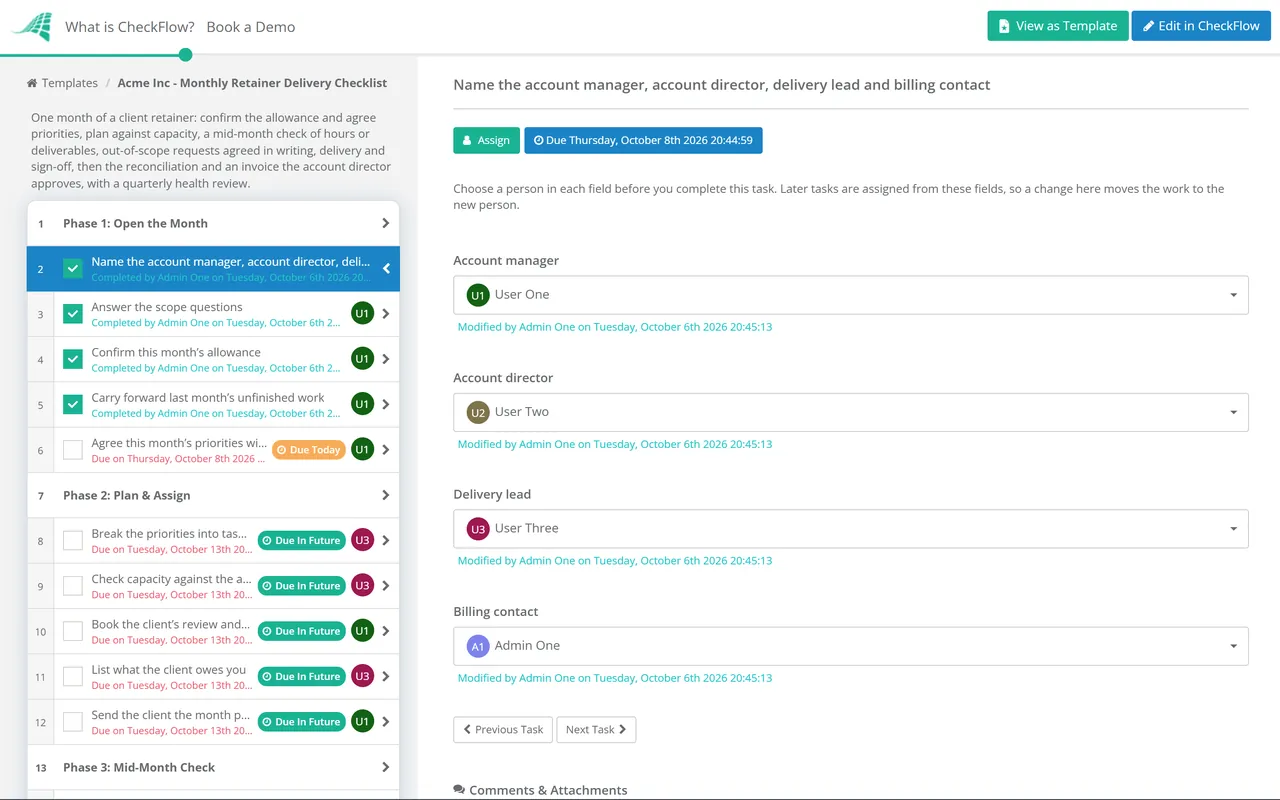
Phase 1: Open the Month
Owned by the account manager. Answer two scope questions here: the retainer type (Hours bank, Fixed deliverables or Hybrid) and whether this is a quarter-end month.
Name the account manager, account director, delivery lead and billing contact — later tasks are assigned from these fields
Answer the scope questions — the retainer type, and whether this month ends a quarter
Confirm this month’s allowance — contracted hours or deliverables, plus any carry-over the rollover rule allows, recorded in a ShortText field
Carry forward last month’s unfinished work — each item given a new date, swapped for something else, or dropped with the client’s agreement
Agree this month’s priorities with the client — ranked and in writing, so later trade-offs are made against a list both sides accepted
Plan
Phase 2: Plan & Assign
Break the priorities into tasks with owners and dates — each booked to the retainer’s time code
Check capacity against the allowance — people booked against hours or deliverables sold, before the work starts
Book the client’s review and approval dates — feedback rounds are where months slip
List what the client owes you — assets, access, data and decisions, each with a date
Send the client the month plan — what will be delivered, when, and what you need from them
Track
Phase 3: Mid-Month Check
The two hours tasks are shown for an Hours bank or Hybrid retainer, the two deliverables tasks for Fixed deliverables or Hybrid. The last task asks “Were any out-of-scope requests received?” and a Yes shows the Phase 4 tasks.
Compare hours used with hours planned — by person and task, from timesheets brought up to date first
Warn the client when the burn passes the agreed threshold — the early-warning point set in the agreement, with the options for the rest of the month
Check each deliverable against its due date — on track, at risk or late, with the reason recorded
Compare effort per deliverable with the estimate — a deliverable that keeps taking twice its budget is a pricing problem, not a busy month
Chase overdue client inputs — and note which delays came from waiting on the client
Log requests outside the agreed scope — answer whether any out-of-scope requests were received this month
Change
Phase 4: Out-of-Scope Requests
Shown only when out-of-scope requests were received. The client’s written agreement is recorded as an attachment; it is not an approval step, because the client works outside the checklist.
Describe each request against the scope — what was asked, by whom, and which part of the agreement it falls outside
Estimate it and offer the options — absorb it, swap it for a planned item, bill it as overage or quote it as a separate project
Record the client’s written agreement — the email or signed change note attached before any work starts
Update the month plan and the allowance count — so the burn check, the summary and the invoice all reflect the change
Flag repeat requests for the quarterly review — the same request every month usually means the retainer is the wrong size
Deliver
Phase 5: Deliver & Check
Check each piece of work against its brief before the client sees it — by someone other than the person who did it
Deliver and log the date — against the date in the month plan
Track revision rounds — against the rounds the retainer includes, and tell the client before an extra round starts
Get sign-off on finished work — in writing, attached to the task
Note what moves to next month — with the reason and whether the client agreed
Close
Phase 6: Close the Month & Invoice
The account director’s approval of the summary and invoice halts the checklist. Nothing is sent to the client until it is Approved.
Lock and reconcile timesheets — hours by person against the allowance, with corrections made before anything is billed
Apply the rollover or overage rule — hours carried forward, hours lost or overage to bill, or deliverables delivered, deferred or swapped
Write the month’s activity summary — delivered, in progress, allowance used and decisions the client needs to make
Prepare the invoice — the fee as the agreement sets it, usually in advance, plus any approved overage, with the client’s PO number where they use one
Account director approval of the summary and invoice — figures, wording and any write-off approved before sending
Send the summary and invoice — to the named contacts, with copies filed against this month’s run
Quarter
Phase 7: Quarterly Retainer Health Review
Shown only in a quarter-end month. Owned by the account director.
Work out the effective hourly rate — fees billed over the quarter divided by hours actually worked, against your target rate
Review scope drift — requests absorbed, swapped and billed over the three months
Review the three-month burn trend — consistently under or over the allowance means it no longer fits the work
Check the relationship — stakeholder changes, satisfaction, the renewal date and the notice period
Decide the recommendation — keep, resize, reprice or restructure the retainer, with a date to propose it
Hold the quarterly review with the client — results against goals, the recommendation and next quarter’s priorities
Most retainer problems are timing problems. The overrun nobody mentioned until the invoice, the request agreed on a call and never written down, the timesheets filled in from memory on the last day. A fixed rhythm catches each of these while it is still cheap to fix. Shift the dates to suit your billing cycle; keep the order.
Days 1 to 2
Open the month
Confirm the allowance and carry-over, close out last month’s loose ends and agree the ranked priorities with the client in writing.
Week 1
Plan and assign
Tasks, owners and dates booked against capacity, the client’s review dates in the diary and the month plan sent.
Mid-month
Check the burn
Hours or deliverables against plan. Warn the client at the agreed threshold, not after it, and log anything outside scope while the request is fresh.
Weeks 3 to 4
Deliver and get sign-off
Quality check, delivery, revision rounds counted against what the retainer includes, and written sign-off on finished work.
Last working day
Lock timesheets
Everyone’s time in by the cut-off, so the reconciliation uses real numbers rather than estimates.
Days 1 to 3 next month
Close and invoice
Apply the rollover rule, write the summary, get the account director’s approval and send the summary with the invoice.
Quarter end
Health review
Effective rate, scope drift and burn trend over three months, then a recommendation to the client before the renewal date forces one.
Keep the performance report separate. The month summary in Phase 6 says what the team did with the allowance. Results such as traffic, leads or coverage belong in the client’s performance report, which has its own data checks and its own approval; the Agency Monthly Client Reporting Checklist covers that run.
Why Run Retainers in CheckFlow?
1
A fresh run every month
Schedule the template to start on the first working day of each month for every retainer client, with the account manager, delivery lead and billing contact already assigned from the role fields. Nobody has to remember to open the month.

2
Overage with a paper trail
Out-of-scope requests appear as tasks only when they happen, and the client’s written agreement is attached before work starts. The invoice stops at the account director’s approval, and the audit trail shows who agreed what.
3
One template, every retainer type
A dropdown shows hours tracking, deliverable tracking or both for a hybrid, so one template serves every retainer. Share a read-only, white-labelled link so the client can see the month’s progress under your brand.
CheckFlow is not time-tracking, accounting or agency management software. It runs the monthly routine around them: the allowance, the checks, the change requests and the sign-off. Recurring checklists explain how scheduled runs work, and the guide to marketing agency client onboarding covers setting the retainer up properly in the first place.
Run every month the same way. Open it by confirming the allowance and agreeing ranked priorities in writing, plan the work against capacity, check hours or deliverables at mid-month and warn the client early if the burn is high, handle anything outside scope with written agreement before starting, then lock timesheets, apply the rollover rule and send a short summary with the invoice. Every quarter, step back and ask whether the retainer is still the right size and price.
Should unused retainer hours roll over?
+
Only as far as the agreement says, which is why it should say something. Common choices are no rollover, rollover capped at a number of hours, or rollover that expires after a month or a quarter. Unlimited rollover tends to build a bank of hours the client expects to spend all at once, usually in your busiest month. Whatever the rule, apply it the same way every month and show the carry-over on the summary, so it never surprises either side.
How should an agency handle out-of-scope requests on a retainer?
+
Log the request, compare it with the agreed scope, and give the client options before doing the work: absorb it this once, swap it for something planned, bill it as overage, or quote it as a separate project. Get the choice in writing, even a one-line email, and attach it. The problem is rarely one request; it is the tenth small one that nobody wrote down. If the same kind of request comes every month, raise it at the quarterly review as a sign the retainer needs resizing.
When should a retainer be invoiced?
+
When the agreement says. Many agencies bill the monthly fee in advance, at the start of the month it covers, and bill any agreed overage in arrears once the hours are known. Whichever way you do it, reconcile timesheets and apply the rollover rule before the invoice is raised, and have someone senior check it, because correcting an invoice after the client has queried it costs more goodwill than getting it right first time.
How do you know whether a retainer is profitable?
+
Divide the fees billed over a period by the hours your team actually worked on the account, including the hours nobody billed, and compare the result with your target hourly rate. That effective rate falls quietly when revisions, meetings and small favours go unrecorded, so it only works if everyone logs their time to the retainer. Review it quarterly alongside scope drift and the burn trend, and reprice or resize before the renewal rather than at it.
Is CheckFlow free for this template?
+
14-day free trial, no card required. The Business plan is $10 per user per month after the trial. Full details at checkflow.io/pricing.
Run Every Retainer Month the Same Way
Free trial — no credit card required.
Do you like cookies? 🍪 We use cookies to ensure you get the best experience on our website. Learn more