Most projects that struggle were never properly started. The sponsor never agreed the scope, the team arrived without access, or the client remembered a different deal.
A kickoff meeting takes ninety minutes. Getting a project to the point where that meeting is worth holding takes a week or two of work that is easy to skip. This free project kickoff checklist gives project managers, PMOs and agency and consultancy delivery leads a workflow from “the project is approved” to “the team is executing”: the mandate and sponsor, a charter with a written scope boundary, stakeholders and a RACI, a baseline the sponsor approves, governance and access, the kickoff meeting itself and the first two weeks of follow-through. Two questions at the start show a client phase for work delivered to an external client and a backlog task for iterative delivery.
Business Case, Charter and Kickoff: Three Different Jobs
A project usually reaches its kickoff through two earlier decisions. The business case decides whether the work is worth doing. The charter, in PMI’s long-standing definition, is the document issued by the sponsor that formally authorises the project and gives the project manager authority to apply the organisation’s resources to it. PRINCE2 puts the same agreement in its project initiation documentation, which acts as the contract between the project manager and the project board. The kickoff is the third step: the point where the people who will do the work hear the authorised plan together, and say what is wrong with it while it is still cheap to change.
Most kickoff checklists are a meeting agenda. The meeting is the easy part. What goes wrong is everything around it: a scope boundary nobody wrote down, a sponsor who has not agreed the budget, a team that arrives on day one without access, or a client who signed a statement of work that says something different from the charter. This checklist starts at approval and ends two weeks into delivery, so the meeting has something solid to present and its decisions are followed up.
If you are still deciding whether to do the project, start with the Business Case Checklist. If the project is under way and you need its documents kept current, the Project Management Documentation Checklist covers the whole lifecycle. On a client project you will usually hold two kickoffs, and they do different jobs.
Internal kickoff
Align the team that does the work
The sponsor opens and explains why the project matters now
Open discussion of risks, constraints, budget and staffing
Roles, the RACI and ways of working settled
Held first on a client project, so the team presents one plan

Client kickoff
Align two organisations on one plan
Scope and acceptance read against the signed statement of work
Client sponsor, day-to-day lead and approvers named
Reporting rhythm and escalation route agreed on both sides
Client access, data handling and the first milestone confirmed
What the Project Kickoff Checklist Covers
Seven phases run from confirming the mandate to the first status report. Phase 2 appears only when the project is delivered for an external client, and the backlog and sprint task in Phase 5 appears only when the work is delivered in sprints or iterations.
Mandate
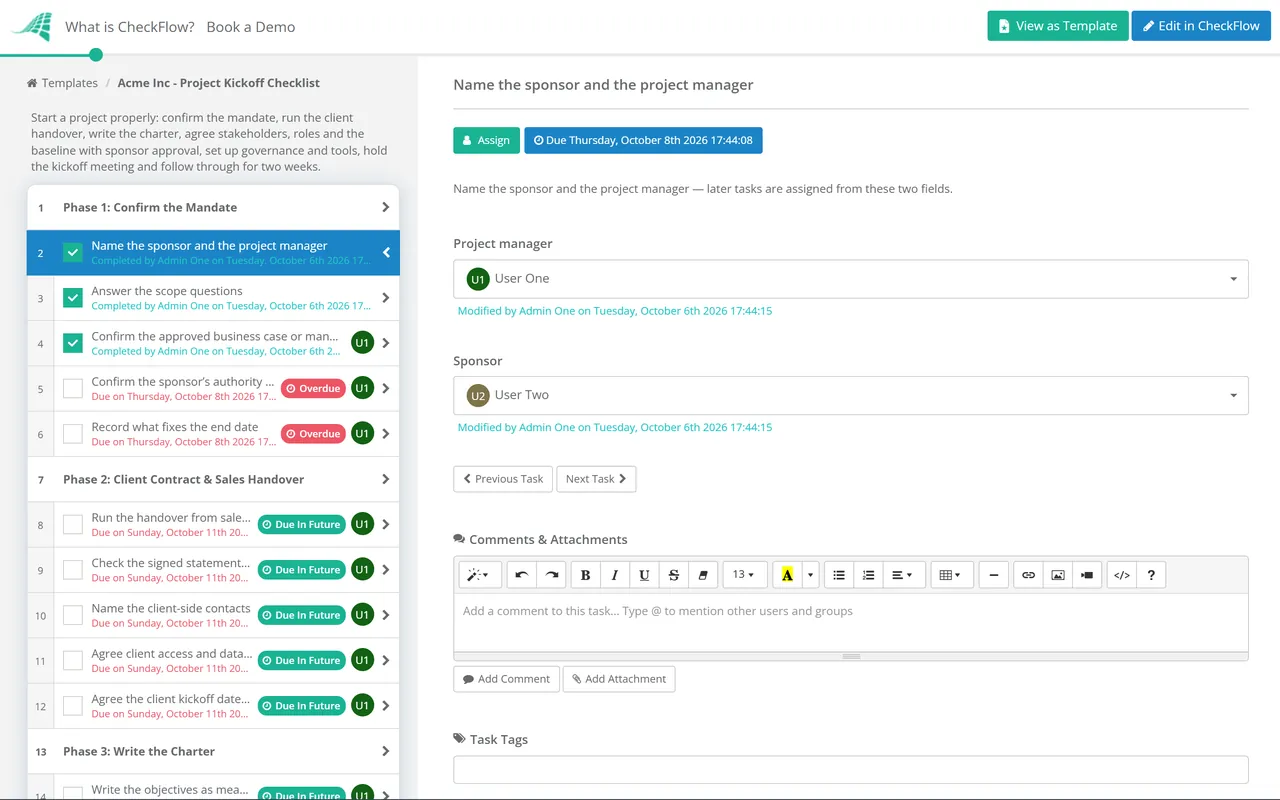
Phase 1: Confirm the Mandate
Answer the two scope questions first. They decide whether the client phase and the sprint setup task appear.
Name the sponsor and the project manager — later tasks are assigned from these two fields
Answer the scope questions — is the project delivered for an external client, and will the work run in sprints or iterations
Confirm the approved business case or mandate — the decision, the date, the approved budget and who approved it, attached to this checklist
Confirm the sponsor’s authority and availability — what the sponsor can decide on scope, money and priority, and how quickly they can answer
Record what fixes the end date — the deadline, regulation, contract or market window that the plan has to meet
Client
Phase 2: Client Contract & Sales Handover
Shown only when the project is delivered for an external client. It runs before the charter so the charter matches the contract.
Run the handover from sales or account management — what was promised, what was discussed but never written down, and any sensitivities
Check the signed statement of work — deliverables, acceptance terms, payment milestones, change terms and exclusions
Name the client-side contacts — client sponsor, day-to-day lead, and who signs acceptance and approves invoices
Agree client access and data handling — which systems, shared spaces and data each side gets, and any confidentiality or security terms
Agree the client kickoff date and agenda — with the client lead, scheduled after the internal kickoff
Charter
Phase 3: Write the Charter
Write the objectives as measurable outcomes — what changes, for whom, by when, and how you will know
Draw the scope boundary — in scope, explicitly out of scope, and undecided items with an owner and a decision date
Define success criteria and who accepts each deliverable — the closeout tests the project against this list
List constraints, assumptions and dependencies — fixed dates, budget ceiling, people you cannot have and other projects you rely on
Set tolerances for time and cost — how far each can move before the sponsor has to decide
Plan
Phase 4: Stakeholders, Roles & Baseline
The sponsor approval at the end halts the checklist. No kickoff invitations go out until it is given.
Map the stakeholders — who is affected, who can block, who must be consulted, and how each wants to hear
Build the RACI for key decisions and deliverables — one Accountable per row, and nobody Accountable for everything
Draft the milestones and critical path — at the level the sponsor reviews, not every task
Confirm the budget and open cost codes — approved budget, contingency, who can commit spend, and time-booking codes
Secure named resources in writing — people agreed with their line managers, with dates and percentage of time
Open the RAID log — the first risks, assumptions, issues and dependencies, each with an owner
Sponsor approval of the charter and baseline — objectives, scope, milestones, budget and tolerances approved before kickoff
Setup
Phase 5: Governance, Tools & Access
The backlog task appears only when the work is delivered in sprints or iterations.
Set the governance rhythm — steering meetings, status reports and the decision log, with who attends and who receives each
Agree the change control route — how a change is raised, assessed and decided, and which changes go to the sponsor
Set up the project workspace — one place for the plan, RAID log, decisions and files, with naming rules
Request access for every team member — systems, shared drives, channels and licences, so nobody starts locked out
Set up the backlog, sprint cadence and definition of done — shown only for iterative delivery; agreed before the first sprint planning
Write the communications plan — audiences, messages, channel and frequency, including who hears bad news first
Kickoff
Phase 6: Run the Kickoff Meeting
Send the agenda and pre-reads three working days ahead — charter summary, milestones, RACI and top risks
Ask the sponsor to open the meeting — why the project matters now, in the sponsor’s own words
Walk through objectives, scope and success criteria — and ask the room what is missing or unclear
Confirm roles against the RACI — each person says what they own, and gaps are fixed in the room
Review the top risks and assumptions — and log new ones while everyone is present
Read back decisions and actions — each with an owner and a date before the meeting ends
Follow-up
Phase 7: First Two Weeks
Publish the kickoff notes and updated RAID log — within one working day, in the project workspace
Check that every kickoff action has started — and chase the ones that have not before the first status report
Issue the first status report — against the baseline the sponsor approved
Hold a two-week check-in with the sponsor — confirm the plan still holds and log any early change requests
Ninety minutes suits a team of up to about a dozen people. Shorten the walkthroughs for a small internal project. For a large one, hold this meeting with the workstream leads and run shorter team sessions after it. The pre-reads go out at least three working days before, so the time is spent on questions rather than reading slides aloud.
0:00 to 0:10
Why this project, why now
The sponsor explains the problem, the decision to fund it and what success looks like from where they sit.
0:10 to 0:25
Objectives, scope and success criteria
The project manager walks the in-scope and out-of-scope lists. Undecided items are logged with an owner and a date, not debated.
0:25 to 0:40
Milestones, budget and constraints
The approved baseline, the critical path, the tolerances and what happens when one is breached.
0:40 to 0:55
Roles and the RACI
Each person states what they own. Rows with two Accountables, or none, are settled before moving on.
0:55 to 1:10
Risks, assumptions and dependencies
Review the top five, ask for new ones and give each an owner. Assumptions nobody can confirm become risks.
1:10 to 1:20
How we work
Status reports, meetings, change control, where documents live and how to escalate.
1:20 to 1:30
Decisions, actions and next steps
Read back every decision and action with its owner and date, and confirm when the first status report is due.
For a client kickoff, keep the order and change the content. Let the client sponsor speak in the first slot alongside yours, replace the budget detail with the commercial milestones in the statement of work, and add ten minutes on access, approvals and who signs acceptance. Margins, staffing debates and risks about the client themselves belong in the internal session.
Why Run Project Kickoffs in CheckFlow?
1
Dates set from the day it starts
Every task carries a due date offset from the day the checklist starts, so the charter, the sponsor approval and the kickoff pre-reads fall in the right order without a plan for the plan. Tasks are assigned from the sponsor and project manager fields as each kickoff begins.
2
No kickoff on an unagreed scope
The charter and baseline stop at an approval step until the sponsor answers, so invitations never go out on a scope nobody has agreed. The approval, the comments and the attached charter stay in the checklist history.
3
One template for every project
Dropdown answers show the client phase and the sprint setup task only where they apply. Reports show which projects are stuck before kickoff, and the API and MCP server can start a kickoff from your own systems.
Everything that has to be true before the team starts work, not just the meeting agenda. That means a confirmed sponsor and mandate, a charter with measurable objectives, a written scope boundary and success criteria, a stakeholder map and RACI, milestones, budget and named resources, an open RAID log, a governance and change control route, access for every team member, the kickoff meeting with pre-reads, and a check two weeks later that its actions are moving. Client projects add a contract check and a client kickoff.
What is the difference between a project charter and a project kickoff?
+
The charter authorises the project; the kickoff launches it with the people who will do the work. In PMI’s definition the charter is issued by the sponsor, formally authorises the project and gives the project manager authority to use the organisation’s resources. The kickoff meeting comes after that: it presents the authorised objectives, scope and plan to the team and stakeholders and settles roles. Holding a kickoff before the charter is approved asks the team to plan around a scope that may still change.
When should the project kickoff meeting take place?
+
After the sponsor has approved the charter and baseline, and before the team starts delivery work. The PMBOK Guide Sixth Edition associates the kickoff with the end of planning and the start of executing, while noting that on small projects, where one team plans and delivers, it happens shortly after initiation. Projects with several phases often hold a kickoff at the start of each phase. Either way, the people doing the work should be in the room before they are asked to commit to dates.
Who should attend a project kickoff meeting?
+
The sponsor, the project manager, everyone with a named role in the RACI and the leads of any team the project depends on. The sponsor should open the meeting, because hearing why the project matters from the person funding it carries more weight than hearing it from the project manager. Keep observers out. If the list grows past about a dozen, hold the main session with workstream leads and run short team kickoffs after it.
How is a client kickoff different from an internal kickoff?
+
A client kickoff aligns two organisations on a plan that a contract already constrains, so it starts from the signed statement of work rather than the charter alone. It names the client’s sponsor, day-to-day contact and approvers, agrees reporting and escalation, and confirms access and data handling. Run the internal kickoff first. That is where the team can discuss margin, staffing and risks about the client openly, and it means the client hears one plan.
Is CheckFlow free for this template?
+
14-day free trial, no card required. The Business plan is $10 per user per month after the trial. Full details at checkflow.io/pricing.
Start Every Project With the Scope Agreed and the Team Ready
Free trial — no credit card required.
Do you like cookies? 🍪 We use cookies to ensure you get the best experience on our website. Learn more