Sprint planning is the scrum ceremony that sets the trajectory of the next sprint — what the team will build, how much they will commit to, and what definition of done looks like for each piece of work. When it works well, it is a focused, energised conversation where the team analyses a well-understood backlog, sets a clear sprint goal, and makes a confident, data-based commitment to a realistic amount of work. When it does not work well — when stories are unclear, estimates do not exist, capacity has not been calculated, and dependencies have not been mapped — it produces a sprint backlog that was assembled under time pressure and is under-committed or overcommitted before the first task starts. The difference between these two outcomes is almost entirely preparation. A structured sprint planning checklist ensures the prerequisites are met before the meeting starts, the ceremony runs to its intended purpose (commitment and task breakdown, not refinement), and the sprint begins with a clear, shared goal and a realistic, team-owned commitment. This free checklist gives scrum masters, product owners, and development teams a structured framework for the full sprint planning process.
Sprint Planning: The Three Non-Negotiables
The product owner sets priority; the team sets commitment
The product owner decides the order and relative importance of backlog items. The team decides how much they can realistically deliver in the sprint. A product owner who dictates the sprint scope without team input produces unrealistic commitments that damage velocity, trust, and delivery predictability.
The backlog must be refined before planning starts
Stories entering sprint planning should already have acceptance criteria, an estimate, and no unresolved questions. A story that needs to be defined during sprint planning is not a story that is ready for a sprint.
Aim for 85–95% commitment accuracy — not maximum throughput
Consistently delivering on commitments builds the trust and predictability that allows the business to plan. A team that takes on 100% of theoretical capacity and delivers 70% every sprint is less useful than a team that commits to 85% and delivers it reliably. Velocity is not a productivity target — it is a planning input.
What the Sprint Planning Checklist Covers
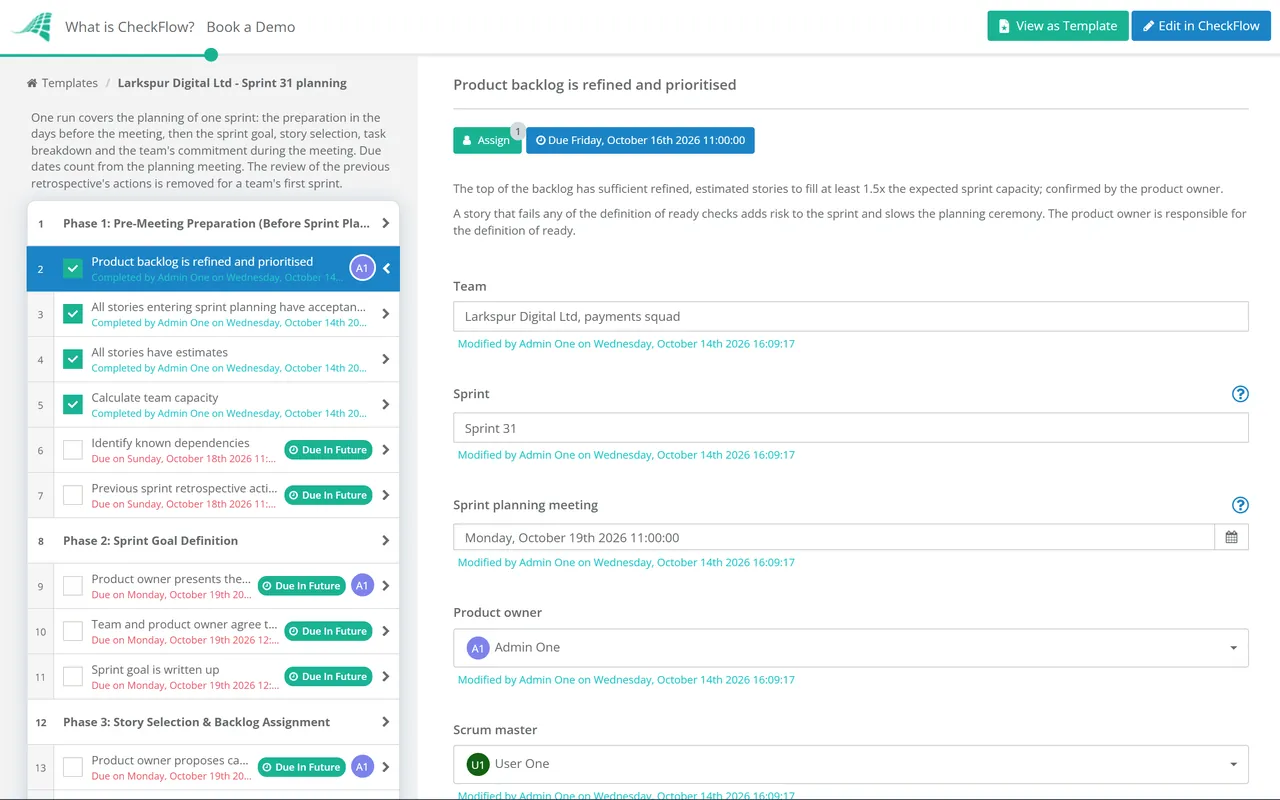
This checklist covers the full sprint planning process in five phases — from pre-meeting preparation through to team commitment and sprint launch.
- 1
Phase 1
Phase 1: Pre-Meeting Preparation (Before Sprint Planning)
6 tasksSprint planning fails when it attempts to do two jobs at once: refining the backlog and planning the sprint. Refinement should be continuous throughout the preceding sprint, so that the top of the product backlog contains stories that are ready to plan.
- Product backlog is refined and prioritised — the top of the backlog has sufficient refined, estimated stories to fill at least 1.5x the expected sprint capacity; confirmed by the product owner
- All stories entering sprint planning have acceptance criteria — no story without clear, testable acceptance criteria is eligible for the sprint backlog
- All stories have estimates — in story points or agreed unit; stories without estimates cannot be accurately included in capacity planning
- Calculate team capacity — for the sprint; total available story points or hours based on: team members available, excluding holidays, planned leave, and recurring ceremonies; historical velocity as the primary reference
- Identify known dependencies — between stories in the candidate backlog; any external dependencies (other teams, third parties, infrastructure); confirmed in advance of the meeting
- Previous sprint retrospective actions reviewed — any committed process improvements from the last retrospective are visible and tracked
- 2
Phase 2
Phase 2: Sprint Goal Definition
3 tasks
- Product owner presents the sprint goal — a single sentence describing the most valuable outcome the sprint should achieve; not a list of features but a statement of value: “Enable customers to manage their billing settings without contacting support”
- Team and product owner agree the sprint goal — the goal guides story selection; if the sprint cannot fully achieve the goal, the goal is adjusted
- Sprint goal is written up — and posted visibly on the sprint board; it is the reference point for scope decisions throughout the sprint
- 3
Phase 3
Phase 3: Story Selection & Backlog Assignment
5 tasks
- Product owner proposes candidate stories — from the top of the refined backlog; prioritised to support the sprint goal
- Team reviews each candidate story — asks questions; confirms understanding; any story with unresolved questions is deferred to the next backlog refinement session, not carried into sprint planning
- Team assesses stories against capacity — sum of selected story estimates vs available capacity; the team selects stories it is confident it can complete
- Include sprint overhead — recurring ceremonies (daily standup, refinement, review, retrospective) and any known non-feature work (technical debt, support rota, release preparation) are accounted for in the capacity calculation
- Sprint backlog created — the selected stories form the sprint backlog; the team has confirmed they understand and agree to the scope
- 4
Phase 4
Phase 4: Task Breakdown & Initial Assignment
4 tasks
- Break down each story into tasks — the specific implementation steps; typically 1–2 day maximum tasks; any task that takes more than 2 days should be decomposed further
- Identify task owners — initial assignment by skill and workload; flexible during the sprint but initial distribution prevents multiple developers gravitating to the same story
- Identify dependencies within the sprint — tasks that cannot start until another task is complete; front-loaded in the sprint schedule
- Confirm the definition of done — the criteria that must be met for each story to be considered complete (code reviewed, tests passing, deployed to staging, QA verified)
- 5
Phase 5
Phase 5: Team Commitment & Sprint Launch
5 tasks
- Team confirms the commitment — every team member agrees the sprint is achievable; not the scrum master’s decision; the team’s decision
- “70% test” applied — “If we complete only 70% of committed work, will we still achieve the sprint goal?” If not, revisit which stories are truly essential
- Sprint board set up — all stories and tasks in the sprint board; in To-Do status; sprint goal visible
- Sprint length and end date confirmed — typically 2 weeks; sprint review and retrospective scheduled on the last day
- Daily standup time confirmed — same time and location every day; brief; maximum 15 minutes
The Definition of Ready — When Is a Story Ready for Sprint Planning?
A story is ready for sprint planning when all of these are true:
✓
The acceptance criteria are written and testable
✓
The story is estimated in story points
✓
The team has seen this story in a backlog refinement session and has no open questions
✓
Any external dependencies are identified and a plan exists to address them
✓
The story is small enough to complete within one sprint (if not, it is an epic that needs decomposing)
✓
The team understands what “done” looks like
A story that fails any of these criteria entering sprint planning adds risk to the sprint and slows the planning ceremony. The product owner is responsible for the definition of ready — not the team.
Why Use CheckFlow for Sprint Planning?
1A sprint planning process that runs consistently every two weeks
Sprint planning that happens slightly differently each sprint — depending on who is facilitating, how much time is available, and how prepared the backlog is — produces inconsistent outcomes. CheckFlow’s recurring sprint planning checklist generates the full preparation and ceremony workflow automatically at the start of every sprint, ensuring the same structured approach is applied every time.
Pre-meeting preparation tracked separately from the ceremony
The sprint planning meeting is the last step in the planning process — not the first. CheckFlow’s pre-meeting phase tracks backlog refinement completion, capacity calculation, and dependency identification in the days before the planning session, so the meeting can focus on commitment rather than preparation.
A sprint record with commitment and goal documented
Sprint-over-sprint velocity analysis requires a record of what was committed and what was delivered. Retrospectives require the sprint goal and commitment to be documented. CheckFlow records the sprint goal, committed stories, and capacity calculation for every sprint — automatically, as the planning process runs.
Sprint planning produces the sprint goal and commitment; the sprint review assesses how well the team met that commitment. CheckFlow’s Sprint Review Checklist covers the structured review and retrospective process. See the Sprint Review Checklist →
Features planned in sprints eventually go through the release process to production. CheckFlow’s Feature Release Process Checklist in the Product Development & Launch series covers the technical deployment workflow. See the Feature Release Process Checklist →