Purchase Order Approval Checklist Template

A purchase order is not just an administrative document — it is the financial contract between the organisation and the supplier, the budget commitment against which every invoice will be matched, and the governance evidence that the spend was authorised by someone accountable for it.

Every organisation that buys goods and services has a procurement process — but not every organisation has a controlled one. The purchase that was approved by someone without sufficient authority, the order raised after the goods were already delivered, the invoice paid without a matching PO or receipt, and the duplicate payment that bypassed every control — all of these are failure modes of an unstructured procurement process. The global PO management market is growing rapidly — forecast to nearly double by 2033 — because organisations that have implemented structured PO workflows report 50–70% reductions in processing time, dramatic reductions in payment errors, and significantly improved spend visibility. A structured purchase order approval process establishes the governance layer that transforms purchasing from a series of individual decisions into a controlled, auditable programme: every purchase justified and approved before commitment, every supplier engagement governed by a valid PO, every payment matched to what was ordered and received. This free checklist gives procurement teams, finance departments, and operations managers a structured framework for the full purchase order approval lifecycle.

Use This Template Free See Live Example
No Credit Card Required

Tiered Approval — Why Different Purchase Values Need Different Approval Levels

Tier 1 — Low-Value / Routine Purchases

Spend range example
Up to £2,500 / $2,500
Appropriate approver
Direct line manager or department budget holder
Competitive sourcing
Not required — order from approved supplier list
Examples
Standard consumables, routine services from established suppliers, recurring subscriptions within budget
Process note
Lowest friction but still governed; the PO must exist and the supplier must be approved.

Tier 2 — Standard Purchases

Spend range example
£2,500 to £25,000 / $2,500 to $25,000
Appropriate approver
Departmental director plus finance sign-off
Competitive sourcing
Minimum 3 quotations required
Examples
Equipment purchases, significant professional services, new supplier engagements of material value
Process note
Business justification and supplier selection documented; quotation comparison on file.

Tier 3 — High-Value / Strategic Purchases

Spend range example
Above £25,000 / $25,000 (often requiring board or CEO approval above a further threshold)
Appropriate approver
CFO, CEO, or board depending on value
Competitive sourcing
Full tender or competitive RFP process
Examples
Capital equipment, long-term service contracts, significant IT investments
Process note
Full business case, formal tender, and board or senior leadership approval before any commitment.

The specific thresholds vary by organisation. What matters is that the thresholds are documented in the spending authority matrix, consistently enforced, and regularly reviewed — and that splitting purchases to stay below a threshold is treated as a policy violation.

What the Purchase Order Approval Checklist Covers

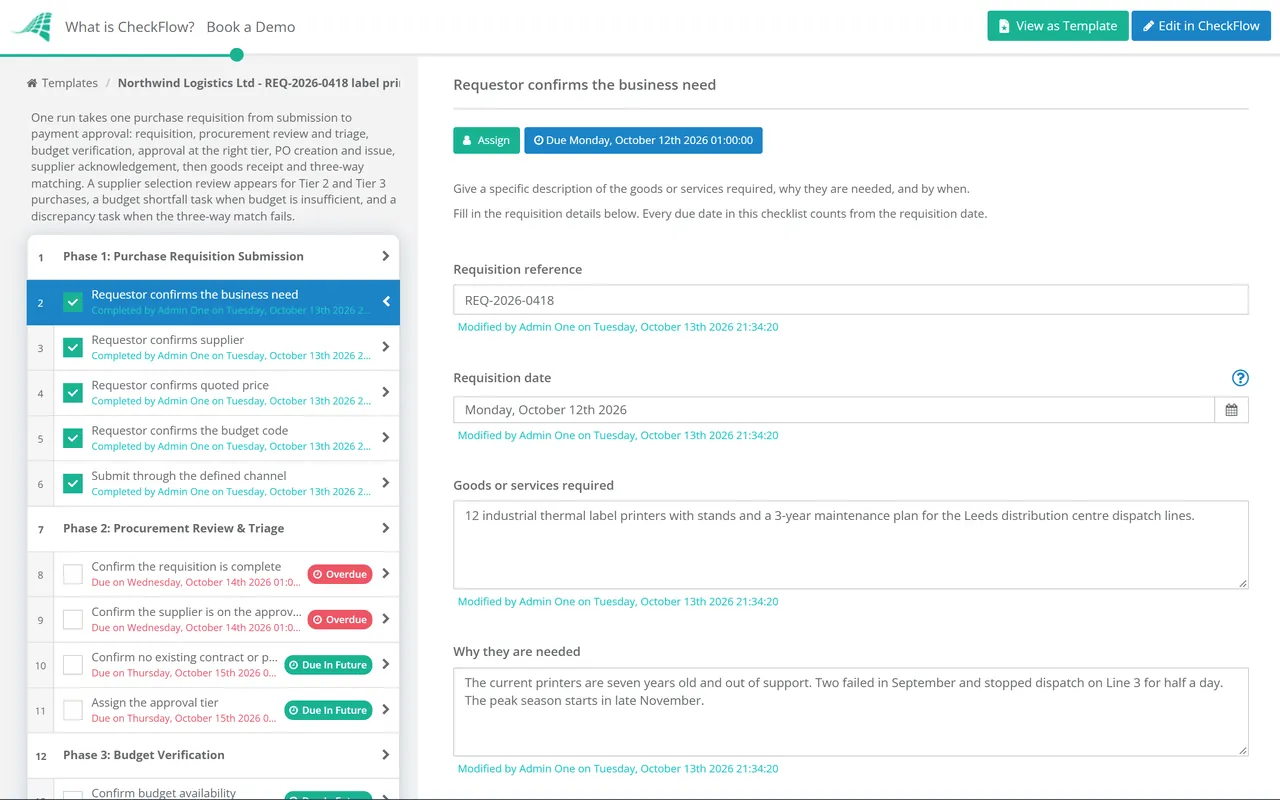
Seven phases covering the complete PO lifecycle — from purchase requisition through procurement review, budget verification, tiered approval, PO issuance, supplier acknowledgement, and three-way matching for payment.

Phase 1

Purchase Requisition Submission

The purchase requisition is the formal request to purchase — it initiates the PO process and creates the record of what was requested, by whom, and why. A purchase that begins with a verbal request or an email to a supplier bypasses every governance step that follows.

  • Requestor confirms the business need — specific description of goods/services required; why they are needed; by when
  • Requestor confirms supplier — from the approved supplier list where available; or proposes a new supplier with justification
  • Requestor confirms quoted price — or price estimate; specification; and delivery requirement
  • Requestor confirms the budget code — the correct cost centre and account code for the purchase
  • Submit through the defined channel — procurement portal, ERP system, or approved form; not directly to a supplier or informally to the procurement team
Phase 2

Procurement Review & Triage

  • Confirm the requisition is complete — all required fields populated; specification sufficient to create a PO and identify the goods/services unambiguously
  • Confirm the supplier is on the approved list — or initiate supplier onboarding process for new suppliers before the PO can proceed
  • Confirm no existing contract or preferred arrangement covers this purchase — avoiding duplication with an existing agreement
  • Assign the approval tier — based on total value and category; route to the appropriate approval queue
Phase 3

Budget Verification

  • Confirm budget availability — the relevant budget code has sufficient uncommitted budget to cover this purchase
  • Confirm capital vs operating classification — is this a capital expenditure (asset purchase) or operating expenditure? Different approval requirements and accounting treatment
  • Confirm no budget period timing issues — the purchase will be received and invoiced in the correct budget period
  • Flag any budget shortfall — if budget is insufficient, the requisition is escalated for additional budget approval before the PO can proceed
Phase 4

Approval Routing & Authorisation

  • Route to the correct approver tier — based on the spend amount and category; per the spending authority matrix
  • Approver reviews business justification — is the purchase genuinely needed? Is the specification appropriate? Is the quoted price reasonable?
  • Approver confirms supplier selection — for Tier 2 and 3 purchases; quotation comparison reviewed; selection justified
  • Approver confirms no conflict of interest — any personal relationship with the proposed supplier declared and the purchase referred to an alternative approver
  • Obtain all required approvals — some high-value purchases require multiple approvals at different levels (department head + finance + CFO); all obtained before PO is issued
Phase 5

Purchase Order Creation & Issuance

  • Create the PO — in the procurement system or ERP; with all required fields: PO number, supplier details, item description, quantity, unit price, total value, required delivery date, and delivery address
  • Confirm the payment terms — consistent with the supplier contract; entered correctly in the PO
  • Issue the PO to the supplier — via the defined channel; electronically where possible; PO number communicated to the supplier
  • Retain the approved PO in the procurement system — linked to the original requisition and all approval records
Phase 6

Supplier Order Acknowledgement

  • Obtain PO acknowledgement — confirmation from the supplier that the PO has been received and the order is accepted; with confirmed delivery date
  • Confirm any supplier changes — if the supplier proposes changes to specification, quantity, price, or delivery date; these must be reviewed and approved before the PO is amended
  • Log the expected delivery date — in the procurement system; triggers follow-up if delivery is late
Phase 7

Goods Receipt & Three-Way Matching

  • Record the goods receipt — when goods are delivered or service is completed; quantity, condition, and specification confirmed; GR recorded in the system
  • Match the supplier invoice — to the PO (price, terms, and line items) and to the goods receipt (quantity and specification); three-way match required before payment is approved
  • Investigate and resolve discrepancies — price differences, quantity differences, or specification variances; resolved with the supplier before payment is released
  • Approve for payment — only after three-way match is confirmed; payment terms clock starts from goods receipt or invoice date per the contract

From Need to Payment — the Full Procure-to-Pay Flow

1
Business need identified
2
Purchase requisition submitted
3
Budget verified
4
Approval obtained (correct tier)
5
PO created and issued
6
Supplier acknowledges
7
Goods delivered / service completed
8
Goods receipt recorded
9
Invoice received
10
Three-way match (PO + GR + Invoice)
11
Payment approved
12
Payment executed
Steps 1–5 prevent unauthorised and unbudgeted spend. Steps 6–10 prevent overpayment, duplicate payment, and payment for goods not received. Steps 11–12 ensure payment is within terms and to the correct payee.

Why Run Your Purchase Order Approval in CheckFlow?

1

Every step in the PO approval sequence enforced

A PO approval process that allows steps to be skipped under time pressure is not a controlled process. CheckFlow makes each approval step dependent on completion of the preceding step — the PO cannot be issued before budget is verified and the correct tier approval is received; payment cannot be initiated before three-way match is confirmed.


2

Approval routing by spend threshold — automatically

Manual approval routing that depends on someone remembering who needs to approve a £25,000 purchase is routing that fails when the procurement team is under pressure. CheckFlow routes each requisition to the correct approver based on the spend amount and category — ensuring the right person always reviews the right purchase.

3

A complete, auditable PO record from requisition to payment

When an auditor asks “who approved this purchase and when?” the answer is in CheckFlow — the requisition, the budget check, every approval with timestamp and approver name, the PO, the goods receipt, and the match confirmation. The audit trail is built automatically as the process runs.

Purchase order approval is the operational heart of the procurement function. CheckFlow’s Procurement Compliance Review covers the periodic audit that verifies PO approval processes are being followed. See the Procurement Compliance Review →

POs for new suppliers require the supplier to be qualified and onboarded first. CheckFlow’s Supplier Onboarding Checklist covers the qualification process that precedes a first PO. See the Supplier Onboarding Checklist →

Frequently Asked Questions

What should a purchase order approval process include?

+

A purchase order approval process covers seven phases: purchase requisition submission (business need confirmation, supplier identification, specification, budget code, and submission through the defined channel), procurement review and triage (completeness check, supplier approval status, existing contract check, tier assignment), budget verification (budget availability, capex vs opex classification, timing), approval routing (spending authority matrix compliance, business justification review, quotation review, conflict of interest confirmation), PO creation and issuance (all required fields, payment terms, electronic issuance), supplier acknowledgement (confirmed receipt and delivery date, any proposed changes), and goods receipt and three-way matching (GR recording, invoice match, discrepancy resolution, payment approval).

What is three-way matching in purchase order processing?

+

Three-way matching is the process of comparing three documents before approving a supplier invoice for payment: the purchase order (what was authorised and at what price), the goods receipt or service confirmation (what was actually delivered or completed), and the supplier invoice (what the supplier is claiming payment for). All three must match within defined tolerances. If the invoice price differs from the PO, if quantities differ from the goods receipt, or if goods claimed on the invoice were not received, the discrepancy must be investigated and resolved before payment is released. Three-way matching is the primary financial control against overbilling, duplicate invoices, and payment for goods or services not received.

What is a spending authority matrix?

+

A spending authority matrix (or delegation of authority) is the document that defines who within the organisation has the authority to approve purchases of specified types and values. It typically specifies: the spend value thresholds at which higher-level approval is required, any category-specific restrictions (certain purchase types requiring board approval regardless of value), the named roles or job titles with each level of authority, and any combined approval requirements (e.g. finance sign-off required for all capex above a threshold regardless of departmental approval). The matrix should be documented, approved by the board or senior leadership, communicated to all budget holders, and reviewed annually.

What is maverick or rogue spending in procurement?

+

Maverick spending (also called rogue spending) occurs when goods or services are procured outside the defined procurement process — commonly by placing an order directly with a supplier before a purchase order is raised and approved, by using an unapproved supplier, or by splitting a purchase to stay below an approval threshold. Research typically shows maverick spend rates of 30–60% of total addressable spend in organisations with weak procurement controls. The consequences include paying above contracted rates, increased fraud risk, supplier relationship problems (when the formal procurement team does not know a commitment has been made), and the inability to manage spend data or negotiate volume discounts.

Is CheckFlow free for this template?

+

14-day free trial, no card required. The Business plan is $10 per user per month after the trial. Full details at checkflow.io/pricing.

Control Every Purchase From Requisition to Payment — With a Complete Audit Trail

Free trial — no credit card required.