CPA Audit Checklist Template

A structured, trackable checklist for every stage of a financial audit engagement.

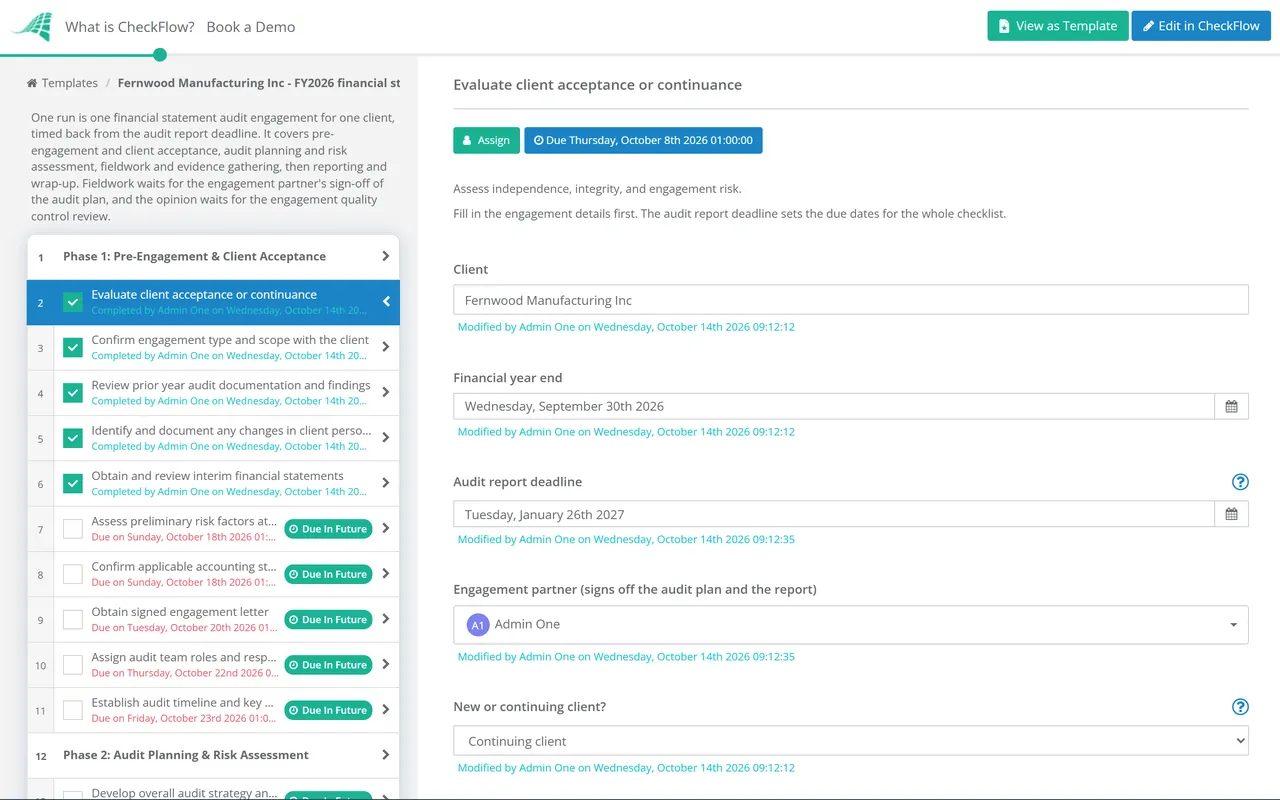
Running a consistent, thorough CPA audit requires the same structured process every time — regardless of client size or engagement complexity. This free CPA audit checklist template covers all four phases of a financial audit: pre-engagement preparation, audit planning, fieldwork, and reporting. Use it as a reference or run it as a live, trackable checklist in CheckFlow — with tasks assigned, deadlines set, and every step logged.

Use This Template Free See Live Example
No Credit Card Required

What Is a CPA Audit Checklist?

A CPA audit checklist is a structured list of tasks, procedures, and verification steps that a Certified Public Accountant or audit team follows when conducting a financial audit engagement. It ensures that every phase of the audit — from initial client engagement through to the final audit opinion — is completed consistently, completely, and in the correct order.

A well-structured CPA audit checklist serves several purposes: it standardises the audit process across engagements and team members, reduces the risk of missed steps during fieldwork, provides a documented record for peer review and quality control, and ensures compliance with applicable auditing standards including GAAS (Generally Accepted Auditing Standards).

For CPA firms running multiple concurrent engagements, a trackable checklist — rather than a static document — gives partners and managers real-time visibility into where each audit stands and which steps remain outstanding.

What the CPA Audit Checklist Covers

This checklist is organised into four phases that follow the standard structure of a financial audit engagement. Each phase should be completed before the next begins.

Phase 1

Pre-Engagement & Client Acceptance

  • Evaluate client acceptance or continuance — assess independence, integrity, and engagement risk
  • Confirm engagement type and scope with the client
  • Review prior year audit documentation and findings
  • Identify and document any changes in client personnel, operations, or accounting policies
  • Obtain and review interim financial statements
  • Assess preliminary risk factors at the financial statement level
  • Confirm applicable accounting standards (GAAP, IFRS, or other)
  • Obtain signed engagement letter
  • Assign audit team roles and responsibilities
  • Establish audit timeline and key milestones
Phase 2

Audit Planning & Risk Assessment

  • Develop overall audit strategy and approach
  • Conduct risk assessment — identify risks of material misstatement
  • Understand and document the client’s internal control structure
  • Assess control risk by assertion for significant audit areas
  • Identify significant risks and fraud risks
  • Determine materiality thresholds
  • Develop detailed audit programme for each significant area
  • Plan the nature, timing, and extent of audit procedures
  • Request and confirm receipt of client-prepared documents (PBC list)
  • Schedule fieldwork dates and client walkthroughs
Phase 3

Fieldwork & Evidence Gathering

  • Review and test internal controls for significant audit areas
  • Perform substantive analytical procedures
  • Test account balances and transactions (revenues, expenses, assets, liabilities)
  • Examine supporting documentation — invoices, contracts, bank statements, supporting schedules
  • Perform confirmation procedures (bank confirmations, accounts receivable)
  • Review related-party transactions
  • Assess going concern indicators
  • Test cut-off procedures for period-end transactions
  • Identify and document audit findings, exceptions, and potential adjustments
  • Discuss findings with client management and obtain management explanations
Phase 4

Reporting & Wrap-Up

  • Summarise audit findings and prepare draft audit report
  • Review proposed audit adjustments with client
  • Obtain management representation letter
  • Evaluate subsequent events through report date
  • Complete engagement quality control review
  • Finalise audit opinion and report
  • Issue signed audit report to client
  • Communicate significant deficiencies or material weaknesses to those charged with governance
  • Archive workpapers and close engagement file
  • Conduct post-engagement debrief and document lessons learned

This checklist is available as a free, runnable template in CheckFlow — with tasks assigned to team members, phase-by-phase enforced order, and a complete audit trail for every engagement.

Use This Template Free

Why Run Your CPA Audit Checklist in CheckFlow?

1

Consistent across every engagement

Build the checklist once as a reusable template. Run a new instance for every audit engagement — with the client name, assigned auditor, and engagement dates pre-filled at the point of launch. Every team member follows the same structured process, every time.

Template Designer
2

Enforce phase-by-phase order

Use CheckFlow’s halt tasks to ensure fieldwork cannot begin before planning is signed off, and reporting cannot start until fieldwork is complete. Critical steps cannot be skipped or reordered — which matters for both audit quality and peer review compliance.

Enforced Order
3

A full audit trail for every engagement

Every completed task is logged with a timestamp and the name of the person who completed it. When a quality control review or peer review asks for evidence of procedures performed, the record is already there — structured, complete, and searchable.

Audit Trail

Frequently Asked Questions

What is the purpose of a CPA audit checklist?

+

A CPA audit checklist ensures that every phase of a financial audit engagement is completed consistently and completely — regardless of client size or which team member is leading the engagement. It reduces the risk of missed steps during fieldwork, provides a documented record for peer review and quality control purposes, and ensures the audit follows applicable standards including GAAS. For firms running multiple concurrent engagements, a trackable checklist gives partners real-time visibility into where each audit stands.

How many phases does a CPA audit typically have?

+

A standard CPA audit engagement has four phases: pre-engagement and client acceptance, audit planning and risk assessment, fieldwork and evidence gathering, and reporting and wrap-up. Each phase has distinct tasks and deliverables, and each should be substantially complete before the next begins. CheckFlow’s halt task feature can enforce this phase-by-phase order automatically.

Can I customise this checklist for my firm?

+

Yes. The CheckFlow template designer lets you add, remove, reorder, or modify any task in the checklist. You can add firm-specific procedures, incorporate your existing document request lists, set up role-based task assignments, and configure due date rules relative to the engagement timeline. Once customised, the template runs consistently for every future engagement.

Can tasks be assigned to different team members within the same checklist?

+

Yes. Each task in a CheckFlow checklist can be assigned to a different team member — the engagement partner, audit manager, senior associate, or the client themselves for document delivery tasks. When the checklist runs, each assignee is notified immediately and sees only the tasks relevant to them.

Is CheckFlow free to use for this template?

+

You can start a free 14-day trial of CheckFlow with no credit card required, which gives you full access to all features including this template. The Business plan is $10 per user per month after the trial. Full pricing details are at checkflow.io/pricing.

Start Running Consistent CPA Audits Today

Free trial — no credit card required.