Purchase and Sales Agreement Process Checklist Template

More than 14% of pending US home sales fell through at the start of 2025 — the highest rate since 2017. Most failures happen not because of the deal itself but because of contingencies not managed, deadlines missed, and problems discovered too late to negotiate.

A real estate transaction is one of the most significant financial commitments most individuals and businesses make — and it is managed through a process with strict legal deadlines, multiple parallel workstreams, and consequences that range from lost earnest money deposits to legal liability. The inspection contingency that expires before the report was received. The appraisal that came in below the purchase price with no contingency in place to protect the buyer. The financing contingency deadline missed while the lender was still processing. The title search that revealed an unresolved lien the day before closing. These are not unusual scenarios — they are the reasons why professional real estate agents and attorneys exist, and why a structured process that tracks every milestone and deadline is the difference between a smooth closing and a failed transaction. This free checklist gives buyers, sellers, real estate agents, and property managers a structured framework for the full purchase and sales agreement process, from offer acceptance through to post-completion.

Use This Template Free See Live Example
No Credit Card Required

Process framework, not legal advice. Real estate transactions are legally complex and vary significantly between US states and between the UK and US. Always use a qualified solicitor (UK) or real estate attorney (US). This checklist is a general guide — it does not constitute legal, financial, or mortgage advice.

UK Conveyancing vs US Closing Process — Key Differences

UK Conveyancing

Process: Offer accepted → Solicitors instructed by both parties → Survey (homebuyer survey or full structural) → Conveyancing searches (local authority, water, drainage, environmental) → Review of title and documents → Mortgage offer confirmed → Contract signed and returned to solicitor → Exchange of contracts (legally binding) → Completion (funds transferred, keys released).

Key point: In the UK, neither party is legally committed until exchange of contracts. “Gazumping” (seller accepting a higher offer after agreeing to sell) is legal but rare.

Typical timeline: 8–16 weeks from accepted offer to completion.

US Closing Process

Process: Offer accepted → Purchase agreement signed (legally binding, subject to contingencies) → Contingency period (inspection, appraisal, financing) → Title search and title insurance → Closing disclosure issued (3 business days before closing) → Final walkthrough → Closing day (signing, funds transferred, title changes hands).

Key point: The purchase agreement is binding from signing, but contingencies provide exit routes within defined periods.

Typical timeline: 30–45 days from signed agreement to closing.

The Purchase and Sales Agreement Process Checklist

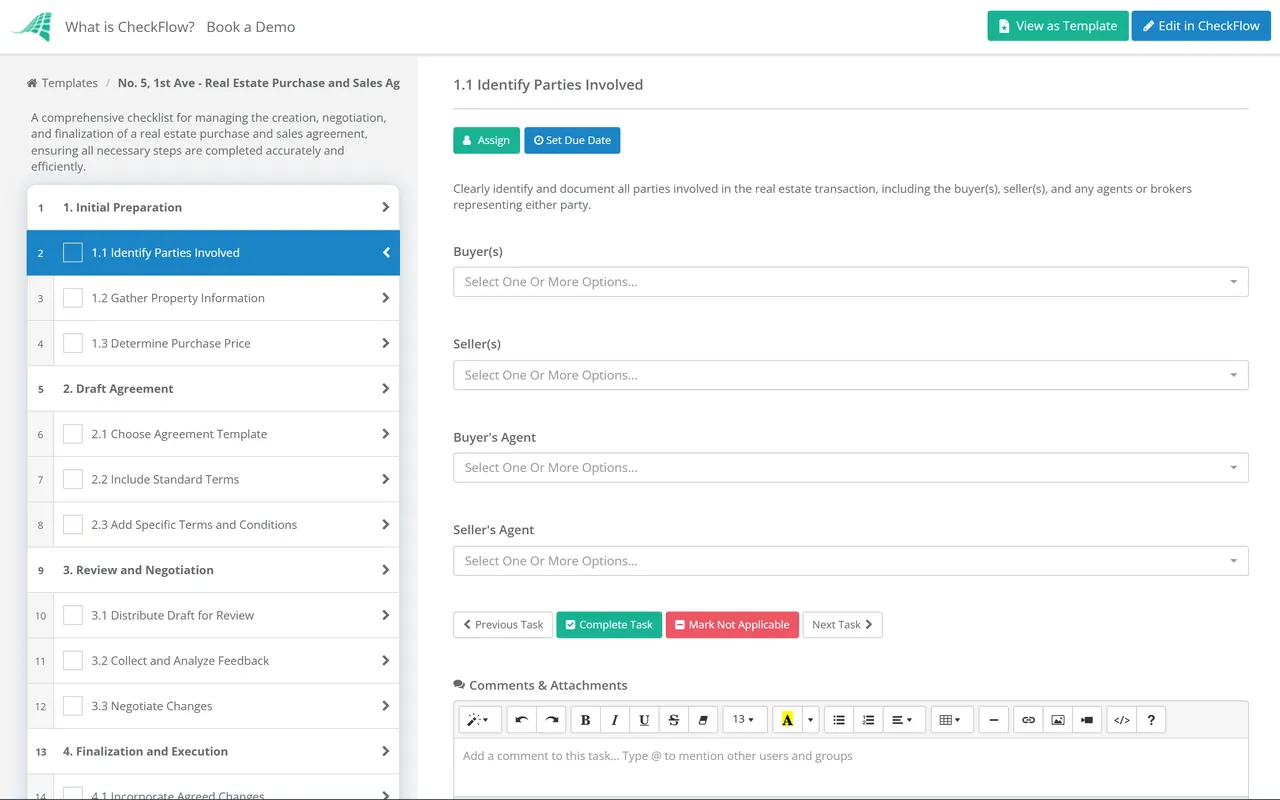
Seven phases covering the full real estate transaction — from offer acceptance and agreement execution through survey/inspection, financing, title/conveyancing, exchange/pre-closing, completion, and post-completion actions.

Phase 1

Offer Acceptance & Agreement Execution

  • Offer confirmed and accepted in writing — specific price, address, and terms; verbal offers have no legal effect in either UK or US
  • Purchase agreement prepared and reviewed — by a qualified solicitor (UK) or real estate attorney (US); all key terms confirmed: purchase price, payment method, closing date, inclusions/exclusions, contingencies, earnest money (US), and possession date
  • Agreement signed by both parties — both buyer and seller; both retain executed copies
  • Earnest money deposited (US) — into escrow; within the timeframe specified in the agreement; the amount and conditions for refund or forfeiture confirmed
  • Solicitors instructed (UK) — by both buyer and seller immediately after offer acceptance; UK transaction cannot proceed without solicitors on both sides
Phase 2

Survey (UK) / Property Inspection (US)

  • Book a survey (UK) — homebuyer survey (RICS Level 2) for standard properties or full building survey (RICS Level 3) for older or unusual properties; instructed promptly after offer acceptance
  • Book a home inspection (US) — within the inspection contingency period (typically 10–14 days from signed agreement); by a qualified inspector; inspection contingency deadline tracked
  • Review the survey/inspection report — immediately upon receipt; significant findings assessed with the relevant professional
  • Negotiate on findings — if the report identifies significant issues: price reduction, seller to repair before completion, or credit at closing; exercise the inspection contingency to exit if findings are unacceptable
  • Exercise or waive the inspection contingency — before the deadline (US); documented in writing; missing the deadline waives the contingency automatically
Phase 3

Financing Confirmation

  • Mortgage application confirmed in progress — lender engaged; all required documents submitted
  • Mortgage in principle / pre-approval is valid — not expired; consistent with the agreed purchase price
  • Appraisal / valuation ordered — by the lender; scheduled within the appraisal contingency period (US) or before mortgage offer (UK)
  • Appraisal reviewed — if the appraisal is below the purchase price: renegotiate price, make up the difference in cash, or exercise the appraisal contingency to exit (US)
  • Formal mortgage offer received — reviewed by the buyer and solicitor before accepting; financing contingency confirmed (US)
  • Financing contingency deadline tracked (US) — must be met or extended in writing before the deadline
Phase 4

Title Search & Conveyancing

  • Title search completed (US) / conveyancing searches completed (UK) — title is clear; no undisclosed liens, easements, or encumbrances; any issues investigated and resolved
  • Title insurance obtained (US) — lender’s and owner’s policies; the owner’s policy protects the buyer against future title claims; strongly recommended
  • Local authority searches confirmed (UK) — no planning issues, proposed road schemes, or enforcement actions affecting the property
  • Environmental search (UK) — flood risk, contaminated land, and other environmental factors; no unacceptable issues
  • Transfer documents prepared (UK) — TR1 (transfer of whole title); signed in readiness for exchange
Phase 5

Exchange of Contracts (UK) / Pre-Closing (US)

  • Final solicitor review (UK) — all queries resolved; both parties’ solicitors confirm ready for exchange
  • Exchange of contracts (UK) — legally binding; both parties now committed; completion date set (typically 2–4 weeks after exchange)
  • Deposit paid on exchange (UK) — typically 10% of purchase price; paid by banker’s draft or telegraphic transfer to seller’s solicitors; non-refundable if buyer defaults
  • Closing disclosure reviewed (US) — received at least 3 business days before closing; all figures reviewed against the loan estimate; any material changes queried
  • Buildings insurance in place — from exchange (UK; buyer’s risk from exchange) or from closing (US); confirmed with lender
Phase 6

Completion (UK) / Closing Day (US)

  • Final walkthrough (US) / pre-completion check (UK) — property in the agreed condition; agreed inclusions present; any agreed repairs completed
  • Completion funds confirmed — mortgage funds in solicitor’s account (UK) or in escrow (US); buyer’s completion funds confirmed
  • Complete / Close — funds transferred to seller (UK: solicitor to solicitor; US: escrow disbursement); keys released; title transfers to buyer
  • Register the title — UK: Land Registry application filed by buyer’s solicitor within priority period; US: deed recorded at county recorder’s office
Phase 7

Post-Completion Actions

  • Stamp Duty Land Tax (UK) — filed and paid within 14 days of completion; buyer’s solicitor typically handles
  • Mortgage registered at Land Registry (UK) — lender’s charge registered against the title
  • Update insurance — to the new property (if move); policy schedule confirms the correct address
  • Utility accounts transferred — all utilities registered in the buyer’s name; meter readings taken on completion day
  • Key safe changed / locks changed — immediately after taking possession; previous owners may have copies of all keys
  • Update all records — with the new address; bank, employer, HMRC, electoral roll, driving licence, vehicle registration

The Three Contingencies That Protect the Buyer — and What Happens If They Expire

US

Inspection Contingency

What it covers: The buyer can exit the agreement without penalty if the home inspection reveals unacceptable conditions, within the contingency period.

Typical period: 10–14 days from signed agreement.

If it expires: The buyer waives the right to exit based on inspection findings. Any issues discovered are the buyer’s problem.

UK equivalent: No direct equivalent — a survey is typically instructed but is not a formal contingency. If survey findings are unacceptable, the buyer can withdraw before exchange but may have incurred survey costs.

US

Appraisal Contingency

What it covers: The buyer can exit or renegotiate if the property appraises below the purchase price.

Typical period: Runs through the financing contingency period.

If it expires: The buyer must make up the difference between the appraised value and the purchase price in additional cash, or lose the earnest money.

US

Financing Contingency

What it covers: The buyer can exit without penalty if they are unable to obtain financing at the agreed terms.

Typical period: 21–30 days from signed agreement.

If it expires: The buyer is committed to completing the purchase regardless of financing outcome. Failure to complete may result in earnest money forfeiture and potential legal liability.

Why Run Your Real Estate Transaction in CheckFlow?

1

Every deadline tracked from the moment the agreement is signed

A real estate transaction has a cascade of interdependent deadlines — each contingency period has a specific expiry; the closing disclosure must arrive 3 business days before closing; exchange and completion dates are contracted. CheckFlow’s purchase agreement process creates a task for every deadline the moment the agreement is logged, with advance alerts that prevent missed contingency windows.

2

Parallel workstreams — inspection, financing, title, and legal — tracked simultaneously

A real estate transaction runs four or five parallel workstreams simultaneously — the inspection process, the lender’s appraisal and underwriting, the title search, the legal/conveyancing work, and the buyer’s preparation for completion. Each has its own timeline and dependencies. CheckFlow assigns each workstream to the relevant party with its own task sequence and deadline.

3

A complete transaction record for tax, legal, and insurance purposes

Property transactions generate tax obligations (Stamp Duty Land Tax, Capital Gains Tax on future sale), legal records (title documents), and insurance requirements that need to be evidenced for years after completion. CheckFlow’s transaction record archives every step, every document, every deadline met, and every party involved.

After a property purchase completes, the property management lifecycle begins. CheckFlow’s Property Management Checklist covers the full lifecycle from setup to annual review. See the Property Management Checklist →

Real estate transactions involve complex contract terms that benefit from a structured review process. CheckFlow’s Contract Review & Approval Checklist in the Legal & Contract Management series covers the legal review process. See Legal & Contract Management Templates →

Frequently Asked Questions

What should a purchase and sales agreement process checklist include?

+

A purchase and sales agreement process covers seven phases: offer acceptance and agreement execution (written offer, agreement reviewed and signed, earnest money deposited, solicitors instructed), survey/inspection (instructed promptly, report reviewed, negotiation on findings, contingency exercised or waived), financing confirmation (mortgage application in progress, appraisal/valuation, formal mortgage offer, financing contingency deadline), title search/conveyancing (searches completed, no unresolved title issues, title insurance), exchange/pre-closing (exchange of contracts UK / closing disclosure review US, deposit paid, buildings insurance), completion/closing (final walkthrough, funds confirmed, transfer executed, title registered), and post-completion (stamp duty UK, utilities transferred, locks changed, address updates).

What is the difference between UK conveyancing and US closing?

+

The UK property transaction process involves a period of legal and survey due diligence during which neither party is legally committed, followed by exchange of contracts at which both parties become legally bound with a deposit (typically 10%) paid by the buyer. Completion typically occurs 2–4 weeks after exchange. In the US, the purchase agreement is signed and becomes binding at the outset, but contingency clauses give the buyer the right to exit without penalty within specific periods for inspection, appraisal, and financing failures. The US closing typically occurs 30–45 days after signing.

What are contingencies in a real estate purchase agreement?

+

Contingencies are conditions built into a US purchase agreement that allow the buyer to exit the transaction without penalty if specific events occur within defined timeframes. The three most common are: the inspection contingency (the right to exit if the home inspection reveals unacceptable conditions, typically within 10–14 days), the appraisal contingency (the right to exit or renegotiate if the property appraises below the purchase price), and the financing contingency (the right to exit if the buyer cannot obtain financing at the agreed terms, typically within 21–30 days). Contingency deadlines are strictly enforced — a missed deadline results in automatic waiver of that contingency.

What happens after exchange of contracts in the UK?

+

After exchange of contracts in a UK property transaction, both buyer and seller are legally committed to completing on the agreed completion date. The buyer’s deposit (typically 10%) has been paid to the seller’s solicitors and is non-refundable if the buyer defaults. During the period between exchange and completion (typically 2–4 weeks), the buyer arranges buildings insurance to commence from exchange (as risk passes to the buyer), the buyer confirms mortgage funds are available for the completion date, both solicitors prepare the completion paperwork, and the buyer conducts a final inspection of the property.

Is CheckFlow free for this template?

+

You can start a free 14-day trial with no credit card required, giving you full access to all features including this template. The Business plan is $10 per user per month after the trial. Full details at checkflow.io/pricing.

Track Every Deadline, Contingency, and Milestone From Offer to Completion

Free trial — no credit card required.