A structured evaluation of how effectively and efficiently your organisation’s processes actually work.
An operational audit examines the engine of your organisation — the processes, controls, systems, and people that determine whether day-to-day operations are as efficient, effective, and compliant as they should be. Unlike financial or compliance audits that focus on specific regulatory requirements, an operational audit looks at whether your processes are achieving their intended outcomes, where inefficiencies and control gaps exist, and what improvements would have the greatest impact. This free operational audit checklist template gives internal auditors and operations managers a structured framework for conducting a comprehensive operational review — aligned with IIA Global Internal Audit Standards — and running it consistently, year after year.
An operational audit checklist is a structured tool used by internal audit teams and operations managers to systematically evaluate whether an organisation’s operational processes are functioning as intended — efficiently, effectively, and in compliance with applicable policies, regulations, and standards.
Where financial audits focus on the accuracy of financial statements and compliance audits focus on regulatory requirements, an operational audit takes a broader view: it asks whether the right processes exist, whether they are being followed consistently, whether they are producing the right outcomes, and where improvements can be made. Common findings from operational audits include process bottlenecks, inconsistent procedure execution, weak internal controls, duplicated effort, technology gaps, and compliance exposures that don’t surface in financial or regulatory audits.
The IIA (Institute of Internal Auditors) Global Internal Audit Standards define four recognised phases of operational auditing: planning, fieldwork, reporting, and follow-up. A well-structured operational audit checklist maps to these phases, ensures consistent coverage across audit cycles and departments, and produces the documented findings and recommendations that drive operational improvement.

What the Operational Audit Checklist Covers
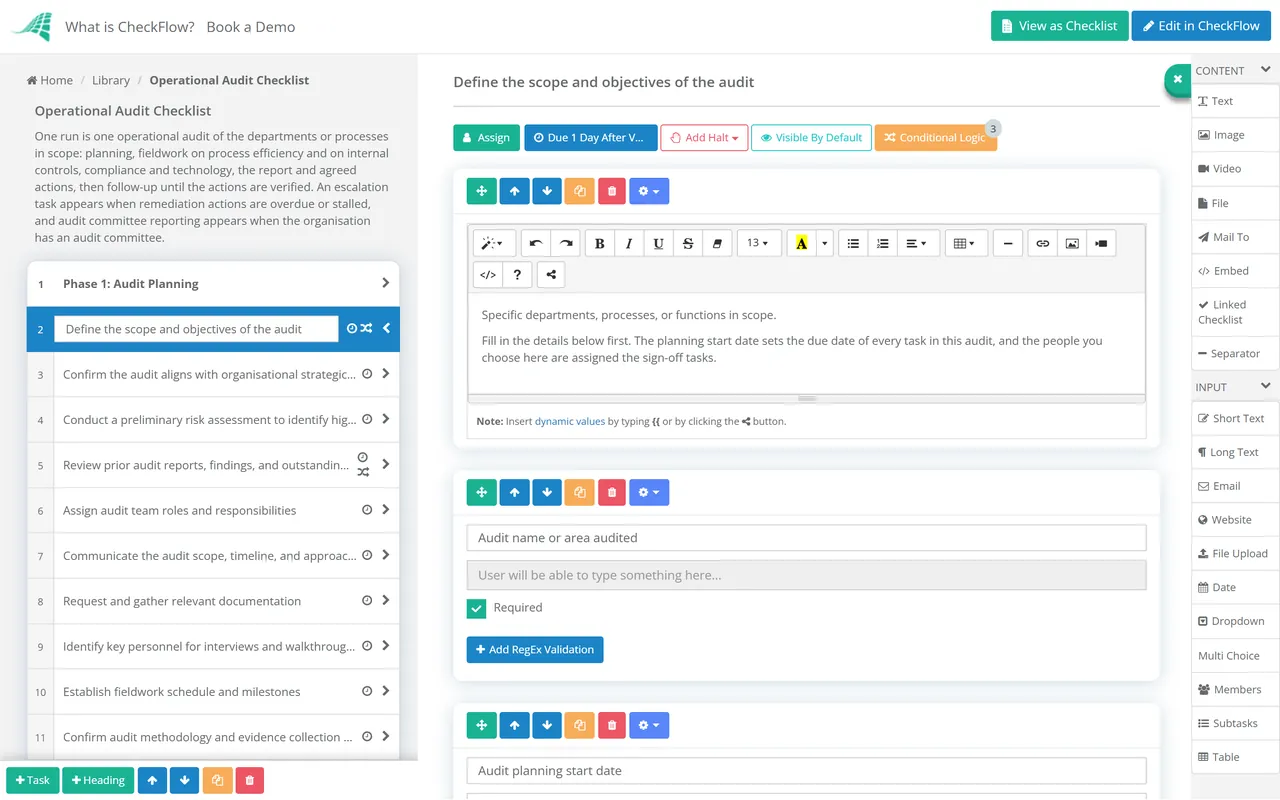
This checklist maps to the four recognised phases of operational auditing defined by the IIA Global Internal Audit Standards — planning, fieldwork (covering processes, controls, compliance, and technology), reporting, and follow-up.
Phase 1
Audit Planning
Define the scope and objectives of the audit — specific departments, processes, or functions in scope
Confirm the audit aligns with organisational strategic objectives and risk priorities
Conduct a preliminary risk assessment to identify highest-risk areas for focused review
Review prior audit reports, findings, and any outstanding recommendations from previous cycles
Assign audit team roles and responsibilities
Communicate the audit scope, timeline, and approach to relevant department heads and management
Request and gather relevant documentation — process maps, SOPs, policies, KPI reports, and organisational charts
Identify key personnel for interviews and walkthroughs
Establish fieldwork schedule and milestones
Confirm audit methodology and evidence collection approach
Phase 2a
Process Efficiency & Effectiveness
Document current state of key operational processes — map actual workflows against documented SOPs and procedures
Identify gaps between documented processes and how work is actually performed
Assess whether processes are achieving their intended outcomes and KPIs
Interview department managers and frontline staff to identify known inefficiencies, bottlenecks, and pain points
Identify manual, duplicated, or redundant steps that could be eliminated or automated
Assess resource utilisation — are staff, equipment, and budget being used efficiently?
Review output quality and error rates for key processes
Assess whether process ownership is clearly assigned and accountability is enforced
Evaluate training adequacy — do staff have the skills and knowledge to perform their roles effectively?
Document process improvement opportunities with estimated impact
Phase 2b
Internal Controls, Compliance & Technology
Assess the adequacy of internal controls for key processes — are appropriate checks and authorisations in place?
Test key controls for operating effectiveness — are they being followed consistently?
Identify control gaps and single points of failure that could lead to errors, fraud, or compliance breaches
Review segregation of duties — confirm no single individual has incompatible responsibilities across critical processes
Assess compliance with applicable regulations, industry standards, and internal policies
Review contract and supplier management processes — confirm obligations are being met and vendor performance is monitored
Evaluate IT systems supporting key operational processes — assess fitness for purpose, data integrity, and access controls
Review data management practices — confirm data is accurate, complete, secure, and retained appropriately
Assess cybersecurity controls relevant to operational processes
Confirm business continuity arrangements are in place for critical operational functions
Phase 3
Reporting & Recommendations
Compile all findings from fieldwork — process gaps, control weaknesses, compliance exposures, and efficiency opportunities
Rate each finding by risk level and potential business impact (critical, high, medium, low)
Develop specific, actionable recommendations for each finding — each recommendation should be SMART (specific, measurable, achievable, relevant, time-bound)
Draft the audit report — include executive summary, scope and methodology, findings, risk ratings, and recommendations
Discuss draft findings with department management before finalising — confirm factual accuracy and obtain management responses
Present final audit report to senior management and audit committee
Obtain management agreement on remediation actions, owners, and target completion dates
Distribute final report to all relevant stakeholders
Archive the audit report and supporting workpapers
Phase 4
Follow-Up & Monitoring
Confirm all agreed remediation actions have been assigned to named owners with target dates
Schedule follow-up reviews for each remediation action based on risk level — higher risk items require earlier and more frequent follow-up
Monitor remediation progress at defined intervals — request evidence of completion for each action
Escalate overdue or stalled remediation items to senior management
Verify that implemented changes have achieved the intended improvement — test effectiveness where possible
Update the risk register and control documentation to reflect remediated items
Document lessons learned from this audit cycle to improve future audits
Report remediation progress to the audit committee at each scheduled meeting
Close the audit engagement once all critical and high-priority actions are verified as complete
Schedule next operational audit cycle and update the annual audit plan
This checklist is available as a free, runnable template in CheckFlow — with tasks assigned across audit, operations, and management teams, findings tracked from identification to remediation, and a complete audit record for every cycle.
The audit process itself should be a well-run process
It would be inconsistent to audit your organisation’s operational processes while running your own audit from a spreadsheet. CheckFlow gives the audit team a structured, trackable checklist — tasks assigned, deadlines set, progress visible in real time — that applies the same discipline to the audit process that the audit is looking for in the rest of the organisation.
The most common failure point in operational auditing is not the audit itself — it is the follow-up. Recommendations sit in a report that nobody acts on. CheckFlow turns every recommendation into a trackable action: assigned to a named owner, given a due date, and monitored with automatic reminders until it is verified as complete.
Build an annual audit programme, not a one-off exercise
Operational auditing is most effective as a recurring programme, not a periodic exercise. CheckFlow’s recurring checklist feature lets you schedule the audit automatically each year — with the same structured checklist, the same assignment logic, and a fresh instance that starts with a record of what last year’s audit found and what was done about it.
A common finding in operational audits is that SOPs and process documentation exist but aren’t consistently followed. CheckFlow turns your SOPs into active, trackable checklists that run themselves — so the gap between documented process and actual practice closes permanently. Learn more about CheckFlow for SOPs →
An operational audit is an independent, structured review of an organisation’s operational processes, internal controls, resource utilisation, and compliance with policies and regulations. Unlike financial audits (which focus on the accuracy of financial statements) or compliance audits (which check adherence to specific regulatory requirements), an operational audit evaluates whether processes are working as intended, efficiently, and effectively — and identifies where improvements would have the greatest impact. The IIA Global Internal Audit Standards define four phases of operational auditing: planning, fieldwork, reporting, and follow-up.
What is the difference between an operational audit and a financial audit?
+
A financial audit examines whether an organisation’s financial statements are accurate and presented in accordance with applicable accounting standards. An operational audit examines whether the organisation’s operations are running efficiently, effectively, and in compliance with internal policies and applicable regulations. The two audits are complementary — financial audits provide assurance on reported numbers, while operational audits look at the processes and controls behind those numbers and across all non-financial functions of the business.
Who typically conducts an operational audit?
+
Operational audits are typically conducted by internal audit teams, although external consultants are sometimes engaged for independence or specialist expertise. For smaller organisations without a dedicated internal audit function, operational audits may be conducted by operations managers, a COO, or a cross-functional team reporting to senior management. The key requirement is sufficient independence from the processes being audited — auditors should not be reviewing their own work. CheckFlow makes it straightforward to assign sections of the audit to different team members and track their completion independently.
How often should an operational audit be conducted?
+
Most organisations conduct a comprehensive operational audit annually, often aligned with the financial year. Higher-risk functions or departments may be audited more frequently. Many organisations operate a rolling audit programme that cycles through different functions each year, ensuring comprehensive coverage over a three to five year period while keeping each individual audit manageable in scope. CheckFlow’s recurring checklist feature can schedule audit cycles automatically so they are never missed.
What are the most common findings in an operational audit?
+
Common operational audit findings include: processes that are not documented or not consistently followed; weak internal controls that create fraud or error risk; duplicated effort or manual workarounds that reduce efficiency; compliance gaps in areas outside the scope of regulatory audits; technology systems that don’t support current operational needs; and recommendations from previous audits that were never implemented. The follow-up phase of the audit — tracking recommendations to completion — is consistently identified as the most commonly neglected part of the operational audit process.
Is CheckFlow free to use for this template?
+
You can start a free 14-day trial with no credit card required, giving you full access to all features including this template. The Business plan is $10 per user per month after the trial. Full details at checkflow.io/pricing.
Start Running Consistent Operational Audits Today
Free trial — no credit card required.
Do you like cookies? 🍪 We use cookies to ensure you get the best experience on our website. Learn more