An experiment without a pre-written protocol is not a scientific experiment — it is an exploratory procedure. An experiment without recorded conditions cannot be reproduced. An experiment without documented controls cannot be interpreted.
Scientific rigour is not a philosophical aspiration — it is an operational practice. The reproducibility crisis in science has demonstrated that a significant proportion of published experimental results cannot be replicated by independent laboratories, and the most common root causes are not fraud but process failures: protocols that were not written before execution began and were reconstructed afterwards, controls that were not included because they were considered unnecessary, conditions that were not recorded because they seemed obvious at the time, and data that was analysed with a method chosen after inspecting the results. The structured experiment tracking workflow addresses each of these failure modes: the hypothesis is stated before the experiment is designed; the protocol is written before it is executed; all conditions are recorded contemporaneously; controls are included as a non-negotiable element; and the analysis method is pre-specified. The Electronic Lab Notebook has become the modern standard for this discipline — replacing handwritten lab notebooks with a versioned, searchable, timestamped digital record that supports the data integrity requirements of both academic publication and regulatory submission. This free checklist gives laboratory researchers, R&D scientists, and research teams a structured framework for the full experiment tracking lifecycle.
From Hypothesis to Archive — the Seven Stages of a Rigorous Experiment
1
Hypothesis
A specific, testable prediction about the relationship between variables.
2
Design
Conditions, controls, variables, sample size, and statistical power — before execution.
3
Protocol
Written procedure specific enough to enable independent reproduction.
4
Execute
Follow the protocol; document contemporaneously; record all conditions and deviations.
5
Record
Raw data captured in the ELN or lab notebook; unaltered; with full context.
6
Analyse
Per the pre-specified analysis plan; deviations from the plan documented.
7
Archive
Protocol, raw data, processed data, analysis code, and results stored for the required retention period.
The R&D Experiment Tracking Workflow Checklist
Seven phases covering the full experiment lifecycle — from hypothesis formulation through design, protocol writing, execution, analysis, interpretation, and archiving.
Phase 1
Hypothesis Formulation
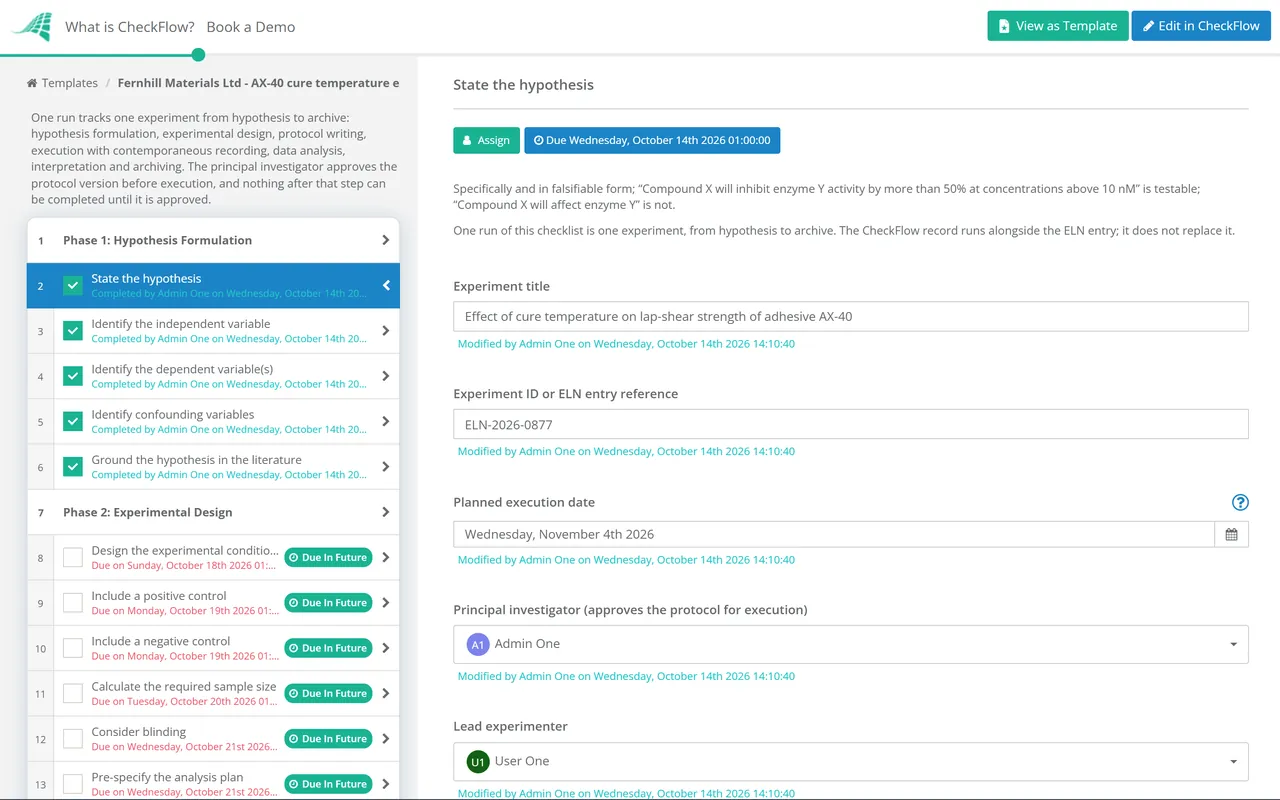
State the hypothesis — specifically and in falsifiable form; “Compound X will inhibit enzyme Y activity by more than 50% at concentrations above 10 nM” is testable; “Compound X will affect enzyme Y” is not
Identify the independent variable — the variable being deliberately manipulated; what the researcher is changing
Identify the dependent variable(s) — what is being measured as the outcome; must be quantifiable
Identify confounding variables — factors that could affect the dependent variable other than the independent variable; controlled for in the design
Ground the hypothesis in the literature — what is the evidence base that makes this hypothesis plausible? Literature cited in the ELN entry
Phase 2
Experimental Design
The experiment should be designed to falsify the hypothesis, not confirm it. An experimental design that can only produce results consistent with the hypothesis — regardless of what happens — is not a scientific experiment.
Design the experimental conditions — how many groups or conditions? What is the control condition?
Include a positive control — a condition known to produce the expected positive result; confirms the assay or measurement system is working
Include a negative control — a condition known not to produce the measured response; confirms absence of contamination or false positive
Calculate the required sample size — using power analysis; based on expected effect size, desired statistical power (typically 80%), and significance threshold (α = 0.05)
Consider blinding — blinding the experimenter to treatment allocation during measurement prevents unconscious bias
Pre-specify the analysis plan — what statistical tests will be used? What is the primary outcome? Pre-specification prevents p-hacking
Phase 3
Protocol Writing
Write the full protocol — before execution begins; in the ELN or lab notebook; specific enough that a colleague of equivalent skill could reproduce the experiment
Include all materials — reagents with lot numbers, concentrations, and sources; equipment with models and settings; cell lines or biological materials with passage numbers and provenance
Include all methods — step-by-step; timing; conditions (temperature, pH, humidity); the protocol is reproducible only if every condition is specified
Version the protocol — if the protocol is revised before execution, the revision is documented with the reason; the executed version is identified in the experiment record
Phase 4
Experiment Execution
The lab notebook rule: if it wasn’t written down, it didn’t happen. Contemporaneous recording — writing observations at the time they are made — is the foundational data integrity practice in laboratory research. Reconstructed records are not original records.
Follow the protocol as written — do not deviate without documenting the deviation; the executed experiment is what was done, not what was intended
Record all conditions in real time — date and time of each step; equipment readings; environmental conditions; operator; material lot numbers used
Record all observations — including unexpected observations; the observation that does not fit the hypothesis is as scientifically valuable as the one that does
Document all deviations from protocol — what happened, when, why, and what impact it is assessed to have on the validity of the results
Photograph or image capture where applicable — gel images, microscopy images, equipment readings; linked to the ELN entry; original unprocessed files retained
Phase 5
Data Analysis
Use the pre-specified analysis plan — analyse the primary outcome using the pre-specified method; any deviations documented and justified
Process raw data transparently — all processing steps documented (normalisation, background subtraction, exclusion criteria); the processing workflow is reproducible from the raw data
Handle outliers per pre-specified policy — not based on whether they change the conclusion; Grubbs’ test or equivalent if formal outlier testing is used
Apply the statistical test — verify assumptions (normality, homogeneity of variance) before parametric tests; use non-parametric alternatives if assumptions are not met
Retain the analysis code — if computational analysis is used (R, Python, etc.); the analysis code is part of the experiment record
Phase 6
Results Interpretation & Documentation
Interpret the results against the hypothesis — is the hypothesis supported, partially supported, or refuted? The conclusion follows from the data, not from the desired outcome
Assess alternative explanations — what other explanations could account for the observed results? How do the controls address these alternatives?
Identify limitations — sample size adequacy, measurement precision, potential confounds not fully controlled; honest acknowledgement of limitations is a mark of scientific rigour
Write the experiment summary — in the ELN: hypothesis, design, protocol version, results, interpretation, and next steps
Phase 7
Experiment Archiving
Archive all experiment records — protocol (executed version), raw data, processed data, analysis code, results summary; in FAIR-compliant storage; with sufficient metadata for future retrieval
Retain for the required period — minimum 5–10 years after publication for most research; longer for regulated research (clinical trials: 25 years; GLP studies: 10–15 years)
Make data available for peer review — upon publication or on request; data sharing per the data management plan and funder requirements
This checklist is available as a free, runnable template in CheckFlow — with hypothesis and design phases as required gates before execution can begin, and a complete experiment archive built automatically as the workflow runs.
The Electronic Lab Notebook — the Modern Standard for Experiment Documentation
An Electronic Lab Notebook (ELN) is a digital platform that replaces the traditional paper lab notebook for recording experimental procedures, observations, and data. ELNs offer significant advantages over paper notebooks: timestamped and versioned entries that cannot be retroactively altered without a visible audit trail; searchable records across all experiments; integration with laboratory instruments for automatic data capture; collaborative access for research teams across locations; and compliance with the data integrity requirements of GLP and regulatory submissions. Major ELN platforms include LabArchives, Benchling, Labfolder, and Agilent’s OpenLab. Most academic institutions and pharmaceutical and biotech companies now consider ELN use a requirement for GLP-compliant or regulatory-submission-quality research.
CheckFlow is not an ELN and does not replace ELN functionality. Rather, CheckFlow’s experiment tracking workflow structures the process that surrounds the ELN entry — ensuring that the hypothesis, design, and protocol are complete before the ELN entry for execution begins, and that the analysis, interpretation, and archiving steps are completed systematically after execution. The CheckFlow record and the ELN record run together as complementary documentation.
Why Run R&D Experiment Tracking in CheckFlow?
1
Hypothesis and design locked before execution begins
The experiment that begins without a written hypothesis and pre-specified analysis plan is the experiment that produces p-hacked results. CheckFlow’s workflow requires Phase 1 (hypothesis) and Phase 2 (design) to be completed before Phase 4 (execution) can begin — enforcing the pre-registration discipline that reproducible research requires.
Contemporaneous documentation enforced by the workflow
The lab notebook entry written from memory three days after the experiment is not a contemporaneous record — it is a reconstruction. CheckFlow’s execution phase is structured for real-time completion during the experiment, with the ELN record and the CheckFlow workflow record running together as complementary documentation.
A complete experiment archive for publication and audit
Journal submissions, grant reports, regulatory filings, and patent applications all require access to the original experimental record. CheckFlow creates a structured experiment record — hypothesis, design, protocol version, raw data reference, analysis, and interpretation — archived automatically as the experiment runs.
Experiments generate the data that supports patent applications. CheckFlow’s Patent Application Process Checklist covers the full IP protection lifecycle for R&D outputs. See the Patent Application Process Checklist →
Experiment data collection requires an approved data management plan and, for human subjects, ethics approval. CheckFlow’s R&D Data Collection Process Checklist covers both. See the R&D Data Collection Process →
What should an R&D experiment tracking workflow include?
+
An R&D experiment tracking workflow covers seven phases: hypothesis formulation (specific and falsifiable, variables identified, literature grounded), experimental design (conditions, positive and negative controls, sample size via power analysis, blinding consideration, pre-specified analysis plan), protocol documentation (written before execution, all materials and methods specified, versioned), execution with real-time recording (protocol followed, conditions recorded contemporaneously, observations and deviations documented), data analysis (pre-specified plan, transparent processing, pre-specified outlier policy, statistical assumption verification, analysis code retained), results interpretation (hypothesis assessment, alternative explanations, limitations documented, experiment summary written), and archiving (all records archived in FAIR-compliant storage, retention period noted, data available for peer review).
What is an Electronic Lab Notebook (ELN) and why should researchers use one?
+
An Electronic Lab Notebook (ELN) is a digital platform that replaces traditional paper lab notebooks for recording experimental procedures, observations, and data. ELNs offer significant advantages over paper notebooks: timestamped and versioned entries that cannot be retroactively altered; searchable records; integration with laboratory instruments for automatic data capture; collaborative access for research teams; and compliance with data integrity requirements for regulatory submissions. Major ELN platforms include LabArchives, Benchling, Labfolder, and Agilent’s OpenLab. Most academic institutions and pharmaceutical companies now consider ELN use a requirement for GLP-compliant or regulatory-submission-quality research.
What are experimental controls and why are they essential?
+
Experimental controls are conditions included in an experiment specifically to validate the experimental system and allow proper interpretation of results. A positive control is a condition known to produce the expected positive result — it confirms that the assay, instrument, or measurement system is working correctly. If the positive control fails, a negative result in the experimental condition may be a system failure, not a true negative. A negative control is a condition known to produce no effect — it confirms that the observed result in the experimental condition is not due to contamination, reagent interference, or system artefact. An experiment without appropriate controls is an experiment whose results cannot be unambiguously interpreted.
What is p-hacking and how does pre-specification prevent it?
+
P-hacking (also called data dredging) is the practice of performing multiple statistical analyses on a dataset until a statistically significant result is found, then reporting only that analysis as if it was the pre-planned analysis. Since statistical significance at p < 0.05 means there is a 5% chance the result occurred by chance, running 20 analyses on the same dataset will produce approximately one “significant” result purely by chance. Pre-specifying the analysis plan — documenting in the ELN or on a registry what statistical tests will be used before the data is analysed — prevents p-hacking by making the analysis binding before the results are seen.
Is CheckFlow free for this template?
+
You can start a free 14-day trial with no credit card required, giving you full access to all features including this template. The Business plan is $10 per user per month after the trial. Full details at checkflow.io/pricing.
Document Every Experiment From Hypothesis to Archive — Reproducibly
Free trial — no credit card required.
Do you like cookies? 🍪 We use cookies to ensure you get the best experience on our website. Learn more