A literature review that searches only one database, cites only supportive sources, and summarises rather than synthesises is not a literature review — it is a selective bibliography with connective prose. A rigorous literature review changes a researcher’s understanding of what is known and what is not.
Printed from checkflow.io/templates/research-development/literature-review-checklist
The literature review is the foundation of every research project — the structured process of identifying what is already known, understanding the debates and gaps in the existing evidence base, and situating the proposed research in relation to both. Done well, a literature review does three things: it demonstrates that the researcher has comprehensively engaged with the existing knowledge in the field (and will not unknowingly replicate work already done); it identifies the specific gap, question, or problem that the proposed research will address; and it establishes the conceptual and methodological framework that will inform the research design. Done poorly — with a search limited to one or two databases, inclusion criteria not defined in advance, and sources summarised rather than critically appraised — it produces a background section rather than a literature review. In corporate R&D, the literature review is the technology scouting and prior art assessment that determines whether a development direction is novel and commercially viable. In both contexts, the discipline is the same: systematic, comprehensive, critical, and documented. This free checklist gives researchers, PhD students, and R&D analysts a structured framework for the full literature review process.
Narrative Review vs Systematic Review — Choosing the Right Approach
Narrative / Traditional Review
Purpose
Synthesise and summarise existing literature to provide background, identify gaps, and establish the conceptual framework for a research project.
Search approach
Comprehensive but not exhaustive; searches major databases; researcher judgment applied in source selection.
Inclusion criteria
Defined but not necessarily pre-registered; researcher judgment applied.
Best for
Research proposals, thesis literature chapters, introductory reviews for journal articles, corporate technology assessments.
Limitation
Susceptible to selection bias; cannot make quantitative claims about the body of evidence.
Systematic Review
Purpose
Provide a rigorous, transparent, reproducible synthesis of all available evidence on a specific question — typically to inform clinical practice or policy.
Search approach
Exhaustive and documented; pre-registered search strategy; multiple databases; grey literature included.
Inclusion criteria
Pre-defined and pre-registered; PRISMA reporting standards applied; two-reviewer screening with adjudication.
Funders or journals explicitly require it; regulatory submissions may require systematic reviews of safety evidence.
The R&D Literature Review Checklist
Six phases covering the full literature review process — from scope definition and search strategy through screening, critical appraisal, synthesis, and writing.
1
Phase 1
Scope Definition & Research Question
4 tasks
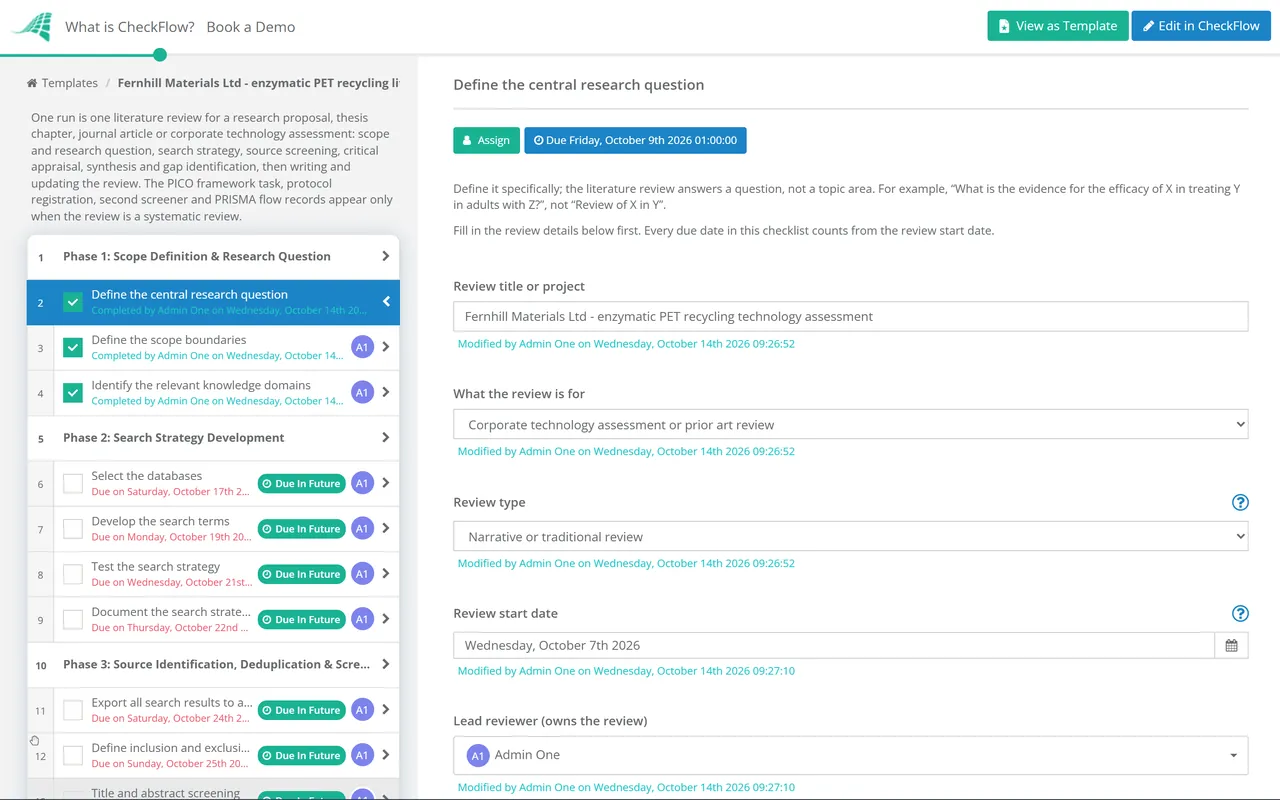
Define the central research question — specifically; the literature review answers a question, not a topic area; “What is the evidence for the efficacy of X in treating Y in adults with Z?” not “Review of X in Y”
Define the scope boundaries — time period, language, geographic scope, study type, population; document these explicitly and in advance
For systematic reviews: PICO or equivalent framework — Population, Intervention, Comparison, Outcome; structures the question precisely
Identify the relevant knowledge domains — what disciplines, sub-fields, and research traditions are relevant? Cross-disciplinary reviews require database selection beyond the primary discipline
2
Phase 2
Search Strategy Development
4 tasks
Select the databases — PubMed/MEDLINE (biomedical), Web of Science and Scopus (broad science), IEEE Xplore (engineering/computing), ACM Digital Library (computer science), PsycINFO (psychology), ERIC (education), SSRN (social sciences), Google Scholar (broad); minimum two or three databases for any review
Develop the search terms — keyword combinations covering the key concepts; MeSH terms for PubMed; Boolean operators (AND, OR, NOT); truncation and wildcards where supported
Test the search strategy — with a known relevant paper; does the search return it? If not, the strategy has gaps
Document the search strategy exactly as run — including the date of the search; for systematic reviews the documented strategy is part of PRISMA reporting
3
Phase 3
Source Identification, Deduplication & Screening
6 tasks
Export all search results to a reference management tool — (Zotero, Mendeley, or EndNote); deduplicate across databases
Define inclusion and exclusion criteria — before screening begins; not after reviewing the results
Title and abstract screening — apply inclusion/exclusion criteria; retain anything that might be relevant; err on the side of inclusion at this stage
Full-text screening — of all papers retained after title/abstract screening; final inclusion/exclusion decision based on full text
Document exclusion reasons — for every excluded paper at full-text stage; required for systematic reviews (PRISMA flow diagram); good practice for all reviews
Hand-search key journals and reference lists — of the most relevant papers retrieved; database searches miss 10–30% of relevant literature
4
Phase 4
Critical Appraisal of Included Sources
3 tasks
A literature review that treats all sources as equally credible is not a critical review — it is an annotated bibliography. Critical appraisal assesses the methodological quality of each source and factors this into how its findings are presented and weighted.
Assess study quality — using an appropriate framework for the study type: RCTs (Cochrane Risk of Bias tool); observational studies (STROBE checklist); qualitative studies (CASP framework)
Assess the evidence level — systematic reviews/RCTs at the top; expert opinion at the base (evidence hierarchy); present findings in proportion to the strength of evidence
Record key characteristics for each included study — authors, year, study design, population/sample, key findings, quality assessment; in a data extraction form
5
Phase 5
Synthesis & Knowledge Gap Identification
4 tasks
Organise sources thematically — by topic, concept, or finding; not chronologically or alphabetically; the structure reflects the conceptual landscape of the field
Synthesise, not summarise — identify patterns, contradictions, developments, and debates across studies; apply the five Cs: Cite, Compare, Contrast, Critique, Connect
Identify knowledge gaps — what is not known? What questions remain unanswered? Where do findings conflict? Where is the evidence weakest? This gap is the justification for the proposed research
Identify the theoretical or conceptual framework — which theoretical perspectives have been used to understand this area? Which is most appropriate for the proposed research?
6
Phase 6
Writing the Literature Review
4 tasks
Structure the review — with an introduction (scope and organisation), thematic sections, and a conclusion (summary of what is known and where the gaps are)
Cite all sources accurately — in the required citation style; via the reference management tool; all in-text citations have corresponding reference list entries
Avoid over-reliance on any single source — conclusions that rest on a single study are not supported by the literature; multiple independent replications provide stronger evidence
Update the review before submission — literature searches should be re-run within 3–6 months of submission; recent publications should be included
This checklist is available as a free, runnable template in CheckFlow — with search strategy and inclusion criteria documented before screening can begin, and a complete literature review record created as the process runs.
Synthesis — as opposed to summary — is the defining quality of a rigorous literature review. The five Cs framework provides a practical structure for achieving it. Cite accurately and comprehensively, attributing claims to their source. Compare findings across studies to identify where the evidence converges on consistent conclusions. Contrast studies that reach different conclusions and explain why the differences exist (different populations, different measurement approaches, different contexts). Critique the quality of the evidence: how strong is the methodology, how large are the samples, how relevant are the findings to the specific question being addressed? Connect the existing body of work to the research question and gap that the proposed research will address — making the logical case for why the proposed research is necessary and how it builds on what is already known. A literature review that applies all five Cs is a literature review that demonstrates genuine command of the field.
Why Run R&D Literature Reviews in CheckFlow?
1
Search strategy documented before screening begins
The literature reviewer who starts searching without a documented strategy, then defines inclusion criteria after seeing which papers are available, produces a biased review that will not survive peer review scrutiny. CheckFlow’s Phase 2 requires the search strategy and Phase 3 requires inclusion/exclusion criteria to be defined and documented before any screening can begin.
A PRISMA-ready documentation trail for systematic reviews
Systematic reviews must follow PRISMA standards, which require documenting: databases searched, search terms, dates of search, number of records at each screening stage, and exclusion reasons at full-text stage. CheckFlow creates this documentation automatically as the review process runs — making the PRISMA flow diagram a byproduct of the workflow.
The literature review conducted for a PhD thesis that needs to be updated for a journal publication two years later requires a complete record of what was searched, when, and what was found. CheckFlow’s literature review record — search strategy, databases, date, and all included and excluded sources — makes updating and extending a review possible without starting from scratch.
The literature review is the foundation of the research proposal. CheckFlow’s Research Proposal Submission Checklist covers the full proposal development process including the literature review component. See the Research Proposal Submission Checklist →
Prior art searches in patent applications share methodology with literature reviews. CheckFlow’s Patent Application Process Checklist covers the IP dimension of R&D knowledge assessment. See the Patent Application Process Checklist →
Describe the process in a sentence and the AI checklist generator drafts the phases and tasks for you.
Frequently Asked Questions
What should a literature review checklist include?
A literature review checklist covers six phases: scope and research question definition (specific question, scope boundaries, relevant knowledge domains), database search strategy (database selection, keyword and Boolean search development, strategy testing, documentation), source identification and screening (reference management export and deduplication, pre-defined inclusion/exclusion criteria, title/abstract screening, full-text screening, exclusion documentation, hand-search of key journals), critical appraisal (study quality assessment, evidence level hierarchy, data extraction), synthesis and gap identification (thematic organisation, synthesis not summary using the five Cs, knowledge gap identification, theoretical framework identification), and writing (structured review with introduction and conclusion, accurate citations, search updated before submission).
What is the difference between a narrative and a systematic literature review?
A narrative review synthesises existing knowledge on a topic using a comprehensive but not exhaustive search and researcher judgment in source selection — appropriate for research proposals, thesis literature chapters, and background sections of original research articles. A systematic review uses a pre-registered, exhaustive, and documented search strategy with explicit inclusion and exclusion criteria, two-reviewer screening to minimise bias, and standardised reporting (PRISMA) — appropriate where a quantitative synthesis of all available evidence is needed to answer a specific question, particularly in clinical medicine and health policy.
What databases should be searched for a literature review?
The appropriate databases depend on the research field. Broad multidisciplinary databases include Web of Science and Scopus. Field-specific databases include PubMed/MEDLINE for biomedical research, IEEE Xplore and ACM Digital Library for engineering and computing, PsycINFO for psychology, ERIC for education, and SSRN for social science. Google Scholar provides broad coverage including grey literature. A minimum of two to three databases should be searched for any systematic review, with additional hand-searching of key journals and citation tracking of highly relevant papers.
What does it mean to synthesise rather than summarise?
Summarising means describing each source individually — “Smith (2020) found X; Jones (2021) found Y.” Synthesising means identifying patterns, agreements, disagreements, and developments across sources — “Three independent studies (Smith 2020, Jones 2021, Kumar 2022) found X under conditions A and B, but conflicting results were reported under condition C.” Synthesis requires comparing and contrasting findings, identifying where evidence converges and where it conflicts, evaluating the strength of evidence at the level of the body of literature rather than the individual study, and identifying the specific gaps that the proposed research will address.
Is CheckFlow free for this template?
You can start a free 14-day trial with no credit card required, giving you full access to all features including this template. The Business plan is $10 per user per month after the trial. Full details at checkflow.io/pricing.
Conduct a Rigorous, Documented Literature Review That Stands Up to Peer Review