
Decides whether the site is ready
- Feasibility, qualification and site selection
- Regulatory submissions and the protocol
- The SIV, its report and open actions
- Releasing investigational product and the green light
Last reviewed: October 2026
No Credit Card Required
Printed from checkflow.io/templates/research-development/clinical-trial-site-initiation-checklist
This free clinical trial site initiation checklist is written from the investigator site’s side: the study coordinator, regulatory coordinator and principal investigator taking a study from site selection to activation, the point where the sponsor confirms the first participant can be enrolled. It covers feasibility, ethics and institutional approvals, the contract and budget, essential records and team qualifications, the delegation log, investigational product and pharmacy readiness, systems access, the sponsor’s site initiation visit and the first participant visit. Two questions at the start show the FDA investigator phase for US IND and IDE studies, and the pharmacy phase when the site stores or dispenses investigational product.
A site is selected when the sponsor or CRO decides it wants the site after feasibility and a qualification visit. It is initiated at the site initiation visit (SIV), when the sponsor’s monitor walks the team through the protocol, consent, safety reporting, investigational product and data entry. It is activated when the sponsor confirms in writing that the site may start screening, usually called the green light. The SIV normally happens after ethics approval and a signed contract, and activation follows once every open item from it is closed. Treating the SIV as the finish line is how sites end up initiated but unable to enrol for weeks.
Good Clinical Practice changed recently. ICH adopted E6(R3) on 6 January 2025, and it took effect in the EU on 23 July 2025. FDA published it as final guidance in September 2025, and in the UK the Medicines for Human Use (Clinical Trials) (Amendment) Regulations 2025 came into force on 28 April 2026, requiring trials of investigational medicinal products to follow its principles. E6(R3) renamed “essential documents” as essential records, which can be paper or electronic and should be proportionate to the trial. It also says the investigator should keep a record of the people and parties to whom trial-related activities are delegated, make sure they are qualified, and keep oversight of them. That record is the delegation log, and this checklist will not let the PI skip it.
This is a site start-up workflow, not an ethics application. If you are the investigator preparing the ethics submission, the R&D Ethics Compliance Checklist covers that. If you are writing the grant or protocol, start with the Research Proposal Submission Checklist.
Seven phases run from feasibility to the first participant visit. Phase 3 appears only for FDA-regulated studies under an IND or IDE, and Phase 5 appears only when the site stores or dispenses investigational product.
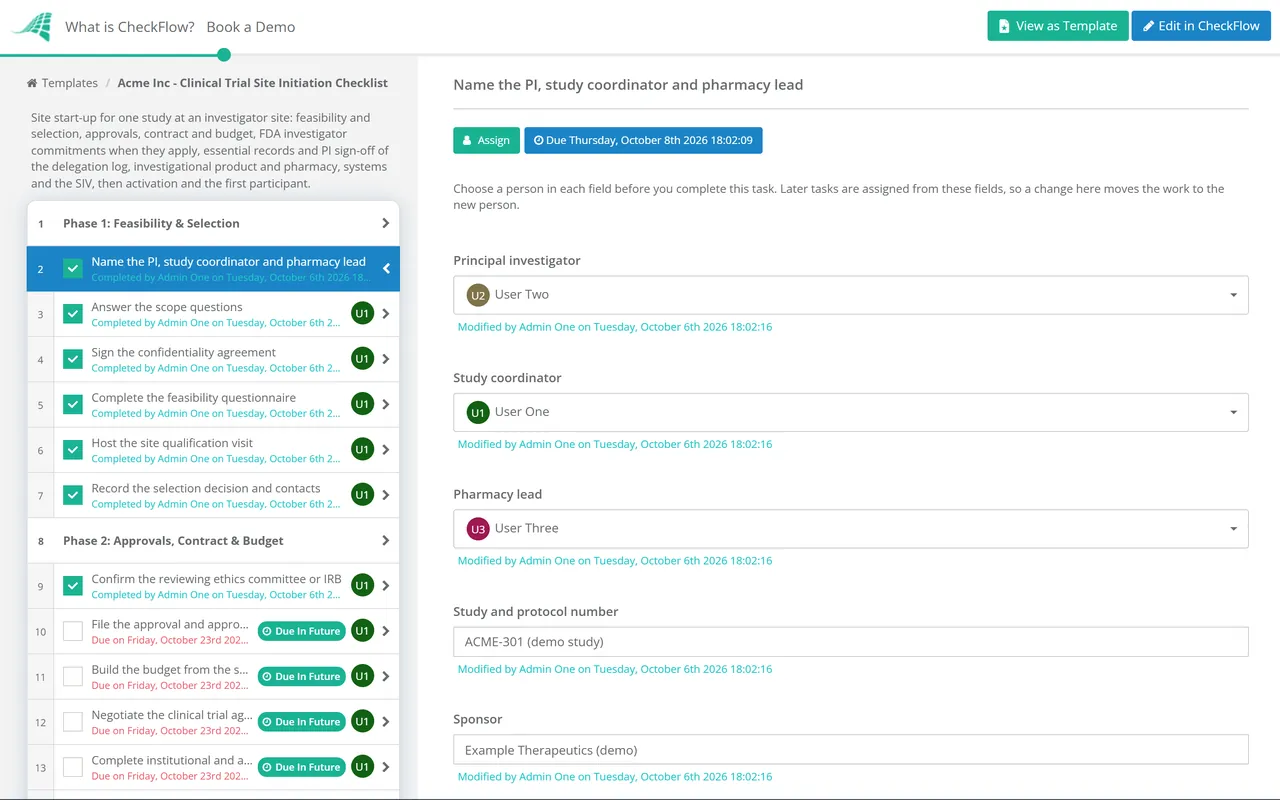
Answer the two scope questions first. They decide whether the FDA phase and the pharmacy phase appear.
Shown only when the study is FDA-regulated under an IND or IDE.
The PI sign-off of the delegation log halts the checklist. Nobody starts trial activities until it is given.
Shown only when the site stores or dispenses investigational product.
Sponsors publish their own essential records index, and E6(R3) expects the list to fit the trial rather than follow a fixed template. These are the records most sponsors ask an investigator site to have filed before the green light, and where each requirement comes from.
| Record | Why it is needed |
|---|---|
| Ethics or IRB approval and approved consent documents | No participant is approached before approval; US consent and IRB rules are in 21 CFR Parts 50 and 56 |
| Form FDA 1572 (drug or biologic IND) | 21 CFR 312.53(c): signed before the investigator takes part |
| Signed investigator agreement (device IDE) | 21 CFR 812.43(c): with the investigator’s CV and relevant experience |
| Financial disclosure from each investigator | Lets the sponsor file FDA Form 3454 or 3455 under 21 CFR Part 54 |
| CVs, licences and GCP training | Shows each person is qualified for what is delegated |
| Delegation log signed by the PI | E6(R3): a record of who the investigator delegated trial activities to |
| Executed contract and budget | Usually a condition of the SIV and of the green light |
| Lab certifications and normal ranges | Lets results from local labs be interpreted and verified |
| Product receipt and accountability logs | US investigators must keep records of drug disposition under 21 CFR 312.62 |
| SIV report, follow-up and green light | Shows the site was trained and released by the sponsor |
Why the delegation log, not the green light, halts this checklist. The PI is a member of the site team, so their sign-off of the delegation log can be a real approval: the checklist stops until they answer, and nobody is assigned trial activities on an unsigned log. The sponsor’s green light comes from outside the site, so it is recorded as a task with the activation letter attached, and nothing is enrolled until that task is complete. In the UK, NHS sites in England and Wales also confirm capacity and capability before recruitment starts, which this checklist records in Phase 2.
Start a checklist for each new study and every task is dated from that day and assigned from the PI, study coordinator and pharmacy lead fields. The approval letter, contract, 1572 and SIV report are attached to the tasks they belong to, and the checklist history shows who did what and when.
The delegation log stops at an approval step until the PI answers, so staff are not assigned trial activities on the strength of a draft. The sign-off and any comments stay in the record for the monitor or an inspector.
Dropdown answers show the FDA and pharmacy phases only where they apply. Reports show which studies are stuck in contracts or waiting on the SIV, and the API and MCP server can start a checklist when a selection letter arrives.
New team members joining a study can work through the New Researcher & Lab Onboarding Checklist before they are added to the delegation log, and research nurses can run the New Nurse Onboarding Checklist alongside it. Once participants are enrolled, the R&D Data Collection Checklist keeps collection consistent, and the Healthcare Staff Credentialing Checklist keeps licences current.
Running start-up across several studies or departments? CheckFlow’s compliance checklists keep the evidence each study needs in one place, and healthcare checklist software covers the clinical side of the same organisation.
New Researcher & Lab Onboarding Checklist

R&D Ethics Compliance Checklist
Research Proposal Submission Checklist
R&D Data Collection Process Checklist
Healthcare Staff Credentialing Checklist
Describe the process in a sentence and the AI checklist generator drafts the phases and tasks for you.
The sponsor’s or CRO’s monitor trains the site team on the protocol and checks the site is ready to enrol. A typical SIV covers the protocol and eligibility criteria, the consent process, safety and adverse event reporting, investigational product handling, data entry and source documents, and the essential records already filed. It usually takes place after ethics approval and a signed contract. The monitor then sends a report listing open actions, and activation follows once those are closed.
Initiation is the training and readiness visit. Activation is the sponsor’s written confirmation that the site may start screening and enrolling participants, often called the green light. A site can be initiated and still not be active, for example while it waits for the first product shipment or for SIV actions to be closed. Check the sponsor’s own rule, but most expect no screening activity before the green light is recorded.
The principal investigator signs it for a drug or biologic study under a US IND. Under 21 CFR 312.53(c), the sponsor must have the completed, signed form before the investigator takes part in the study. It names the sub-investigators, the facilities and labs used and the reviewing IRB, and by signing it the investigator commits to the obligations in 21 CFR Part 312. Device studies under an IDE use a signed investigator agreement instead, under 21 CFR 812.43(c).
E6(R3) is more principles-based and risk-proportionate than E6(R2). For sites the most visible changes are the rename of essential documents to essential records, which can be electronic, and a clearer expectation that the investigator keeps a record of delegated activities proportionate to their importance and stays in oversight of them. It took effect in the EU in July 2025, FDA published it as guidance in September 2025, and UK trials of medicines must follow its principles under the regulations in force since 28 April 2026.
No. It is a process template for getting a study open: it records who did each step and keeps the evidence together. The protocol, the sponsor’s start-up requirements, your institution’s SOPs and the applicable regulations decide what is actually required, and your research office or regulatory team should confirm anything you are unsure of. Edit the tasks to match your SOPs before the first study.
14-day free trial, no card required. The Business plan is $10 per user per month after the trial. Full details at checkflow.io/pricing.
14-day free trial, no credit cardFull refund in your first 30 daysUS hosting, EU on request