Institutional Review Boards exist because researchers — including well-intentioned ones — cannot always reliably assess the risks their research poses to participants. An independent ethics review is not a bureaucratic obstacle. It is the mechanism by which research avoids the Tuskegee study.
Research ethics requirements vary significantly by institution, jurisdiction, research type, funding source, and participant population. This checklist is a general framework. Always consult your institution’s IRB, Research Ethics Committee, or compliance office before beginning any research involving human subjects, animal subjects, or personal data.
Printed from checkflow.io/templates/research-development/rd-ethics-compliance-checklist
Research ethics governance exists because of historical episodes in which research caused serious harm to participants who were not adequately protected — the Nuremberg trials, the Tuskegee syphilis study, and the thalidomide tragedy among them. The frameworks that emerged from these failures — the Nuremberg Code, the Belmont Report, the Declaration of Helsinki — and the institutional structures that implement them (IRBs, Research Ethics Committees) are not regulatory obstacles to scientific progress. They are the systems that ensure research participants’ rights and welfare are protected, that research data has not been fabricated or selectively reported, that conflicts of interest are disclosed, and that research with potential dual-use applications is assessed for biosecurity risk. For corporate R&D, the ethics dimension is increasingly significant: GDPR and CCPA govern personal data used in research; clinical trial ethics requirements affect pharmaceutical and medical device development; and research integrity failures create reputational and regulatory consequences that dwarf the cost of the ethics review. A structured R&D ethics compliance checklist addresses this comprehensively: from the initial ethics risk assessment through IRB submission, informed consent, ongoing monitoring, and research integrity maintenance. This free checklist gives researchers, R&D teams, and research compliance officers a structured framework for the full ethics compliance lifecycle.
The Belmont Report — Three Principles That Govern All Human Subjects Research
Respect for Persons
Principle
Individuals should be treated as autonomous agents capable of making their own decisions. Those with diminished autonomy — children, prisoners, individuals with cognitive impairments — are entitled to additional protection.
In practice
Informed consent — the process of ensuring participants understand the research, its risks and benefits, their right to withdraw, and that they are voluntarily agreeing to participate.
Beneficence
Principle
Researchers must maximise the possible benefits and minimise the possible harms of research, and must not harm participants to benefit others.
In practice
Risk–benefit assessment — are the risks to participants proportionate to the potential knowledge gains? Are all risks minimised to the lowest practicable level?
Justice
Principle
The benefits and burdens of research should be distributed fairly. Vulnerable or disadvantaged populations should not bear a disproportionate burden of research risk while advantaged populations receive the benefits.
In practice
Fair participant selection — selection criteria justified by scientific need, not by convenience or the vulnerability of the population.
The R&D Ethics Compliance Checklist
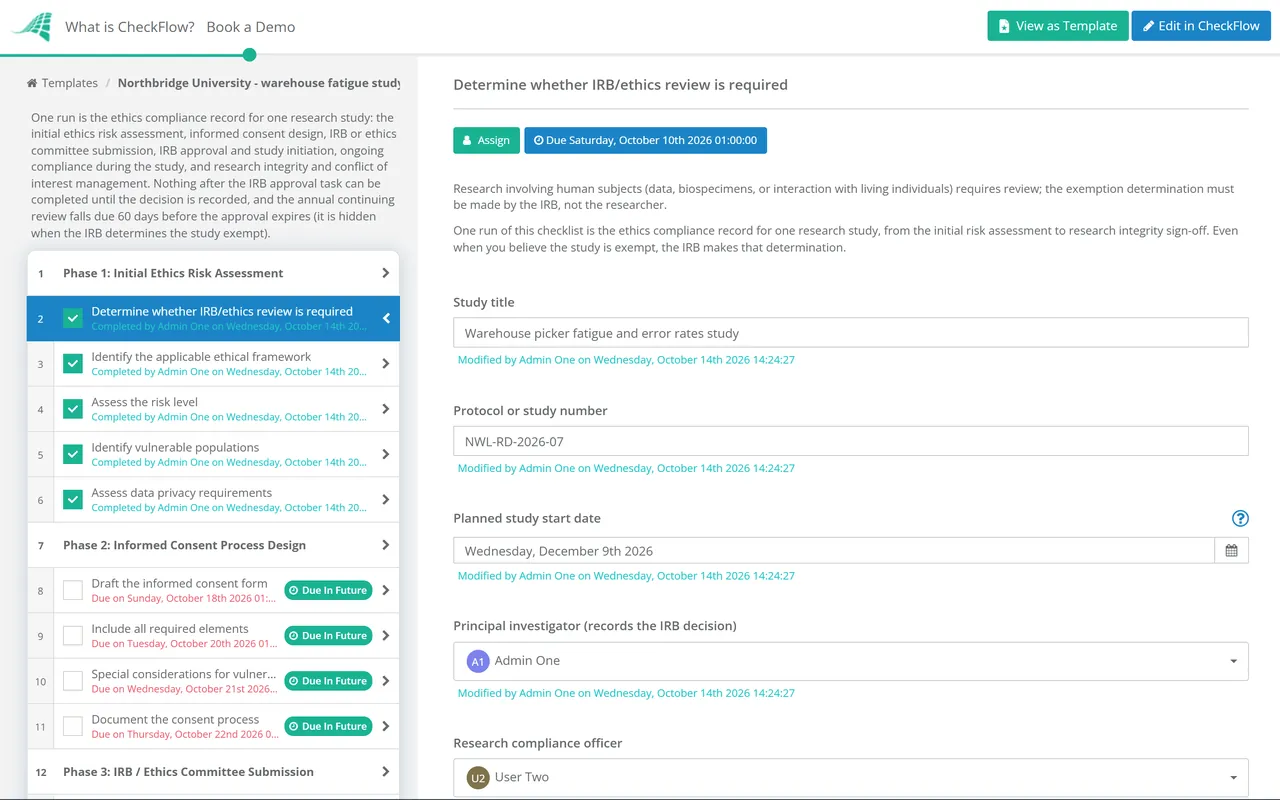
Six phases covering the full ethics compliance lifecycle — from initial risk assessment through informed consent design, IRB submission, approval, ongoing compliance monitoring, and research integrity management.
1
Phase 1
Initial Ethics Risk Assessment
5 tasks
Determine whether IRB/ethics review is required — research involving human subjects (data, biospecimens, or interaction with living individuals) requires review; the exemption determination must be made by the IRB, not the researcher
Identify the applicable ethical framework — US: Belmont Report, 45 CFR 46; UK: UK Policy Framework for Health and Social Care Research; EU: Helsinki Declaration; any funder-specific requirements
Assess the risk level — minimal risk vs greater than minimal risk; this determines the review pathway (exempt, expedited, or full board)
Assess data privacy requirements — does the research involve personal data? GDPR (EU/UK) or HIPAA (US health data)? Legal basis for processing confirmed
2
Phase 2
Informed Consent Process Design
4 tasks
Informed consent is not a signature on a form. It is an ongoing process of ensuring participants understand what they are agreeing to, what risks they are accepting, and that their participation is genuinely voluntary. The form documents the process — it is not the process itself.
Draft the informed consent form — in plain language accessible to the target population (typically 6th–8th grade reading level for general populations); IRB-approved language where required
Include all required elements — purpose of the research, procedures involved, foreseeable risks, potential benefits, alternatives, confidentiality provisions, right to withdraw at any time without penalty, contact details for questions
Special considerations for vulnerable populations — for children: parental consent plus age-appropriate assent; for prisoners: additional safeguards against coercion; for cognitively impaired: legally authorised representative consent
Document the consent process — signed consent form retained; copy provided to participant; the consent conversation documented
3
Phase 3
IRB / Ethics Committee Submission
5 tasks
Prepare the full protocol — background and rationale, specific aims, research design and methodology, participant selection criteria, data collection procedures, data management plan, risk-benefit analysis, informed consent procedures
Prepare supporting documents — informed consent form, recruitment materials, data collection instruments, investigator CVs and training certifications (CITI training or equivalent)
Submit through the institutional system — all required fields completed; all attachments included
Identify the appropriate review pathway — Exempt, Expedited, or Full Board; the IRB determines this, not the researcher
Respond to any IRB queries promptly and completely — the clock on approval does not run during outstanding queries
4
Phase 4
IRB Approval & Study Initiation
3 tasks
Obtain IRB approval BEFORE beginning — no human subjects data collection before IRB approval is received; this is an absolute requirement; retroactive approval does not exist
File the approval documentation — with the IRB approval number and approval date; expiry date noted; continuing review scheduled
Conduct the research as approved — any modification to the approved protocol requires an amendment submission to the IRB before the modification is implemented
5
Phase 5
Ongoing Ethics Compliance During the Study
4 tasks
Annual continuing review — most IRB approvals require annual renewal; submit continuing review report before the approval expires
Report unanticipated problems — any unexpected adverse event or problem involving risk to participants reported to the IRB promptly (typically within 5–10 business days)
Report protocol deviations — any departure from the approved protocol reported to the IRB; distinguished from protocol amendments (planned changes approved in advance)
Monitor for emerging risks — as the study progresses, are any previously unforeseen risks to participants emerging? Report to IRB and reassess
6
Phase 6
Research Integrity & Conflict of Interest Management
4 tasks
Disclose all conflicts of interest — financial, employment, or personal relationships that could bias the research; to the institution and funder; at the proposal stage, not after publication
Data fabrication and falsification prevention — raw data is retained in original form; all data processing and exclusions documented; the analytical workflow is reproducible
Authorship criteria — all authors meet the ICMJE criteria (intellectual contribution, drafting or revising, final approval, accountability); gift authorship and ghost authorship avoided
Dual-use research review — for life sciences research with potential for misuse (biosecurity, chemical, nuclear): institutional dual-use review completed
This checklist is available as a free, runnable template in CheckFlow — with IRB approval as a required gate before data collection can begin and continuing review reminders tracked automatically.
IRB Review Pathways — Exempt, Expedited, and Full Board
Exempt review applies to research that presents no more than minimal risk and falls within specific regulatory categories — such as research using existing data that is publicly available or properly de-identified, or research conducted in established educational settings using normal educational practices. Critically, the researcher does not determine whether their research qualifies for exemption. The IRB makes this determination. Research must not proceed without either an exemption determination or IRB approval.
Expedited review applies to research involving no more than minimal risk that meets specific regulatory criteria — such as voice or video recordings, or the collection of data through non-invasive procedures. Expedited reviews are conducted by the IRB chair or a designated reviewer rather than by the full board.
Full board review is required for all research involving greater than minimal risk that does not qualify for expedited review. The full IRB convenes to review, discuss, and vote on the protocol. This is required for most clinical trials, research with vulnerable populations, and studies involving sensitive topics or significant risks to participants.
Why Run R&D Ethics Compliance in CheckFlow?
1
Ethics approval confirmed before data collection begins
The most serious research ethics violation — beginning human subjects data collection without IRB approval — occurs when the data collection workflow is not dependent on ethics approval. CheckFlow makes IRB approval receipt a required phase gate: the data collection workflow cannot be initiated until the ethics approval phase is marked complete.
Continuing review and reporting tracked automatically
An IRB approval that expires mid-study because continuing review was not filed invalidates all data collected after the expiry. CheckFlow tracks the IRB approval expiry date and triggers the continuing review submission task 60 days in advance — preventing the lapse that invalidates the study.
A complete ethics compliance record for audit and publication
Journal submissions, grant reports, and regulatory filings require evidence of ethics compliance: approval number, approval date, informed consent documentation, and any protocol amendments. CheckFlow’s ethics compliance record contains all of this — built automatically as the compliance process runs.
Ethics approval is a prerequisite for human subjects data collection. CheckFlow’s R&D Data Collection Process Checklist covers the data collection methodology that follows ethics approval. See the R&D Data Collection Process →
Ethics compliance is a required component of research proposals and should be addressed at proposal stage. CheckFlow’s Research Proposal Submission Checklist covers the full proposal development process. See the Research Proposal Submission Checklist →
Describe the process in a sentence and the AI checklist generator drafts the phases and tasks for you.
Frequently Asked Questions
What should an R&D ethics compliance checklist include?
An R&D ethics compliance checklist covers six phases: ethics risk assessment (IRB review requirement determination, applicable framework identification, risk level assessment, vulnerable population identification, data privacy requirements), informed consent design (plain language form, all required elements, vulnerable population adaptations, consent process documentation), IRB/ethics committee submission (full protocol, supporting documents, institutional submission, review pathway, query responses), IRB approval and study initiation (approval before any data collection, documentation filed, study conducted as approved), ongoing compliance (annual continuing review, adverse event reporting, protocol deviation reporting, emerging risk monitoring), and research integrity and conflict of interest (COI disclosure, data integrity procedures, authorship criteria, dual-use review).
What does informed consent require?
Informed consent requires that participants receive and understand: the purpose of the research; all procedures they will be asked to undergo; all foreseeable risks and discomforts; any potential benefits; disclosure of alternatives to participation; how confidentiality will be maintained; compensation arrangements if any; contact information for questions; a statement that participation is voluntary; and confirmation that they can withdraw at any time without penalty. Informed consent is an ongoing process — not a one-time event at enrolment. If new information emerges during the study that might affect participants’ willingness to continue, the consent process must be repeated.
What is the difference between an IRB amendment and a protocol deviation?
A protocol amendment is a planned, prospective modification to an approved protocol that must be submitted to and approved by the IRB before implementation. A protocol deviation is an unplanned departure from the approved protocol that has already occurred — it is reported to the IRB after the fact. Protocol deviations are often inadvertent (equipment failure, participant misunderstanding) and do not necessarily affect the validity of the study or participant safety, but they must be reported so the IRB can assess their significance. Protocol deviations that do affect participant safety are treated as unanticipated problems and require immediate reporting.
When is IRB review not required?
In the US, certain categories of research may be eligible for exemption from IRB review under 45 CFR 46. Exemptions apply to research in categories such as research conducted in established educational settings using normal educational practices, research involving surveys or interviews of adults on non-sensitive topics where confidentiality is maintained, and research involving solely secondary analysis of de-identified data. Critically, the researcher does not determine whether their research qualifies for exemption — the IRB makes this determination. Research should not proceed without either an exemption determination or IRB approval.
Is CheckFlow free for this template?
You can start a free 14-day trial with no credit card required, giving you full access to all features including this template. The Business plan is $10 per user per month after the trial. Full details at checkflow.io/pricing.
Document Every Ethics Approval, Consent Process, and Compliance Action — Before the Audit