Research Proposal Submission Checklist Template

A research proposal that is scientifically excellent but submitted with the wrong font size, without the required ethics statement, two days after the deadline, or with a budget that does not add up will not be funded — regardless of its scientific merit.

The research proposal is one of the most demanding documents in professional life: it requires a clear problem statement that would make a sceptical reviewer think “why has nobody answered this already?”; a literature review that demonstrates comprehensive command of the field; a methodology detailed enough to be credible but sufficiently concise to fit within page limits; an expected outcomes section that is ambitious enough to be exciting but realistic enough to be achievable; a timeline that accounts for reality; a budget that is justified to the last line item; and compliance with every formatting, eligibility, and submission requirement of the funding programme. The reviewer who reads 200 proposals in a cycle is not forgiving of avoidable errors that signal insufficient care: a bibliography missing entries from the reference list, a figure that does not render, a co-investigator CV that is one page too long, or a budget that exceeds the programme’s limit. A structured research proposal checklist addresses the full development and submission process — ensuring that scientific excellence is not undermined by process failure. This free checklist gives academic researchers, postdoctoral fellows, and corporate R&D teams a structured framework for the full proposal development and submission lifecycle.

Use This Template Free See Live Example
No Credit Card Required

Academic Grant Proposals vs Corporate R&D Investment Proposals — Common Structure, Different Framing

Academic Grant Proposal

AudiencePeer reviewers and programme officers; scientific community.
Evaluation criteriaScientific significance, innovation, approach, and investigator qualifications (NIH’s five criteria); or excellence, impact, and implementation (EU Horizon Europe).
Key sectionsSpecific aims, background and significance, innovation, approach/methodology, team/environment, budget and justification.
Funder requirementsStrict format requirements (NIH page limits, font requirements, section headers); eligibility requirements; data management plan required by most major funders.
EthicsEthics statement or IRB approval plan required in the application.

Corporate R&D Investment Proposal

AudienceR&D committee, senior leadership, investors.
Evaluation criteriaCommercial potential, strategic alignment, technical feasibility, resource requirements, competitive landscape.
Key sectionsExecutive summary, problem and opportunity, proposed solution and R&D approach, market analysis, IP strategy, timeline and milestones, budget, risk assessment, expected ROI.
RequirementsInternal format requirements vary; typically less prescriptive than academic funders but linked to the business case and investment committee process.
EthicsMay require ethics review if the research involves human subjects or regulated applications.

The Research Proposal Submission Checklist

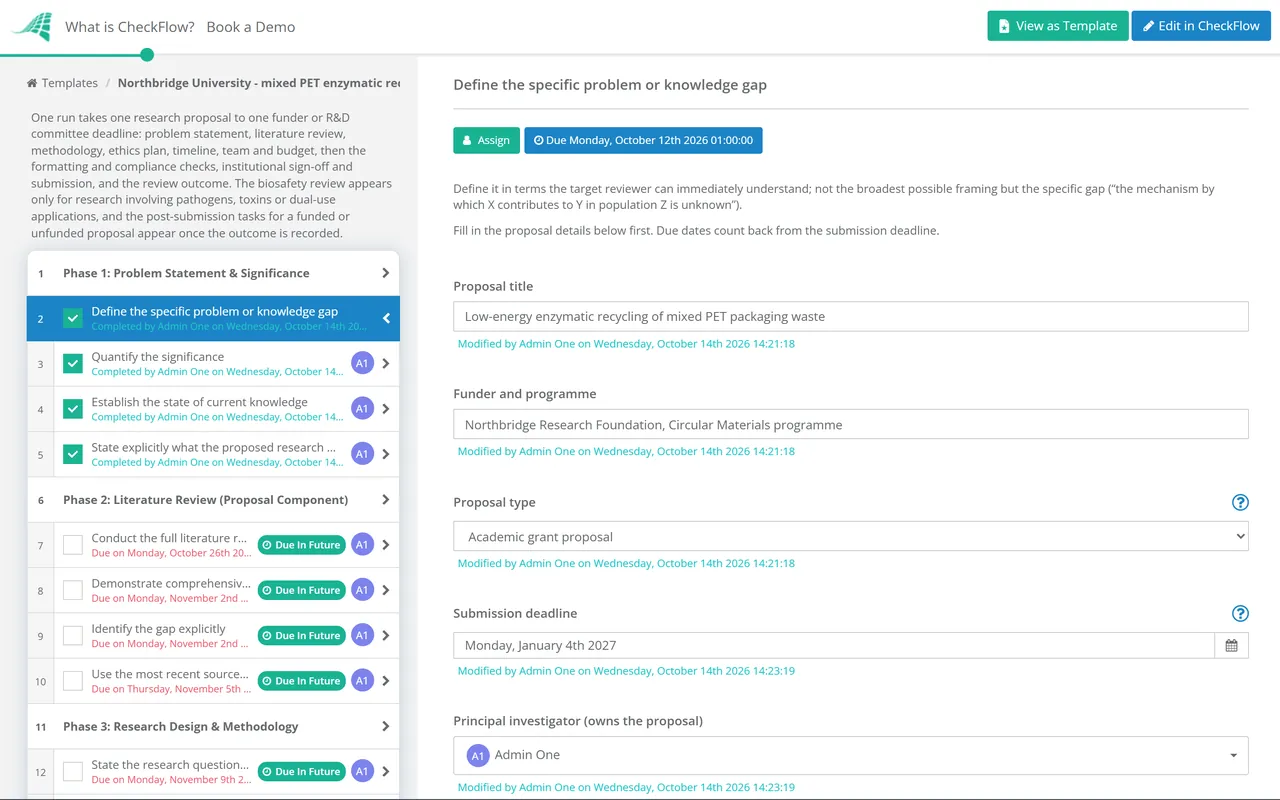
Eight phases covering the full proposal development and submission lifecycle — from problem statement through literature review, methodology, ethics, timeline, budget, formatting compliance, submission, and post-submission.

Phase 1

Problem Statement & Significance

The most common reason proposals are rejected is not that the methodology is weak — it is that the reviewer is not convinced the problem is worth solving. The problem statement must make a compelling case for why this research matters, to whom, and with what urgency.

  • Define the specific problem or knowledge gap — in terms the target reviewer can immediately understand; not the broadest possible framing but the specific gap (“the mechanism by which X contributes to Y in population Z is unknown”)
  • Quantify the significance — how many people are affected? What is the economic or scientific cost of not answering this question?
  • Establish the state of current knowledge — briefly; what is known and why it is insufficient to answer the question
  • State explicitly what the proposed research will contribute — not what it will “investigate” but what it will produce that does not currently exist
Phase 2

Literature Review (Proposal Component)

  • Conduct the full literature review — per the R&D Literature Review Checklist; the proposal literature section is a condensed synthesis, not the full review
  • Demonstrate comprehensive coverage — the reviewer should be unable to name a major study the proposal has not cited; gaps in citation signal limited field knowledge
  • Identify the gap explicitly — the literature review should build directly to “and therefore this gap remains and this proposal will address it”
  • Use the most recent sources available — a literature section citing only sources from 2015 in an active research area signals the researcher has not engaged with recent work
Phase 3

Research Design & Methodology

  • State the research questions or hypotheses specifically — each must be answerable by the proposed methodology
  • Describe the research design — qualitative, quantitative, or mixed methods? Experimental, observational, or computational? Justified by the research question
  • Detail the data collection approach — who/what, how many, how; instruments and their validity; sampling strategy
  • Describe the analysis plan — statistical approach, software, analysis framework; credible and appropriate for the design
  • Address potential weaknesses and limitations — acknowledging them and showing mitigation strategies is more credible than presenting the methodology as flawless
  • Include alternative approaches — “if approach A fails, we will use approach B”; demonstrates contingency planning and field expertise
Phase 4

Ethics & Regulatory Compliance Plan

  • Address ethics requirements explicitly — for human subjects: IRB/ethics committee approval obtained or plan for obtaining it; for animal research: IACUC approval; for sensitive data: GDPR/HIPAA compliance
  • Data management plan — required by NIH, UKRI, EU Horizon Europe, and most major funders; how data will be stored, shared, and archived per FAIR principles
  • Biosafety and dual-use review — for life sciences research involving pathogens, toxins, or potentially dual-use applications; institutional review noted
Phase 5

Timeline & Milestones

  • Develop a realistic timeline with specific milestones — for grant applications: broken into years or quarters; reviewers assess feasibility — too ambitious a timeline for the proposed scope is a credibility signal
  • Include all project activities — ethics approval (if not yet obtained), recruitment, data collection, analysis, dissemination, reporting; none of these are instantaneous
  • Identify critical path activities — the activities that, if delayed, delay the whole project
  • Include time for unexpected delays — research never runs exactly to schedule; a timeline with no buffer signals inexperience
Phase 6

Team Qualifications & Resource Plan

  • Demonstrate PI and team qualifications — relevant track record, publications, and prior funding success; CV/biosketch current and within page limits
  • Describe the institutional environment — why this institution? What facilities, collaborators, and support infrastructure are available?
  • Budget developed and justified — per the funder’s budget categories; personnel effort levels realistic; all line items justified; within the programme limit
  • Indirect costs/overheads calculated — at the institution’s negotiated rate; included in the total cost calculation
Phase 7

Formatting & Final Compliance Check

A proposal that exceeds the page limit is typically disqualified without review. A proposal submitted after the deadline is never reviewed. These are entirely preventable failures.

  • Read the funder’s submission guidelines in full — every requirement; not after the proposal is drafted
  • Check page limits for every section — total and individual sections where specified
  • Check font and margin requirements — NIH requires 11pt Georgia or Arial; margins 0.5” minimum; failure to comply is grounds for rejection
  • Check all figures and tables render correctly — within size limits; figures referenced in the text
  • Verify the reference list — every in-text citation has a reference; every reference is cited; no broken citations
  • Check all required attachments — CVs/biosketches, data management plan, letters of support, ethics documentation, institutional sign-off; all present
  • Institutional sign-off — allow 5–10 working days; initiated well before the deadline
  • Submit before the deadline — not at the deadline; submission systems fail; allow at least 24 hours buffer
Phase 8

Post-Submission & Review Response

  • Acknowledge receipt — confirm the submission was received and a reference number issued
  • Await the review outcome — typical timelines: NIH: 5–6 months to review outcome; EU Horizon Europe: 5 months; UKRI: varies by scheme
  • If funded: initiate project — complete institutional setup; award agreement signed; project formally started
  • If unfunded: read the reviews carefully and without defensiveness — reviewer feedback is the most valuable free input to the next submission
  • Resubmit or redirect — most successful grants are resubmissions; address reviewer concerns in the revision; or consider alternative funders if the fit was poor

This checklist is available as a free, runnable template in CheckFlow — with every component assigned to a named owner, institutional sign-off tracked as a required gate, and reviewer feedback captured after the outcome.

Use This Template Free

Why Proposals Fail — The Most Common Rejection Reasons

The most common reasons for research proposal rejection include: insufficient significance (reviewers are not convinced the problem is important enough or urgent enough to justify the investment — the problem statement has not made the case); weak innovation or originality (the proposed research does not clearly advance beyond the existing literature — the review has not identified a genuine gap); methodology weaknesses (insufficient detail, statistical approach not appropriate, sample size not justified, limitations not acknowledged); overambitious scope for the requested resources and timeline; PI or team qualifications insufficient for the proposed work; formatting non-compliance (in some programmes, grounds for disqualification without review); and missing required attachments or institutional approvals. The structured checklist addresses each of these systematically: significance is articulated in Phase 1; the literature review gap is identified in Phase 2; methodology is detailed in Phase 3; timeline feasibility is reviewed in Phase 5; and every formatting requirement is verified in Phase 7.

Why Run Research Proposal Development in CheckFlow?

1

Proposal development tracked from conception to submission

A research proposal developed over 12 weeks involves multiple co-investigators, multiple iterations of multiple sections, institutional approvals, and a strict submission deadline. CheckFlow’s proposal submission checklist assigns every component to a named owner with a deadline, making the whole team’s progress visible and ensuring the submission is never derailed by a single undone task.

Template Designer
2

Format compliance verified before submission — not during

The font size check and page limit verification done at 11pm the night before the deadline are done in a state of anxiety that produces errors. CheckFlow’s formatting compliance phase is a required step before the submission can be marked complete — with every requirement from the funder’s guidelines as a distinct task, verified calmly before the deadline window closes.

Powerful Checklists
3

Reviewer feedback captured and incorporated

The unfunded proposal that goes in a folder and is never improved is the funded proposal’s opposite. CheckFlow’s post-submission phase captures reviewer feedback against the specific sections it concerns — making the next submission a structured revision rather than a fresh start, and giving the team a clear record of what was changed and why.

Analytics & Reporting

Research proposals require a rigorous literature review. CheckFlow’s R&D Literature Review Checklist covers the systematic process for reviewing and synthesising the existing evidence base. See the R&D Literature Review Checklist →

Most research proposals require an ethics plan. CheckFlow’s R&D Ethics Compliance Checklist covers the full IRB/ethics committee process. See the R&D Ethics Compliance Checklist →

Frequently Asked Questions

What should a research proposal submission checklist include?

+

A research proposal submission checklist covers eight phases: problem statement and significance (specific knowledge gap, significance quantified, current knowledge state, research contribution stated), literature review component (comprehensive coverage, explicit gap identification, current sources), research design and methodology (specific questions/hypotheses, justified design, data collection detail, analysis plan, weaknesses addressed, alternatives), ethics and compliance plan (ethics approvals, data management plan, biosafety), timeline and milestones (realistic, includes all activities, critical path, includes buffer), team and resource plan (PI qualifications, institutional environment, justified budget), formatting and compliance (all funder requirements, page limits, all attachments, institutional sign-off, submitted before deadline), and post-submission (receipt confirmed, review outcome, reviewer feedback captured, resubmission plan).

What are the most common reasons research proposals are rejected?

+

The most common reasons for research proposal rejection include: insufficient significance (reviewers are not convinced the problem is important enough or urgent enough to justify the investment), weak innovation or originality (the proposed research does not clearly advance beyond the existing literature), methodology weaknesses (insufficient detail, statistical approach not appropriate, sample size not justified, limitations not acknowledged), overambitious scope for the requested resources and timeline, PI or team qualifications insufficient for the proposed work, formatting non-compliance (in some programmes, grounds for disqualification without review), and missing required attachments or institutional approvals.

What is a data management plan and why do funders require it?

+

A data management plan (DMP) is a formal document describing how research data will be managed during and after a research project. It typically covers: what data will be collected or generated; the methodology and standards used; how data will be stored and backed up during the project; how data will be shared and made accessible after the project (in compliance with FAIR principles); and arrangements for long-term preservation and archiving. Major funders including NIH, UKRI, and EU Horizon Europe require DMPs because research data produced with public or institutional funding represents a scientific asset that should be preserved and made available for reuse.

How long does grant review typically take?

+

Review timelines vary by funder and programme. NIH: applications are reviewed approximately 6 months after the submission deadline, with funding decisions following a further 3–6 months after review (total 9–12 months from submission to funding). UK Research Councils (UKRI): typically 3–6 months from deadline to outcome notification. EU Horizon Europe: typically 5 months from the proposal deadline to the evaluation result. During the review period, the principal investigator should not contact reviewers or programme staff to enquire about the application status unless the funder’s process explicitly invites this.

Is CheckFlow free for this template?

+

You can start a free 14-day trial with no credit card required, giving you full access to all features including this template. The Business plan is $10 per user per month after the trial. Full details at checkflow.io/pricing.

Develop Every Research Proposal With Every Component Complete and Every Deadline Met

Free trial — no credit card required.