Printed from checkflow.io/templates/creative-design/creative-brief-intake-checklist
An incomplete brief is not a minor inconvenience — it is the root cause of revision cycles, scope creep, missed deadlines, and work that technically meets the brief but completely misses the point. The creative team cannot produce what has not been clearly defined. The client cannot approve what they have not clearly asked for. A structured creative brief intake process ensures that every project begins with the right information captured in full — objective, audience, deliverables, timeline, budget, brand requirements, visual direction, and success criteria — reviewed and clarified before a single creative decision is made. This free creative brief intake checklist gives agencies, design studios, and in-house creative teams a structured framework for capturing, reviewing, and accepting briefs consistently — for every project, every time.
Why the Brief Is the Most Important Document in Any Creative Project
Every revision cycle, every piece of unexpected rework, every client who says “this is not what I had in mind” — these almost always trace back to the same origin point: a brief that was accepted without all the information needed to produce the work correctly. Not because the information did not exist, but because the intake process did not systematically collect it. The client knew what they needed — they just were not asked the right questions. The creative team knew what they needed to know — they just assumed it rather than confirming it.
A structured brief intake process does two things. First, it gives the requester a clear framework for communicating what they actually need — because most non-creative stakeholders do not naturally think in terms of format, dimensions, tone of voice, and visual reference. Second, it gives the creative team a structured review process for identifying gaps, ambiguities, and unrealistic expectations before work begins — when addressing them costs nothing — rather than discovering them mid-project, when addressing them costs a revision round.
What the Creative Brief Intake Checklist Covers
This checklist covers two components — the intake form (the information to collect from the requester before work begins) and the brief review process (the creative team’s structured review before accepting and briefing out the project). Both must be completed before production begins.
Part A — The Intake Form
Part A1
Project Context & Background
Context is not preamble — it is the information that tells the creative team why this project exists and what it needs to accomplish in the real world. Without it, creative decisions are made in a vacuum.
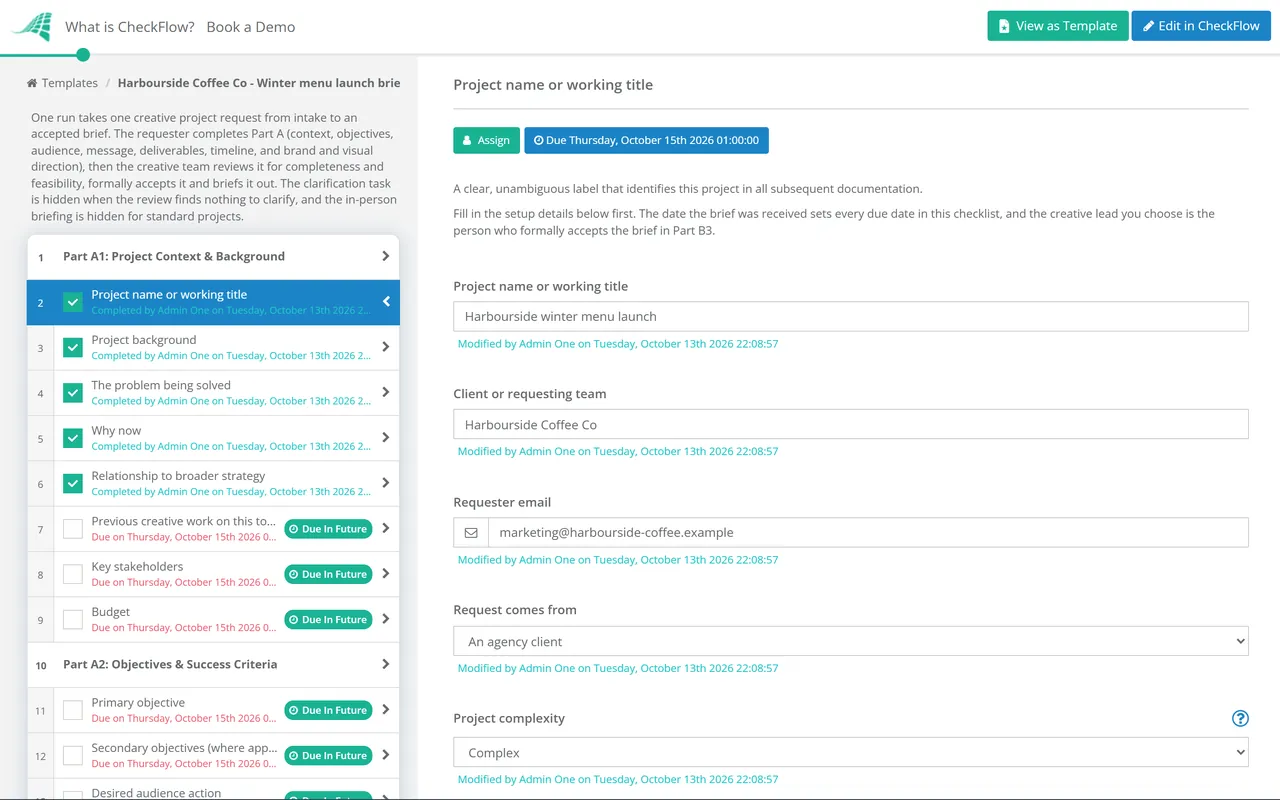
Project name or working title — a clear, unambiguous label that identifies this project in all subsequent documentation
Project background — what is the context for this project? What has led to this request? Is it a new initiative, a response to a competitor, a campaign deliverable, or something else?
The problem being solved — what specific problem does this creative work need to solve? Not the format, but the underlying need
Why now — is there a specific trigger, deadline, event, or business reason that drives the timing of this project?
Relationship to broader strategy — is this part of a larger campaign, initiative, or brand programme? If so, what are the connections and dependencies?
Previous creative work on this topic — has this brief or something similar been executed before? What worked, what did not, and what should be preserved or avoided?
Key stakeholders — who is the primary requester, who will be reviewing, and who has final sign-off authority?
Budget — confirmed budget for this project; if not yet defined, a realistic range
Part A2
Objectives & Success Criteria
Primary objective — what does this piece of creative work need to achieve? One clear statement; not “brand awareness and lead generation and engagement”
Secondary objectives (where applicable) — any additional goals that the primary objective does not cover, clearly ranked in priority
Desired audience action — what do you want the target audience to do, think, or feel after encountering this creative work?
Success metrics — how will the success of this project be measured? Views, clicks, conversions, NPS, qualitative feedback, or other KPI?
What does a good outcome look like — describe the ideal result in concrete terms; this becomes the benchmark against which the work will be assessed
What does failure look like — what outcome would mean this project did not achieve its goal? Surfacing this explicitly prevents vague post-project disappointment
Part A3
Target Audience
Primary audience — who is this creative work for? Specific enough to guide tone, format, and visual direction; not “18–55 year olds who use our product”
Audience knowledge level — what does the audience already know about this topic, brand, or product? What do they need to learn or understand?
Audience mindset and context — where and how will the audience encounter this work? What are they doing when they see it, and what is their likely emotional state?
Audience motivations and barriers — what motivates the audience to act, and what might prevent them from doing so?
Secondary audience (where applicable) — is there a secondary audience this work also needs to reach or consider?
What the audience should NOT think — are there perceptions, associations, or messages that should be explicitly avoided?
Part A4
Key Message & Tone
One brief, one message. A brief that tries to communicate five things simultaneously produces work that communicates none of them effectively.
Single-minded proposition — the one thing the target audience should take away from this work; if they remember nothing else, what is it?
Supporting messages — up to three secondary points that support the primary message; ranked in order of importance
Tone of voice — how should this work sound? Reference the brand guidelines tone of voice, and provide specific guidance for this project if it differs from the default tone
Tone guidance — provide a few adjectives that describe the desired tone (e.g. confident but not arrogant, warm but not sentimental, direct but not cold)
Tone to avoid — what tones, voices, or styles should explicitly NOT be used? Reference the brief’s audience context if applicable
Legal or regulatory messaging requirements — any mandatory claims, disclaimers, or regulated language that must or must not be included
Part A5
Deliverables & Specifications
Complete list of deliverables — every asset required, listed individually; not “social assets” but “3 x Instagram feed posts (1080x1080), 2 x Instagram Stories (1080x1920), 1 x LinkedIn post”
Format and dimensions — confirmed format, dimensions, and file type for each deliverable; if unknown, the requester must confirm before production begins
Quantity and variations — how many versions of each deliverable? Are different versions needed for different audiences, markets, or channels?
Mandatories — elements that MUST appear in the work (logo, tagline, product, specific copy, legal disclosure, URL, QR code, etc.)
Exclusions — elements that must NOT appear (competitor references, colours associated with a rival brand, specific imagery, claims that are not approved, etc.)
Existing assets to incorporate — photography, video, copy, or other materials that the creative must use
File delivery requirements — in what format(s) should final files be delivered? (Print-ready PDF, editable source files, web-optimised exports, etc.)
Part A6
Timeline & Milestones
Hard deadline — the non-negotiable date by which the final deliverables must be ready; this is the live date, print date, or event date, not the approval date
Approval deadline — working backwards from the hard deadline, when must final approval be obtained?
Review and feedback deadline — when must first round feedback be returned to allow time for revisions before the approval deadline?
Concept presentation date — when does the requester expect to see initial concepts?
Brief acceptance deadline — when does the creative team need to confirm acceptance of the brief for the timeline to be achievable?
Dependencies — are there any assets, approvals, or inputs that need to arrive before production can begin? When will they be available?
Is the timeline flexible or fixed — can the deadline be moved if scope is adjusted? Or is it fixed by an external factor?
Part A7
Brand & Visual Direction
Brand guidelines reference — confirm which version of the brand guidelines applies and where they are located
Visual style — describe the desired visual approach; provide references if possible
Reference work and inspiration — links or files showing work the requester admires and would like to draw from; note what specifically they like about each reference
What to avoid visually — references or styles to explicitly NOT draw from; note why if relevant (competitor brand, previous rejected direction, etc.)
Photography and image style — if imagery is required, what style? Studio, lifestyle, documentary, illustration, data visualisation?
Colour guidance — beyond the core brand palette, any specific colour direction for this project? Campaign colour, product-specific palette, or seasonal variation?
Typography guidance — any project-specific typographic direction beyond the brand standard?
Existing creative context — is this work part of a visual system already in production? Are there assets the new work needs to be consistent with?
Part B — Brief Review (Creative Team)
Part B1
Brief Completeness Review
The brief review is the gate between intake and production. A brief that is accepted incomplete is a brief that will generate revision cycles. Review every section before confirming acceptance.
Review the brief for completeness — is every required section filled in with enough detail to begin production?
Identify any missing information — list every gap; do not begin production with outstanding questions that will need to be answered later
Identify any ambiguous information — where is the brief open to interpretation in ways that could lead to different creative directions? Clarify before briefing out
Identify any contradictions — does any section of the brief conflict with another? (e.g. tone instructions that conflict with visual references, or objectives that conflict with audience needs)
Send clarification questions to the requester — compiled as a single list, not dripped through multiple emails; set a deadline for responses
Part B2
Feasibility Review
Is the timeline achievable for the scope? — if not, raise this now and negotiate either a revised timeline or a reduced scope before accepting the brief
Is the budget appropriate for the deliverables? — if not, communicate the gap and agree on options before work begins
Does the team have capacity to deliver this project within the required timeline?
Are any specialist skills, third-party suppliers, or licensed assets required that need to be procured before production begins?
Are there any legal, regulatory, or brand approval requirements that will affect the timeline?
Document any feasibility concerns — and confirm they are resolved before the brief is formally accepted
Part B3
Brief Acceptance & Briefing Out
Confirm all clarification questions have been answered and the brief is complete
Confirm all feasibility concerns have been resolved
Formally accept the brief — confirm acceptance in writing to the requester; include the agreed scope, timeline, and any variations from the original request
Assign the project to the relevant creative team members — with the finalised brief, timeline, and any relevant context from the intake process
Brief the creative team in person or via a briefing session where the project is complex — do not rely on the document alone
Set up the project in the production system — confirm the brief is accessible to all team members, the timeline is entered, and the production workflow is initiated
Confirm the review and approval process — who reviews at each stage, who gives final sign-off, and how feedback will be collected
Archive the brief as the project’s source of truth — all subsequent creative decisions should be referable to the brief
This checklist is available as a free, runnable template in CheckFlow — with the intake form shareable directly with the requester as a structured checklist they complete, brief review tasks enforced before production begins, and every accepted brief logged for the project record.
The Two Most Common Creative Brief Failures — and How to Prevent Both
The vague objective
What it looks like
“We want to increase brand awareness.” “We need something fresh and exciting.” “We’d like to tell our brand story.”
Why it happens
The requester knows what they want to feel about the outcome but has not been asked to define what the work needs to actually achieve.
How to prevent it
The intake form asks for a specific, measurable objective — and the brief review rejects any objective that cannot be evaluated against a defined success criterion. “Increase awareness with 25–34 year old professionals in the UK” is an objective. “Increase brand awareness” is a wish.
The incomplete deliverables list
What it looks like
“Social media assets.” “Marketing materials for the event.” “Something for the website.”
Why it happens
The requester is thinking about the outcome, not the format — and assumes the creative team will know what is needed.
How to prevent it
The intake form requires every deliverable to be specified individually — format, dimensions, quantity, and file requirements. If the requester does not know the specifications, the brief review raises this as a gap before production is assigned.
A structured brief intake process is not about making things more bureaucratic. It is about making the right questions impossible to skip.
Brief Intake for Agencies and In-House Creative Teams
The brief intake process serves the same purpose in both contexts — but the dynamics are different. Both are addressed below.
Creative agencies
In an agency, the brief intake process is managed by an account manager or client services team member — the bridge between what the client needs and what the creative team requires. The account manager’s role is to translate client intent into a workable brief that the creative team can execute without ambiguity. Common failure modes include accepting incomplete briefs under deadline pressure, and not involving the creative team in the intake review before accepting scope and timelines the team cannot realistically deliver.
CheckFlow use
The intake form is shared with the client as a structured checklist they complete — each section a specific task with clear guidance on what is required. Responses feed directly into the internal brief review process.
In-house creative teams
In-house creative teams face a different challenge: internal requesters who do not view brief completion as their responsibility. Marketing, product, HR, and sales all believe the creative team should “just know” what is needed. An intake process that requires structured input before a project is accepted shifts the quality responsibility appropriately — the creative team is accountable for the output, but the requester is accountable for the input.
CheckFlow use
The intake checklist is shared with internal requesters as a self-service form — they complete it independently before submitting a request. The creative team only reviews requests that arrive with a completed brief, eliminating the back-and-forth of incomplete submissions.
Why Run Brief Intake in CheckFlow?
1
Share the intake form directly with requesters
CheckFlow’s secure sharing feature lets you send the brief intake checklist directly to the client or internal requester as a structured form they complete at their own pace — with each section clearly described, each question a specific task, and every response visible to the creative team in real time as it arrives. No email chains. No incomplete PDF forms. No “can you send me the brief again?”
2
Enforce brief completeness before production begins
CheckFlow’s enforced task order means the brief acceptance and briefing-out phase cannot be started until the intake form review is marked complete. Production tasks are locked until the brief has been formally accepted. When deadline pressure pushes the team to skip the review and start work on an incomplete brief, the checklist prevents it — protecting the team from the revision cycles that always follow.
3
Every accepted brief is archived and traceable
Every accepted brief is logged in CheckFlow with a timestamped record of when it was received, who reviewed it, what clarifications were requested, and when it was formally accepted. When a project encounters disputes about scope or deliverables, the accepted brief is the source of truth — not a memory of what was verbally agreed in a meeting three weeks ago.
A well-structured brief intake feeds directly into a well-structured content production workflow. CheckFlow’s Content Production Workflow template takes every accepted brief from the intake phase through production, review, approval, publishing, and performance tracking — as a single, connected process. See the Content Production Workflow Checklist →
Brief quality is also the single most effective way to reduce revision cycles. A clear, complete brief that establishes success criteria at the start means review rounds can be evaluated against objective measures rather than subjective preference — the difference between a productive revision and an endless one. See the Client Feedback & Revision Process Checklist →
Describe the process in a sentence and the AI checklist generator drafts the phases and tasks for you.
Frequently Asked Questions
What is a creative brief intake?
A creative brief intake is the structured process by which a creative agency or in-house creative team collects, reviews, and accepts the information required to begin a creative project. It has two components: the intake form (a structured questionnaire that the client or internal requester completes, covering project context, objectives, target audience, key message, deliverables, timeline, budget, and brand and visual direction) and the brief review (the creative team’s structured assessment of the completed intake for completeness, ambiguity, feasibility, and any gaps that need resolving before production begins). A well-run intake process is the single most effective way to reduce revision cycles and improve project outcomes.
What should a creative brief intake form include?
A comprehensive creative brief intake form should collect eight categories of information: project context and background (why this project exists and what preceded it), objectives and success criteria (what the work needs to achieve and how success will be measured), target audience (specific enough to guide tone, format, and visual direction), key message and tone (the single-minded proposition and tone of voice guidance), deliverables and specifications (every required asset individually listed with confirmed format and dimensions), timeline and milestones (hard deadline, approval deadline, and any dependencies), brand and visual direction (guidelines reference, visual references, and explicit exclusions), and budget (confirmed or estimated range). Every section should include guidance on what level of detail is required — vague answers in any section will produce vague output.
What is the difference between a creative brief and a creative brief intake?
A creative brief is the output — the finished document that defines a project’s objectives, audience, message, deliverables, and visual direction for the creative team. A creative brief intake is the process by which that document is created — the structured collection of information from the requester, the review for completeness and feasibility, the clarification of ambiguities, and the formal acceptance before production begins. In many agencies and in-house teams, the intake and the brief are the same document — the brief is the completed intake form. In others, the intake feeds into a separately produced brief document. Either approach works, as long as the information collected is complete and reviewed before work begins.
How do you handle an incomplete brief from a client or internal requester?
Do not begin work on an incomplete brief — this is the most common and most avoidable cause of revision cycles. When a brief arrives incomplete, compile all missing information and ambiguous points into a single clarification request and return it to the requester before the project is accepted. Be specific about what is missing and why it matters for the outcome. Set a deadline for responses that fits within the project timeline. For in-house teams that regularly receive incomplete briefs, a structured intake form that must be completed before a request is submitted — with clear guidance on what each section requires — shifts the quality responsibility to the requester and reduces the volume of incomplete submissions over time.
Should the creative team be involved in the brief intake process?
Yes — particularly on larger or more complex projects. Account managers and client services teams are skilled at gathering information and managing client relationships, but may not immediately recognise that a visual brief is contradicting the tone instructions, or that the specified timeline cannot accommodate the number of deliverables requested. Involving the creative director or a senior creative in the brief review phase — even briefly — surfaces these issues while they can still be addressed without cost. For in-house teams, the production manager or creative director should review every accepted brief before work is assigned.
Is CheckFlow free to use for this template?
You can start a free 14-day trial with no credit card required, giving you full access to all features including this template. The Business plan is $10 per user per month after the trial. Full details at checkflow.io/pricing.
Start Every Creative Project Right — With a Complete Brief