
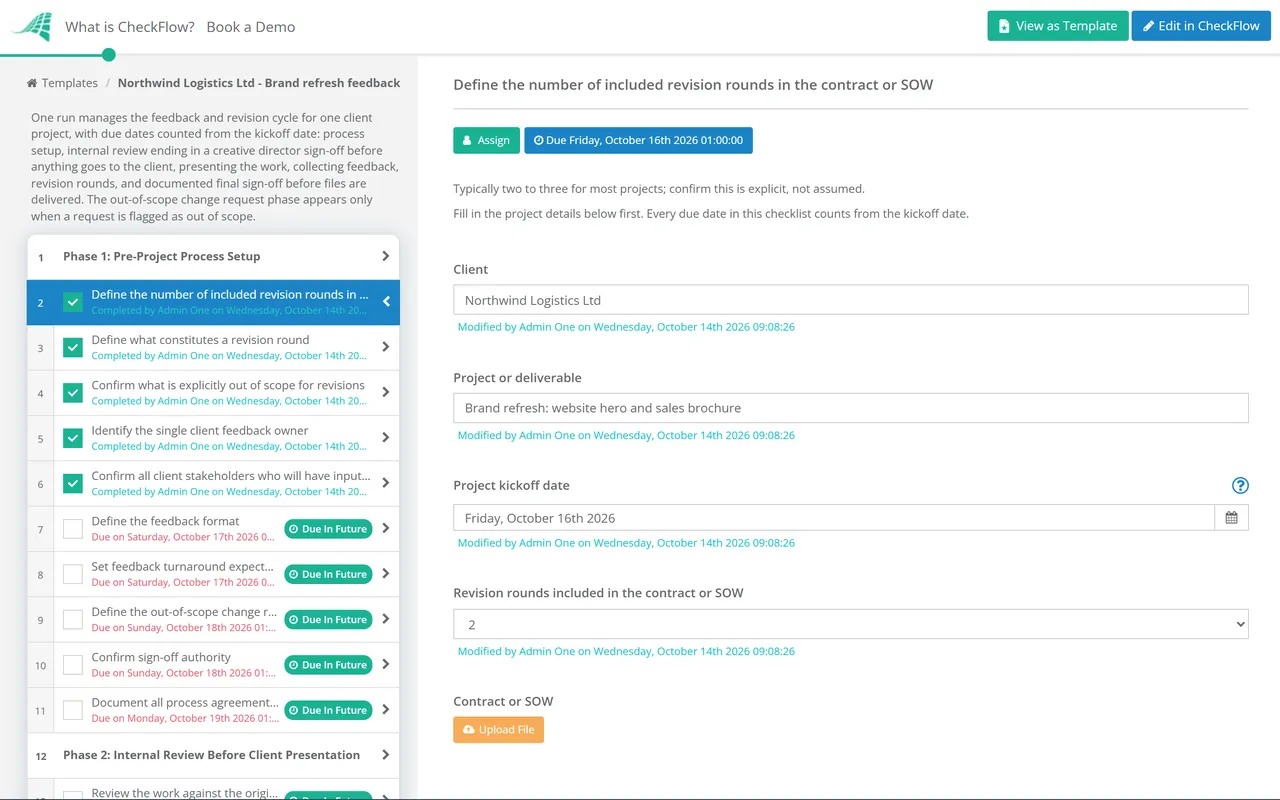
Client Feedback & Revision Process Checklist Template
Agencies with a structured feedback process run 60% fewer revision rounds. Most agencies still have no process at all.
Endless revision cycles are not a client problem or a creative problem — they are a process problem. They happen when revision rounds are not defined in the contract, when internal review happens after client presentation instead of before, when feedback arrives from five people through three channels and nothing is consolidated, and when verbal approvals are given but never documented. Every single one of these is preventable. This free client feedback and revision process checklist gives creative agencies, design studios, and freelancers a structured framework for every project — from pre-project process setup through internal review, client presentation, structured feedback collection, revision rounds, final sign-off, and out-of-scope request management.
Why Revision Cycles Break Down — and Where It Usually Starts
The revision cycle almost always breaks down in the same place: before the project starts. When the number of included revision rounds is vague or undefined, when the client does not know who in their organisation has final approval authority, when feedback is invited through whatever channel the client prefers rather than a structured single source — the conditions for scope creep and endless iteration are set from day one. The creative work itself is rarely the problem. The process around it is.
The agencies and freelancers who consistently reach final approval in two to three rounds do so not because their clients are easier or their creative is better — but because they set up the process correctly before a single brief is written. Revision rounds are defined in the contract. Feedback is consolidated from a single stakeholder before it reaches the creative team. Internal review happens before client presentation, not after. Sign-off is documented in writing, not accepted verbally. A structured checklist makes all of this consistent — not dependent on individual project managers remembering to do it.
What the Client Feedback & Revision Process Checklist Covers
This checklist covers seven phases — from pre-project process setup through to final sign-off and out-of-scope management. Run it for every project to ensure the revision process is defined, tracked, and documented from start to finish.
Phase 1
Pre-Project Process Setup
The revision process must be defined before creative work begins — not after the first round of feedback reveals that the client expected unlimited changes and the agency included two.
Define the number of included revision rounds in the contract or SOW — typically two to three for most projects; confirm this is explicit, not assumed
Define what constitutes a revision round — a single consolidation of all client feedback, not each individual comment; confirm the client understands the distinction
Confirm what is explicitly out of scope for revisions — direction changes, new brief elements, or changes that require starting from scratch are not revisions; document this clearly
Identify the single client feedback owner — one named person responsible for consolidating all internal client feedback before it is sent to the agency; confirm this is agreed at kickoff
Confirm all client stakeholders who will have input on the creative — and confirm they all review work at the same time, not sequentially
Define the feedback format — written, consolidated, and submitted through a single channel; confirm the client will not send feedback verbally, via phone call, or across multiple emails
Set feedback turnaround expectations — how long the client has to provide feedback on each round (typically 24–48 hours for smaller projects, longer for larger ones)
Define the out-of-scope change request process — how additional revision rounds or direction changes will be scoped, quoted, and approved
Confirm sign-off authority — who in the client organisation has authority to give final approval; verbal approval from someone without authority is not approval
Document all process agreements in the project briefing notes or kickoff summary — send to the client for acknowledgement before work begins
Phase 2
Internal Review Before Client Presentation
Internal review is not optional. Presenting work to a client that has not been reviewed against the brief internally wastes a revision round on changes the team should have caught.
Review the work against the original brief — confirm every requirement in the brief is addressed before the work leaves the building
Review the work against brand guidelines — confirm colours, typography, logo usage, and tone of voice are all correct
Review all copy for accuracy — spelling, grammar, factual claims, pricing, contact details, and any required legal disclaimers
Confirm technical specifications are met — file formats, dimensions, resolution, and any platform-specific requirements
Conduct a fresh-eyes review — have someone not involved in the project review the work before it is presented; familiarity blindness is real
Confirm all internal amends from the review are addressed before the work goes to the client
Confirm the presentation or delivery format is appropriate — how the work will be shared (PDF, live presentation, review link, file share) is confirmed and ready
Obtain internal sign-off from the creative director or project lead before sending to client — confirm this is a named, documented approval
Prepare the presentation context — the rationale for creative decisions; work presented without context invites gut-reaction feedback rather than considered response
Confirm the work is ready to present — do not send work that is not ready in the hope the client will not notice
Phase 3
Presenting Work to the Client
Present the work live where possible — a live presentation gives the agency the opportunity to walk through the rationale, answer questions, and manage immediate reactions before feedback is formed
Present the brief first — remind the client what was set out to be achieved before revealing the creative; this frames feedback constructively rather than reactively
Walk through the creative rationale — explain the thinking behind key decisions before inviting feedback; “we chose this because…” is more persuasive than silent delivery
State the revision round number at the time of presentation — “this is round one of two included rounds”; keeping the client aware of where they are in the process manages expectations continuously
Ask for initial reactions before detailed feedback — “does this feel like it’s solving the brief?” before “what would you change?”; direction confirmation before detail feedback saves rounds
Set the feedback timeline — confirm when consolidated feedback is due and through which channel it should be sent
Remind the client of the consolidated feedback requirement — all feedback from all stakeholders must be gathered internally and sent as a single submission
Confirm the next steps in writing after the presentation — what happens next, by when, and who is responsible for what on each side
Record the presentation or share the presented assets in a format the client can review with internal stakeholders who were not present
Document that presentation occurred — date, attendees, and initial client reaction summary
Phase 4
Collecting & Processing Client Feedback
Receive consolidated client feedback — confirm it arrives through the agreed channel as a single, consolidated submission
If feedback arrives fragmented or through multiple channels — do not begin revisions; request the client consolidate all feedback before the revision round is opened
Review the feedback in full before beginning any revisions — understand the full scope of requested changes before acting on any individual item
Categorise the feedback — brand and brief compliance changes (must action), refinements (should action), subjective preferences (discuss before actioning), and direction changes (may be out of scope)
Flag any feedback items that appear to contradict the original brief — do not silently action a direction change; raise it with the client before proceeding
Flag any feedback items that appear to be out of scope for the included revision rounds — confirm with the client and follow the out-of-scope request process where applicable
Clarify any ambiguous feedback items before beginning revisions — “can you clarify what you mean by…” saves a revision round; do not guess
Log all feedback items in the revision tracker — each item with a status (actioning, discussing, out of scope) and assigned owner
Confirm the revision round is formally opened — document the round number, date received, and total items in the revision log
Communicate back to the client — acknowledge receipt, confirm what will be actioned and what is being flagged for discussion, and provide a revised delivery date
Phase 5
Applying Revisions & Managing Revision Rounds
Action all agreed revision items — confirm each item from the feedback log is addressed
Do not introduce new creative decisions or changes during revisions unless specifically requested — unsolicited changes introduce new feedback opportunities and extend the cycle
Run the internal review process again before presenting the revised work — revisions can introduce new errors; catch them internally before the client does
Mark each feedback item as resolved in the revision log — confirm every item from the client’s feedback is addressed before the work is sent
Note the revision round number on the revised work — label or name files to reflect the current round (e.g. v2, Round 2)
Present the revised work with a clear changelog — “here is what we changed based on your feedback”; make it easy for the client to see their feedback was heard
Track cumulative revision rounds — confirm the team and client both know which round they are on and how many remain
If the project is approaching the final included revision round — notify the client clearly and in advance; do not let the client discover they have run out of rounds when they submit more feedback
Document the revision history — a complete log of what was requested and what was actioned in each round
Confirm the revision round is closed — do not leave revision rounds open indefinitely; a round is closed when the revised work has been submitted
Phase 6
Final Approval & Documented Sign-Off
Verbal approval is not approval. A client who approves work on a call and then raises issues after final file delivery is a process failure, not a client failure. Documented sign-off prevents it.
Confirm the final deliverable has passed internal review before requesting sign-off — the same process as earlier rounds
Present the final work for approval — confirm it is presented to the person with sign-off authority, not a proxy
Request written sign-off — an email confirmation, a completed approval form, or a signed approval document; anything that creates a written record
Do not deliver final files before written sign-off is received — delivery of files without documented approval removes the agency’s protection against post-delivery change requests
Confirm sign-off has been received from the correct authority — the day-to-day contact is not always the sign-off authority
Archive the sign-off confirmation — store it with the project files and the revision log
Confirm any post-approval requests are treated as new work — once sign-off is given, any further changes are out of scope and should be quoted separately
Deliver final files in agreed formats — confirm file formats, naming conventions, and delivery method match the agreed specification
Confirm delivery receipt — obtain acknowledgement that the client has received the final files
Archive the complete project file — brief, all revision rounds, feedback logs, sign-off confirmation, and final files
Phase 7
Handling Out-of-Scope Change Requests
Identify the request as out of scope — confirm it represents a direction change, a new brief element, or a request that exceeds the included revision rounds
Do not action out-of-scope requests without agreement — actioning changes without acknowledging they are out of scope sets the precedent that unlimited revisions are acceptable
Communicate clearly that the request is outside the agreed scope — calmly, without blame; reference the contract or SOW definition of included revisions
Scope the additional work — estimate the time and cost of the requested changes and provide a written quote
Obtain written approval of the additional scope before beginning work — a change order, purchase order, or email confirmation
Document the out-of-scope request and its resolution — date, what was requested, what was agreed, and at what cost
Review the original brief if out-of-scope requests are frequent — recurring direction changes often signal a brief that was not thorough enough at the start
Run a post-project retrospective — what caused the out-of-scope request and how could the brief or process have prevented it?
This checklist is available as a free, runnable template in CheckFlow — with revision rounds tracked from phase to phase, internal review enforced before client presentation, and every sign-off documented with a timestamped record.
Why Most Projects Should Complete in 2–3 Revision Rounds — and What It Means When They Don’t
Industry research consistently shows that two to three revision rounds is the optimal balance between creative refinement and project efficiency. The first round catches misalignments between the brief and the execution. The second round refines the direction. The third round, if needed, addresses final details. Beyond three rounds, something almost always went wrong earlier — an insufficiently detailed brief, feedback that was not properly consolidated, a direction change dressed up as a revision, or sign-off given by someone without authority whose manager then had different opinions.
What it usually means when a project exceeds three revision rounds:
The brief was not specific enough — the agency and client had different mental images of the outcome from the start
Feedback was not consolidated — multiple stakeholders with contradictory opinions are each getting a revision round
Direction changed after the brief was approved — new requirements arrived mid-project dressed as “refinements”
Sign-off authority was unclear — the day-to-day contact approved work that their manager later overruled
A structured revision process does not guarantee two rounds. It does guarantee that if you exceed two rounds, you know exactly why — and you have the documentation to have a constructive conversation about it.
Why Run the Revision Process in CheckFlow?
1
Enforce internal review before client presentation
The most expensive revision round is the one caused by something the agency should have caught internally. CheckFlow’s enforced task order means internal review cannot be skipped — the client presentation phase cannot be started until the internal review phase is marked complete. Work goes to clients reviewed, not raw.

2
Track every revision round with a complete log
Every feedback item, every revision action, and every round number is logged in CheckFlow with a timestamp and the name of the person responsible. When a client disputes what was agreed, or a post-approval change request arrives, the complete revision history is already there — structured, timestamped, and exportable.
3
Document sign-off so it actually protects you
A verbal approval is not a protection. CheckFlow’s sign-off task assigns the final approval confirmation to the project manager, requires it to be marked complete before files are delivered, and logs the completion with a timestamp. The sign-off record is part of the project archive — not a forwarded email someone has to find six months later.
Client feedback and revision management is one part of running an efficient creative agency. CheckFlow’s marketing agency client onboarding checklist covers how to set up the client relationship — including the feedback and revision process — from the very start of the engagement. See the Marketing Agency Client Onboarding Checklist →
Every agency project that involves a client feedback loop benefits from a structured process. Once the revision process is documented as a CheckFlow template, it runs the same way for every client and every project — making agency quality consistent, not dependent on who happens to be running the account. Learn more about SOP software in CheckFlow →
How many revision rounds should be included in a creative project?
+
Most agencies and freelancers include two to three revision rounds as standard — and research suggests this is the right balance. The first round addresses misalignments between the brief and the execution. The second refines the chosen direction. A third round, if included, handles final detail adjustments. Beyond three rounds, the project is likely experiencing one or more structural problems: an insufficiently detailed brief, unconsolidated feedback from multiple stakeholders, direction changes presented as revisions, or sign-off from someone without final approval authority. The number of rounds should be defined explicitly in the contract or SOW — not left vague — and both parties should understand what constitutes a revision round before work begins.
What is the difference between a revision and a new brief?
+
A revision is a change to the work within the agreed creative direction — adjusting a colour, refining copy, resizing an element, or modifying a layout within the established concept. A new brief is a direction change — introducing a new concept, changing the strategic message, replacing imagery with a different style, or adding requirements that were not in the original brief. Direction changes are not revisions and should not be treated as such. They represent additional scope, require a new quote and approval, and should be handled through the out-of-scope change request process rather than absorbed silently into a revision round.
How should client feedback be structured to reduce revision cycles?
+
The most effective client feedback is consolidated, specific, and actionable. Consolidated means all feedback from all stakeholders arrives as a single submission — not multiple emails, Slack messages, or verbal comments accumulated over several days. Specific means identifying exactly what is not working and where — not “I don’t love it” but “the headline on the hero section doesn’t communicate the urgency of the offer.” Actionable means providing a direction for the change — not just identifying a problem but suggesting what success would look like. Agencies that provide clients with a structured feedback form or template consistently receive better feedback and complete projects in fewer rounds.
How do you handle a client who keeps requesting more changes after sign-off?
+
Post-sign-off change requests should be treated as new work, not revisions. The first step is to reference the documented sign-off — the written confirmation that the work was approved — and acknowledge that the request represents additional scope. Then scope the changes, quote the additional work, and obtain written approval before beginning. If post-sign-off requests are frequent, the root cause is almost always that the sign-off process was not rigorous — sign-off was given by someone without final authority, or work was delivered without a written sign-off confirmation. A structured sign-off task that requires documented written approval before file delivery prevents this.
Should the agency do an internal review before sending work to the client?
+
Yes — always. Presenting work to a client that has not been reviewed internally against the brief wastes a revision round on errors the agency should have caught. Internal review should check: does the work meet every requirement in the brief? Does it comply with brand guidelines? Is all copy accurate? Are there any technical errors? A fresh-eyes review by someone not involved in the project is particularly valuable — familiarity blindness is a real phenomenon that causes experienced creatives to miss obvious errors in their own work. Internal review is not an optional quality check. It is the gate between production and client presentation.
Is CheckFlow free to use for this template?
+
You can start a free 14-day trial with no credit card required, giving you full access to all features including this template. The Business plan is $10 per user per month after the trial. Full details at checkflow.io/pricing.
Start Running a Revision Process That Actually Protects You
Free trial — no credit card required.
Do you like cookies? 🍪 We use cookies to ensure you get the best experience on our website. Learn more