Human Resources Strategy Process Checklist Template

Only 12% of US HR leaders plan three or more years ahead. The organisations that do are the ones that are not surprised by talent gaps, capability mismatches, or culture drift at scale.

The most common HR function is reactive by design. A role opens and the recruitment process starts. A manager has a conflict and HR is called in. A regulatory change arrives and the policy is updated. A strategic initiative launches and HR is asked — too late — to provide the people capacity to execute it. McKinsey’s HR Monitor 2025 found that only 12% of US HR leaders look three or more years ahead, and Gartner estimates that just 15% of organisations practise true strategic workforce planning. The cost of this reactive posture is measured in talent gaps that appear at the worst moment, leadership pipelines that are empty when succession is needed, and a culture that drifts from intent as the organisation scales. An HR strategy process converts reactivity into deliberate, business-aligned planning — defining where the people function needs to go over a 2–3 year horizon, why, and what the specific priorities and initiatives are that will get it there. This free checklist gives HR directors, CHROs, and VP People Ops professionals a structured framework for the full HR strategic planning process.

Use This Template Free See Live Example
No Credit Card Required

The Difference Between Reactive HR and Strategic HR

Reactive HR fills positions when they become vacant, handles compliance when it is due, and addresses performance issues when they become unavoidable. It is competent and necessary but insufficient. Strategic HR identifies the workforce capabilities the business will need 12–36 months from now and builds the plans to develop, acquire, or retain them before the gap becomes a crisis. It connects every HR priority to a specific business outcome — so that HR investment is not seen as overhead but as a measurable contributor to business performance.

The shift from reactive to strategic is not primarily a capability shift — it is a process shift. HR leaders who build a structured annual strategy process that starts with business strategy input, uses workforce data to assess current capability, and produces a written, stakeholder-approved HR plan with defined metrics operate at a fundamentally different level of strategic influence than those who do not. The strategy process is the mechanism; the strategic outcomes follow from the discipline of running it.

What the HR Strategy Process Checklist Covers

This checklist covers seven phases of the HR strategic planning process — from business context gathering through to quarterly review and adjustment. Run it annually at the start of the planning cycle.

Phase 1

Phase 1: Business Strategy Alignment & Context Setting

An HR strategy that is not grounded in the business strategy is a wish list. Every HR priority should be traceable to a specific business goal.

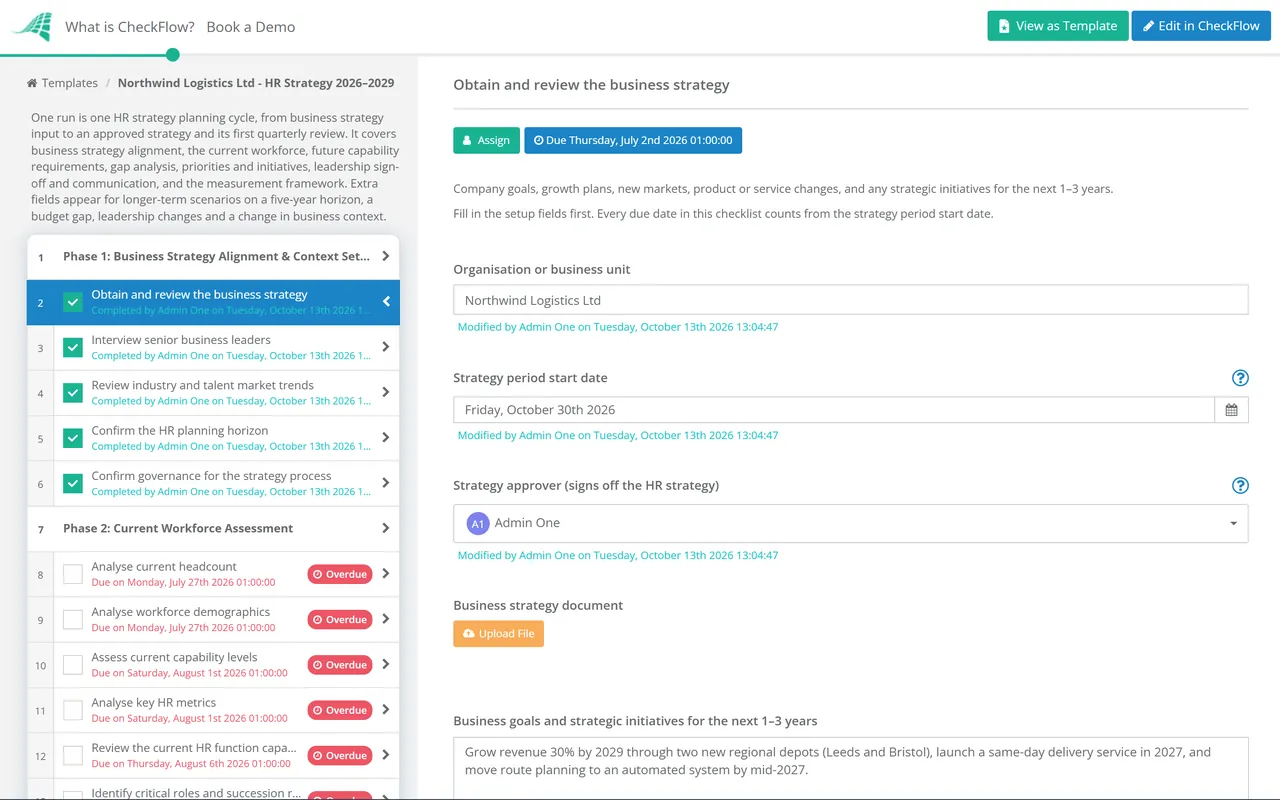
  • Obtain and review the business strategy — company goals, growth plans, new markets, product or service changes, and any strategic initiatives for the next 1–3 years
  • Interview senior business leaders — on their people-related challenges and opportunities; what workforce changes, capability needs, or culture priorities will the business strategy require?
  • Review industry and talent market trends — what is changing in the external talent market? Skills in short supply? Technology displacing roles? Competitor talent strategies?
  • Confirm the HR planning horizon — one year, three years, or five years; and the level of specificity expected at each horizon
  • Confirm governance for the strategy process — who approves the HR strategy; who is consulted; what is the output format?
Phase 2

Phase 2: Current Workforce Assessment

  • Analyse current headcount — by function, level, location, and employment type; against the current business structure
  • Analyse workforce demographics — age profile, tenure distribution, and succession risk in key roles
  • Assess current capability levels — what are the organisation’s current strengths and weaknesses from a skills and capability perspective?
  • Analyse key HR metrics — turnover rate, engagement score, time-to-fill, L&D investment, absenteeism; year-on-year trends identified
  • Review the current HR function capability — is the HR team itself capable of delivering the people strategy the business needs?
  • Identify critical roles and succession risk — roles where departure would have significant operational or strategic impact; current bench strength
Phase 3

Phase 3: Future Capability Requirements Analysis

  • Define the future workforce the business needs — to execute the business strategy: how many people, with what skills, in what roles, at what locations, over what timeframe?
  • Identify skills and capabilities that will become more critical — driven by technology, market change, or strategic direction; AI-adjacent skills are a current priority for most organisations
  • Identify roles likely to be transformed or displaced — by technology or process change; plan for reskilling or redeployment
  • Define the culture the business needs — what behaviours and norms will the strategy require? Where is the current culture misaligned?
  • Confirm the leadership capability required — at what levels does the business need to develop stronger leaders? What kind of leadership will the strategy demand?
Phase 4

Phase 4: People & Capability Gap Analysis

  • Compare current workforce to future requirements — headcount gaps, skills gaps, role gaps, and leadership pipeline gaps
  • Identify build vs buy vs borrow decisions — for each significant gap: develop internally (build), hire externally (buy), or use contractors/partnerships (borrow)?
  • Quantify the workforce investment required — indicative costs for recruitment, L&D, technology, and HR capability to close the gaps
  • Identify culture and engagement gaps — where current engagement, retention, or culture data indicates risk to the strategy
  • Risk-assess the gaps — which workforce gaps represent the highest risk to business strategy if unaddressed?
  • Document the gap analysis — a structured summary shared with senior leaders as input to strategic priority setting
Phase 5

Phase 5: Strategic Priority Setting & Initiative Planning

  • Define the HR strategic priorities — typically three to five for the planning period; each directly connected to a business need or identified gap
  • For each priority, define the initiative — what specific programme, policy change, process improvement, or investment will address the priority?
  • Define the success measure — how will progress and impact on each priority be measured? OKRs or equivalent
  • Define the owner, budget, and timeline — for each initiative; strategic priorities without resources and owners remain aspirations
  • Confirm alignment with finance — HR strategic initiatives need budget; confirm alignment with the annual planning and budgeting process
Phase 6

Phase 6: Stakeholder Approval & Communication

  • Present the draft HR strategy to senior leadership — the business context, the gap analysis, the proposed priorities, and the resource requirements
  • Incorporate feedback — adjust priorities and initiatives based on senior leadership input; confirm alignment with business strategy
  • Obtain formal sign-off — from the CEO, leadership team, or board as appropriate; HR strategy is not an HR document — it is a business document
  • Communicate to the HR team — the approved strategy, the priorities, and each team member’s role in delivering it
  • Communicate people-relevant elements to the wider business — what employees and managers can expect from HR over the planning period
Phase 7

Phase 7: Measurement Framework & Quarterly Review

  • Define the metrics dashboard — the specific measures that will track progress against each strategic priority; confirmed before the strategy period starts
  • Establish the review cadence — quarterly strategy reviews; annual full strategy refresh; who attends and what format
  • Review progress against priorities quarterly — initiatives on track; obstacles to address; metrics moving in the right direction
  • Adjust priorities when business context changes — the HR strategy is a living document; significant business change should trigger a priority review
  • Report HR strategy progress to leadership quarterly — connecting HR activity to business outcomes; the foundation of HR’s strategic credibility

This checklist is available as a free, runnable template in CheckFlow — with business leader interview tasks, gap analysis documentation, stakeholder approval routing, and quarterly review scheduled automatically.

Use This Template Free

Planning at Three Horizons

Effective HR strategy operates at three time horizons simultaneously. Most HR functions operate exclusively at Horizon 1.

This year

Horizon 1

Focus: Operational improvement and compliance. Filling open roles. Delivering the current year’s L&D plan. Managing the performance cycle. Addressing known compliance gaps.

HR posture: Executing current plans effectively.

1–3 years

Horizon 2

Focus: Building capabilities the business will need. Developing the leadership pipeline. Building the culture the strategy requires. Improving talent acquisition for harder-to-fill roles. Implementing significant HR system or process improvements.

HR posture: Building for the medium-term capability requirements.

3+ years

Horizon 3

Focus: Workforce transformation. AI and automation impact on roles. Future talent market positioning. Employer brand investment. Succession at the C-suite level.

HR posture: Scenario planning and strategic positioning.

Only 12% of US HR leaders plan at Horizon 3. Most never progress beyond Horizon 1. The competitive advantage in talent belongs to the organisations that are building for Horizon 2 and thinking about Horizon 3 while their competitors are still filling today’s vacancies.

Why Use CheckFlow for HR Strategic Planning?

1

A structured annual planning process that actually happens

HR strategy processes that exist as well-intentioned intentions rarely materialise into structured annual plans. CheckFlow’s recurring checklist schedules the HR strategy process every year — starting with the business context-gathering phase in Q4, moving through analysis and priority-setting in Q1, and producing a reviewed and approved strategy before the new planning year is underway.
2

Stakeholder input and approval tracked systematically

An HR strategy that has not genuinely engaged the CEO and senior business leaders is not a business-aligned strategy — it is an HR wish list. CheckFlow assigns the senior leader interview tasks, the presentation and feedback tasks, and the formal sign-off task to named individuals, making the stakeholder engagement process structured and traceable rather than informal and hoped-for.

3

Quarterly reviews that maintain strategic momentum

The most common failure of strategic HR plans is not in the creation — it is in the follow-through. CheckFlow’s recurring quarterly review checklist ensures the HR leadership team reviews progress against priorities, updates metrics, and adjusts the plan four times per year — maintaining the strategic discipline that produces measurable outcomes.

The HR strategy defines where the people function needs to go. The HR Management Plan operationalises that direction into the specific processes and governance that run the function day-to-day. See the HR Management Plan Checklist →

Workforce capacity planning is the operational twin of HR strategy — translating strategic direction into near-term headcount, skills, and role requirements. CheckFlow’s HR Capacity Management Checklist covers this operational translation. See the HR Capacity Management Checklist →

Frequently Asked Questions

What is an HR strategy and why does it matter?

+

An HR strategy is a multi-year plan that aligns the people function’s priorities and initiatives with the organisation’s business goals. It translates the business strategy into workforce implications — what capabilities will be needed, where gaps exist, and what HR priorities will close those gaps. Without a strategy, HR operates reactively, addressing immediate needs without anticipating future requirements. With one, HR can influence talent decisions before they become urgent, build capabilities ahead of business need, and demonstrate its contribution to business outcomes with specific metrics. McKinsey’s 2025 HR Monitor found that only 12% of US HR leaders plan three or more years ahead — a significant competitive disadvantage for the 88% who do not.

How do you develop an HR strategy that the business actually supports?

+

An HR strategy gains business support when it visibly starts from the business strategy rather than from HR’s interests. The strategy development process should begin with interviews with senior business leaders — asking what workforce challenges the business faces, not telling them what HR plans to do. The gap analysis should use business data and language — “we lack the product leadership capability to execute the growth strategy” rather than “we need to improve succession planning.” The proposed priorities should each be directly traceable to a specific business objective, with success measured in terms the business cares about. A strategy built this way earns senior leader approval because it addresses their problems rather than HR’s.

What should HR strategic priorities include?

+

Effective HR strategic priorities typically fall into three categories. Capability building: developing the skills and capabilities the business will need (leadership development, technical skills investment, AI literacy programmes). Culture and engagement: building the culture the strategy requires and maintaining the engagement levels that support performance and retention. HR operating model: improving the HR function itself — technology, process quality, data capability, and team skills — to increase the function’s capacity to deliver the other priorities. Most effective HR strategies have three to five priorities. More than five typically means the function is trying to do everything at once and will likely deliver little.

How should HR strategy progress be measured?

+

HR strategy progress should be measured at two levels. Leading indicators track whether the strategic initiatives are being executed — are the development programmes running, are the recruitment changes in place, has the culture measurement system been implemented? Lagging indicators track whether the strategic priorities are producing the intended outcomes — has the leadership pipeline improved, is turnover in priority roles declining, has the engagement score in the targeted dimensions moved? Both are required: leading indicators provide early warning; lagging indicators prove impact. Quarterly reviews should examine both.

Is CheckFlow free to use for this template?

+

You can start a free 14-day trial with no credit card required, giving you full access to all features including this template. The Business plan is $10 per user per month after the trial. Full details at checkflow.io/pricing.

Build an HR Strategy That the Business Endorses and HR Delivers

Free trial — no credit card required.