Most workforce planning happens in silos — HR plans headcount, Finance plans budgets, and neither talks to the other until the quarterly review produces surprises. The organisations that avoid this have a process, not just a conversation.
Workforce capacity planning is the discipline of ensuring the right number of people, with the right skills, are in the right roles at the right time — before the gap appears, not after. McKinsey describes it as “strategic workforce planning’s operational twin”: strategy sets the long-term skills direction, capacity planning delivers near-term execution by regularly matching workforce supply to business demand. The urgency is growing. Between 2025 and 2030, the World Economic Forum projects that 22% of jobs will be reshaped, 170 million new roles will be created, and 92 million existing roles will be displaced. Nearly 40% of existing skills will be disrupted by technology change. In this context, organisations that plan reactively — hiring when a gap appears, reskilling when a skill becomes obsolete — are permanently behind the curve. This free HR capacity management checklist gives HR leaders, workforce planners, and operations and finance partners a structured process for the full capacity planning cycle.
The Three Reasons Most Workforce Capacity Planning Fails
HR and Finance plan in parallel, not together
HR produces a headcount plan based on workforce needs. Finance produces a headcount budget based on cost targets. The two are reconciled at the quarterly review — often producing difficult conversations and delayed hiring decisions. A connected planning process where workforce need and budget are aligned from the start eliminates this recurring friction.
Demand is forecast from the past, not the future
Most headcount forecasting is based on run rate — current headcount adjusted for planned growth. It does not reflect skills that will become more critical, roles that will be transformed, or capabilities that will be needed to execute the strategy. The plan looks like last year rather than the future the business is building towards.
Plans exist but are not monitored
A workforce plan produced at the start of the year that is not reviewed until the next annual cycle is not a plan — it is a historical document. Capacity planning requires regular monitoring of actual vs planned headcount, skills gaps opened by attrition, and demand changes driven by the business.
What the HR Capacity Management Checklist Covers
This checklist covers the full capacity planning cycle in seven phases — from business demand forecasting through to ongoing monitoring and plan adjustment.
Phase 1
Phase 1: Business Demand Forecasting
Capacity planning starts with the business, not with HR. What work does the business need to get done, and what workforce capacity does that require? HR follows from the answer — not the other way around.
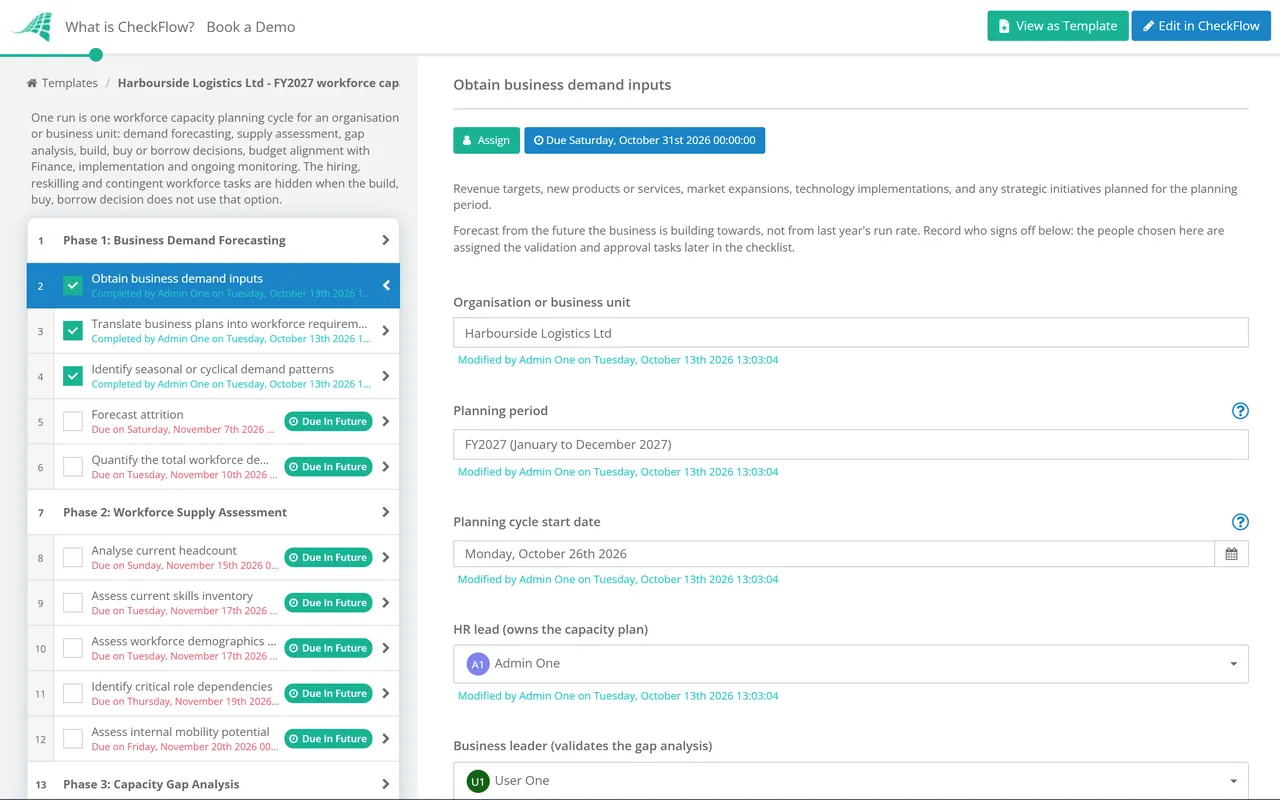
Obtain business demand inputs — revenue targets, new products or services, market expansions, technology implementations, and any strategic initiatives planned for the planning period
Translate business plans into workforce requirements — what headcount, skills, and role types does each business initiative require? Work with business unit leaders to quantify
Identify seasonal or cyclical demand patterns — peak workload periods, project cycles, or other demand variations that affect workforce needs
Forecast attrition — based on historical voluntary turnover data by function and level; identify high-risk departure windows
Quantify the total workforce demand — required headcount and skills by function, level, and time period across the planning horizon
Phase 2
Phase 2: Workforce Supply Assessment
Analyse current headcount — actual headcount by function, level, employment type, and location; against approved headcount plan
Assess current skills inventory — what skills and capabilities the current workforce has; skills data from performance reviews, L&D records, or skills assessments
Assess workforce demographics and risk — age profile and retirement risk; tenure distribution; high-potential employees at flight risk
Identify critical role dependencies — roles where departure would have disproportionate operational impact; single points of knowledge or relationship
Assess internal mobility potential — which current employees could be reskilled or upskilled to meet forecast demand; reduces reliance on external hiring
Phase 3
Phase 3: Capacity Gap Analysis
Calculate the headcount gap — demand minus supply; by function, level, and time period
Identify skills gaps — capabilities required by business demand that the current workforce does not have at sufficient depth or scale
Identify capability surpluses — roles or skills where supply exceeds near-term demand; opportunity for redeployment or upskilling rather than redundancy
Map gaps to business risk — which capacity gaps represent the highest risk to business strategy if unaddressed?
Validate the gap analysis with business leaders — confirm the analysis reflects operational reality; business leaders may have context that changes the assessment
Document the gap analysis summary — the quantified gaps, their business impact, and the options for addressing them
Phase 4
Phase 4: Build, Buy, Borrow Strategy
For each significant gap, there are typically three options: develop internally (build), hire externally (buy), or use contractors, partners, or technology (borrow). Each option has different costs, timelines, and risks.
Determine build vs buy vs borrow for each significant gap — build (internal development or reskilling): lower cost, longer timeline, higher engagement; buy (external hire): faster, higher cost, retention risk; borrow (contractor, partner, technology): flexible, no permanent cost, limited institutional knowledge
Define the talent acquisition plan — for roles to be hired externally: headcount, role type, timeline, and sourcing strategy
Define the reskilling and internal mobility plan — for gaps to be addressed through internal development; specific employees, development paths, and timelines
Define the contingent workforce plan — for demand to be met through contractors, consultants, or gig workers; type, duration, and sourcing channel
Confirm technology and automation can address any demand — before adding headcount; some capacity gaps are better addressed by process or technology change than by hiring
Prioritise gap-closing actions by urgency and risk — critical gaps affecting near-term business delivery addressed first

Phase 5
Phase 5: Budget Alignment & Financial Governance
Quantify the cost of the gap-closing plan — recruitment costs, reskilling investment, contingent workforce spend, and ongoing payroll impact
Submit the workforce plan to Finance — as input to the annual budgeting process; workforce and financial plans produced together, not separately
Confirm headcount approval process — each new role requires documented business justification and approval within the agreed governance framework
Confirm compensation band alignment — new roles and promotions are within approved bands; exceptions require documented approval
Establish variance tracking — actual headcount and payroll spend versus plan, tracked monthly
Phase 6
Phase 6: Plan Implementation & Execution
Initiate recruitment for approved roles — via the structured recruitment process; see the HR Recruitment Process Checklist for the full hiring framework
Launch reskilling and internal mobility programmes — for employees identified for internal development; L&D team briefed on the capacity plan requirements
Engage contingent workforce channels — for roles to be filled through contractors or consultants
Communicate the workforce plan to managers — what hiring and development they can expect and on what timeline
Track open role status — time-to-fill for each approved role; escalate any that are significantly behind timeline
Phase 7
Phase 7: Ongoing Monitoring & Plan Adjustment
Conduct monthly headcount reviews — actual vs planned headcount by function; explain significant variances
Review skills gap status quarterly — are reskilling programmes on track? Are new skills gaps emerging from attrition or business change?
Monitor attrition vs forecast — is actual turnover tracking above or below the forecast? Adjust the replacement hiring plan accordingly
Adjust the capacity plan when business demand changes — significant business strategy changes (new product, market exit, acquisition) should trigger a plan update
Produce quarterly workforce report for leadership — headcount status, skills gap progress, attrition trends, and any capacity risks emerging
Conduct an annual capacity plan refresh — full cycle repeats; incorporating learnings from the current year’s experience
This checklist is available as a free, runnable template in CheckFlow — with HR and Finance tasks assigned simultaneously, quarterly monitoring scheduled automatically, and headcount approval documentation tracked.
Making Build, Buy, and Borrow Decisions for Workforce Gaps
Each option has different characteristics. The right choice for each gap depends on urgency, the skill availability in the internal workforce, cost constraints, and strategic importance.
Internal development
Build
Best for: Gaps where the skills can be developed in existing employees within the required timeframe; where culture fit is critical; where institutional knowledge is a prerequisite.
Timeline: 6–18 months typically.
Cost: Lower direct cost; higher indirect cost of time away from current role.
Risk: Employee may not develop sufficiently; may leave after development investment.
External hire
Buy
Best for: Skills that the organisation does not have and cannot develop quickly; senior roles requiring significant experience; immediate need.
Timeline: 40–90 days to hire; additional 3–6 months to full productivity.
Cost: Highest immediate cost (recruitment + higher starting salary for external vs internal).
Risk: Cultural fit; misaligned expectations; retention after development investment.
Contractors / partners
Borrow
Best for: Time-limited demand peaks; specialist skills needed for specific projects; capability the organisation tests before buying permanently.
Timeline: Can be mobilised in 1–4 weeks.
Cost: Higher rate per unit of work but no long-term commitment.
Why Use CheckFlow for Workforce Capacity Planning?
1
A quarterly planning cycle that connects HR and Finance
CheckFlow’s capacity management checklist runs as a recurring quarterly process, with headcount demand, supply assessment, and budget alignment tasks assigned to both HR and Finance team members simultaneously. The plan is produced together, not reconciled after the fact — eliminating the quarterly surprise conversation about variance between workforce plan and budget.
2
Visible tracking of open roles and workforce gaps
The gap between a workforce plan and its execution is visible in CheckFlow — which approved roles are open, which are in recruiting, which reskilling programmes are on track, and which attrition targets are being exceeded. The plan is a live operational document, not a filed spreadsheet.
3
A documented decision trail for headcount governance
Every headcount approval, every build-vs-buy decision, and every deviation from the approved plan is documented in CheckFlow with a timestamp and the name of the approver. When the annual planning cycle reviews workforce decisions for learning and improvement, the full decision history is there.
HR capacity management and HR strategy are connected — strategy sets the direction, capacity management executes it at the operational level. CheckFlow’s HR Strategy Checklist covers the strategic planning process that capacity management then delivers. See the HR Strategy Checklist →
Workforce capacity planning triggers recruitment when external hiring is the chosen gap-closing strategy. CheckFlow’s HR Recruitment Process Checklist provides the structured hiring framework that executes the buy decisions from the capacity plan. See the HR Recruitment Process Checklist →
What is HR capacity management and how does it differ from workforce planning?
+
HR capacity management and workforce planning are closely related and often used interchangeably, but can be distinguished by time horizon and focus. Strategic workforce planning typically refers to the longer-horizon process of identifying the roles, skills, and headcount the business will need to execute its multi-year strategy. HR capacity management (or workforce capacity planning) is more operational — regularly matching current workforce supply to near-term business demand, identifying and closing gaps through a combination of hiring, development, and contingent workforce. McKinsey describes capacity planning as strategy’s “operational twin”: strategy sets direction, capacity planning delivers near-term execution through regular supply-demand matching.
How often should workforce capacity be reviewed?
+
Workforce capacity planning runs as both an annual cycle (comprehensive plan produced at the start of each planning year, aligned to the business plan and budget) and a quarterly monitoring cycle (actual vs planned headcount reviewed, attrition tracked, skills gap progress assessed, and demand changes incorporated). The quarterly review ensures the plan stays current and responsive to business change — which is essential in environments where business conditions, strategic priorities, or team structures change frequently. Monthly headcount reviews at the operational level provide the data that feeds the quarterly analysis.
What is the build, buy, borrow framework in workforce planning?
+
Build, buy, borrow is a framework for deciding how to close each identified workforce gap. Build means developing the required capability in existing employees through reskilling, upskilling, or internal mobility — lower cost, higher retention, but slower and limited by the extent to which existing employees can develop the required skills. Buy means hiring externally — faster for some skills, more expensive, with cultural integration and retention risks. Borrow means using contractors, consultants, or automation to meet demand without adding permanent headcount — flexible, no long-term commitment, but higher per-unit cost and no institutional knowledge build. Most workforce plans use a combination of all three; the decision for each gap depends on urgency, skill availability, cost, and strategic value.
How do HR and Finance collaborate on workforce capacity planning?
+
Effective workforce capacity planning requires genuine collaboration between HR and Finance from the start — not reconciliation of separately produced plans. HR brings the workforce demand analysis (what roles and skills the business needs and when), the supply assessment (what the current workforce has and where attrition is expected), and the gap-closing options (build, buy, borrow). Finance brings budget constraints, the connection to the P&L plan, and the financial analysis of gap-closing options. Together they produce a workforce plan that is both operationally grounded and financially constrained — with headcount approvals aligned to budget from the start.
Is CheckFlow free to use for this template?
+
You can start a free 14-day trial with no credit card required, giving you full access to all features including this template. The Business plan is $10 per user per month after the trial. Full details at checkflow.io/pricing.
Plan Your Workforce Before the Gaps Become Crises
Free trial — no credit card required.
Do you like cookies? 🍪 We use cookies to ensure you get the best experience on our website. Learn more