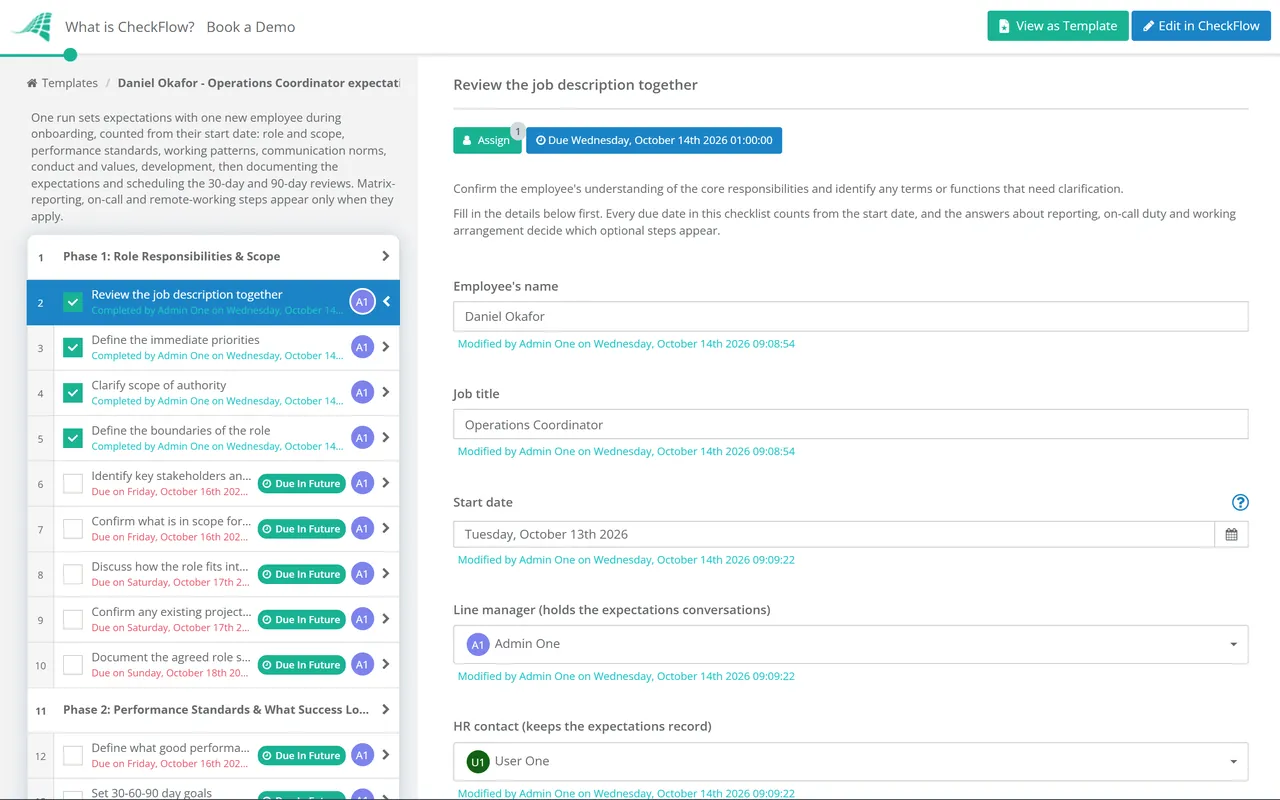
Employee Expectations Checklist Template

Only 21% of employees worldwide know clearly what is expected of them. The rest are guessing — and disengaging as a result.

Most managers cover the job description in the first week. Fewer explicitly discuss how they like to communicate, what good performance actually looks like in this team, what the working pattern and flexibility expectations are, how decisions get made, and what the development path looks like. The result is employees who work hard at the wrong things, make assumptions about norms that turn out to be wrong, feel surprised by feedback that should have been predictable, and disengage from a role that was never clearly defined for them. Gallup’s 2025 research found only 21% of employees worldwide were engaged — and unclear expectations are consistently identified as a primary driver. A structured expectations checklist ensures every dimension of what is expected of a new employee is explicitly discussed, agreed, and documented during onboarding — so the expectations set at the beginning become the shared foundation for every performance conversation that follows.

Use This Template Free See Live Example
No Credit Card Required

Why Unclear Expectations Cost More Than Poor Performance

When an employee underperforms, the first question is whether they were given the tools, training, and support to perform well. The second — and often the more important — question is whether the performance standard was clearly defined and communicated in the first place. Performance management conversations that surface a problem after six months without evidence that expectations were set clearly at the outset are not just ineffective — they are often legally indefensible and almost always unfair. A structured expectations-setting process is not just a management tool. It is the foundation of fair and effective performance management.

The scope of what needs to be communicated is broader than most managers recognise. Role responsibilities and KPIs are the obvious ones. Working pattern expectations, communication norms, decision-making authority, professional conduct standards, and development expectations are the ones that go unspoken — and that cause friction when they turn out to have been misunderstood. A checklist that covers all of these dimensions ensures nothing is left to assumption, regardless of which manager is running the conversation or how busy the team is when the new hire joins.

What the Employee Expectations Checklist Covers

This checklist covers seven areas of expectations that should be discussed, agreed, and documented with every new employee — ideally during the first week, reviewed at the 30-day milestone, and revisited at every performance review thereafter.

Phase 1

Phase 1: Role Responsibilities & Scope

Start with the role — but go deeper than the job description. The job description describes the role in the abstract. The expectations conversation describes what the role looks like in this team, at this stage, with these specific priorities.

  • Review the job description together — confirm the employee’s understanding of the core responsibilities; identify any terms or functions that need clarification
  • Define the immediate priorities — what are the two or three most important things this person should focus on in the first 30 days?
  • Clarify scope of authority — what decisions can this person make independently? What decisions need manager input? What requires broader sign-off?
  • Define the boundaries of the role — where does this role end and an adjacent role begin? Confirm how overlapping areas are handled in practice
  • Identify key stakeholders and dependencies — who does this role rely on? Who relies on this role? What are the critical relationships?
  • Clarify any dotted-line reporting or matrix relationships — if the employee has responsibilities to more than one manager or team, confirm how competing priorities are resolved
  • Confirm what is in scope for the current stage — for complex roles, some responsibilities may be phased in over the first 90 days; confirm what is expected now versus later
  • Discuss how the role fits into the team and the wider organisation — what does the team do, how does it contribute to the business, and how does this role contribute to the team’s outcomes?
  • Confirm any existing projects or commitments the employee is inheriting — what is already in flight that requires immediate attention?
  • Document the agreed role scope — a written summary that both parties can refer back to
Phase 2

Phase 2: Performance Standards & What Success Looks Like

  • Define what good performance looks like in this role — not in the abstract, but specifically: what does a high-performing person in this role do differently from an average one?
  • Set 30-60-90 day goals — specific, measurable outcomes for each milestone; confirm both parties agree these are achievable and represent genuine progress
  • Define the KPIs or performance metrics — the specific measures that will be used to assess performance; confirm the employee understands how each metric is calculated and what the target is
  • Confirm quality standards — what standard of work is expected? How is quality assessed in this role?
  • Set output expectations — volume, speed, and quality parameters where these are relevant to the role
  • Introduce the performance review process — how often reviews happen, who conducts them, how performance is rated, and how ratings connect to salary, progression, or development
  • Introduce the probationary review process — the milestones, the criteria, and what happens at each review point; no surprises at the three-month review
  • Discuss how feedback will be given — how often, in what format, and what the employee should do if they disagree with feedback or need clarification
  • Confirm the employee knows how to raise concerns about workload, capacity, or goal feasibility — the channel for raising concerns proactively rather than silently failing to meet expectations
  • Document the agreed performance standards and goals — written record shared with the employee and retained in the HR system
Phase 3

Phase 3: Working Patterns, Hours & Availability Expectations

Working pattern expectations are among the most commonly unspoken — and the most commonly misunderstood. A new employee who assumes 9-to-5 when the team culture is 8-to-6 will create friction before the end of the first week. Discuss this explicitly.

  • Confirm core working hours — the hours the employee is expected to be working and available; where flexibility exists, confirm the boundaries
  • Confirm flexibility and remote working arrangements — which days are expected in the office, which can be remote, and any conditions that apply; confirm this is consistent with the stated policy
  • Confirm expectations for availability outside core hours — is the employee expected to be reachable in evenings or weekends? Under what circumstances? This should be explicit, not assumed
  • Discuss overtime and time-off-in-lieu arrangements — if the role regularly requires working beyond contracted hours, confirm the arrangement clearly
  • Confirm leave booking procedures — how far in advance, how to request, any blackout periods, and how many people from the team can be away simultaneously
  • Confirm expectations during busy periods — seasonality, financial year-end, product launches, or other predictable periods when extended availability is expected
  • Clarify on-call or standby requirements where applicable — frequency, expectations, and compensation arrangements
  • For remote employees — confirm home office requirements, equipment provisions, and any connectivity or security expectations
  • Confirm travel expectations — frequency, destinations, booking procedures, and any applicable expenses policy
  • Document the agreed working pattern — confirm in writing where it differs from the standard policy or contract
Phase 4

Phase 4: Communication Preferences & Collaboration Norms

  • Confirm how the manager likes to communicate — preferred channels (email, Slack, in-person), preferred response times, and how to signal urgency versus routine queries
  • Confirm how the team communicates — which channel is used for what purpose; how decisions are recorded; the norms around meeting requests and agendas
  • Confirm expected response times — to email, to messages, and to urgent requests; explicit norms prevent both under-responsiveness and notification anxiety
  • Discuss meeting culture — the norms for attendance, preparation, contribution, and follow-up in team meetings; what is expected of participants
  • Confirm status update expectations — how and how often does the manager expect progress updates on work? Proactive communication or updates on request?
  • Discuss how to escalate issues — at what point should the employee bring something to the manager? What information should they have prepared?
  • Confirm document and file management norms — where work is saved, how it is named, and how it is shared; do not assume the new hire will discover this by osmosis
  • Discuss cross-team communication — how does the employee engage with other departments or teams? Are there protocols or relationships to be aware of?
  • Confirm confidentiality expectations — what information about the team, the business, or specific projects is confidential and should not be shared externally or across teams?
  • Document the communication norms — a brief written summary that the new employee can refer to in their first weeks
Phase 5

Phase 5: Professional Conduct, Culture & Values Expectations

  • Introduce the company values — not the poster on the wall but what the values mean in practice; how they inform decisions and behaviour in this team
  • Discuss professional conduct standards — the behavioural expectations in terms of professionalism, respect, and how colleagues and clients are treated
  • Review the code of conduct — confirm the employee has read and understood the key conduct requirements; answer any questions
  • Discuss conflict resolution — how disagreements and tensions are expected to be raised and resolved in this team; confirm the escalation path for interpersonal issues
  • Confirm social media and external communication expectations — what can and cannot be said publicly about the organisation, clients, or colleagues
  • Discuss equality, diversity, and inclusion expectations — the organisation’s commitments and the specific behavioural expectations of all employees
  • Review any role-specific professional standards — regulatory obligations, professional body membership requirements, or sector-specific conduct codes
  • Confirm intellectual property and confidentiality obligations — work created in the course of employment belongs to the organisation; confidential information must be protected
  • Confirm the employee knows how to raise concerns — the whistleblowing or speak-up channel; that raising genuine concerns in good faith is both permitted and encouraged
  • Document any specific conduct expectations discussed — particularly where the role has specific regulatory or professional obligations
Phase 6

Phase 6: Development, Growth & Career Expectations

  • Discuss the employee’s development goals — what skills do they want to build? What does their career development look like?
  • Confirm the organisation’s expectations around professional development — the learning and development budget, supported activities, and any minimum CPD requirements
  • Confirm the appraisal and development review cycle — how often formal reviews happen, what they cover, and how development goals feed into the review
  • Discuss the career pathway in this organisation — what does progression look like from this role? What milestones would typically precede a promotion or role change?
  • Confirm any mandatory training requirements — compliance training, professional qualifications, or role-specific training that is required; confirm timelines
  • Introduce mentoring or coaching available — if the organisation has a formal mentoring programme or coaching support, ensure the employee knows about it and how to access it
  • Discuss performance-development linkage — how does performance rating connect to salary review, progression, and development opportunity?
  • Confirm the employee’s immediate development priorities — what should they be learning in the first 90 days beyond their core role?
  • Set up the first development conversation — a dedicated one-to-one focused on the employee’s goals, not just performance; scheduled within the first 30 days
  • Document the agreed development plan — goals, activities, timelines, and support agreed; reviewed at the 30-day and 90-day milestones
Phase 7

Phase 7: Documenting & Reviewing Expectations

Expectations documented at the start of employment become the reference point for every performance conversation that follows. Expectations that were never written down cannot be fairly enforced or meaningfully reviewed.

  • Summarise all agreed expectations in writing — a structured document covering all seven areas; shared with the employee and retained in the HR record
  • Confirm the employee has read and understood the documented expectations — a signed acknowledgement or written confirmation is best practice for areas relating to performance and conduct
  • Identify any expectations that will be phased in — confirm a timeline for introducing full responsibility for areas where the employee will be supported initially
  • Schedule the 30-day expectations review — confirm a dedicated conversation to review and adjust expectations in the light of the first month’s experience
  • Schedule the 90-day expectations review — part of the probationary review; confirm all expectations remain appropriate or update them where the role has evolved
  • Establish a process for raising expectation ambiguity — when the employee is uncertain what is expected, confirm they know to ask rather than guess
  • Confirm expectations are revisited at every annual review — role scope, performance standards, and development goals should be reviewed at least annually
  • Communicate when expectations change — if the role changes, the team changes, or the business priorities shift, update expectations formally rather than assuming the employee will adapt without clarity
  • Use documented expectations as the reference point for performance conversations — feedback should be anchored to agreed expectations, not to subjective impressions
  • Archive the expectations documentation — retained in the personnel file alongside performance reviews; available for reference in any performance management process

This checklist is available as a free, runnable template in CheckFlow — with tasks assigned to the hiring manager, a shared view for the employee, and a complete documented record of expectations set and acknowledged for every new hire.

Use This Template Free

The Seven Areas Where Expectations Are Most Commonly Left Unspoken

Most managers cover job duties. Few cover all seven of these — and the ones left unspoken are usually the ones that cause friction.

Area 1

Role and scope

Most commonly unspoken: What decisions the employee can make independently, where their role ends and a colleague’s begins, and which responsibilities are immediate versus phased in.

Area 2

Performance standards

Most commonly unspoken: What “good” actually looks like in practice (not just the KPI number), how quality is assessed, and what the standard for a high performer in this team is.

Area 3

Working patterns

Most commonly unspoken: Whether the contracted hours reflect the actual cultural expectation, what flexibility really means in practice, and whether availability outside hours is expected or optional.

Area 4

Communication norms

Most commonly unspoken: Response time expectations, when to email versus message versus meet, and how much proactive status updating is expected versus assumed.

Area 5

Professional conduct

Most commonly unspoken: The specific behaviours that are valued and those that would cause concern, how disagreements are handled in this team, and what the confidentiality expectations are beyond the obvious.

Area 6

Development and growth

Most commonly unspoken: Whether the organisation genuinely supports development or pays lip service to it, what progression really looks like from this role, and how closely performance is linked to advancement.

Area 7

The feedback relationship

Most commonly unspoken: How often the manager gives feedback, whether they prefer direct or diplomatic delivery, and what the employee should do when they disagree with or do not understand feedback they have received.

Why Use CheckFlow for Setting Employee Expectations?

1

Consistent expectations across every manager and every hire

Expectation-setting quality should not depend on which manager a new employee gets. CheckFlow runs the same structured expectations checklist for every new hire — ensuring every dimension is covered for every employee, regardless of the manager’s experience or the busyness of the team when the hire joins. Every employee gets the same thoroughness of expectation-setting as the first hire the organisation ever made.


2

A shared view for manager and employee

CheckFlow’s secure sharing feature lets the manager assign expectations-setting tasks while giving the new employee visibility into what was discussed, agreed, and documented. Both parties have the same reference point for the conversation — removing the “but I thought you said…” dynamic that erodes trust in early performance conversations. What was agreed is written down and visible to both.

3

The expectations record that supports performance management

Every expectation documented in CheckFlow is timestamped and retained. When a performance review, a performance improvement plan, or an employment dispute requires evidence of what was communicated and when, the record is complete. Expectations that were set clearly, documented promptly, and acknowledged by the employee create a fair and defensible foundation for all subsequent performance management conversations.

Setting clear expectations is most effective when it is embedded within a structured onboarding process. CheckFlow’s Employee Onboarding Checklist places the expectations conversation within the broader 30-60-90 day framework — at the right point in the new hire’s journey, with the right context already in place. See the Employee Onboarding Checklist →

The expectations documented during onboarding become the reference point for performance reviews. CheckFlow’s recurring checklist feature can schedule expectation reviews at 30, 60, and 90 days automatically — ensuring the expectations conversation doesn’t stop after the first week. Learn more about recurring checklists in CheckFlow →

Frequently Asked Questions

What should an employee expectations template include?

+

A comprehensive employee expectations template covers seven areas: role responsibilities and scope (including decision-making authority and immediate priorities); performance standards and success criteria (KPIs, quality standards, and what good looks like in practice); working pattern and availability expectations (hours, flexibility, remote working, and out-of-hours availability); communication and collaboration norms (channel preferences, response times, update frequency, and meeting expectations); professional conduct and values alignment (behavioural standards, culture expectations, and confidentiality); development and growth expectations (development goals, progression pathway, and learning support); and a documented and reviewed expectations record (written summary, acknowledgement, and scheduled review dates). Each area should be discussed and agreed with the employee — not presented as a fait accompli — and documented for reference throughout the employment relationship.

When should expectations be set with a new employee?

+

The initial expectations conversation should take place in the first week of employment — ideally across two or three focused conversations covering different dimensions rather than one overwhelming single session. Role and performance expectations are typically discussed in the manager one-to-one during week one. Working pattern, communication norms, and conduct expectations are often covered as part of team orientation. Development expectations are best discussed when the new hire has had a few days to settle in and can have a more genuine conversation about their goals. Expectations should then be formally reviewed at 30 days (adjusted in the light of early experience), at 90 days (as part of the probationary review), and at every annual performance review thereafter.

Why do unclear expectations lead to disengagement?

+

Gallup’s 2025 research found that only 21% of employees worldwide were engaged — and unclear expectations are consistently identified as a primary driver. Employees who do not know clearly what is expected of them cannot prioritise their time effectively, do not know whether they are performing well or not, cannot ask for help or resources at the right moment, and feel anxious rather than confident in their role. Over time, this ambiguity produces either defensive under-contribution (avoiding failure by attempting less) or disengaged over-accommodation (working hard at the wrong things to avoid feedback). Neither produces the performance the role requires or the experience the employee deserves. Clear expectations are not just a management nicety — they are the prerequisite for both engagement and performance.

Should expectations be different for remote employees?

+

The content of expectations is the same for remote employees — role, performance, conduct, and development expectations apply equally. The emphasis and communication approach should differ in two areas. Working pattern expectations need more explicit agreement for remote employees, because the informal cues that communicate norms in an office (when people arrive, when they leave, how responsive they are to messages) are absent. Communication norms also require more explicit discussion — the default channel, response time expectations, and how to signal availability or unavailability need to be stated clearly rather than discovered informally. Remote employees who are unclear on these norms often over-communicate anxiously or under-communicate in ways that create concerns — both of which a clear expectations conversation prevents.

What is the difference between expectations and a job description?

+

A job description describes the role — its purpose, key responsibilities, required qualifications, and how it fits into the organisational structure. It is typically written before the hire is made and describes the role in general terms. Expectations are the specific, contextualised version of the job description in practice — they answer the question “what does good look like in this role, in this team, at this moment?” rather than “what is this role responsible for?” They cover dimensions the job description does not address — working norms, communication preferences, decision-making authority, and development goals — and they are agreed with the specific employee rather than described generically. Both are necessary; neither substitutes for the other.

Is CheckFlow free to use for this template?

+

You can start a free 14-day trial with no credit card required, giving you full access to all features including this template. The Business plan is $10 per user per month after the trial. Full details at checkflow.io/pricing.

Set Expectations Once. Reference Them for the Entire Employment Relationship.

Free trial — no credit card required.