Global financial crime compliance spending now exceeds $206 billion per year (AscentAI, 2025). The average financial institution dedicates 19% of annual revenues to compliance activities. And yet non-compliance is still 2.71 times more expensive than maintaining an effective compliance programme — because when controls fail, the consequences are not just regulatory fines. They are reputational damage, operational disruption, and in the most serious cases, existential threats to the business.
The compliance burden has grown faster than most firms can staff for it. Employee hours devoted to regulatory activities increased 61% between 2016 and 2023 (Bank Policy Institute). C-suite executives now devote 42% of their time to compliance matters. 98% of financial institutions in EMEA reported rising compliance costs in 2023. The traditional approach — adding headcount to meet each new regulatory requirement — is no longer economically viable.
Workflow automation, applied systematically across KYC onboarding, AML transaction monitoring, regulatory reporting, audit trail maintenance, and recurring operational compliance tasks, is the primary mechanism by which financial institutions reduce their compliance cost burden while simultaneously improving control quality and reducing regulatory risk.
This guide is a practical, regulation-specific resource for compliance officers, operations managers, and risk managers — covering the key regulatory frameworks, the specific workflows that benefit most from automation, the technologies available, and the compliance risks of getting automation wrong.
Why Compliance Automation Matters
The Compliance Cost Burden
The numbers are unambiguous. Global financial crime compliance spend reached $206 billion per year, with North America alone accounting for $61 billion. Large banks with more than 20,000 employees now spend more than $200 million per year on compliance — approximately 2.9% of non-interest expenses. For small community banks with assets under $100 million, the proportion is even higher: roughly 8.7% of non-interest expenses, reflecting the disproportionate burden on smaller institutions with fewer resources to absorb fixed compliance costs.
Compliance-related IT spend has increased from 9.6% of total IT budgets in 2016 to 13.4% in 2023. Employee hours devoted to regulatory activities rose 61% over the same period. In the UK alone, the financial sector's annual compliance bill reached £38.3 billion (Oxford Economics, 2024).
The Cost of Non-Compliance
Against this backdrop, the cost of getting compliance wrong remains catastrophically higher. Non-compliance costs 2.71 times more than maintaining an effective programme — with the average non-compliance cost reaching $14.82 million per year per organisation, against an average compliance programme cost of $5.47 million.
The 2024 enforcement data makes this concrete: global bank fines for financial crime, consumer protection, and operating guideline breaches totalled $4.5 billion. Transaction monitoring fines alone exceeded $3.3 billion. AML fines in H1 2024 surged 31% year-over-year to $263.25 million; KYC fines in the same period rose 102% to $51 million — a record high. TD Bank's $3.09 billion fine for systemic AML programme failures stands as the largest single sanction of 2024. In March 2026, FinCEN issued a record civil money penalty of $80 million against a US broker-dealer for AML violations. Since 2000, cumulative global AML and sanctions fines have exceeded $45.7 billion.
The Manual Process Problem
The operational cost of manual compliance processes is equally significant. Up to 95% of AML alerts industry-wide are false positives — the direct consequence of rules-based transaction monitoring without machine learning. Ten to fifteen percent of FTE workforce in many institutions is allocated solely to KYC and AML tasks. A single KYC review took an average of 95 days in 2023 (up from 84 days in 2022) at a cost of approximately $2,200 per review. The documented cost of human error in financial operations is not theoretical: "fat finger" mistakes have produced losses of $139 million at Citi and $1.5 billion at Barclays in documented cases (ORX News, 2024).
The Automation Value Proposition
The measured outcomes from financial services automation implementations are consistent. KYC onboarding time reduced by 94% with automation. KYC process costs reduced by 70%. AML false positives reduced by 40–85% with AI-powered monitoring. Compliance errors reduced by 90% in RPA implementations. Compliance task time reduced by 50%. An EY case study with RPA deployment in a compliance function demonstrated a 92% compliance audit performance boost. Napier AI (2025) estimates US AI-powered AML savings potential at $23.4 billion.
Automation's primary compliance value is not speed — it is consistency. A well-configured automated compliance process executes the same steps, applies the same criteria, and maintains the same documentation every single time. Manual processes, under the pressure of volume and deadlines, do not.
Key Regulatory Frameworks
The following frameworks drive the most significant demands on compliance workflow automation across financial services. Understanding which apply to your firm, and what they specifically mandate, is the foundation for any automation programme.
BSA/AML (Bank Secrecy Act / Anti-Money Laundering) — US
The primary US AML law, administered by FinCEN. Key requirements: Currency Transaction Reports (CTRs) for cash transactions exceeding $10,000, filed within 15 days; Suspicious Activity Reports (SARs) filed within 30 days of detecting suspicious activity (60 days if no suspect is identified); the Customer Due Diligence (CDD) Rule requiring identification of beneficial owners with ≥25% equity interest; and ongoing transaction monitoring. The AML Act of 2020 strengthened FinCEN's mandate and the Corporate Transparency Act added a beneficial ownership registry.
KYC (Know Your Customer)
A component of BSA/AML and international AML frameworks. Requires customer identity verification, risk profiling, source of funds documentation, PEP and sanctions screening, beneficial ownership identification, and ongoing monitoring. High-risk customers require Enhanced Due Diligence (EDD) with adverse media searches, source of wealth verification, and senior management sign-off.
MiFID II — EU
Markets in Financial Instruments Directive II. Requires documented best execution for all client orders, real-time trade surveillance with sequential reconstruction capability, and near-real-time transaction reporting through Approved Reporting Mechanisms. All orders and transactions must be retained for five years and be accessible on request.
SOX (Sarbanes-Oxley Act) — US
Applies to all US-listed public companies. Section 302 requires CEO and CFO personal certification of financial accuracy quarterly. Section 404 requires annual assessment and testing of internal controls over financial reporting (ICFR). Section 802 imposes criminal penalties for altering financial records (up to 20 years). Every material control test and exception requires documented workflow evidence — making SOX one of the most significant drivers of structured compliance workflow requirements. The free SOX 404 Compliance Checklist runs the annual programme, and the SOX Internal Control Testing Checklist runs each quarterly test cycle.
DORA (Digital Operational Resilience Act) — EU
Effective January 17, 2025. The five-pillar framework covers ICT risk management, incident reporting (4-hour initial notification window for major incidents), resilience testing, third-party risk management, and information sharing. Applies to 20 categories of EU-regulated financial entities plus their ICT service providers. See Section 6 for full detail.
SEC Rules 17a-3 and 17a-4 — US
Books and records rules for broker-dealers. Electronic records must be stored in non-rewritable, non-erasable format (WORM) or via an audit-trail alternative — as amended in 2022. Most records must be retained for three to six years. The 2022 amendment to Rule 17a-4, with compliance effective May 3, 2023, significantly updated the electronic storage requirements.
FINRA Rules — US
Rule 4511 (books and records), Rule 4530 (event reporting — 30 calendar days from knowledge of a specified event), and the Supplemental Liquidity Schedule (SLS — filed within 24 business days after month-end) all impose structured reporting workflows with defined deadlines.
GDPR — EU
72-hour breach notification to the supervisory authority. Maximum fine: 4% of global annual turnover or €20 million. KYC data retention requirements interact with GDPR's storage limitation principle — resolved through the legal obligation lawful basis, but requiring documented retention schedules for each data category.
KYC/AML Automation
The KYC Problem at Scale
More than half of financial institutions spend between 61 and 150 days on KYC client reviews. The average cost per review is $2,200; large banks processing 10,000 new clients annually can spend up to $35 million on KYC alone. Despite this investment, regulatory scrutiny is intensifying: KYC fines hit record levels in H1 2024, up 102% year-over-year. The manual KYC model is simultaneously expensive and increasingly inadequate.
Customer Due Diligence (CDD) — Automation Points
Identity verification: Document AI extracts, validates, and cross-references government-issued identity documents against watchlists and databases in seconds rather than hours. Automated OCR combined with AI validation replaces manual document review and data entry, eliminating transcription errors and reducing review time by orders of magnitude.
Risk scoring: Automated assignment of customer risk tier (Low/Medium/High) based on jurisdiction, occupation and industry, transaction profile, and ownership structure complexity. Eliminates the inconsistent manual risk classification that arises when different analysts apply the same criteria with different thresholds.
Beneficial ownership: Automated corporate registry lookups and ownership chain analysis identify ultimate beneficial owners at or above the 25% threshold (US) without requiring analysts to manually trace ownership structures across multiple filings in multiple jurisdictions.
Enhanced Due Diligence (EDD) — Automation Points
EDD is triggered automatically when a customer is connected to a high-risk jurisdiction, PEP status is detected, ownership structure exceeds a defined complexity threshold, or certain industry types are identified (money services businesses, cannabis-related businesses, and similar). Automated adverse media monitoring scans news and public records in real time. Automated escalation routes to a senior compliance officer when EDD criteria are met. Source of wealth verification workflows are triggered and tracked automatically.
PEP and Sanctions Screening
Commercial databases — LSEG World-Check, Dow Jones Risk & Compliance, ComplyAdvantage — are checked automatically at onboarding and on an ongoing basis, triggered by list updates. AI-powered fuzzy matching reduces false positives from name-matching variations. Screening must cover: OFAC SDN list (US), UN Consolidated List, EU Consolidated List, HM Treasury (UK), and relevant national PEP registers. The human steps around the tool, from alert disposition to freezing and reporting a true match, are set out in our sanctions screening checklist.
Ongoing Monitoring — Perpetual KYC (pKYC)
The traditional model operates on scheduled re-review cycles: annual for high-risk customers, every two to three years for medium-risk, every five years for low-risk. The gap: risk changes between review dates go undetected until the next scheduled review. Most firms still run that cycle alongside any monitoring, and a KYC periodic review checklist keeps each scheduled or trigger-event refresh consistent.
pKYC connects external data sources via API — corporate registries, sanctions databases, adverse media feeds, beneficial ownership registers — and monitors them in real time. When a trigger event occurs (a beneficial owner appearing on a sanctions list, adverse media about a criminal investigation, an ownership structure change), an automated alert immediately routes to a compliance officer for review. pKYC eliminates the bulk re-review cycle, converts KYC from a static snapshot to continuous risk management, and is increasingly expected by regulators as evidence of a genuinely risk-based approach to ongoing monitoring.
Transaction Monitoring — AML
The industry-wide false positive rate for AML alerts runs as high as 95% — meaning 19 in every 20 alerts require human investigation and resolve with no suspicious activity found. This volume makes effective transaction monitoring both operationally expensive and analytically degraded: analysts suffering from alert fatigue make worse decisions on the small proportion of genuinely suspicious cases buried in the noise.
AI and ML-powered monitoring reduces false positives by 40–85%. A documented Danske Bank implementation achieved a 60% reduction in false positives with AI-powered monitoring. One global bank study showed an alert-to-SAR conversion rate improvement of 600% (from approximately 1–2% to approximately 17%) while simultaneously reducing overall alert volume, with an accompanying productivity improvement of 53%.
| Metric | Manual KYC | Automated KYC |
|---|---|---|
| Onboarding time | 95 days average | Under 15 minutes (fully automated cases) |
| Case review time | 3–4 hours | 15–30 minutes (analyst review of pre-populated file) |
| Per-review cost | $2,200 | 70% cost reduction |
| AML false positive rate | Up to 95% | 40–85% lower with AI |
| Consistency | Variable by analyst | Uniform criteria applied every time |
Regulatory Reporting Automation
Regulatory reporting imposes some of the tightest deadlines in financial services operations. Missed or deficient filings attract their own penalties, separate from any underlying compliance failure. Automation removes the manual aggregation, formatting, and submission steps that create both errors and filing delays.
| Report | Regulator | Deadline | Automation Approach |
|---|---|---|---|
| Currency Transaction Report (CTR) | FinCEN | 15 days after transaction | Automated trigger when cash transaction >$10,000; bot compiles and submits |
| Suspicious Activity Report (SAR) | FinCEN | 30 days (60 if no suspect) | Workflow from alert investigation through SAR compilation and submission |
| FINRA Rule 4530 event report | FINRA | 30 calendar days | Automated event detection and reporting workflow |
| Supplemental Liquidity Schedule | FINRA | 24 business days after month-end | Automated data aggregation from treasury and liquidity systems |
| Form ADV (investment advisers) | SEC | 90 days after fiscal year-end | Annual update workflow with automated data pull |
| MiFID II transaction reports | National CA/ESMA via ARM | Near real-time (within seconds) | API-connected ARM submission; real-time data pipeline |
| DORA major incident notification | Relevant national authority | Initial: 4 hours after classification | Automated detection, classification, and notification workflow |
| GDPR breach notification | Supervisory authority | 72 hours after becoming aware | Automated detection → incident triage → notification workflow |
Automation Components for Regulatory Reporting
Data aggregation engines pull from multiple source systems — core banking, trading platforms, CRM — without manual export and import. Automated validation runs pre-submission schema checks that catch format errors before filing. API-connected portals integrate directly with FINRA Gateway, EDGAR, and FinCEN BSA E-Filing, eliminating manual portal entry. Threshold monitoring triggers automatically when reportable thresholds are met: a cash transaction above $10,000, an identified suspicious pattern, or a material change event. NLP regulatory change management tools monitor regulatory publications and flag changes requiring report template updates. Batch submission capabilities (FINRA and SEC both provide these) handle high-volume filing requirements.
Audit Trails and Record Retention
Why Audit Trails Matter
Regulators do not only ask whether a control exists — they ask for evidence that it was executed. An audit trail is the proof that the process described in the policy manual actually happened in the way and at the time documented. In financial services, where the consequences of inadequate documentation range from regulatory censure to criminal liability, the quality of the audit trail is as important as the quality of the control itself.
Record Retention Requirements
| Record Type | Retention Period | Format Requirement | Authority |
|---|---|---|---|
| Broker-dealer general records | 6 years (2 years easily accessible) | WORM or audit-trail alternative | SEC Rule 17a-4 |
| Communications (broker-dealer) | 3 years (2 years easily accessible) | Non-rewritable / non-erasable | SEC Rule 17a-4(b)(4) |
| MiFID II records | 5 years | Accessible on request | ESMA |
| BSA/AML records (SARs, CTRs) | 5 years | Required for regulatory examination | FinCEN |
| SOX financial records | 7 years minimum | Required for audit | SOX Section 802 |
| PCI DSS audit logs | 1 year (3 months immediately available) | Real-time availability for forensics | PCI DSS v4.0 |
SEC Rule 17a-4 Amendment (2022)
Electronic records must be stored in non-rewritable, non-erasable format (WORM storage) or via an audit-trail alternative that can reconstruct the original record if modified or deleted, with a complete log of all changes. Compliance date: May 3, 2023. Every record must include: a timestamp, the identity of the person taking the action, original and modified values, and the date and time of modification. The audit trail for compliance purposes must itself be immutable — it cannot be altered after creation.
E-Signature Compliance
Under the US ESIGN Act (2000), electronic signatures are legally equivalent to wet-ink signatures when intent to sign is demonstrated, consent to electronic records is established, and records can be accurately reproduced and retained. For EU financial services, the eIDAS Regulation establishes three tiers: Simple Electronic Signature (SES), Advanced Electronic Signature (AdES), and Qualified Electronic Signature (QES) — which is legally equivalent to a handwritten signature across all EU member states and is required for high-value financial documents and regulated instruments.
DORA: Digital Operational Resilience
EU Regulation 2022/2554, effective January 17, 2025, requires EU-regulated financial entities and their ICT third-party service providers to build, maintain, and demonstrate digital operational resilience. DORA does not set a fine level for financial entities itself: Article 50 requires each member state to lay down effective, proportionate and dissuasive administrative penalties, so maximum fines vary by country. Critical ICT third-party service providers can be given periodic penalty payments of up to 1% of their average daily worldwide turnover, for up to six months (Article 35). DORA has extraterritorial effect — it applies to non-EU ICT service providers serving EU financial entities regardless of where those providers are headquartered.
DORA applies to more than 20 entity types, including: banks (credit institutions), payment institutions, investment firms, asset managers, insurance companies, electronic money institutions, crypto-asset service providers (MiCA), central counterparties, credit rating agencies, and benchmark administrators.
Pillar 1: ICT Risk Management
A formal, documented ICT risk management framework is required, covering: identification of ICT assets and risks, protection and prevention controls, detection mechanisms, response and recovery plans, and post-incident learning. Board-level governance of ICT risk is required. The ICT Business Continuity Policy must include specific RPO and RTO targets.
Workflow automation implication: Recurring quarterly ICT risk review workflows; annual policy review and board sign-off checklists; documented risk assessment for all ICT systems maintaining the required granularity.
Pillar 2: ICT Incident Reporting
Incidents must be classified using European Supervisory Authority (ESA)-defined technical standards. For "major" incidents: initial notification to the relevant national authority within 4 hours of classification; intermediate report on resolution progress; final report with root cause analysis. Significant cyber threats must also be reported even without an actual incident.
Workflow automation implication: Automated incident detection and classification workflow; 4-hour notification process with timed escalation; structured post-incident report templates with required fields enforced.
Pillar 3: Digital Operational Resilience Testing
All in-scope entities must conduct: regular vulnerability assessments, network security reviews, and gap analyses. Significant entities are additionally required to conduct Threat-Led Penetration Testing (TLPT) at least every 3 years using certified third-party testers following the TIBER-EU framework. All weaknesses identified must be remediated with documented plans.
Workflow automation implication: Annual test planning checklists; TLPT scope and execution tracking; remediation tracking with deadline monitoring and escalation for overdue items.
Pillar 4: ICT Third-Party Risk Management
All ICT third-party contracts must include: service level standards, security requirements, audit rights, data portability provisions, exit strategy provisions, and incident notification obligations. DORA Registers of Information (RoI) — complete registers of all ICT third-party relationships — had a first submission deadline of April 4, 2025. Critical ICT providers designated by the European Supervisory Authorities are subject to direct oversight and binding recommendations.
Workflow automation implication: Vendor due diligence questionnaire workflows; contract gap analysis against DORA requirements; ongoing vendor monitoring checklists; RoI maintenance and update workflows.
Pillar 5: Information Sharing
Financial entities may participate voluntarily in cyber threat intelligence sharing arrangements under defined governance rules. Arrangements must protect confidential information, comply with GDPR, and include clear participation governance.
DORA's first deadline — the Register of Information submission on April 4, 2025 — caught many firms under-prepared. The ongoing quarterly ICT risk review and continuous third-party monitoring requirements are the operational compliance burden that general-purpose checklist and workflow tools are well-suited to support.
Process Automation Technologies
RPA (Robotic Process Automation)
Software bots replicate human actions in digital systems without changing the underlying applications. 80% of finance executives have implemented or plan to implement RPA; 36% of all RPA use cases are in finance and accounting. First-year ROI ranges from 30–200%, with long-term potential up to 300%. Typical payback period is 6–12 months.
Key compliance use cases: SAR filing, CTR generation, sanctions screening, regulatory report compilation, audit data collection, and policy acknowledgment tracking. Critical caveat: RPA scripts require ongoing maintenance when underlying systems change. Bot maintenance is a compliance obligation, not a one-time implementation investment — a bot that breaks silently when the underlying system updates can create a compliance gap that goes undetected.
AI/ML for Compliance
Machine learning transaction monitoring reduces AML false positives by 40–85%. Document AI extracts and validates identity document data for KYC. NLP tools monitor regulatory publications and flag changes requiring compliance programme updates. For regulated use in compliance, AI decisions must be explainable and auditable — "black box" ML models are not acceptable where regulatory decisions require documented reasoning. Model drift monitoring is required on an ongoing basis.
Straight-Through Processing (STP)
End-to-end automated transaction processing from initiation to settlement without manual intervention. Current industry STP rates average approximately 60%; 80%+ is considered good performance. The average cross-border payment STP rate is only 26% (Backbase 2026) — a significant operational efficiency gap. Compliance integration requires OFAC screening and fraud detection embedded at each STP stage without slowing throughput.
Workflow Management Software
Workflow management routes tasks, enforces sequences, tracks completion, and maintains audit trails. It is the layer between pure automation (RPA and AI) and manual compliance tasks. Key functions: required fields enforcement, document attachment to workflow steps, approval routing with escalation, deadline tracking, and completion timestamps. This layer is critical for compliance tasks that cannot be fully automated because they require human judgment — and for creating the audit trail that documents when that judgment was exercised.
API Integrations
Modern compliance platforms connect via API to: core banking systems, regulatory portals (FINRA Gateway, EDGAR, FinCEN BSA E-Filing), sanctions databases (OFAC, World-Check), credit bureaus, corporate registries, and court records. These integrations enable automated data flows that eliminate the manual system-to-system data entry that produces both errors and delay in compliance workflows.
Compliance Workflows That Need Human Oversight
Automation is not appropriate for all compliance decisions. Regulators distinguish between automated monitoring — which can be fully automated — and compliance judgement calls, which must involve human decision-making and be documented as such. The responsibility for compliance decisions always remains with the regulated entity; it cannot be delegated to a vendor system or a bot.
1. SAR Filing Decisions
Automated monitoring identifies alerts; a compliance officer must make the judgement call on whether to file a SAR. The decision — and the reasoning behind it — must be documented. Automated SAR filing without human review is a control failure. The workflow can be automated up to and including case file assembly and routing; the decision itself requires a named, authorised human.
2. Enhanced Due Diligence Sign-Off
High-risk customer decisions require senior management approval. The automated system can gather the information, assemble the EDD file, and route it to the appropriate approver. The decision requires a named, authorised human with their sign-off timestamped and retained as part of the customer file.
3. Regulatory Exception Handling
When automated systems encounter edge cases or scenarios outside their configured parameters, manual escalation and human review is required. Bots that fail silently on exceptions — rather than escalating to a human — represent a serious compliance risk. Exception handling must route to a named owner with a tracked resolution deadline.
4. Annual Compliance Programme Attestations
The compliance officer's annual attestation that the AML programme meets regulatory requirements is a personal certification. It must be a human act with documented review of the programme's adequacy — including review of monitoring effectiveness, training completion, SAR filing statistics, and control testing results.
5. AI and ML Model Validation
AI and ML compliance models must be periodically validated by qualified personnel who can assess model performance, bias, and drift. This is both a regulatory expectation and an operational risk management requirement. Model validation is not a one-time activity — it is a recurring compliance obligation.
6. Material Change Assessments
When regulatory changes occur, a compliance officer must assess the impact on the firm's programme and document that assessment. NLP tools can flag the regulatory change; the impact assessment is a human judgement that must be captured with date, reviewer identity, and conclusions.
The recurring compliance tasks that benefit most from general-purpose checklist tools — monthly AML programme reviews, quarterly ICT risk assessments, annual employee certification tracking — are precisely the human-judgment workflows that enterprise automation systems don't address. This is the gap structured checklist workflows fill.
Track Every Compliance Task With a Complete Audit Trail
CheckFlow gives compliance teams a structured way to manage the recurring operational workflows that enterprise automation systems don't address — monthly AML programme reviews, quarterly control testing, annual employee certifications, and audit prep checklists — with completion timestamps, named owners, and an immutable audit trail.
Start free trialCompliance Automation Failures and Risks
Automation introduces compliance risks as well as mitigating them. The following failure modes are the most consequential — and the most commonly encountered in compliance automation implementations.
Failure 1: Bot Obsolescence
RPA scripts configured against systems that later change. When the underlying system updates, the bot fails — sometimes silently. The compliance process appears to be running; it is not. Fix: treat RPA bot maintenance as a compliance obligation with scheduled review cycles. Any system change triggers bot re-validation testing before the next compliance deadline.
Failure 2: Configuration Drift
Gradual divergence between bot logic and current process requirements. The bot was configured correctly at implementation; the process has been updated six times since then. Fix: version control for all automation configurations; mandatory re-testing after any process or system change; annual configuration audit against current process documentation.
Failure 3: Missing Exception Handling
Bots that encounter edge cases and fail silently rather than escalating to a human. The most dangerous compliance automation failure mode — the process appears to be running, but problem cases are falling through. Fix: mandatory exception logging and human escalation for all out-of-scope scenarios; exception volume monitoring as a compliance KPI.
Failure 4: Over-Automation Removing Required Human Review
Automated SAR filing without compliance officer review. Automated high-risk customer approvals without EDD sign-off. Regulatory requirement for human judgement circumvented by automation. Fix: design automation to automate data gathering and routing, not to replace human decision-making at regulated decision points.
Failure 5: Audit Trail Gaps
Bot actions that are not logged with sufficient granularity to demonstrate compliance during examination. Regulators expect: who took what action, when, on what data, and what the outcome was. Fix: all automated actions must be logged with equivalent detail to what a human action would require; logs must meet the same immutability requirements as manually-created records.
Failure 6: Vendor Dependency Risk
Third-party compliance platforms have their own ICT operational risks. A critical compliance platform outage during a regulatory reporting deadline can create a filing failure. Fix: vendor risk management with SLA requirements, downtime contingency procedures, and — under DORA — contractual audit rights and incident notification obligations.
Failure 7: Model Drift
AI and ML compliance models trained on historical data that gradually become less effective as the threat landscape changes. AML models that no longer detect current typologies; KYC models that mis-classify emerging risk patterns. Fix: regular model performance monitoring; scheduled model revalidation; monitoring of false negative rates (missed suspicious activity), not just false positive rates.
Failure 8: Access Control Failures
Bot credentials with excessive system privileges creating security vulnerabilities. Fix: principle of least privilege for all bot accounts; bot credentials managed through privileged access management systems with the same controls applied to human accounts; regular access reviews that include automated accounts.
Financial Services Compliance Software
The compliance technology market is large, segmented, and specialised. The global compliance software market reached $35.82 billion in 2025, with the BFSI sector holding the highest share at 23.89%. The top five vendors collectively hold approximately 31.5% of market revenue. The following is a practical landscape overview — not a full product evaluation.
Financial Crime Compliance
NICE Actimize — industry-leading AML transaction monitoring, SAR management, fraud detection, and trade surveillance for large banks globally. Fenergo — end-to-end Client Lifecycle Management and KYC onboarding automation with deep integration into core banking systems; used for enterprise KYC implementations. ComplyAdvantage — real-time AML data and transaction screening for sanctions, PEPs, and adverse media. Flagright — API-first AML monitoring architecture designed for fintechs.
KYC / Identity Verification
Onfido (now Entrust) — AI-based document and biometric identity verification for digital onboarding. Sumsub — KYC and AML automation platform for fintechs; document verification combined with ongoing monitoring.
GRC (Governance, Risk, Compliance) Platforms
MetricStream — AI-powered GRC covering operational risk, regulatory compliance, audit management, and third-party risk; used by major banks globally. RSA Archer — risk management, compliance management, and third-party risk for large enterprises. ServiceNow GRC — integrated risk management with deep IT operations integration; growing adoption for DORA ICT risk management workflows. Nasdaq BWise — particularly strong for SOX Section 404 compliance and internal controls management.
Regulatory Reporting
Wolters Kluwer OneSumX — regulatory reporting, compliance programme management, and risk management on a single platform with a strong regulatory content library and automated regulatory change management. SteelEye — MiFID II transaction reporting, communications compliance, and trade surveillance.
Recurring Compliance Checklists
The Compliance Workflow Gap
Enterprise RegTech platforms handle transaction monitoring, KYC automation, and regulatory report submission. They do not manage the operational compliance programme — the recurring scheduled reviews, employee certifications, pre-examination preparation, and structured attestations that constitute the day-to-day compliance management function. This is the gap that structured recurring checklists fill.
Key Recurring Compliance Workflows
Monthly: AML programme review (monitoring alert metrics, SAR filing statistics, training completion rates, CDD exceptions — documented and signed off by compliance officer); sanctions list update verification (confirm screening databases updated following OFAC, EU, and UN list changes); OFAC SDN list check refresh (confirm automated screening configured against current list version).
Quarterly: SOX control testing (structured test checklist with evidence attachment, reviewer sign-off, exception documentation, and remediation tracking); DORA ICT risk review (systematic review of ICT risk register, new risks identified, existing risk treatments verified); FCA Consumer Duty outcomes monitoring (documented review of customer outcome data with board-level reporting).
Annually: Employee compliance training completion (all staff confirmed to have completed mandatory training; records attached); personal account dealing and conflicts of interest disclosure (structured attestation workflow, run with licence and continuing education checks in an employee compliance certification tracking checklist); information security programme review and board report (for US non-bank lenders and other FTC-regulated firms, the GLBA Safeguards Rule checklist); AML risk assessment (documented annual review of the firm's AML risk profile); vendor and third-party risk review (structured assessment of all critical ICT and compliance service providers — DORA requirement); policy review and acknowledgment cycle (updated policies distributed; staff acknowledgment recorded).
Pre-examination: Evidence gathering checklist (a regulatory examination preparation checklist: structured workflow to assemble documentation regulators will request; ownership assigned; completion tracked); control testing validation (confirm all controls have been tested, documented, and exceptions resolved ahead of examination); staff briefing (pre-exam communication and preparation checklist).
| Workflow | Regulatory Driver | Frequency | Key Sign-Off Requirement |
|---|---|---|---|
| AML programme review | BSA/AML programme requirements | Monthly | Compliance officer |
| SOX control testing | SOX Section 404 | Quarterly | Control owner + reviewer |
| DORA ICT risk review | DORA Pillar 1 | Quarterly | CRO / Board |
| KYC periodic re-review scheduling | CDD Rule / FATF | Risk-based cadence | Relationship manager + compliance |
| Employee certification tracking | FINRA / FCA SM&CR | Annual | HR + Compliance |
| Vendor DORA compliance review | DORA Pillar 4 | Annual | Procurement + Compliance |
| Pre-examination readiness | All regulators | As needed | Compliance officer |
Compliance Checklist Templates
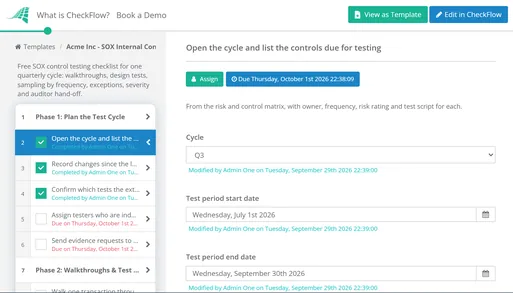
CheckFlow includes ready-to-use compliance checklist templates — built to run as live, recurring checklists with task assignments, due dates, approval steps, and completion tracking. The templates below cover the core recurring compliance workflows for financial services operations teams.
How CheckFlow Supports Compliance Operations
What CheckFlow Is Not
CheckFlow is not a RegTech platform and does not replace AML transaction monitoring systems, KYC automation tools, or regulatory reporting platforms. These are specialised systems with deep regulatory data integrations that compliance teams need for their core automated workflows. CheckFlow does not screen transactions, file SARs, or submit regulatory reports.
What CheckFlow Addresses
The operational compliance programme — the recurring human-judgment workflows that run around the automated systems. Monthly programme reviews. Quarterly control tests. Annual certifications. Pre-examination preparation. Vendor due diligence workflows. The tasks that compliance teams currently manage through email, spreadsheets, and calendar reminders — with inconsistent execution, no audit trail, and no real-time visibility into what has been done and by whom.
Specific Capabilities for Compliance Operations
- Scheduled triggers: Monthly AML reviews, quarterly SOX testing, and annual certifications automatically trigger and assign on schedule — without a calendar reminder or manual initiation
- Named ownership: Every compliance task has one named accountable person — no shared inbox, no ambiguity about who is responsible for the quarterly ICT risk review
- Evidence attachment: Compliance officers attach supporting documentation directly to each checklist step — the audit trail is the checklist completion record
- Approval workflows: Review and sign-off steps enforce the separation required between preparers and approvers for SOX, DORA, and similar frameworks
- Immutable completion records: Every step completed is timestamped with user attribution — the exact format regulators expect when asking for evidence of process execution
- Conditional escalation: If a compliance check reveals an exception, the workflow automatically branches to an escalation task — routing the finding to the right person without manual intervention
CheckFlow is particularly valuable for mid-market financial services firms that have grown beyond spreadsheet-based compliance management but don't have the budget or scale for enterprise GRC implementations. For compliance teams managing recurring operational workflows alongside (not within) their core RegTech systems, and for firms preparing for a first regulatory examination who need to demonstrate documented, consistent processes, the tool provides the operational infrastructure that ties together the programme.
FAQ
What is the cost of non-compliance in financial services?
Non-compliance in financial services is estimated to cost 2.71 times more than maintaining a compliance programme. The average annual cost of non-compliance per organisation is approximately $14.82 million, compared to an average compliance programme cost of $5.47 million. In 2024, global bank fines for financial crime, consumer protection, and operating guideline breaches totalled $4.5 billion. Transaction monitoring fines alone exceeded $3.3 billion in 2024. Since 2000, cumulative AML and sanctions fines globally have exceeded $45.7 billion. The largest single fine in 2024 — TD Bank — reached $3.09 billion, largely for systemic AML programme failures. In March 2026, FinCEN issued a record civil money penalty of $80 million against a US broker-dealer for AML violations. The pattern is consistent: the cost of getting compliance wrong vastly exceeds the cost of building the systems to do it right.
What is DORA and who does it apply to?
DORA — the Digital Operational Resilience Act (EU Regulation 2022/2554) — is a comprehensive EU regulation that became effective on January 17, 2025. It requires all EU-regulated financial entities and their ICT third-party service providers to maintain robust digital operational resilience frameworks. DORA applies to banks, payment institutions, investment firms, asset managers, insurance companies, crypto-asset service providers, and approximately 16 other categories of financial entity operating in the EU. It also applies to critical ICT third-party providers (cloud service providers, data centres, software vendors) serving EU financial institutions — regardless of where those providers are headquartered, giving DORA extraterritorial effect. DORA has five pillars: ICT risk management, ICT incident reporting, digital operational resilience testing, ICT third-party risk management, and information sharing. Penalties for financial entities are set nationally under Article 50, so they vary between member states; critical ICT third-party service providers can face periodic penalty payments of up to 1% of average daily worldwide turnover (Article 35).
What are the key regulatory reporting deadlines in financial services?
Key US regulatory reporting deadlines: Currency Transaction Reports (CTRs) must be filed with FinCEN within 15 days of a cash transaction exceeding $10,000. Suspicious Activity Reports (SARs) must be filed within 30 days of detecting suspicious activity (60 days if no suspect is identified). FINRA Rule 4530 event reports must be filed within 30 calendar days of knowledge of a specified event. The Supplemental Liquidity Schedule must be filed with FINRA within 24 business days after month-end. Form ADV annual updates (investment advisers) must be filed with the SEC within 90 days of fiscal year-end. Under MiFID II in the EU, transaction reports must be submitted near real-time — preferably within seconds — through Approved Reporting Mechanisms. EMIR trade reporting is required on a T+1 basis. DORA requires initial notification of a major ICT incident within 4 hours of classification. GDPR requires notification of a data breach to the supervisory authority within 72 hours.
How does RPA (Robotic Process Automation) help with financial compliance?
RPA automates rule-based, repetitive compliance tasks by deploying software bots that replicate human actions in digital systems — without changing the underlying systems. Key compliance applications include: SAR filing (bot compiles case data, formats the report, and submits to FinCEN); sanctions screening (automated OFAC list checks on transactions); CTR generation (triggered when a transaction exceeds threshold); regulatory report compilation (bot aggregates data from multiple systems, validates, and submits); audit data collection (bot gathers evidence from source systems for testing); and policy acknowledgment tracking (automated distribution and completion recording). Measured outcomes: approximately 90% reduction in compliance errors, 50% reduction in time on compliance tasks, and first-year ROI of 30–200% (long-term potential up to 300%). Typical payback period is 6–12 months. Critical caveat: RPA bots require ongoing maintenance as underlying systems change; compliance teams must treat RPA maintenance as a compliance obligation itself, not a one-time project.
What is perpetual KYC (pKYC) and how does it differ from traditional periodic review?
Traditional KYC operates on a scheduled review cadence: high-risk customers are re-reviewed annually, medium-risk every 2–3 years, low-risk every 5 years. This means risk changes between review cycles are not detected until the next scheduled review. Perpetual KYC (pKYC) replaces scheduled reviews with continuous automated data monitoring. External data sources — corporate registries, sanctions databases, adverse media feeds, court records, beneficial ownership registers — are connected via API and monitored in real time. When a trigger event occurs (a beneficial owner appearing on a sanctions list, a news article about a criminal investigation, an ownership structure change), an automated alert immediately routes to a compliance officer for review and action. pKYC eliminates the "blind spot" periods between scheduled reviews, reduces the operational burden of mass periodic re-reviews, and converts KYC from a static snapshot to a dynamic, ongoing risk management process. It is increasingly expected by regulators as evidence of a risk-based approach to ongoing monitoring.