Onboarding a new financial planning client is not just an administrative exercise — it is the moment where trust is established or lost. Clients are sharing the most sensitive information in their lives: their income, debts, assets, family situation, and fears about money. How you handle those first weeks — how organised you appear, how clearly you communicate what happens next, and how efficiently you collect what you need — tells the client everything about how you will manage their financial life. This free financial planner client onboarding checklist gives advisors and planning practices a structured, repeatable framework for every new client — covering pre-meeting preparation, discovery, KYC and compliance documentation, financial data collection, plan development and presentation, account implementation, and the critical first 90 days.
Why Financial Planner Client Onboarding Is Different From Other Professional Services
Most professional services onboarding involves collecting a brief, signing an agreement, and getting to work. Financial planning onboarding is categorically more complex. Before meaningful advice can be given, the adviser must collect a comprehensive picture of the client’s financial life — employment income, investment portfolios, pension arrangements, insurance coverage, mortgage and debt obligations, estate planning documents, and tax history. This can involve 30 or more individual documents and data points, collected from a client who is busy, sometimes anxious, and not always sure what they actually hold or where to find it.
Layered on top of this is a compliance obligation that does not exist in most other professional services. KYC (Know Your Customer) and AML (Anti-Money Laundering) verification must be completed before accounts can be opened or advice formally delivered. Suitability assessments, disclosure documents, and signed engagement letters are regulatory requirements, not optional steps. A structured onboarding checklist is not just an efficiency tool in financial planning — it is part of the compliance framework that protects both the client and the practice.
What the Financial Planner Client Onboarding Checklist Covers
This checklist covers seven phases that take a new client from initial contact to fully implemented financial plan — with compliance documentation embedded throughout and document collection sequenced to avoid overwhelming the client.
- 1
Phase 1
Pre-Meeting Preparation (Internal)
10 tasksA professional first impression depends on what happens before the client arrives. Every minute spent preparing before the discovery meeting saves ten minutes of follow-up afterwards.
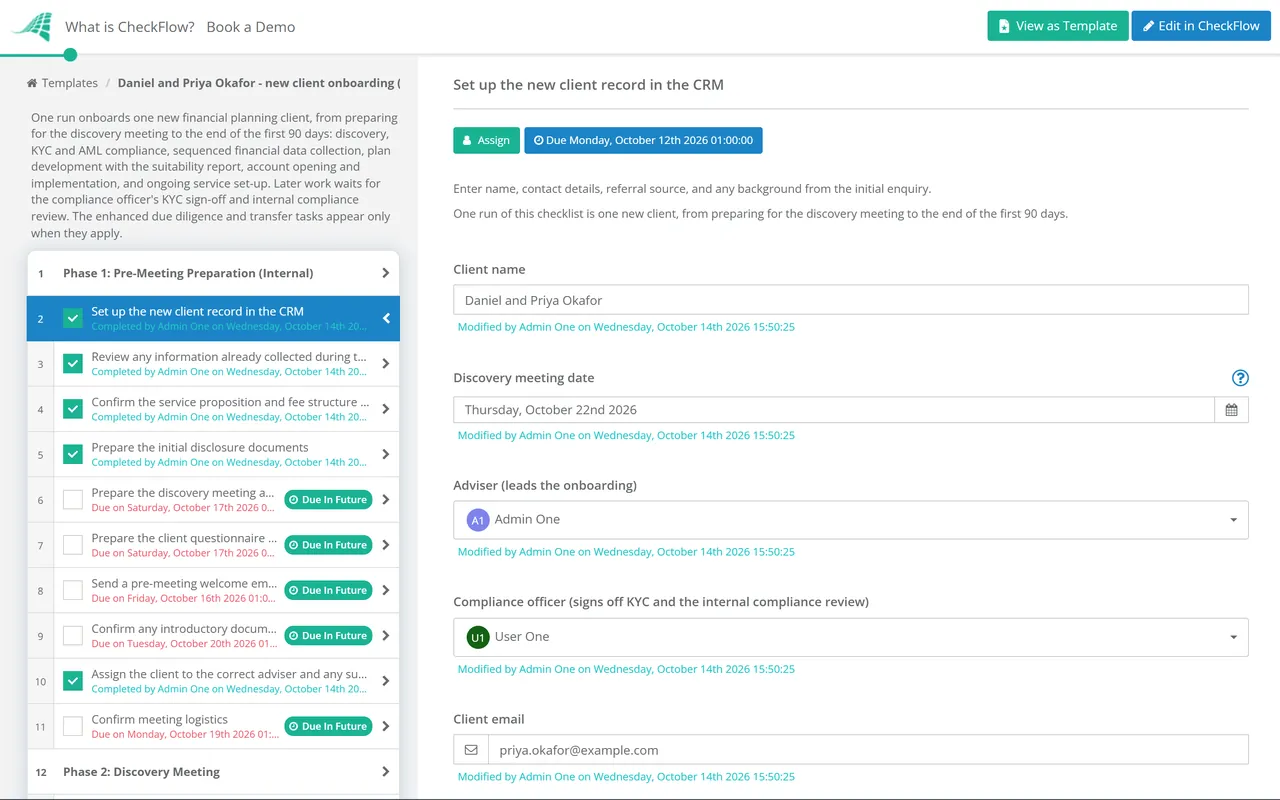
- Set up the new client record in the CRM — enter name, contact details, referral source, and any background from the initial enquiry
- Review any information already collected during the lead or referral process
- Confirm the service proposition and fee structure applicable to this client — prepare fee disclosure documents in advance
- Prepare the initial disclosure documents — terms of engagement, fee agreement, privacy notice, and regulatory disclosure (ADV Part 2 for RIAs; Initial Disclosure Document for FCA-regulated advisers)
- Prepare the discovery meeting agenda — confirm topics to cover and questions to ask
- Prepare the client questionnaire or fact find — confirm it covers goals, risk tolerance, existing financial arrangements, and relevant personal circumstances
- Send a pre-meeting welcome email — introduce the adviser, confirm the meeting details, explain what to expect, and provide a short list of documents to bring or have to hand
- Confirm any introductory documents are reviewed before the meeting — do not rely on the client to have read them at the meeting itself
- Assign the client to the correct adviser and any supporting team members — confirm roles and responsibilities internally
- Confirm meeting logistics — venue or video link, duration, and any technical requirements
- 2
Phase 2
Discovery Meeting
10 tasks
- Conduct the discovery meeting — introductions, agenda overview, and context setting
- Explain the advisory process clearly — what happens at each stage, what the client can expect to receive, and when
- Review and confirm the fee structure — ensure the client fully understands how and when they will be charged before any engagement proceeds
- Present and obtain signature on the terms of engagement and fee agreement
- Present the regulatory disclosure documents — confirm the client has received and understood them (ADV Part 2 / IDD as applicable)
- Begin the fact find — capture goals, financial objectives, time horizons, and immediate concerns
- Complete the risk tolerance assessment — ensure the assessment is appropriate to the scope of advice being given
- Identify the client’s existing financial arrangements at a high level — pensions, investments, insurance, mortgage, and estate planning documents
- Document agreed next steps — what the client needs to provide, what the adviser will do, and by when
- Send a meeting summary within 24 hours — confirm agreed actions, document requirements, and timeline
- 3
Phase 3
KYC, AML & Compliance Documentation
10 tasksKYC and AML verification must be completed before accounts can be opened or regulated advice formally delivered. These steps are not optional — they are legal requirements under anti-money laundering regulations in all major jurisdictions.
- Collect government-issued photo identification — passport, national ID, or driving licence
- Collect proof of address — utility bill, bank statement, or official document dated within the last three months
- Verify identity documents — confirm verification method (in-person, certified copy, or electronic verification service) and document the outcome
- Complete AML risk assessment for the client — confirm standard or enhanced due diligence is required based on the client’s profile
- Conduct enhanced due diligence where required — additional source of funds verification for high-risk clients or large transactions
- Screen client against sanctions lists and Politically Exposed Persons (PEP) registers — document the screening outcome
- Obtain signed client agreement and terms of engagement — confirm fully executed copies are filed
- Confirm privacy notice and data protection consent are documented — confirm the client has consented to data processing in accordance with applicable law (GDPR, CCPA, or equivalent)
- File all compliance documentation in the client record — confirm retention periods meet regulatory requirements
- Document the date of KYC completion and set a reminder for periodic KYC refresh as required by your compliance framework
- 4
Phase 4
Financial Data Collection
17 tasksDo not request all documents at once. Sending a client a list of 30+ items causes cognitive overload and delays the entire process. Sequence requests by regulatory priority and then by effort — start with what is easy to provide and what you need first.
Income & Employment
- Collect most recent payslips (last 3 months) or self-employment income evidence
- Collect most recent tax return or P60/P11D (UK) / W-2/1040 (US)
- Collect details of any other income sources — rental income, dividends, benefits, or trust distributions
Assets & Investments
- Collect most recent statements for all investment accounts — brokerage, ISA, 401(k), stocks and shares
- Collect details of all pension arrangements — statements from each scheme, including defined benefit transfer value if applicable
- Collect details of any property assets — current estimated value and any associated mortgage
Protection & Insurance
- Collect details of all life assurance policies — sum assured, premiums, and policy type
- Collect details of income protection and critical illness cover where held
- Collect details of any private health insurance arrangements
Liabilities & Obligations
- Collect most recent mortgage statement — outstanding balance, interest rate, and term
- Collect details of any other loans, credit cards, or financial commitments
- Confirm details of any financial guarantees or contingent liabilities
Estate Planning
- Confirm whether a will is in place — collect a copy or confirm location
- Confirm whether lasting power of attorney (LPA / POA) documents are in place
- Collect details of any trust arrangements
Confirmation
- Confirm all data collection is complete and cross-reference against the fact find
- Confirm all documents are securely stored in the client file
- 5
Phase 5
Financial Plan Development & Presentation
10 tasks
- Analyse the complete financial picture — assets, liabilities, income, protection gaps, and estate planning position
- Identify the client’s priorities — confirm the order of planning work based on the discovery meeting and subsequent data
- Develop the financial plan — covering asset allocation, investment strategy, tax efficiency, protection recommendations, retirement planning, and estate planning as applicable to scope
- Prepare suitability assessment documentation — confirm that all recommendations are demonstrably suitable for the client’s circumstances, goals, and risk profile
- Prepare the suitability report or letter of recommendation — document the basis for each recommendation, the options considered, and the costs and risks involved
- Internal compliance review — confirm recommendations have been reviewed against your firm’s compliance standards before client presentation
- Schedule the plan presentation meeting — allow adequate time to walk through all recommendations and answer questions
- Present the financial plan — walk through each recommendation in plain language, confirm understanding, and obtain questions and feedback
- Obtain client agreement to proceed — confirm which recommendations the client wishes to implement and document any they do not
- Issue the suitability report or letter of recommendation to the client — confirm receipt and provide a cooling-off period where required
- 6
Phase 6
Account Opening & Implementation
10 tasks
- Complete and submit all account opening applications — investment accounts, pension accounts, insurance applications, as applicable
- Confirm all applications have been submitted and note expected processing timelines
- Initiate any transfers — pension transfers, ISA transfers, or investment account transfers — and confirm transfer paperwork is complete and submitted
- Track transfer progress — follow up with providers if transfers are delayed beyond expected timescales
- Confirm account opening confirmations have been received and filed
- Verify that investment mandates and asset allocations have been implemented as recommended
- Confirm beneficiary nominations are in place for pension and life assurance accounts
- Confirm direct debits or regular contribution instructions are set up correctly where applicable
- Provide the client with an implementation summary — what has been set up, account numbers, and who to contact for each arrangement
- File the completed client file — confirm all documentation, compliance records, and correspondence are complete and retained
- 7
Phase 7
First 90 Days & Ongoing Service Establishment
10 tasks
- Send a 30-day implementation check-in — confirm all accounts are operating correctly and address any questions
- Confirm all transfers and account setups have completed as expected — follow up on any outstanding items
- Review initial investment performance at 60 days — a brief, contextual update rather than a performance verdict at this early stage
- Schedule the first annual review meeting — set the expectation that the financial plan is a living document reviewed regularly, not a one-off exercise
- Confirm the ongoing service proposition — what the client receives for their ongoing fee, how often they will hear from the practice, and how to contact the adviser
- Introduce the client to the client portal or reporting platform — confirm they have access and know how to use it
- Gather feedback on the onboarding experience — how did the process feel, what could have been clearer?
- Identify any gaps in the initial plan that the client has raised since the plan presentation
- Identify advocacy opportunities — is the client in a position to refer the practice to family or colleagues?
- Document the completed onboarding and archive the client file — confirm all regulatory documents are retained for the required period
This checklist is available as a free, runnable template in CheckFlow — with compliance steps enforced before advice delivery, document collection shared directly with the client as a sequenced checklist, and a complete audit trail for every regulatory obligation.
Use this template freeThe Biggest Bottleneck in Financial Planner Onboarding: Document Collection
Sending a client a list of 30+ items — payslips, tax returns, pension statements, mortgage documents, insurance policies, estate planning documents — in a single email is one of the most common mistakes in financial planner onboarding. The client opens the email, feels overwhelmed by the scale of the task, and closes it. Weeks pass. The adviser follows up. The client apologises and promises to get to it. The plan development is delayed by a month before it has even started.
The solution is not to ask for less — it is to sequence the requests intelligently. Start with what is easiest to provide and what is needed first for regulatory purposes: identification documents for KYC. Then income evidence. Then investment statements. Then pension documents. Breaking the collection into three or four sessions spread across two weeks — each with a small number of specific, clearly described requests — produces a faster overall collection time than one overwhelming email.
CheckFlow lets you share the document collection phase of the onboarding checklist directly with the client — broken into sequenced tasks they complete at their own pace. Each task is clearly described, assigned to the client by name, and visible to the adviser the moment it is completed. No more chasing.
See how CheckFlow’s client sharing feature works →
The Compliance Steps You Cannot Skip
Financial planning onboarding involves regulatory obligations that vary by jurisdiction but share common requirements across all major markets. These steps are legal requirements — not optional administrative tasks.
Requirement
KYC Verification
Know Your Customer verification requires advisers to confirm the identity and address of every client before delivering regulated advice or opening accounts. Standard verification requires photo ID and proof of address. Enhanced due diligence is required for higher-risk clients or large transactions.
Requirement
AML Compliance
Anti-Money Laundering regulations require advisers to assess the source of client funds, screen against sanctions lists and PEP registers, and maintain records of due diligence for a defined retention period. Non-compliance carries significant regulatory and criminal penalties.
Requirement
Suitability Assessment
Regulated financial advisers must demonstrate that every recommendation is suitable for the specific client — based on their financial situation, objectives, risk tolerance, and knowledge and experience. Suitability must be documented in a suitability report or letter of recommendation.
Requirement
Disclosure Documents
Advisers are required to provide clients with disclosure documents before advice is delivered — including terms of engagement, fee disclosure, and firm details (ADV Part 2 in the US; Initial Disclosure Document / Client Agreement in the UK and EU).
Requirement
Data Protection Compliance
Financial planners collect highly sensitive personal and financial data subject to data protection law — GDPR in the UK and EU, CCPA in California, and equivalent legislation in other jurisdictions. Consent to data processing must be documented and data retained securely for required periods.
Requirement
Record Retention
Regulatory frameworks typically require financial planning records to be retained for a minimum of five to seven years — including client files, suitability documentation, compliance records, and correspondence. A structured onboarding checklist produces a complete, timestamped record of every step taken.
CheckFlow’s audit trail automatically logs every completed onboarding task with a timestamp and the name of the person who completed it — providing the documented compliance record that regulators require without any additional manual effort.
Why Run Client Onboarding in CheckFlow?
1Enforce compliance steps before advice delivery
CheckFlow’s halt task feature prevents later phases from being started while earlier required steps are incomplete. KYC cannot be bypassed before discovery. The suitability report cannot be issued before the compliance review is signed off. The process enforces the order the regulations require — not the order that feels convenient that week.
Share document requests directly with the client
Instead of a single overwhelming email listing everything you need, CheckFlow lets you share a sequenced document collection checklist directly with the client — via a secure link, no account required. Each document request is a separate task with a clear description. Clients work through the list at their own pace; you see each item completed in real time. Document collection that used to take six weeks compresses to ten days.
A complete compliance record built automatically
Every step of the onboarding process is logged with a timestamp and the name of the person who completed it. When a compliance review or regulatory audit asks for evidence of the onboarding process — when KYC was completed, who reviewed suitability, when the client signed the engagement letter — the record is already there, without any additional documentation effort.
Running a financial planning practice requires the same structured approach across every client — not just onboarding. CheckFlow’s SOP software lets you turn every repeatable process in your practice into a structured, trackable checklist that any team member can run consistently. Learn more about SOP software →