
Credit approval
- Can this customer pay, and how much exposure do we accept?
- Limit, terms and any security
- Approved by authority level
- This checklist
Last reviewed: October 2026
No Credit Card Required
Printed from checkflow.io/templates/finance-accounting/customer-credit-approval-checklist
Sales wants the order shipped today; finance wants to know it will be paid. This free customer credit approval checklist gives credit managers, controllers and finance managers in B2B companies a consistent decision for every new account and every limit increase. It covers the credit application and signed terms, company and identity checks, trade references and a commercial credit report, a financial review and risk rating, approval by an authority that rises with the limit, security where the risk needs it, and set-up in your accounting system with review triggers. The approvers shown depend on the limit requested, and the security phase appears only when approval is conditional on it.
Trade credit is the decision to deliver now and be paid later. The credit limit caps how much a customer can owe you at once, and the terms set how long it has to pay. Getting both right is cheaper than collecting a debt that should never have been allowed to build up, and a documented decision protects the business when a customer fails and someone asks why it was given credit.
Credit approval is often confused with two neighbouring processes. Collections starts once credit has been granted. Customer due diligence answers a regulatory question about who the customer is and whether you may deal with it at all. A credit decision answers a commercial one: how much exposure you are prepared to carry, on what terms and with what protection.
Seven phases take a request from application to an account set up with a review date. Phase 5 shows only the approvers the requested limit needs, and Phase 6 appears only when approval is conditional on security.
Owned by the credit analyst. The scope answers decide which approvers and checks follow.
Each approval halts the checklist until it is answered. Higher bands add approvers on top of the lower ones.
Shown only when approval is conditional on security. Nothing ships on credit until it is in place.
Set the limit bands in your credit policy, in your own currency and scaled to your sales and margins. The template ships with three bands that you rename and resize.
| Limit band | Approvers | Evidence normally expected |
|---|---|---|
| Band 1 (smallest) | Credit manager | Application, company check, credit report |
| Band 2 | Credit manager and CFO | Plus trade references and filed accounts |
| Band 3 (largest) | Credit manager, CFO and credit committee | Plus full financial analysis, management accounts and a decision on security |
Business credit is less regulated than consumer credit, but it is not unregulated. These are the rules most likely to touch a trade credit decision.
| Topic | United States | United Kingdom |
|---|---|---|
| Fair treatment and declines | The Equal Credit Opportunity Act and Regulation B apply to business credit. For trade credit, 12 CFR 1002.9(a)(3) requires notice of the decision within a reasonable time, orally or in writing, and a written statement of reasons if the applicant asks within 60 days | No general statutory duty to give reasons when trade credit to a company is refused; follow your policy and explain the decision |
| Records | For trade credit, keep application records for 60 days after notifying the decision, or 12 months if the applicant asks in writing for reasons or retention (12 CFR 1002.12) | Sole traders, partners and guarantors are individuals, so UK GDPR applies to their data, including telling them about credit reference searches |
| Guarantees | Regulation B bars requiring a spouse to guarantee only because they are married to a guarantor or owner. A creditor may obtain a consumer report on an individual guarantor (FTC staff opinion, 2001) | A guarantee must be in writing and signed by the guarantor to be enforceable (section 4 of the Statute of Frauds 1677) |
| Late payment | Interest and late charges come from your contract terms, within state law | The Late Payment of Commercial Debts (Interest) Act 1998 allows statutory interest at 8% over the Bank of England base rate, plus fixed compensation of £40, £70 or £100 depending on the debt |
What changed in 2026. Amendments to Regulation B took effect on 21 July 2026. They removed disparate-impact liability from the regulation, narrowed the discouragement rule and restricted special purpose credit programmes. Intentional discrimination on a prohibited basis is still unlawful, and the notification rules above were not part of the change. In the UK, the Commercial Payments Bill was introduced in the House of Lords in May 2026 and was still before Parliament in October 2026. As introduced, it would cap most business-to-business payment terms at 60 days and make statutory late payment interest mandatory, so check your standard terms and any long-term customer agreements once it passes.
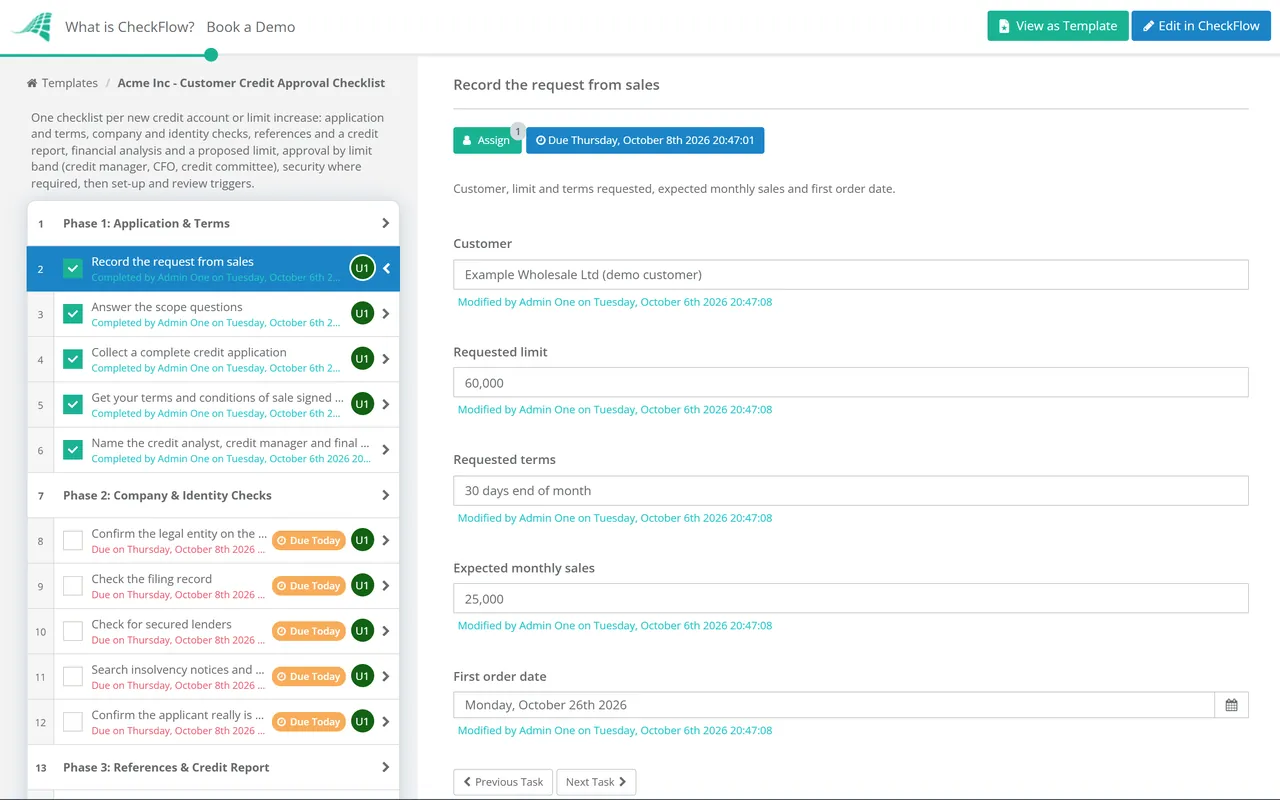
The limit band chosen in Phase 1 shows only the approval tasks that band needs. Each one halts the checklist until the named approver answers Approved or Not approved, so a large limit cannot reach set-up on a credit manager’s signature alone.
Keep customers, limit bands and risk ratings in a data set with live dropdowns. A recurring checklist starts each annual review, and the Tasks grid shows every open review and approval.
The credit report, accounts, references and guarantee sit on the tasks that asked for them, with comments explaining the judgement. The activity trail records who approved what and when, and exports for auditors or credit insurers.
Approval is where the customer relationship starts, not where the credit work ends. The Accounts Receivable & Collections Checklist works the ageing report and escalates overdue accounts, the Monthly Invoicing & Billing Run Checklist makes sure invoices go out on the agreed terms, and regulated businesses run the Customer Due Diligence Checklist alongside this one.
CheckFlow is not a credit bureau or an accounting system, and it does not score customers or calculate limits. You attach the agency’s report, apply your own policy and record the decision. CheckFlow runs the workflow around those tools: who checked what, which approver signed, and when the next review is due. The same approval pattern runs supplier-side controls such as the Vendor Bank Detail Change Verification Checklist.

Accounts Receivable & Collections Checklist

Customer Due Diligence Process

Monthly Invoicing & Billing Run Checklist

Contract Review & Approval

Simple Client Onboarding
Describe the process in a sentence and the AI checklist generator drafts the phases and tasks for you.
It is how a business decides whether to sell to a customer on credit, how much it can owe at once and on what terms. It usually runs from a credit application through company checks, references, a credit report and a review of the accounts to an approval by someone with authority for that limit.
The customer’s full legal name and registration number, registered and trading addresses, owners or directors, years trading, an accounts payable contact, two or three trade references, bank details, the limit requested and a signature accepting your terms of sale. Ask for recent accounts on larger requests.
Start from what the customer needs: expected monthly purchases multiplied by the months it will take to pay, plus the time it takes you to notice a problem and stop supplying. Then test that figure against the credit report’s suggested limit, the trade references and the accounts, and reduce it or ask for security where they do not support it.
Yes. ECOA and Regulation B cover business credit, including trade credit, so a decision cannot be based on a prohibited characteristic such as race, sex or marital status of the owners. For trade credit, a declined applicant must be told within a reasonable time and can ask in writing, within 60 days, for the reasons.
Yes. Under the Late Payment of Commercial Debts (Interest) Act 1998 you can claim statutory interest at 8% above the Bank of England base rate, plus fixed compensation of £40, £70 or £100 depending on the size of the debt, unless your contract provides a substantial alternative remedy. The Commercial Payments Bill before Parliament in 2026 would make statutory interest mandatory.
When the customer is young, thinly capitalised or files little financial information, and the owners want a higher limit than the company’s own figures support. Ask for it in your policy by risk rating or limit band rather than case by case, take it in writing signed by the guarantor, and check the guarantor can actually meet it. A parent company guarantee does the same job for a subsidiary.
14-day free trial, no card required. The Business plan is $10 per user per month after the trial. Full details at checkflow.io/pricing.
14-day free trial, no credit cardFull refund in your first 30 daysUS hosting, EU on request