Role ambiguity is one of the most expensive and most avoidable problems in team performance. When it is not clear who owns a decision, both people either make it independently or neither does. When role boundaries overlap, effort is duplicated and accountability is diffused. When gaps exist between roles, critical work falls through. These are not personality problems or performance problems — they are structural problems caused by roles that were never explicitly defined, documented, and agreed. A structured roles, responsibilities, and expectations process establishes the shared understanding that makes teams function: who is responsible for what, who makes which decisions, how roles connect, where boundaries sit, and what each team member can count on from every other. This free checklist gives team managers, HR business partners, and people operations teams a structured framework for defining, documenting, and aligning team roles — for new team setups, team restructures, new hire integration, and cross-functional role mapping.
The Three Things That Go Wrong When Roles Are Not Clearly Defined
Problem 1
Duplicated effort and ownership conflict
What it looks like: Two people both doing the same work with slightly different outputs. Both believing they own a decision. Friction in team meetings about who should lead on a problem. Work that is done twice or done differently because neither person knew the other was doing it.
Root cause: Overlapping role definitions that were never resolved. Often most visible when two roles are filled simultaneously or after a restructure when responsibilities shift without explicit reallocation.
Problem 2
Work that falls through the gaps
What it looks like: A problem that nobody addresses because everyone assumes it belongs to someone else. A critical process that is not owned. A capability gap that exists in the team but is invisible because no role is explicitly responsible for it.
Root cause: Adjacent roles whose boundaries leave a gap between them — and nobody has drawn a map of where each role ends and the next begins.
Problem 3
Accountability without authority
What it looks like: A person held responsible for an outcome they do not have the authority to influence. A decision that requires consensus from six people when one person should own it. An employee who cannot act without approval at every step because their decision-making scope was never defined.
Root cause: Responsibilities were assigned without equally clear definition of the authority needed to fulfil them — and the two must always be in balance.
What the Roles, Responsibilities & Expectations Checklist Covers
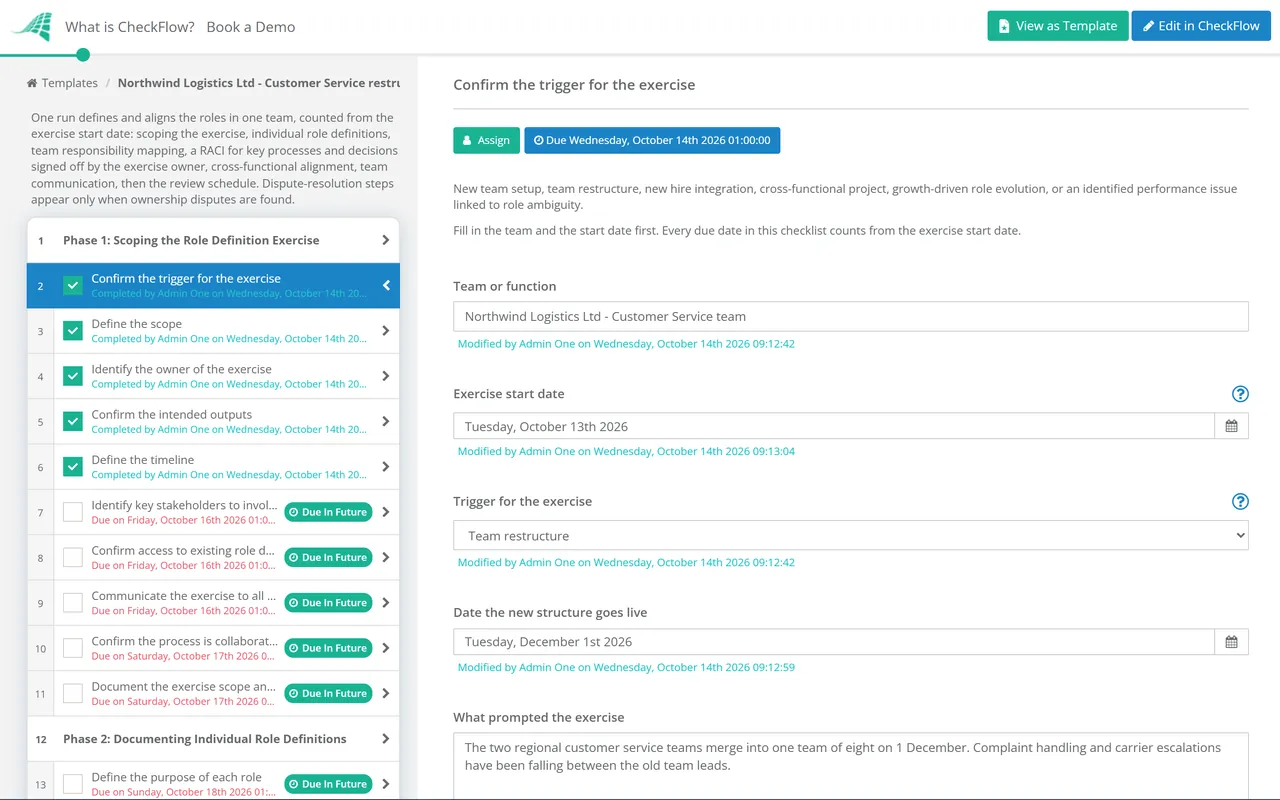
This checklist covers seven phases — from scoping the role definition exercise through to documenting individual roles, mapping team responsibilities, applying a RACI framework, communicating and aligning across the team, and maintaining role clarity over time.
- 1
Phase 1
Phase 1: Scoping the Role Definition Exercise
10 tasksBefore defining any roles, confirm why you are doing this and what outcome you need. A team restructure requires different emphasis than a new hire integration. A cross-functional project requires different output than a departmental reorganisation.
- Confirm the trigger for the exercise — new team setup, team restructure, new hire integration, cross-functional project, growth-driven role evolution, or identified performance issue linked to role ambiguity
- Define the scope — which roles, teams, or functions are included; confirm any out-of-scope boundaries
- Identify the owner of the exercise — the manager or HR business partner who leads the process and is accountable for the output
- Confirm the intended outputs — documented role definitions, a RACI matrix, an updated team structure, or a shared expectations document; confirm what success looks like
- Define the timeline — when will the exercise be complete? For new hires, this should happen in week one; for restructures, before the new structure goes live
- Identify key stakeholders to involve — team members whose roles are being defined, adjacent team managers where cross-team dependencies exist, and HR where structural decisions are involved
- Confirm access to existing role documentation — job descriptions, organisational charts, existing RACI matrices or process documentation to use as starting points
- Communicate the exercise to all participants — why it is happening, what they will be asked to contribute, and how their input will be used
- Confirm the process is collaborative — role definitions imposed without input from the people in the roles produce less accurate definitions and less commitment to honouring them
- Document the exercise scope and plan — shared with all participants before any role definition work begins
- 2
Phase 2
Phase 2: Documenting Individual Role Definitions
10 tasks
- Define the purpose of each role — a one to two sentence statement explaining why the role exists and what value it delivers; the purpose statement is more useful than a job title alone
- List the core responsibilities — the five to eight primary responsibilities of the role using active verb-led language; distinguish responsibilities from tasks (responsibilities are ongoing ownership; tasks are specific activities)
- Define the scope of each responsibility — what is included and, importantly, what is not; scope boundaries are where overlap and gaps occur
- Clarify decision-making authority — what decisions can this role make independently? What requires manager input? What requires cross-functional alignment? What is advisory only?
- Define key performance indicators — how is the role’s contribution measured? Two to four specific, measurable indicators that reflect the role’s purpose
- Identify key relationships and dependencies — who does this role work with most closely? Who does this role depend on? Who depends on this role?
- Confirm reporting lines — direct manager, any matrix reporting relationships, and any indirect leadership responsibilities (roles this person influences without managing directly)
- Note what is explicitly NOT in scope — particularly important where two adjacent roles cover similar territory; a “not responsible for” statement prevents overlap as effectively as a “responsible for” statement
- Validate the role definition with the person in the role — confirm they agree the documentation accurately reflects their responsibilities and is achievable
- Document and store the role definition — in a shared system accessible to the employee, their manager, and HR
- 3
Phase 3
Phase 3: Team Responsibility Mapping
10 tasksIndividual role definitions confirm what each person owns. Team responsibility mapping confirms the gaps and overlaps that individual definitions miss — the places where the team’s coverage either doubles up or falls short.
- List all key team responsibilities and functions — everything the team is collectively accountable for delivering; work from the team’s objectives downward
- Map each team responsibility to a role owner — who is primarily responsible for each function? Confirm there is a single primary owner for each item
- Identify where multiple roles share responsibility — confirm whether sharing is intentional (collaboration) or accidental (overlap that needs resolving)
- Identify gaps — team responsibilities that do not have a clear owner; confirm whether they need to be assigned to an existing role or create the case for a new role
- Identify single points of failure — functions where a single person holds all knowledge or ownership; assess the risk and whether cross-training or backup ownership is needed
- Assess workload distribution — are responsibilities equitably distributed across the team? Identify any roles that are overloaded or underutilised
- Map interdependencies — where one role’s output is another role’s input; confirm handoff points are clear and agreed by both sides
- Identify any external dependencies — team functions that depend on other teams or third parties; confirm those dependencies are documented and the interfaces are clear
- Review the coverage map with the full team — a team discussion about the mapping often reveals informal ownership arrangements that were not captured in formal definitions
- Document the team responsibility map — a single reference document showing the full team’s coverage and how roles connect
- 4
Phase 4
Phase 4: Applying a RACI Framework to Key Processes and Decisions
10 tasks
- Identify the key processes, decisions, and projects where role clarity is most critical — RACI is most valuable for recurring processes, significant decisions, and cross-functional activities where ownership is ambiguous
- Define each RACI category clearly — Responsible (does the work), Accountable (ultimately answerable for the outcome), Consulted (provides input before decisions), Informed (told of outcomes); confirm all team members understand the distinctions
- Confirm there is exactly one Accountable person per activity — the most common RACI error is multiple Accountable owners; accountability shared is accountability diffused
- Assign Responsible owners for each activity — the people who will actually do the work; there can be multiple Responsible parties for a single activity
- Identify Consulted parties carefully — consulting too many people creates decision-making overhead; consulting too few creates blind spots; be deliberate about who genuinely needs to provide input
- Keep the Informed column realistic — inform only those who genuinely need to know outcomes; over-informing creates notification fatigue and reduces the signal value of being informed
- Review the RACI matrix with all parties — particularly Consulted and Informed parties; they should agree with their designation or flag any misclassification
- Identify RACI conflicts — where one person is both Accountable and Responsible for too many activities, or where the Accountable and Responsible roles are so different that handoff is unclear
- Use the RACI to resolve existing disputes — if two people believe they own an activity, the RACI exercise creates a forum for resolving the ambiguity explicitly
- Document the finalised RACI matrix — stored in a shared location accessible to all team members; updated when processes or team structure changes
- 5
Phase 5
Phase 5: Cross-Functional Role Alignment
10 tasks
- Identify interfaces with adjacent teams — where does this team’s work connect to other teams’ work? Where do handoffs happen across team boundaries?
- Map the cross-functional RACI for shared processes — for any process that spans teams, confirm which team owns each element and how the handoff is managed
- Resolve any cross-team ownership disputes — functions that both teams believe they own, or that both believe the other team owns; bring both managers together to resolve explicitly
- Confirm service level agreements between teams — where one team provides a service to another, confirm the turnaround time, quality standard, and escalation path
- Clarify any matrix management relationships — team members with functional reporting to one manager and operational reporting to another; confirm how priority conflicts are resolved
- Brief adjacent team managers — share the team’s role definitions and responsibility map with managers whose teams work closely with this one; invite feedback on interface accuracy
- Establish a process for raising cross-functional role disputes — how are cross-team ownership questions raised and resolved after the initial exercise is complete?
- Confirm escalation paths for cross-functional decisions — who has authority to resolve a dispute that cannot be resolved between the two team managers?
- Document the cross-functional interfaces — a clear record of how this team connects to adjacent teams; shared with all relevant parties
- Review cross-functional interfaces annually — or whenever a significant organisational change occurs; team structures evolve and interfaces need to evolve with them
- 6
Phase 6
Phase 6: Team Communication & Expectations Alignment
10 tasks
- Present the documented role definitions to the full team — a team meeting or workshop where each person’s role is visible to everyone; mutual understanding of colleagues’ roles is as important as self-understanding
- Allow time for questions and clarification — the presentation of role definitions should invite dialogue, not conclude it
- Invite team members to flag any remaining gaps or ambiguities — the people doing the work often identify gaps in the mapping that the manager does not see
- Discuss how the team will handle situations that fall outside defined roles — confirm the default approach when something arises that is not clearly owned
- Agree on team norms — how the team will work together, communicate, make decisions, and resolve disagreements; these complement role definitions with behavioural expectations
- Confirm individual expectations conversations will follow — the team-level exercise informs the individual one-to-one expectations conversation each team member has with their manager; confirm these are scheduled
- Share the documented role definitions and RACI with all team members — confirm everyone has access to the final documentation in a shared location
- Obtain team acknowledgement — confirm each team member has reviewed and understood their role definition and the team responsibility map
- Brief new team members using the documentation — the role definitions and RACI matrix become the primary onboarding tool for new joiners; they explain how the team works faster than any other single document
- Document the team alignment session outcomes — any changes agreed, any outstanding questions, and any follow-up actions
- 7
Phase 7
Phase 7: Maintaining & Reviewing Role Definitions
10 tasksRole definitions documented once and never reviewed become inaccurate quickly. As teams grow, strategies change, and individuals develop, roles evolve — and the documentation needs to evolve with them.
- Set a review schedule — role definitions should be formally reviewed at least annually; additionally triggered by headcount changes, restructures, or significant strategic pivots
- Update role definitions when responsibilities change — confirm there is a clear process for updating documentation when a role evolves; changes agreed informally that are not documented quickly reintroduce ambiguity
- Revisit role definitions when a new team member joins — a new hire changes the team dynamic and may require rebalancing responsibilities across existing roles
- Revisit after any team performance issues with a role ambiguity component — if a recurring problem appears to have unclear ownership at its root, the role definition exercise is the right response
- Use role definitions as the reference point for performance conversations — feedback anchored to agreed role definitions is more specific, more fair, and more actionable than feedback based on unstated expectations
- Review RACI matrices when key processes change — process changes invalidate existing RACI assignments; confirm the matrix is updated when a process it governs changes significantly
- Collect feedback from team members on role clarity — at regular one-to-ones, ask whether the role definition still accurately reflects their work and whether any new ambiguities have emerged
- Monitor for role creep — roles that gradually accumulate responsibilities beyond their defined scope; this often produces both burnout and team-level gaps elsewhere
- Ensure role definitions inform recruitment — when a role becomes vacant, the documented role definition is the foundation for the job description; review and update before posting
- Archive previous versions of role definitions — a historical record of how roles have evolved is useful for restructuring decisions and organisational learning
This checklist is available as a free, runnable template in CheckFlow — with tasks assigned to team managers and HR business partners, the RACI and role definition phases tracked to completion, and a shared documentation record accessible to the full team.
Use this template freeRACI — The Most Widely Used Framework for Clarifying Roles in Teams
RACI stands for Responsible, Accountable, Consulted, and Informed. It is the most widely used framework for mapping roles and ownership in teams and across cross-functional processes.
R
Responsible
Definition: The person or people who do the work — who perform the task or activity.
Key rule: There can be more than one Responsible party for a single activity.
Common mistake: Confusing Responsible with Accountable. Responsible means doing; Accountable means owning the outcome.
Example: The analyst who runs the report is Responsible. The manager who owns the reporting function is Accountable.
A
Accountable
Definition: The single person who is ultimately answerable for the outcome — who ensures the work happens and is correct.
Key rule: There must be exactly one Accountable person per activity. Shared accountability means no accountability.
Common mistake: Assigning multiple Accountable parties to avoid conflict. Multiple Accountable owners produce exactly the conflict they were meant to prevent.
Example: The department head who signs off on the budget is Accountable. There is only one signature required.
C
Consulted
Definition: People whose input is sought before a decision is made or work is completed — two-way communication.
Key rule: Keep the Consulted list as short as possible. Consulting too many people creates overhead and slows decision-making.
Common mistake: Putting people in Consulted because it feels inclusive, when they are actually only Informed. Consulted means their input genuinely shapes the outcome.
Example: The legal team consulted before a contract is signed. The finance team consulted before budget is committed.
I
Informed
Definition: People who are told about decisions or outcomes after the fact — one-way communication.
Key rule: Inform only those who genuinely need to know. Over-informing creates notification fatigue and reduces the signal value of being included.
Common mistake: Using Informed as a default for everyone not otherwise involved. Informed should be a deliberate choice, not a catch-all.
Example: The wider team informed when a new process goes live. Senior management informed when a project milestone is reached.
A completed RACI matrix makes every ownership question answerable in seconds. CheckFlow’s structured checklist ensures the RACI exercise is completed properly — with all parties reviewed and agreed — before it is treated as the team’s operating framework.
Four Situations Where Role Clarity Is Most Urgently Needed
Situation 1
Building a new team
What happens without it: Early team members wear multiple hats informally as the team grows. Each hire assumes the others have clarity about who does what. By the time the team is six people, there are overlapping responsibilities no one has ever explicitly resolved and gaps no one has ever explicitly assigned.
What this checklist does: Establishes clear role definitions from the first hire. Maps team responsibilities as new roles are added. Creates the RACI for key team processes before ambiguity becomes established as the default.
Situation 2
Team restructure or reorganisation
What happens without it: Roles are renamed and reporting lines change, but the actual responsibilities were never explicitly reallocated. People default to what they were doing before. Critical responsibilities fall through the new structure. The restructure produces a new org chart but not new clarity.
What this checklist does: Uses the restructure as a forcing function to explicitly redefine all roles in the new structure. Maps new team-level responsibility coverage. Resolves cross-team interfaces that changed in the restructure.
Situation 3
New hire joining an existing team
What happens without it: The new hire’s role description exists in the abstract. How it fits with existing roles is never explicitly discussed. Within weeks, there is overlap with one colleague and a gap nobody noticed adjacent to another. The new hire spends their first months negotiating role boundaries informally instead of working.
What this checklist does: Maps the new hire’s role against all existing roles before they arrive. Identifies and resolves any overlaps or gaps proactively. Gives the new hire a clear picture of how the team works on day one.
Situation 4
Cross-functional project or initiative
What happens without it: Multiple teams each believe different aspects of the project are the other team’s responsibility. Key decisions are made by consensus because no single person owns them. Project timelines slip when handoffs between teams are not clearly defined.
What this checklist does: Maps cross-functional roles and ownership for the project explicitly. Applies RACI to key project decisions and deliverables. Confirms which team owns each element and where handoffs occur.
Why Use CheckFlow for Roles and Responsibilities Alignment?
1A structured process that covers every dimension
Role definition exercises that start well often produce an incomplete output — individual job descriptions without the team-level responsibility map, or a RACI for one process without the broader role clarity framework. CheckFlow’s structured checklist ensures every phase is completed: individual role definitions, team responsibility mapping, RACI assignment, cross-functional alignment, and team communication. Nothing is treated as optional because it is inconvenient.
Documentation shared with the whole team
Role definitions and RACI matrices only deliver their value when they are accessible — not locked in a manager’s document or an HR system that team members cannot reach. CheckFlow’s shared checklist makes the documentation visible to every relevant team member, updated in real time as changes are agreed, and available to new joiners as part of their onboarding from day one.
A living record that stays current
Role definitions that are documented once and never reviewed become outdated within months. CheckFlow’s recurring feature schedules annual role definition reviews automatically, and the checklist structure makes it straightforward to trigger an out-of-cycle update when a hire, restructure, or process change requires it. The documentation stays current because the process stays active.
Team-level role definitions are the foundation for individual expectations conversations. Once the team’s responsibility map is established, each team member’s individual expectations should be confirmed in a one-to-one conversation. CheckFlow’s Employee Expectations Checklist provides the individual framework that follows from this team exercise. See the Employee Expectations Checklist →
For HR teams wanting an audit-ready record of how roles and responsibilities are defined and maintained across the organisation, CheckFlow’s HR Audit Checklist covers the governance standards that underpin role clarity as part of a comprehensive HR compliance framework. See the HR Audit Checklist →