Intellectual Property Registration Checklist Template

The business that has not identified, registered, and monitored its IP does not lose it all at once — it loses it progressively, through competitors’ registrations, expired renewals, and infringement that was never challenged.

Intellectual property is often a business’s most valuable asset — its brand identity, its proprietary technology, its creative works, and its confidential business information. But IP protection is not passive. A trademark that is not registered can be registered by a competitor. A patent that is not filed before the invention is disclosed to the public may be barred from protection forever. Copyright that exists automatically provides weaker remedies than registered copyright. A trade secret that is not protected by appropriate access controls and NDAs may lose its protected status entirely. Research shows that companies with registered IP rights are valued significantly higher than those without — not because registration creates the asset, but because it creates the legal framework for enforcing and defending it. A structured IP registration process starts with a comprehensive IP inventory, identifies what needs to be registered or protected and by what mechanism, executes the registration process correctly in the right jurisdictions, and maintains the portfolio through timely renewals and active monitoring. This free checklist gives businesses, legal teams, and IP managers a structured framework for the full IP protection lifecycle.

This checklist describes an IP registration process framework. IP law is complex and jurisdiction-specific. Always engage qualified IP counsel before making filing decisions.
Use This Template Free See Live Example
No Credit Card Required

Trademarks, Patents, Copyrights, and Trade Secrets — What Each One Protects and How

Trademarks

What they protect: Brand names, logos, taglines, and distinctive marks that identify the source of goods or services.

Registration: Filed with the national trademark office (USPTO in the US, UKIPO in the UK, EUIPO for EU marks). Must search for conflicts first. USPTO fee: at least $350/class as of January 2025.

Duration: Indefinite, provided the mark is used in commerce and renewed (every 10 years in the US; every 10 years in the UK and EU).

Without registration: Common law rights only — harder to enforce; no nationwide presumption of ownership.

Patents

What they protect: Inventions, processes, and designs that are new, non-obvious, and useful.

Registration: Filed with the patent office (USPTO, EPO, UKIPO). Must be filed before public disclosure in most jurisdictions (US allows a 12-month grace period).

Duration: 20 years from filing date for utility patents; 15 years for design patents (US). Subject to maintenance fee payments.

Without registration: No patent protection — the invention is unprotected once disclosed.

Copyrights

What they protect: Original creative works — writing, software code, music, art, and other tangible expressions.

Registration: Copyright arises automatically on creation. Registration with the US Copyright Office provides enhanced remedies (statutory damages, attorneys’ fees) and is required before bringing an infringement suit in the US.

Duration: Life of the author plus 70 years (US and EU); 70 years from creation for works made for hire.

Without registration: Exists automatically but limited remedies in enforcement.

Trade Secrets

What they protect: Confidential business information — formulas, processes, customer lists, marketing strategies — that derive value from secrecy.

Registration: None — trade secrets are protected by maintaining actual secrecy through NDA agreements, access controls, and security measures.

Duration: Indefinite, provided secrecy is maintained.

Without protection measures: Once publicly disclosed, a trade secret loses protected status and cannot be recovered.

The Intellectual Property Registration Checklist

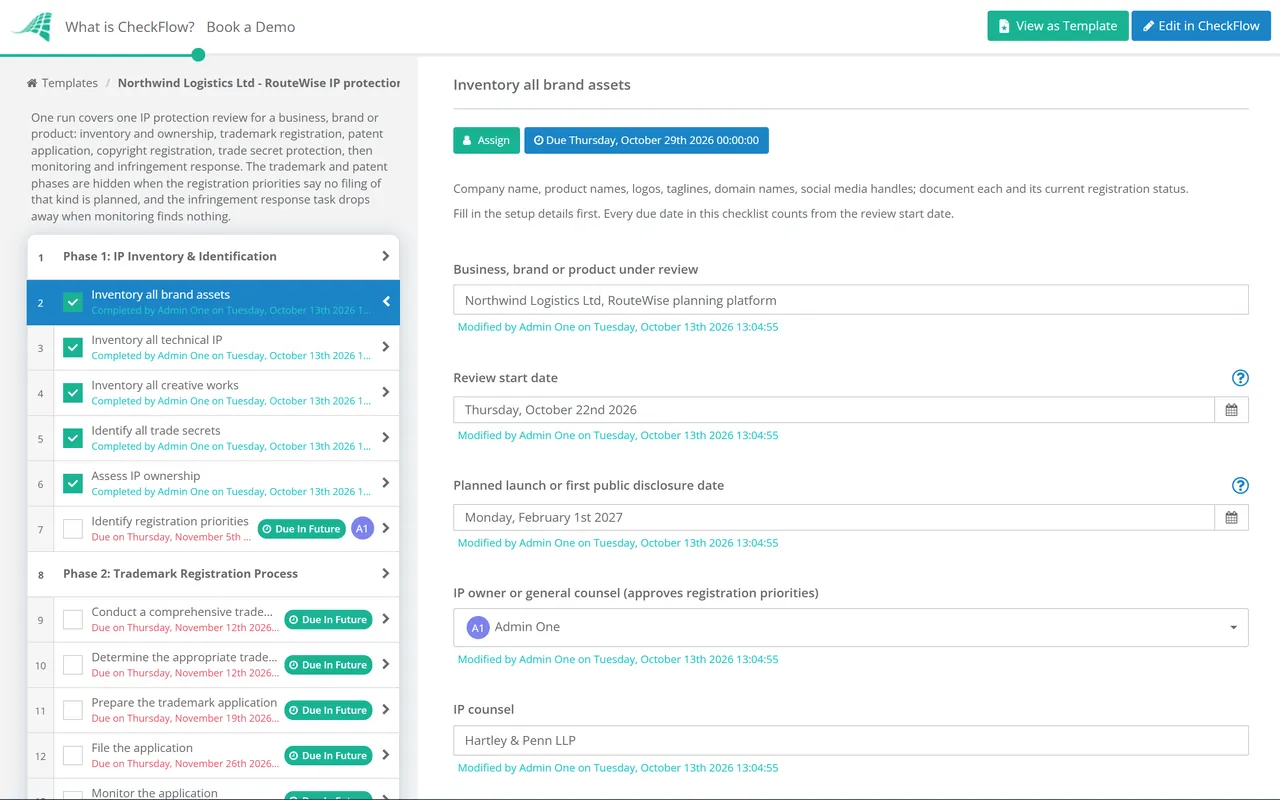
Six phases covering the full IP protection lifecycle — from inventory and identification through trademark registration, patent application, copyright protection, trade secret measures, and ongoing monitoring.

Phase 1

IP Inventory & Identification

The IP audit is the most important and most neglected step in IP protection. You cannot protect what you have not identified. Many businesses discover significant unprotected IP during due diligence for a sale or investment — at the worst possible moment.

  • Inventory all brand assets — company name, product names, logos, taglines, domain names, social media handles; document each and its current registration status
  • Inventory all technical IP — proprietary software, algorithms, processes, formulas, designs, and inventions; note which are currently patented or patent-pending
  • Inventory all creative works — marketing materials, website content, published works, software code, training materials; note copyright registration status
  • Identify all trade secrets — confidential business information with commercial value from secrecy; confirm current protection measures (NDAs, access controls, security)
  • Assess IP ownership — confirm the business owns the IP it believes it owns; check contractor agreements for IP assignment; check employee agreements for work-for-hire or IP assignment provisions
  • Identify registration priorities — which unregistered IP is most valuable to the business and most at risk without registration?
Phase 2

Trademark Registration Process

Search before you file. A trademark application that conflicts with an existing registered mark will be rejected and the filing fee is not refundable. A comprehensive search identifies conflicts before money is spent.

  • Conduct a comprehensive trademark search — using the USPTO TESS database (US), UKIPO database (UK), EUIPO database (EU), and any other relevant national registers; also common law search for unregistered marks
  • Determine the appropriate trademark classes — identify the Nice Classification classes covering the goods and services for which the mark will be used; one filing fee per class
  • Prepare the trademark application — mark description, specimen of use (if use-based filing), goods and services description; engage IP counsel for filing preparation
  • File the application — through the relevant trademark office; TEAS Plus or TEAS Standard at USPTO; retain the filing receipt and application number
  • Monitor the application — respond to any Office Actions within the required timeframe; publication opposition period; registration certificate
  • Set trademark renewal reminders — Section 8/15 declarations due 5–6 years after registration (US); 10-year renewal cycle; non-use cancellation risk if the mark is not used in commerce
Phase 3

Patent Application Process

Patent filing has strict deadlines. In the US, you have a 12-month grace period after public disclosure. In most other jurisdictions, public disclosure BEFORE filing permanently bars patent protection. File before disclosing, or file a provisional application immediately.

  • Confirm the invention is patentable — new, non-obvious, and useful; prior art search conducted; qualified patent counsel engaged
  • Determine filing strategy — US utility patent, provisional application (buys 12 months and “patent pending” status), PCT international application (up to 18 months to decide on national filings); confirm with patent counsel
  • Document the invention thoroughly — technical description, drawings, claims; the quality of this documentation directly affects patent strength and prosecution success
  • Prepare and file the application — through qualified patent counsel; specification, claims, abstract, drawings; retain the filing receipt
  • Respond to office actions — USPTO typically issues office actions during examination; timely responses required; counsel manages the prosecution
  • Set patent maintenance fee reminders — US utility patents require maintenance fees at 3.5, 7.5, and 11.5 years; failure to pay is abandonment
Phase 4

Copyright Registration & Protection

  • Identify registrable works — creative works of significant commercial value (software code, marketing campaigns, published works); prioritise for formal registration
  • Register with the US Copyright Office — via the electronic Copyright Office (eCO) system; registration within 3 months of publication enables statutory damages and attorneys’ fees in an infringement suit
  • Include copyright notices — © [Year] [Owner] on all published works; notice is not legally required in most jurisdictions but prevents infringers from claiming innocent infringement
  • Ensure IP assignment in all contractor agreements — copyright created by a contractor does NOT automatically belong to the client unless there is a written assignment or work-for-hire provision
Phase 5

Trade Secret Protection Measures

Trade secrets have no formal registration — they are protected entirely by maintaining actual secrecy. Once publicly disclosed, they cannot be recovered. The protection measures must be in place before disclosure.

  • Identify and document trade secrets — a written inventory of confidential information with commercial value; helps demonstrate the information was treated as secret
  • Implement access controls — limit access to trade secrets to those with a genuine need to know; document who has access
  • Ensure NDAs are in place — with all employees, contractors, and third parties with access to trade secrets; specific enough to cover the relevant information
  • Implement technical security measures — access controls, encryption, document classification; demonstrating reasonable measures is required to maintain trade secret status
  • Document confidentiality obligations in employment agreements — post-employment confidentiality obligations; non-disclosure provisions; document return on exit
Phase 6

IP Monitoring & Infringement Response

  • Monitor trademark usage — watch services to detect new trademark applications that conflict with existing marks; opposition period monitoring
  • Monitor for online infringement — periodic searches for unauthorised use of brand assets, logos, and registered marks online
  • Monitor patent landscape — competitor patent activity in relevant technology areas; freedom-to-operate analysis before launching new products
  • Establish the infringement response process — cease and desist letter; DMCA takedown (for online copyright infringement); opposition or cancellation proceedings; litigation as last resort
  • Respond promptly to potential infringement — delay in asserting IP rights can be used as a defence (laches) in enforcement proceedings

This checklist is available as a free, runnable template in CheckFlow — with renewal reminders set at registration, monitoring tasks assigned to a named owner, and a complete IP portfolio record maintained as the process runs.

Use This Template Free

Five IP Registration Mistakes That Are Almost Always Preventable

1

Disclosing before filing

Publicly presenting, publishing, or selling an invention before filing a patent application. In most non-US jurisdictions this permanently bars patent protection. File before you disclose, or file a provisional application immediately.

2

Failing to register across all relevant classes

Filing for the primary product class but not for services or adjacent classes. Competitors register the same mark in unprotected classes. Register for all classes where you have or intend to have commercial activity.

3

Missing renewal deadlines

Trademark and patent protection lapse if renewal fees are not paid on time. There are typically grace periods but they involve additional fees. Build renewal deadlines into the calendar immediately on registration.

4

Assuming contractor work is owned by the company

Copyright created by a freelancer or agency does not automatically belong to the client. Every contractor agreement must include a clear IP assignment or work-for-hire provision. Retroactive assignments are difficult and sometimes impossible.

5

Failing to include IP assignment in employment agreements

Employees create IP in the course of employment, and in most jurisdictions this belongs to the employer. But jurisdiction-specific requirements vary, and employment agreements should include explicit IP assignment provisions — confirmed by qualified employment law counsel.

Why Run IP Registration and Maintenance in CheckFlow?

1

A structured process from IP inventory to registration

IP protection failures are almost always failures of process rather than strategy. The brand was not searched before launch. The patent was not filed before the product was demonstrated. The contractor agreement did not include assignment. CheckFlow’s IP registration checklist builds the sequence — inventory, search, decide, file, track, renew — into a structured process that runs consistently for every IP asset.

Template Designer
2

Renewal deadline tracking that never lapses

Trademark and patent rights that lapse for missed renewal fees are not recoverable without significant cost, and in some cases not at all. CheckFlow sets renewal reminders at every required maintenance interval immediately on registration — Section 8/15 declarations, 10-year trademark renewals, and patent maintenance fees are tracked as recurring tasks assigned to a named owner.

Recurring Checklists
3

A documented IP portfolio for investment and due diligence

IP is reviewed in every major investment or M&A due diligence process. CheckFlow maintains a structured record of every IP asset: what it is, its registration status, filing dates, renewal history, and ownership chain. The IP portfolio documentation that due diligence requires is maintained as a byproduct of running the registration and maintenance process.

Audit Trail

IP ownership in contracts — particularly contractor agreements — is one of the most important contract review elements. CheckFlow’s Contract Review & Approval Checklist includes IP ownership as a required review step for every contract. See the Contract Review & Approval Checklist →

Trade secret protection relies on NDA coverage of all parties with access. CheckFlow’s NDA Processing Workflow covers the structured process for issuing and tracking NDAs. See the NDA Processing Workflow →

Frequently Asked Questions

What does an IP registration process cover?

+

An IP registration process covers six phases: IP inventory and identification (conducting an audit of all brand assets, technical IP, creative works, and trade secrets — identifying what needs protection and confirming ownership), trademark registration (search, classification, application filing, and maintenance), patent application (patentability confirmation, filing strategy, application preparation and prosecution, maintenance fees), copyright protection (registration of high-value works and ensuring IP assignment provisions in contractor agreements), trade secret protection (access controls, NDA coverage, and technical security measures), and IP monitoring and enforcement (watch services, infringement detection, and response process).

Do I need to register copyright to be protected?

+

In the US and most jurisdictions, copyright arises automatically the moment an original creative work is fixed in a tangible form — no registration is required for the copyright to exist. However, in the US, copyright registration with the US Copyright Office provides important additional benefits: it creates a public record of ownership, is required before an infringement lawsuit can be brought in federal court, and — if registered within three months of publication or before the infringement occurs — entitles the copyright owner to statutory damages (up to $150,000 per work for wilful infringement) and attorneys’ fees. These remedies can make the difference between viable and unviable enforcement of copyright claims.

What is the difference between a provisional patent application and a full utility patent?

+

A provisional patent application is a lower-cost, abbreviated filing that establishes a priority date (the date from which novelty is assessed) and gives the applicant “patent pending” status for 12 months — during which the full utility patent application must be filed. A provisional application is never examined by the patent office and does not by itself result in a patent. Its primary uses are: establishing an early filing date before public disclosure, buying time to assess commercial viability before committing to the full application cost, and filing quickly when time is short. The full utility patent application is the substantive filing that is examined and, if approved, grants patent rights for 20 years from the filing date.

How does trademark registration affect enforcement rights?

+

A registered trademark provides significantly stronger enforcement rights than an unregistered common law trademark. In the US, federal registration on the Principal Register creates: nationwide constructive notice of ownership (meaning competitors cannot claim they did not know of your mark), a legal presumption of validity and exclusive ownership, the right to use the ® symbol, the ability to record the registration with US Customs to prevent importation of infringing goods, and — after five years of continuous use and registration — “incontestability” status that limits the grounds on which the registration can be challenged. Unregistered common law rights are limited to the geographic area of actual use.

Is CheckFlow free for this template?

+

You can start a free 14-day trial with no credit card required, giving you full access to all features including this template. The Business plan is $10 per user per month after the trial. Full details at checkflow.io/pricing.

Identify, Register, and Protect Every IP Asset Your Business Has Created

Free trial — no credit card required.