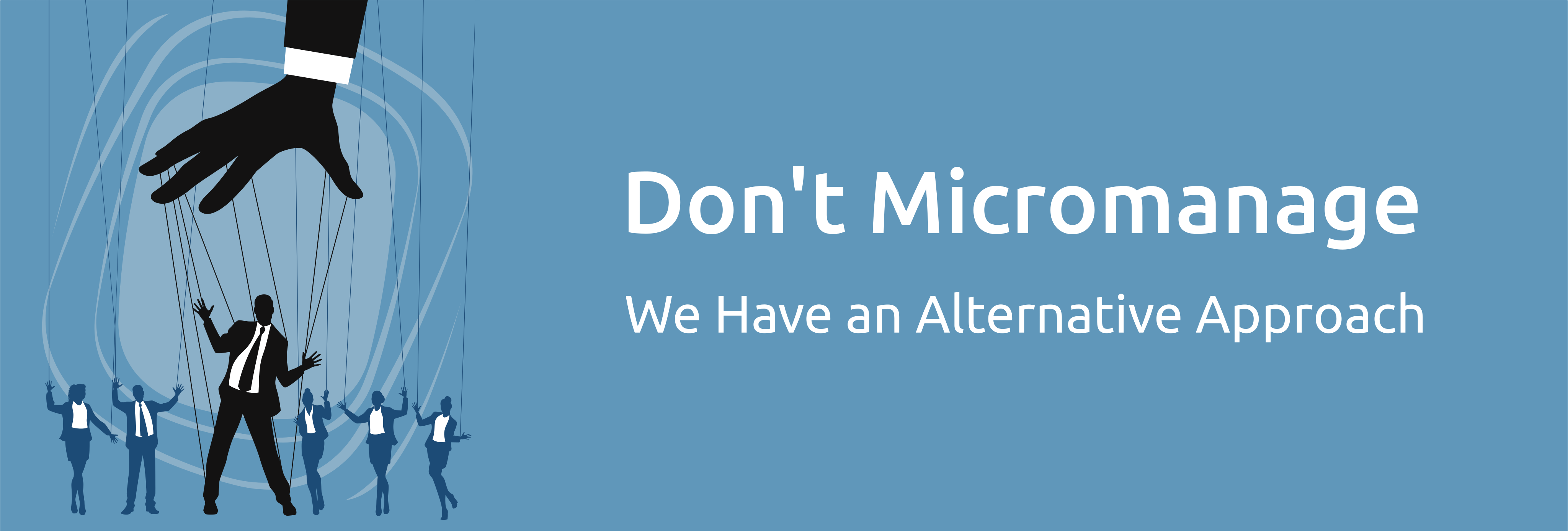
The alternative to micromanagement is not less management. It is a different object of attention: instead of checking on people, you check on the process. Micromanagement is what happens when a manager cannot see whether work is being done properly and compensates by asking, hovering, re-doing and approving everything. Replace the blind spot with visibility — documented processes, named ownership, defined checkpoints and a live view of progress — and the urge to hover has nothing left to feed on.
That framing matters because most guides treat micromanagement as a character flaw to be corrected with self-awareness. Self-awareness helps, but it does not survive the first missed deadline. A manager who has been burned by a botched client onboarding will start checking in daily again, however many articles on trust they have read, unless something else now tells them the onboarding is on track. The fix has to be structural.
This guide is for team leads, operations managers, IT and HR heads at companies of 10 to 500 people — the size at which a founder or first-line manager who used to see everything suddenly cannot. It covers what micromanagement is and why it happens, a self-test, what it costs, when close supervision is actually right, the systems that replace it, a seven-step plan to stop, a delegation framework you can use tomorrow, and what to do if you are the one being micromanaged. By the end you should be able to get consistent results from your team without being in every conversation.
What Micromanagement Is and Why It Happens
Micromanagement is a management style in which the manager closely observes, controls and corrects the work of their reports at a level of detail the work does not require. It shows up as unnecessary approvals, constant status requests, instructions on how rather than what, re-doing finished work, and a reluctance to let anyone make a decision the manager could have made. The defining feature is not attention to detail — good managers care about detail — but attention applied where it is not needed and withheld where it is.
The conventional explanation is personality: some people are controlling, insecure or perfectionist, and they micromanage because of who they are. That explanation is popular because it lets everyone else off the hook, and it is mostly wrong. Micromanagement is far more often a response to a situation than an expression of a trait, and the situation is nearly always the same one: the manager cannot see the work.
Consider how it starts. A founder runs a team of five and knows the state of every job because they are in the room. The team grows to fifteen. The founder no longer sees the work directly, so they ask. Asking works, so they ask more. One job goes wrong that nobody mentioned, so they add an approval step. Now everything goes through them, they are the bottleneck, and everyone calls them a micromanager. Nothing about their personality changed. What changed is that the informal visibility they used to get for free disappeared and nothing was built to replace it.
Definition
Micromanagement is control applied at the wrong altitude: supervising how work is done when the manager should be defining what a good outcome is, who owns it, and when to check. It is usually a symptom of missing visibility, not a fixed trait.
The four usual triggers
Once you look for the situational causes, the same four appear repeatedly. Lack of visibility: the manager genuinely does not know whether the work is on track and has no way to find out except asking. A recent failure: something went wrong, it was expensive or embarrassing, and the manager has resolved never to be surprised again. Undefined standards: nobody has written down what "done properly" means, so the only way to check quality is for the manager to inspect every output against the standard in their head. Promotion from doing to managing: the manager was the best practitioner on the team, still believes they can do each job better, and has never been taught that their job is now a different one.
All four have the same remedy. None of them is solved by telling the manager to trust more. They are solved by giving the manager a way to know, without asking, that the work is being done to a standard that has been written down. That is what the rest of this guide builds.
Signs You Are Micromanaging: A Self-Test
Almost nobody believes they micromanage. The people who do it describe themselves as hands-on, detail-oriented or high-standards. The test below is written from the manager's side, because the behaviours are easier to recognise in your own calendar and inbox than in your self-image. Tick each one that applied in the last month.
- You asked for a status update on something that had no agreed checkpoint or deadline, because you wanted to know rather than needed to.
- You are copied on emails or messages that do not need a decision from you, and you read them.
- Work cannot leave the team without your approval, including work you could not improve.
- You have re-done or heavily rewritten a report's finished work rather than sending it back with what was wrong.
- You give instructions on how to do a task to people who have done it successfully before.
- Your reports check with you before making decisions you would consider obvious.
- You are the bottleneck: work waits for you more often than you wait for work.
- You feel anxious when you do not know exactly what each person is doing right now.
- You have said "it's quicker if I just do it myself" in the last fortnight.
- Your team has stopped bringing you ideas, and brings you only questions.
Three or more is a pattern. Seven or more means your team almost certainly describes you as a micromanager to each other, and the last two items are the ones to take most seriously — they describe a team that has adapted to you by switching off its own judgement.
If you ticked the visibility item (anxious when you do not know what is happening) and the bottleneck item, note that they point at the cause, not the symptom. You are asking and approving because you cannot see. The behaviours will stop when the seeing is solved.
The Real Cost of Micromanagement
The damage from micromanagement is well understood by anyone who has worked under it, but it is worth setting out precisely, because each cost points at a specific part of the alternative.
Turnover of the people you least want to lose
The people who leave a micromanaged team first are the ones with the most options: the experienced, the competent, the ones who could have run the team. They leave because being supervised at a level of detail their skill does not require is a daily insult, and because they can see their own judgement atrophying. What remains is a team selected for its tolerance of being told how to do things, which makes the manager's belief that nobody else can be trusted come true.
Slow decisions
When every decision routes through one person, the organisation's decision throughput is that person's calendar. A quote waits two days for approval. A supplier question waits until the manager is back from leave. A customer complaint is escalated instead of resolved. None of these delays shows up as a cost in any report, but customers notice, and so do the competitors who answer the same question in an hour.
The manager as bottleneck
A manager who reviews everything has no time for the work only a manager can do: planning, hiring, improving the process, dealing with the problems that are genuinely difficult. They are permanently busy and permanently behind, and the busyness feels like diligence. The organisation is paying a senior salary for someone to re-read junior work.
Learned helplessness
Psychologists use the term learned helplessness for what happens when an animal or person discovers that their actions do not affect outcomes: they stop acting. A team whose decisions are routinely overridden learns exactly this. They stop deciding, stop suggesting, and wait to be told. The manager then observes, accurately, that the team shows no initiative — and concludes that closer supervision is needed. This loop is the most expensive cost of all, because it is self-reinforcing and because a team in this state cannot scale beyond its manager's attention.
No record of anything
Less obvious but equally real: micromanagement produces no evidence. The checking happens in conversations, in stand-ups, in "quick questions" over the desk. When a client asks what was done and when, or an auditor asks who signed off, there is nothing to show except the manager's memory. The manager knew everything and recorded nothing. A system that creates visibility also creates the record, which is the second reason to build one.
When Close Supervision Is Legitimate
It would be dishonest to claim that close supervision is always wrong. There are three situations in which a manager should be looking closely at how work is done, and part of stopping micromanagement is being able to say clearly when it is not micromanagement.
New starters and new tasks
Someone in their first month has not yet shown what they can do, and someone experienced doing a task for the first time is, for that task, a beginner. Close attention here is training, not distrust — provided it is explicitly temporary and the criteria for loosening it are known. Situational leadership models make the same point: the right amount of direction depends on the person's competence at this specific task, and should reduce as competence is demonstrated. A structured 90-day onboarding plan with checkpoints at 30, 60 and 90 days is the honest version: the new starter knows when supervision steps down and what they need to show for it to happen.
Safety-critical work
Where a mistake can injure someone — machinery, working at height, hazardous materials, clinical procedures — direct observation and sign-off of specific steps is not micromanagement but the standard of care. The distinction is that the observation is of the process, defined in advance, applied to everyone, and recorded. A supervisor who checks every lockout before maintenance begins is running a control; a supervisor who checks only the people they do not trust is micromanaging.
Regulated and audited work
Financial controls, data protection, clinical governance and quality standards all require certain steps to be reviewed and approved by a second person. That review is mandatory and is not what anyone means by micromanagement, as long as it is limited to the steps the regulation actually names. The failure mode is the manager who uses "compliance" to justify approving everything.
The test
Legitimate supervision is defined in advance, applied to the process rather than to particular people, has a stated end point or trigger, and produces a record. Micromanagement is improvised, personal, open-ended and leaves nothing behind but an anxious team.
The Alternative: Systems That Create Visibility
If micromanagement is a response to not being able to see the work, the alternative is to make the work visible without the manager having to ask. Five elements do this, and they work as a set. Each one on its own leaves a gap that the manager will eventually fill by hovering again.
1. Documented processes
A manager who has never written down how a job should be done has no choice but to inspect every instance of it against the version in their head. Once the process is documented — as a procedure, a workflow or a checklist — the standard exists outside the manager. Anyone can be measured against it, including the manager, and the question "was this done properly?" becomes "was this done as documented?", which a system can answer. The guide to process standardisation covers which processes to document first; in a team that is being micromanaged, it is whichever ones the manager keeps checking.
2. Clear ownership
Every piece of work needs one named owner. Not a team, not "whoever is free", one person. Micromanagers often micromanage because ownership is diffuse and they are the only person who feels responsible for the outcome; the moment a named individual owns the result, the manager's responsibility shifts from doing to ensuring, which is a job that can be done from a dashboard rather than a desk.
3. Defined checkpoints
The difference between a checkpoint and a check-in is that a checkpoint was agreed in advance. "Show me the draft on Wednesday and the final on Friday" is a checkpoint: the report knows when scrutiny is coming and can work freely in between. "How's it going?" on Tuesday afternoon is a check-in, and its unpredictability is what makes it corrosive. Checkpoints should be placed where the cost of a wrong turn becomes high — before a client sees anything, before money is committed, before a change goes live — and nowhere else.
4. Live dashboards
A manager who can see, at any moment and without asking anyone, which processes are running, who owns each step, what is complete and what is overdue has no reason to ask for status. This is the element that most directly replaces the hovering. A real-time view of every active checklist and task turns "how's the onboarding going?" into a glance, and it does so without the report having to stop and write a status report, which is the hidden cost of the question.
5. Outcome metrics
Finally, the manager needs something to look at instead of the work itself. Outcome metrics — on-time completion, error rate, customer response time, first-pass quality — let a manager know that the team is performing without knowing what each person is doing at 2pm. When the metrics are fine, there is nothing to inspect. When a metric moves, the manager knows where to look, and looks at the process, not the person.
Give Your Team a Process Instead of a Supervisor
CheckFlow's template library has ready-made onboarding, expectations and operational checklists that make ownership and progress visible from day one.
Browse Free TemplatesFrom Checking on People to Checking the Process
W. Edwards Deming's line that a bad system will beat a good person every time is usually quoted in the context of quality, but it is the whole argument against micromanagement in one sentence. If outcomes vary, the cause is far more likely to be in the process — unclear steps, missing handovers, no definition of done — than in the individual, and inspecting the individual will not find it. The shift a recovering micromanager has to make is to redirect the same attention to detail from people to the system they work in.
In practice the shift changes what the manager looks at, what they ask, and what they do when something goes wrong. The table below sets the two approaches side by side.
| Situation | Checking on people (micromanagement) | Checking the process (the alternative) |
|---|---|---|
| Wanting to know progress | Ask each person, several times a week | Look at the dashboard; ask only when something is overdue |
| Assigning work | Explain how to do it, step by step, every time | Point at the documented process; define the outcome and the checkpoint |
| Quality control | Review every output personally before it leaves | Required fields and sign-offs at the two or three steps that matter; sample the rest |
| Something goes wrong | Find who did it; supervise them more closely | Find which step failed; fix the step so it cannot fail the same way again |
| A decision is needed | All decisions come to the manager | Decision rights are pre-agreed by level; the manager sees the decision in the record |
| Evidence of work done | The manager's memory of conversations | A completion record per run: who, what, when |
| Manager's time | Spent inspecting and approving | Spent improving the process and handling exceptions |
Notice that the right-hand column is not hands-off. The manager in that column still cares intensely about quality and still knows what is happening. They have simply moved the checking into the system, where it happens every time, for everyone, without anyone needing to be asked. That is the practical meaning of trust in a team: not the absence of verification, but verification that does not depend on the manager's presence.
What "consistency" actually requires
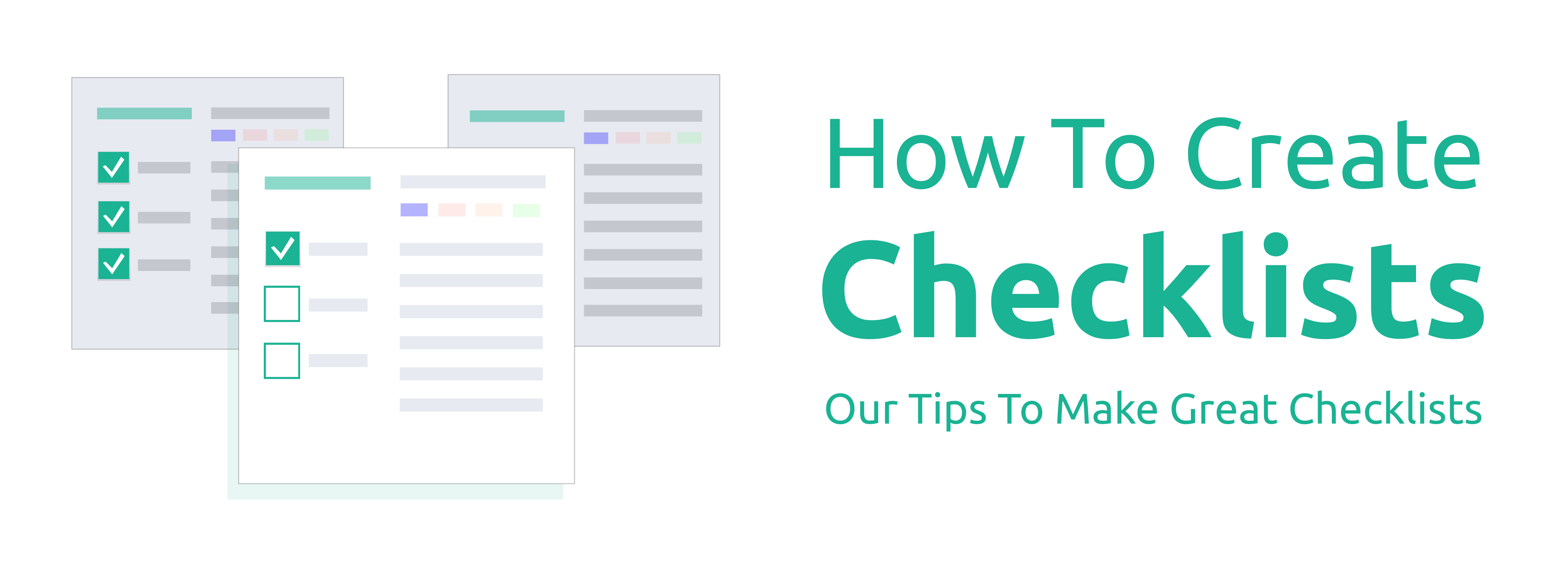
Managers who micromanage usually say they do it for consistency, and consistency is a legitimate goal. But consistency comes from the process being the same each time, not from the same person watching each time. A well-designed checklist, run by different people, produces more consistent results than one manager's supervision, because the checklist does not get tired, distracted or called into a meeting. The guide to creating checklists that actually get used explains how to write one that people follow rather than tick.
How to Stop Micromanaging: A Seven-Step Plan
Stopping is not a matter of deciding to. It is a matter of replacing each hovering behaviour with a system that makes it unnecessary, one process at a time. The following seven steps are ordered so that visibility arrives before control is released — which is the only sequence a nervous manager will actually follow through on.
List what you keep checking
For one week, note every time you ask for a status update, review someone's work before it goes out, or take a task back. Group the notes by process rather than by person: client onboarding, weekly reporting, invoice approval, support escalations. The list is usually short — three to six processes account for most of the checking — and it tells you exactly where visibility is missing. Those processes are the ones to fix first, and nothing else needs to change yet.
Document the standard for each one
Write down, or have the person who does it write down, what a properly completed run of each process looks like: the steps, the order, what must be true at the end, and the two or three points where a mistake would be expensive. This is the standard that has so far lived only in your head. Keep it short; a procedure that is too long to follow is as useless as none. If you are new to this, the guide to how to write an SOP gives a format that takes an hour per process.
Assign a named owner
Give each process one owner who is accountable for its outcome, not just its steps. Tell them explicitly that it is theirs, that you will not be reviewing every run, and what you will be looking at instead (the checkpoints and metrics from the next two steps). Ownership that is not announced does not count; the report needs to hear that the decision is now theirs, or they will keep bringing it to you out of habit.
Agree checkpoints and definition of done
With the owner, decide where you genuinely need to see the work before it proceeds — typically once or twice per process, at the points of highest cost — and what "done" means so that neither of you has to guess. Write both into the process. Everything not at a checkpoint is the owner's to run without you. Resist the urge to add "just one more" checkpoint; each one you add is a statement that you do not trust the step before it.
Put the process somewhere you can see it run
A documented process in a shared drive gives you a standard but no visibility, so you will go back to asking. Run it instead as a live checklist with each step assigned and timestamped, so that a dashboard shows you where every run is. Now you can satisfy the need to know without a conversation. This is the step that makes the others stick, because it removes the reason for the behaviour rather than asking you to suppress it.
Replace check-ins with a fixed review
Cancel the ad-hoc questions and replace them with one scheduled review per process or per person — weekly for most teams — at which you look together at the dashboard, the overdue items and the metrics. Between reviews, contact the owner only when something is overdue or a checkpoint is due. Your team will notice the silence within a fortnight, and the quality of what they bring to the review will improve once they know it is the only time they need to account for themselves.
When something goes wrong, fix the step
The first failure after you step back is the moment the whole effort is won or lost. If you respond by reinstating daily check-ins, the team learns that autonomy was conditional on perfection. Instead, treat the failure as data about the process: which step was missed, why the checkpoint did not catch it, what field or sign-off would have. Change the process, tell the team what changed and why, and leave the ownership where it was. A team that sees failures turned into better steps rather than tighter supervision will start reporting problems early, which is the outcome micromanagement was trying and failing to get.
A Delegation Framework: Task, Authority, Checkpoint, Done
Much micromanagement is failed delegation: the manager hands over the doing but not the deciding, so every decision comes back. A usable delegation has four parts, and most managers only ever specify the first.
Task
What is being delegated, described as an outcome rather than a method. "Get the new starter productive by the end of week two" delegates a result; "send the laptop request, then book the induction, then…" delegates a script, and a script is not delegation. If the process has a documented checklist, point at it as the default method and make clear the owner can deviate if the outcome is better served.
Level of authority
This is the part that is almost never made explicit and causes almost all of the friction. Agree, for this task, which of these five levels applies:
| Level | What the owner does | Use when |
|---|---|---|
| 1. Investigate and report | Gathers the facts; the manager decides | Genuinely new territory, or the owner's first time on this task |
| 2. Recommend | Proposes a decision with reasoning; the manager approves | The owner is competent but the cost of error is high |
| 3. Decide and inform before acting | Decides, tells the manager, proceeds unless stopped | Routine decisions where the manager wants a veto but not a queue |
| 4. Act and report after | Decides and acts; the manager sees it in the record | Most day-to-day operational work by experienced staff |
| 5. Act | Decides and acts; no reporting beyond the normal record | Fully owned processes with metrics the manager reviews periodically |
Most work in a healthy team sits at levels 3 to 5. A micromanaged team sits at levels 1 and 2 for everything, regardless of the owner's experience. Saying the level out loud — "this is a level 4: do it, and I'll see it on the board" — removes the guesswork that sends people back to the manager's desk to check, and it gives you a clean way to raise the level as someone demonstrates competence.
Checkpoint
When, if at all, the manager will see the work before it is finished. State it as a moment in the process, not a frequency: "before the proposal goes to the client", not "keep me posted". For level 4 and 5 work the checkpoint may be nothing more than the completion record.
Definition of done
What must be true for the task to be complete, in terms both of you can verify: the client has confirmed receipt, the account is live and tested, the report is in the shared folder with the three sections filled. Without this, the owner will either stop early or keep polishing, and the manager will either accept incomplete work or send it back — all four outcomes look like a reason to supervise more closely, and none of them is.
Worked example
An operations manager delegates monthly client reporting to a coordinator. Task: every client receives their report by the fifth working day. Authority: level 4 — produce and send without approval, except for the two enterprise accounts, which are level 2 until March. Checkpoint: the enterprise drafts on working day three. Done: all reports sent, logged in the reporting checklist, any client questions answered within a day. The manager's involvement drops from reviewing twelve reports to reading two drafts and checking one dashboard.
For the Micromanaged: Managing Upward
If you are on the receiving end, the same diagnosis applies in reverse. Your manager is checking because they cannot see, and the most effective thing you can do is give them the visibility before they ask for it. This feels like rewarding the behaviour; it is actually removing its cause.
Pre-empt the question. If your manager asks for status on Tuesdays, send a three-line update on Monday afternoon: what is done, what is next, what you need. Once the update arrives reliably before the question, the question stops. If your team runs its processes as tracked checklists, the update can be a link to the dashboard.
Ask for the level. Use the authority framework above explicitly: "For the supplier renewals, would you like me to recommend and you approve, or decide and let you know?" Managers who have never been asked this often discover they are comfortable with more autonomy than their behaviour suggests, and the conversation gives them a way to say so without feeling they have lost control.
Propose the checkpoint. "I'll bring you the draft on Thursday" is a boundary dressed as helpfulness. It tells the manager when scrutiny is welcome, which quietly implies when it is not.
Document the process yourself. A report who writes the checklist for their own recurring work, and offers it to the manager to review, has moved the standard out of the manager's head and into a document both can see. Many managers relax markedly once the way the work is done is something they approved rather than something they are guessing at.
Name it, carefully. If none of that works, a direct conversation is reasonable: "I notice you're checking in on this most days — is there something about how it's going that worries you?" Framed as a question about the work rather than about them, it often surfaces a specific past failure that is driving the behaviour, and a specific worry can be addressed with a specific control.
Remote and Hybrid Teams
Remote work removes the last of the informal visibility a manager gets from being in the room, and the response is predictable: managers who never micromanaged in the office start asking for daily updates, requiring cameras on, and reading the online-status indicator as a measure of effort. The tools that promise to solve this — activity monitors, keystroke trackers, screenshot software — are micromanagement automated, and they damage trust faster than a hovering manager ever could.
The alternative is the same set of systems, applied more deliberately. In a distributed team, the documented process, the named owner and the live dashboard are not improvements; they are the only way the manager can know anything at all. A remote team running its recurring work as assigned, timestamped checklists gives its manager more visibility than a co-located team run on conversations, and does it without anyone being watched.
Three adjustments matter specifically for remote and hybrid teams. First, move the checkpoints from meetings into the record: a sign-off step in a checklist is visible in every time zone, whereas a Tuesday review is not. Second, make outcome metrics the shared language for performance, so that hours online never become a proxy for contribution. Third, onboard new remote starters against an explicit plan — the remote employee onboarding checklist is a starting point — because the temptation to hover is strongest with someone you have never met in person and the structure is what lets you not.
A useful distinction
Monitoring watches the person: hours online, keystrokes, camera. Visibility watches the work: which steps are done, which are overdue, what the outcome was. The first tells a remote team you do not trust them. The second tells them you have built something that makes trust unnecessary as a matter of faith and available as a matter of fact.
Common Mistakes When Trying to Stop
Managers who set out to stop micromanaging fail in a small number of recognisable ways. Each looks like progress at the time.
Mistake: swinging to abdication. The manager, having been told they hover, withdraws entirely: no checkpoints, no metrics, no review. The team is now unsupported rather than over-supervised, the first failure is worse than anything that happened before, and the manager concludes that stepping back does not work. The alternative to micromanagement is a system, not absence. Build the visibility first and release control second.
Mistake: delegating tasks but not decisions. The report does the work and the manager still makes every call, so the queue at the manager's desk is as long as ever. Use the authority levels explicitly and push routine work to level 3 or above. If you are not comfortable letting someone decide, ask what evidence would make you comfortable and go and get it, rather than defaulting to approval forever.
Mistake: reinstating supervision after the first failure. Something goes wrong in week three and the daily check-ins return. The team learns that autonomy was a trial they have failed. Treat the first failure as a process defect: find the step, fix the step, keep the ownership where it was, and say so out loud.
Mistake: replacing check-ins with reports. The manager stops asking in person and instead requires a written status report from everyone every day. This is micromanagement with extra typing. Status should be a by-product of the work being tracked in the system, not a document the report writes about the work. If people are spending time telling you what they did, the tooling is wrong.
Mistake: documenting everything before releasing anything. The manager decides they will stop hovering once every process is written up, which takes months, during which nothing changes. Start with the three processes from step one of the plan. A team that gains autonomy over three processes this month has more trust than one promised full autonomy next year.
Mistake: mistaking a task list for a process. Putting "onboard new starter" on a task board and assigning it does not create visibility, because the twenty steps inside it are still invisible and the manager still has to ask. Repeating work needs to run as a checklist with each step owned and timestamped; the guide to task management methods sets out which work belongs on a board and which belongs in a checklist.
Free Templates for Expectations and Ownership
Much micromanagement traces back to expectations that were never made explicit. The three templates below make roles, responsibilities and standards visible at the point where the habit usually starts — a new starter, a new role, a distributed team. Each opens as a runnable checklist you can adapt in the template designer; the full library is at checkflow.io/templates.



How CheckFlow Fits
CheckFlow is built around the idea this guide has been arguing for: that the way to get consistent work from a team is to make the process visible rather than to watch the people. It is business process management software that runs documented processes as live checklists, so the five elements of visibility above come from one place.
Each process is a template with steps, required fields and sign-off points, built in the template designer or picked from the library. Every step is assigned to a named person or role, so ownership is explicit on every run rather than announced once and forgotten. Dynamic due dates are calculated from the run's start or from earlier steps, so checkpoints land at the right moment without the manager scheduling them, and a recurring schedule starts the weekly, monthly and quarterly processes on their own so that nobody has to remember or be reminded.
Conditional logic shows the extra approval steps only when they apply — a level 2 sign-off for enterprise accounts, an additional check for a new starter's first three runs — so the control is in the process rather than in the manager's inbox. The real-time dashboard is the manager's replacement for the check-in: every active run, its owner, its progress and anything overdue, at a glance and without anyone being asked. The audit trail records who completed each step and when, which gives the manager, the client and the auditor the evidence that micromanagement never produced. Analytics and reporting across runs supply the outcome metrics — on-time rate, time to complete, steps most often late — that let a manager know the team is performing without watching it work. And the Zapier integration and API start runs from the systems where work originates, so a new hire in the HR system or a signed deal in the CRM kicks off the process without a manager forwarding an email.
The result is trust without hovering: the manager can see everything and needs to ask about nothing. CheckFlow's checklist software starts from $10 per user per month, with a 14-day free trial and no credit card required.
See the Work Without Watching the People
Run your team's recurring processes as assigned, tracked checklists and replace the daily check-in with a dashboard you can read in ten seconds.
Start Your Free TrialFrequently Asked Questions
What is the opposite of micromanagement?
The word usually offered is macromanagement — managing outcomes rather than methods — but the honest answer is that the opposite of micromanagement is not less management, it is management through systems. The manager defines what a good result looks like, assigns a named owner, agrees the level of authority and the checkpoints, and then gets visibility of progress from the process itself rather than from the person.
Abdication — stepping back with no checkpoints, metrics or process — is sometimes mistaken for the opposite of micromanagement, and it fails just as badly. The team is unsupported, the first failure is severe, and the manager concludes that supervision was necessary after all.
How do I stop micromanaging my team?
Replace each checking behaviour with a system that makes it unnecessary, one process at a time. List the three to six processes you keep checking, document the standard for each, assign a named owner, agree one or two checkpoints and a definition of done, and run the process somewhere you can see it — a live checklist with each step assigned and timestamped, feeding a dashboard.
Then cancel the ad-hoc check-ins in favour of one scheduled review, and when the first thing goes wrong, fix the step rather than reinstating supervision. The order matters: build the visibility before you release the control, because that is the only sequence a nervous manager will follow through on.
What are the signs of a micromanager?
From the team's side: frequent unscheduled status requests, approval required for work the manager could not improve, instructions on how to do tasks people have done before, finished work re-done rather than sent back with feedback, all decisions routed through the manager, and a general sense that initiative is unwelcome.
From the manager's side, the reliable signs are being the bottleneck (work waits for you more than you wait for it), feeling anxious when you do not know what each person is doing, saying "quicker to do it myself", and noticing that the team brings you questions but no longer brings you ideas. That last one indicates learned helplessness and is the most serious.
Is micromanagement ever a good thing?
Close supervision is legitimate in three situations: new starters or experienced people doing a task for the first time, safety-critical work where a mistake can injure someone, and regulated work where a second-person review is mandated. In each case the supervision is defined in advance, applied to the process rather than to particular people, has a stated end point, and produces a record.
What distinguishes that from micromanagement is that it is a control, not a habit. A supervisor who checks every lockout before maintenance is running a control; one who checks only the people they distrust, indefinitely, with nothing written down, is micromanaging. Temporary, explicit and recorded is the test.
How do I deal with a boss who micromanages me?
Give them the visibility before they ask for it. Send a short update before the usual question arrives, propose the checkpoint yourself ("I'll bring you the draft Thursday"), and ask explicitly what level of authority they want you to have on a given task — recommend and they approve, or decide and let them know. Managers who have never been asked often grant more autonomy than their behaviour suggested.
Writing up the process for your own recurring work and offering it for their review moves the standard out of their head and into something you both can see, which is what most micromanagers are missing. If none of that shifts it, ask directly and non-defensively whether something about the work worries them; a specific worry can usually be answered with a specific control.
Why do managers micromanage?
Far more often because of the situation than the personality. The usual triggers are lack of visibility (the manager cannot see whether work is on track and has no way to find out except asking), a recent expensive failure, standards that have never been written down so the only quality check is the manager's inspection, and promotion from being the best practitioner to managing practitioners without any change in how they see their job.
All four are addressed by the same thing: a documented process with a named owner, run somewhere the manager can see it. That is why telling a manager to trust more rarely works — trust does not survive the first missed deadline unless something else now tells them the work is on track.
How can I get consistent results without checking everything?
Consistency comes from the process being the same each time, not from the same person watching each time. Document the process as a checklist that anyone can follow, put required fields and sign-offs at the two or three steps where an error would be expensive, assign each step to a named owner, and run it so that every completion is recorded. Different people running the same well-designed checklist produce more consistent results than one manager's supervision, because the checklist never gets tired or called into a meeting.
Then track outcome metrics — on-time completion, error rate, first-pass quality — rather than activity. When the metrics are steady there is nothing to inspect; when one moves, you know which process to look at, and you look at the process rather than the person.