
Before the first plan
Starts from: no file.
Work: discovery, identity checks, full fact-find, first recommendation.
Output: an agreed plan and service level.
Last reviewed: October 2026
No Credit Card Required
Printed from checkflow.io/templates/financial-services/adviser-annual-client-review-checklist
The annual client review is the recurring meeting at the heart of an ongoing advice service. This free checklist is for financial advisers, planners, paraplanners and the client services teams behind them, in the UK and the US. It covers preparation, the fact-find refresh, attitude to risk and capacity for loss, the suitability of the current plan, costs and charges, vulnerability, the review report and follow-up actions. A client who declines or ignores the invitation gets a defined path rather than a quiet gap, retirement income clients get a drawdown sustainability check, and the jurisdiction answer switches between UK and US tasks.
Onboarding builds the relationship from nothing: discovery, identity checks, the first fact-find, the first plan. Our Financial Planner Client Onboarding Checklist covers that. The annual review starts from a plan that is already in place and asks whether it still fits the client. That means finding out what has changed, testing the risk profile again and recording a fresh view on suitability, not just reporting performance.
Regulators on both sides of the Atlantic have looked hard at this. In February 2025 the FCA published data from 22 of the largest UK advice firms: suitability reviews were delivered in around 83% of cases, clients declined or did not respond in a further 15%, and in under 2% the firm had made no effort. The FCA asked all advice firms to check their own delivery, look back to 2018 and consider redress where a paid-for service was not provided. In the US, the SEC’s 2019 interpretation of an adviser’s fiduciary duty includes a duty to monitor at a frequency consistent with the agreed scope of the relationship.
Starts from: no file.
Work: discovery, identity checks, full fact-find, first recommendation.
Output: an agreed plan and service level.
Starts from: the plan, last review and a year of data.
Work: refresh facts, retest risk, reassess suitability, check costs.
Output: a review report, actions and the next date.
Starts from: a specific need, such as a pension transfer, inheritance or redundancy.
Work: advice on that need, with its own suitability record.
Output: a recommendation and, if agreed, an ongoing service.
Five phases run on every review. Two switch on only when the answers call for them: client non-engagement, and retirement income for clients in or approaching drawdown.
Assigned to the adviser and paraplanner. The answers recorded here decide which later phases and tasks appear.
Shown only when the client has not booked or has declined. What happens to the fee follows the firm’s own ongoing service policy.
Shown only when the client is in or approaching retirement income.
UK and US tasks switch on the jurisdiction answer from Phase 1.
The file check is an approval task assigned to compliance or a supervising adviser. The checklist cannot close until it is answered.
Neither country requires an annual review for every client. The duty comes from what the firm agreed to provide and charge for. Your obligations depend on your permissions, registration and contracts, so treat the table as a starting point, not legal advice.
| Requirement | United Kingdom | United States | Phase |
|---|---|---|---|
| Ongoing fee needs an ongoing service | COBS 6.1A.22R: ongoing adviser charges only for a disclosed ongoing service the client can cancel | Fees and services disclosed in Form ADV Part 2A and the advisory agreement | 1, 2, 6 |
| How often to review | At least annually where a MiFID firm offers periodic suitability assessment (COBS 9A); otherwise as agreed | Advisers: monitor as often as the agreed scope requires; Part 2A Item 13 describes reviews. Broker-dealers: no duty unless agreed under Reg BI | 1 |
| Know the client | COBS 9 and 9A information gathering | Adviser duty of care; broker-dealer account records sent for update at least every 36 months (Rule 17a-3(a)(17)) | 3 |
| Suitability or best interest | COBS 9 and 9A, including capacity for loss | Fiduciary duty of care (2019 interpretation); Reg BI care obligation | 4, 5 |
| Costs and value | Annual ex-post costs and charges for MiFID business; Consumer Duty price and value outcome | Form ADV and Form CRS fee disclosure; conflicts disclosure | 6 |
| Vulnerable clients | Consumer Duty and FCA guidance FG21/1 | FINRA Rule 4512 trusted contact and Rule 2165 temporary holds for broker-dealers | 3 |
UK rules are changing. In consultation paper CP26/10, published on 25 March 2026, the FCA proposed merging COBS 9 and 9A into a single suitability chapter, COBS 9C. It would replace the annual periodic suitability assessment with reviews at a frequency the firm sets from the client’s needs and circumstances, and would clarify COBS 6.1A.22R. The consultation closed on 22 May 2026 and the FCA expects a policy statement in the fourth quarter of 2026. At the time of writing these are proposals, so the current rules apply. If they are made, the checklist’s review frequency becomes a recorded decision rather than a fixed twelve months, and the rest of the review stays the same. Targeted support, which went live on 6 April 2026, is a separate regime and is not personal advice.
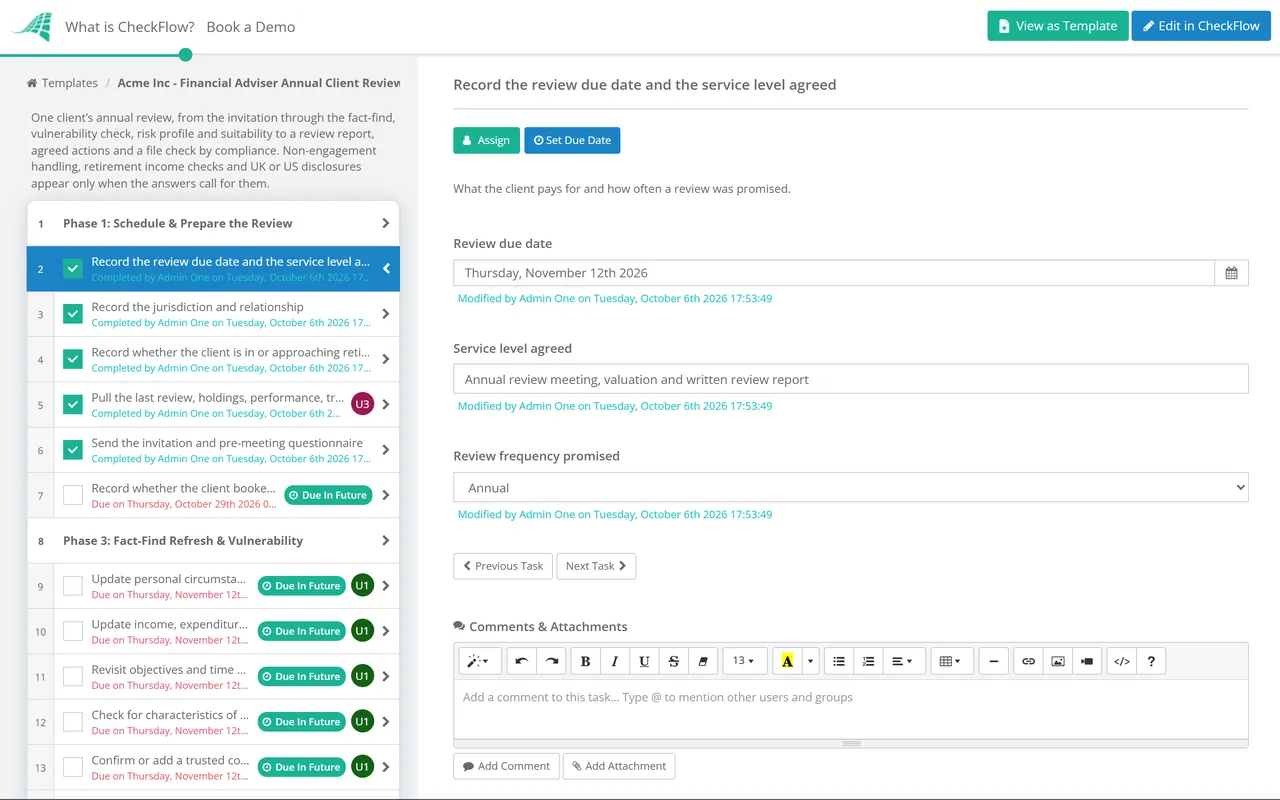
Each client’s review starts on a recurring schedule from their service anniversary, with the adviser and paraplanner assigned. The Tasks grid shows every review due this month, and overdue reviews show up in analytics before they show up in a complaint.
Conditional logic reads the jurisdiction, the retirement income answer and whether the client engaged. A client in drawdown gets the sustainability checks, and a client who ignores the invitation gets a recorded follow-up path.
The questionnaire, risk profile and review report attach to their tasks, and the file check is an approval task for a named supervisor. The timestamped activity trail exports, which answers the question the FCA asked the largest firms.
CheckFlow is not a back-office platform, risk profiling tool or cash flow modeller, and it does not hold client money or documents for you. It runs the review workflow around those tools: who prepares, who meets the client, what was decided and who checked the file. Client lists can be held as a data set so each checklist picks the client from a live dropdown. The financial services overview shows other adviser workflows run the same way.
New clients start with the Financial Planner Client Onboarding Checklist, then move to this annual review. Firms regulated by the SEC run their firm-level review with the RIA Annual Compliance Review Checklist, and UK firms report on outcomes in the Consumer Duty Annual Review Checklist. Identity refreshes can follow the KYC Periodic Review Checklist.

Financial Planner Client Onboarding Checklist

KYC Periodic Review Checklist

Customer Due Diligence Checklist

Employee Compliance Certification Tracking Checklist

Regulatory Examination Preparation Checklist
Describe the process in a sentence and the AI checklist generator drafts the phases and tasks for you.
Changes in the client’s circumstances and goals, a fresh look at attitude to risk and capacity for loss, whether the portfolio and the plan are still suitable, the costs charged and the value delivered, any signs of vulnerability, and agreed actions. The FCA has said a review should reassess suitability, not just update the client on their financial position.
Not for every client. A firm may only charge an ongoing adviser fee for an ongoing service it has disclosed, and must deliver what it promised. Where a MiFID firm provides periodic suitability assessments, the current rules require them at least annually. The FCA’s CP26/10 proposes letting firms set the review frequency from the client’s needs instead; it is a proposal until a policy statement is published.
Record every attempt, try another channel, and ask whether the client still wants the service. If they do not, offer a lower-cost or no ongoing service and apply the firm’s policy on the fee. The FCA has asked firms to consider redress where clients paid for reviews that were not delivered, so a documented trail matters.
No rule sets a single interval. A registered investment adviser’s fiduciary duty includes monitoring at a frequency consistent with the agreed scope of the relationship, and Form ADV Part 2A Item 13 must describe how often accounts are reviewed. Under Reg BI a broker-dealer has no duty to monitor unless it agrees to, in which case each agreed review is covered. Many firms review at least annually.
Attitude to risk is how much risk the client is willing to take. Capacity for loss is how much of a fall they can absorb without harming their standard of living or goals. They can point in different directions, especially for clients drawing an income, and the FCA’s 2024 review of retirement income advice found too little focus on capacity for loss.
14-day free trial, no card required. The Business plan is $10 per user per month after the trial. Full details at checkflow.io/pricing.
14-day free trial, no credit cardFull refund in your first 30 daysUS hosting, EU on request