A full audit yearly, spot checks between
A recurring schedule starts this checklist every year and a shorter regression run every quarter. Due dates count from the audit start, and retests from each finding’s target date.
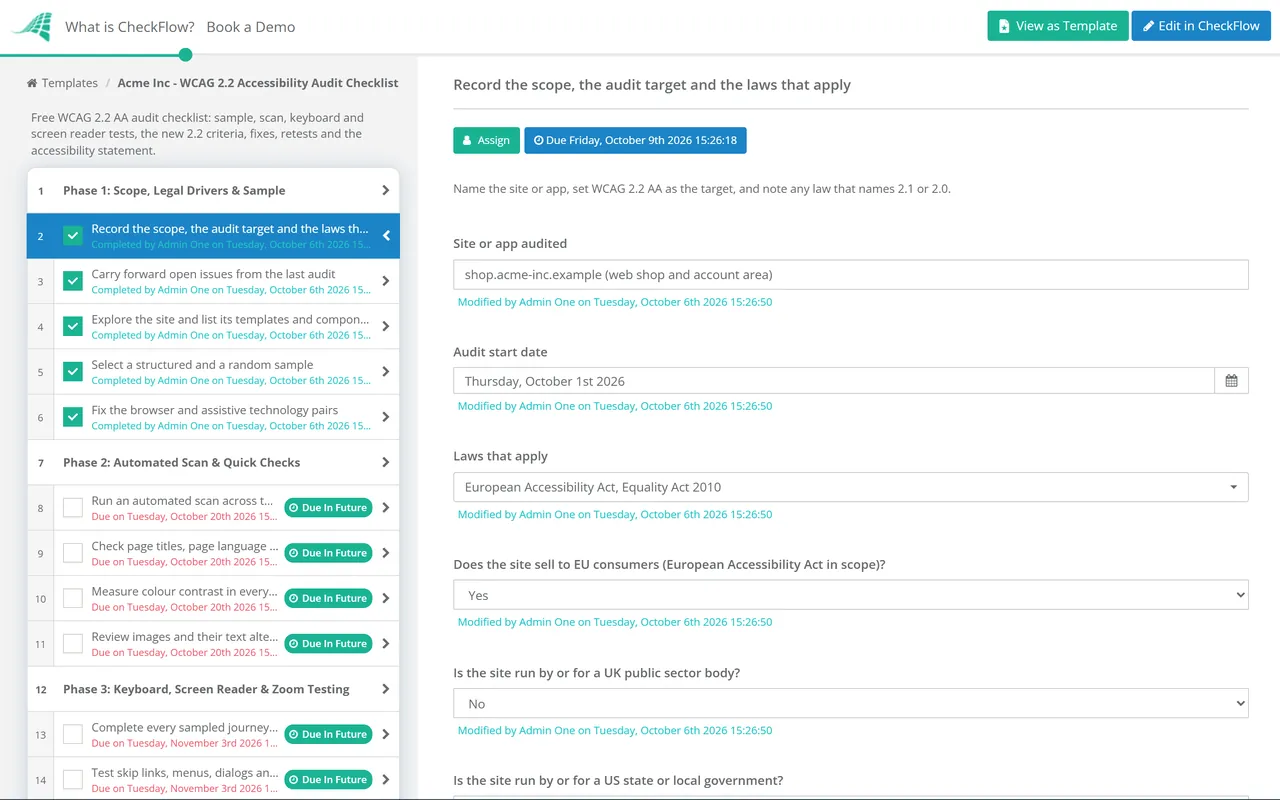
This free WCAG accessibility audit checklist is for the digital, product or compliance lead who owns a website or web app and needs a repeatable audit against WCAG 2.2 Level AA. It follows the W3C evaluation method from scope and sample through scan, keyboard, screen reader and zoom testing, and the new 2.2 criteria. Findings are rated, fixed and retested, and the run ends with an approved accessibility statement. Answers on the first task add the European Accessibility Act, UK public sector and US Title II tasks only where they apply.
WCAG 2.2 became a W3C Recommendation on 5 October 2023 and was updated on 12 December 2024. ISO also publishes it as ISO/IEC 40500:2025. It adds nine success criteria to WCAG 2.1, six of them at Level A or AA, and removes 4.1.1 Parsing. W3C states that content conforming to 2.2 also conforms to 2.1 and 2.0, which makes 2.2 AA the right audit target even where a law names an older version.
Several laws do. The US Title II and HHS Section 504 rules specify WCAG 2.1 AA, Section 508 still points at WCAG 2.0, and the cited version of EN 301 549, the European standard behind the EU directives, uses WCAG 2.1. Record the legal benchmark next to the audit target so the report answers both questions.
What: rule-based checks a tool runs across many pages at once.
Finds: missing alternative text, low contrast, empty links and buttons, unlabelled fields, no page language.
Misses: whether alternative text makes sense, focus order, custom widgets, screen reader output.
Use: on every release, as a regression net.
What: a tester checks a defined sample against every A and AA success criterion.
Covers: keyboard, screen reader, zoom, forms, media, documents and complete processes.
Output: findings by criterion and the evidence behind the accessibility statement.
Use: annually, and after a redesign or platform change.
W3C says plainly that “tools cannot check all accessibility aspects automatically”. A page can pass every automated rule and still be unusable without a mouse. The Phase 2 scan clears the obvious failures so the manual hours in Phases 3 and 4 go on what only a person can find.
Seven phases follow the WCAG-EM steps from scope to report, then publish the statement and set up the checks that keep the site conformant. Success criterion numbers are from WCAG 2.2.
The answers on the first task decide whether the document task in Phase 5 and the EU, UK and Title II tasks in Phase 7 appear.
Automated rules cover only part of WCAG. A clean scan is where manual testing starts, not a result.
Six of the nine new criteria are Level A or AA. The other three (2.4.12, 2.4.13 and 3.3.9) are AAA and sit outside an AA audit.
The document task appears only when PDFs or other documents are in scope.
When the first task records at least one failure, the three remediation and retest tasks appear.
The EU, UK and Title II tasks appear only when the matching scope answer on the first task is Yes. The approver named in Phase 1 signs off the statement.
The audit target stays the same. What changes between regimes is the benchmark a regulator or court would apply, the dates, and what you must publish. Treat the table as a starting point, not legal advice.
| Law or standard | Who it covers | Technical benchmark | Key dates | Evidenced in |
|---|---|---|---|---|
| WCAG 2.2 (W3C; ISO/IEC 40500:2025) | Any website or web app; the audit target | Level A and AA success criteria | Recommendation 5 October 2023; updated 12 December 2024 | Phases 1–6 |
| European Accessibility Act, Directive (EU) 2019/882 | Services to consumers, including e-commerce and consumer banking (Art. 2(2)); microenterprises providing services are exempt (Art. 4(5)) | Annex I requirements; EN 301 549 V4.1.1 (WCAG 2.2) once cited in the Official Journal | Applied from 28 June 2025; transitional period to 28 June 2030 for products already used to provide a service (Art. 32) | Phases 5–7 |
| Web Accessibility Directive (EU) 2016/2102 | EU public sector bodies | EN 301 549 V3.2.1 (WCAG 2.1 AA), cited by Implementing Decision (EU) 2021/1339 | V3.2.1 cited August 2021 | Phase 7 |
| UK Public Sector Bodies Accessibility Regulations 2018 | UK public sector bodies | WCAG 2.2 AA, per GOV.UK guidance | GDS monitoring the 2.2 criteria since October 2024; statement under regulation 8 | Phase 7 |
| Equality Act 2010, sections 20 and 29 | UK service providers, public and private | No named standard; a duty to make reasonable adjustments | Continuing duty | Phases 6 and 7 |
| ADA Title II, 28 CFR 35.200 | US state and local governments | WCAG 2.1 A and AA | 26 April 2027 (population 50,000 or more); 26 April 2028 (under 50,000, and special district governments) | Phases 5 and 7 |
| Section 504 (HHS), 45 CFR 84.84 | Recipients of HHS federal financial assistance | WCAG 2.1 A and AA | 11 May 2027 (15 or more employees); 10 May 2028 (fewer than 15) | Phase 7 |
| Section 508, 36 CFR part 1194 | US federal agencies’ ICT | WCAG 2.0 A and AA (E205.4) | In effect since 18 January 2018 | Phase 1 |
| ADA Title III | US businesses open to the public | No regulation names a WCAG version | None set | Phase 1 |
Three things were moving at the time of review. ETSI, CEN and CENELEC published EN 301 549 V4.1.1 on 2 September 2026, but it gives a presumption of conformity only once cited in the Official Journal, which had not happened. The Justice Department moved the Title II dates back a year by interim final rule on 20 April 2026 and plans a further review of the rule; HHS did the same for Section 504 in May 2026. WCAG 3.0 is an incomplete draft that W3C does not expect to finish for a few more years. None of this changes how you audit. This page is not legal advice.
A recurring schedule starts this checklist every year and a shorter regression run every quarter. Due dates count from the audit start, and retests from each finding’s target date.
Conditional logic shows the EAA, UK public sector and Title II tasks and the document test only where the scope answers call for them. The findings answer opens the remediation tasks.
Scan exports, screenshots and screen reader notes sit on the task they support, beside the findings table. The statement runs as an approval for the person named in Phase 1, and the activity trail shows who tested what and when.
CheckFlow is not an accessibility scanner, an overlay or a certification body, and it does not test your pages. It runs the audit around the tools and testers you already use and keeps the dated record. CheckFlow’s compliance checklist software shows how the same schedules, evidence and approvals work across your other compliance reviews.
If the same review covers the cookie banner and privacy notice, run the Website Privacy & Cookie Compliance Checklist alongside this one: the banner is often the element that hides keyboard focus. For pre-release testing, add the Phase 3 keyboard checks to the QA Testing Checklist so new templates arrive accessible.
Audit against WCAG 2.2 Level AA. W3C states that content conforming to 2.2 also conforms to 2.1 and 2.0, so one audit covers a law that names either. Note in the report that 4.1.1 Parsing, removed in 2.2, may still be tested by someone assessing against 2.1.
Under 28 CFR 35.200 as amended by the Justice Department’s interim final rule of 20 April 2026: from 26 April 2027 for public entities with a total population of 50,000 or more, and from 26 April 2028 for smaller entities and all special district governments. The original dates were 24 April 2026 and 26 April 2027. The technical standard did not change, and the department has said it will review the rule further.
It applies to listed services provided to consumers after 28 June 2025, including e-commerce, so a site selling to EU consumers is likely in scope. Microenterprises providing services, meaning fewer than 10 staff and annual turnover or balance sheet total of no more than €2 million, are exempt. Services provided only to businesses are outside its scope. National laws transpose the Directive, so confirm the detail for the countries you sell into.
Once a year is a common baseline, plus a fresh audit after a redesign or a new platform. Between audits, scan each release and check key journeys quarterly. The UK regulations require the statement to be kept under regular review, and the EAA requires procedures that keep a service conformant as it changes.
No. Automated tools reliably catch some failures, such as missing alternative text or low contrast, but W3C notes that human judgement is needed for the rest. Focus order, custom widgets with a screen reader and the meaning of alternative text all need a person.
Nine success criteria were added. Six count in an AA audit: Focus Not Obscured (Minimum), Dragging Movements, Target Size (Minimum) and Accessible Authentication (Minimum) at AA, and Consistent Help and Redundant Entry at A. Focus Not Obscured (Enhanced), Focus Appearance and Accessible Authentication (Enhanced) are AAA. 4.1.1 Parsing was removed as obsolete.
14-day free trial, no card required. The Business plan is $10 per user per month after the trial. Full details at checkflow.io/pricing.