Run once, by a project lead
Answers: what does the organisation need to build before its first certification audit?
Cadence: one project, typically months long.
Output: a documented EMS ready for the Stage 1 audit.
Last reviewed: September 2026
No Credit Card Required
This free ISO 14001 checklist is for environmental managers and EHS leads who already run an environmental management system. It follows one EMS year under ISO 14001:2026: context and change, environmental aspects, the compliance obligations register, objectives and operational control, emergency preparedness, evaluation of compliance under clause 9.1.2, internal audit and management review. It produces the documented information a certification body samples, and a transition plan if you still hold a 2015 certificate.
ISO 14001:2026 is the fourth edition of the environmental management system standard, published by ISO on 15 April 2026. It sets management system requirements, not performance limits. It asks you to know your environmental aspects, meet your compliance obligations, set objectives, control operations and prove the system is effective.
An EMS rarely fails in its design. It fails in the months nobody looks at it: a new production line goes in and the aspects register is never reopened, the legal register gains entries nobody checks the site against, the spill drill slips twice, and management review meets without compliance evaluation results.
This checklist is the recurring work in the middle.
Answers: what does the organisation need to build before its first certification audit?
Cadence: one project, typically months long.
Output: a documented EMS ready for the Stage 1 audit.
Answers: is the EMS still accurate, are we meeting our obligations, and is it effective?
Cadence: annual, with monthly and quarterly tasks inside it.
Output: refreshed registers, a compliance evaluation, audit results and management review records.
Answers: can the certificate be kept or renewed?
Cadence: usually a surveillance audit each year and recertification every three.
Output: the certification decision. Out of scope here, but it samples the middle column.
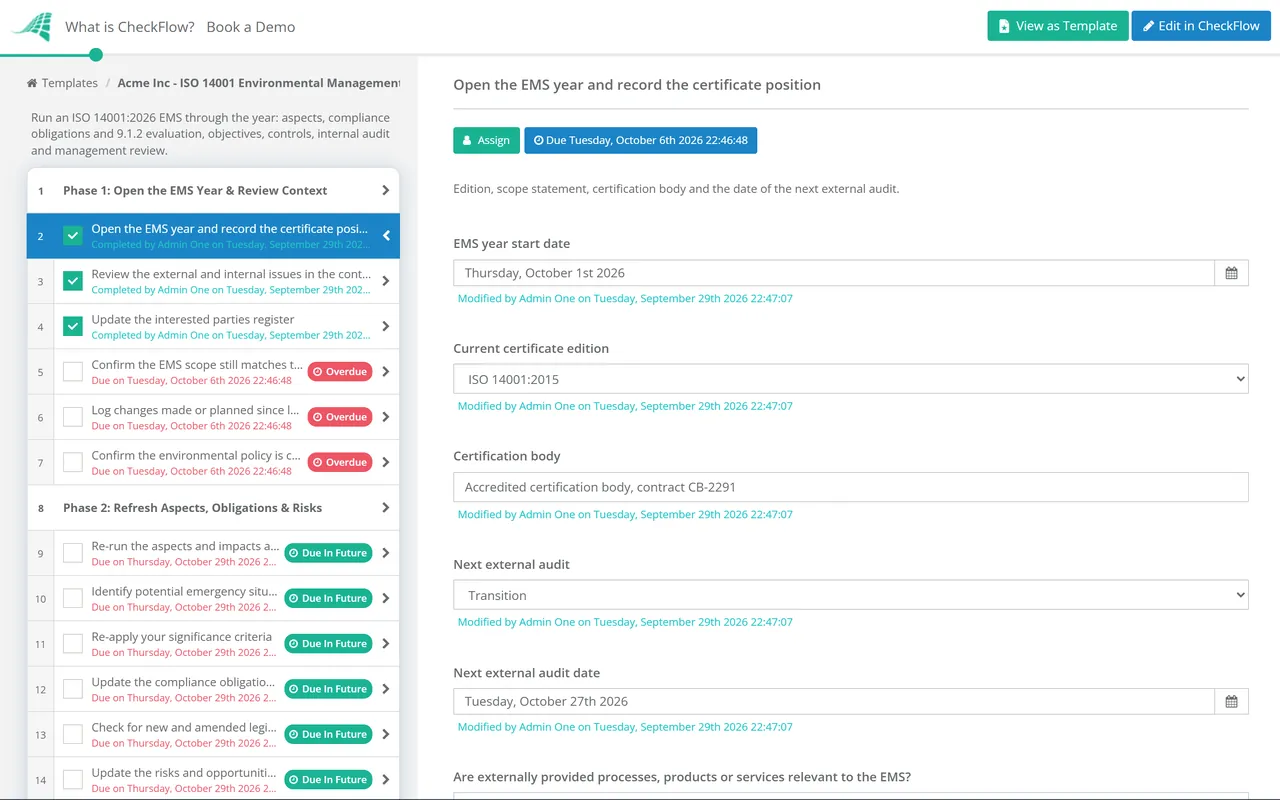
Phases 1 and 2 refresh the plan, Phases 3 to 5 run and check it, and Phase 6 closes the year. Phase 7 appears only while your certificate is still to ISO 14001:2015.
The first task asks two scope questions. The certificate answer switches on Phase 7; the external provider answer switches on a task in Phase 3.
The external provider task appears only when Phase 1 records that externally provided processes, products or services are relevant to the EMS.
The last two tasks appear only when the evaluation records at least one obligation not being met.
Shown only when Phase 1 records that the current certificate is to ISO 14001:2015. Once the 2026 certificate is issued, it drops out.
The table maps the requirements an EMS has to keep meeting each year to their ISO 14001:2026 clause and the phase that produces the evidence. ISO 14001 lists no laws: your compliance obligations depend on where you operate and which permits you hold. Treat the table as a starting point, not legal or certification advice.
| Requirement | ISO 14001:2026 | Evidence you keep | Phase |
|---|---|---|---|
| Context and environmental conditions | 4.1 | Context register covering the named conditions | 1 |
| Scope of the EMS | 4.3 | Scope statement matching the certificate | 1 |
| Environmental policy | 5.2 | Current, communicated policy | 1 |
| Environmental aspects | 6.1.2 | Aspects register, significance criteria and results | 2 |
| Compliance obligations | 6.1.3 | Obligations register with owners | 2 |
| Risks and opportunities | 6.1.4 | Risks and opportunities register | 2 |
| Planning of changes | 6.3 | Change log with assessments | 1 |
| Environmental objectives | 6.2 | Objectives, action plans and indicators | 3 |
| Operational planning and control | 8.1 | Operating criteria, external provider controls | 3 |
| Emergency preparedness and response | 8.2 | Response plans and test records | 4 |
| Monitoring, measurement, analysis and evaluation | 9.1.1 | Results, analysis and calibration records | 4 |
| Evaluation of compliance | 9.1.2 | Evaluation results per obligation | 5 |
| Internal audit | 9.2 | Audit programme and results | 6 |
| Management review | 9.3 | Inputs, minutes and results | 6 |
| Nonconformity and corrective action | 10.2 | Causes, actions and effectiveness checks | 5, 6 |
ISO published ISO 14001:2026 on 15 April 2026, replacing ISO 14001:2015 and its 2024 climate change amendment, and this checklist uses its clause numbers. The harmonized structure stays, so most changes are clarifications and renumbering, plus a few new requirements: a dedicated risks and opportunities clause, planning of changes and audit objectives.
Certificates to ISO 14001:2015 stay valid during the transition. Under requirements published on 14 September 2026 by Global Accreditation Cooperation Incorporated (Global ACI), which replaced IAF and ILAC in January 2026, new and initial accredited certifications may only be issued to the 2026 edition from 31 October 2027, and 2015 certificates must transition by 30 April 2029. Your certification body will confirm your own timing.
An annual recurring schedule opens the EMS year, and shorter schedules run monthly monitoring or quarterly permit checks. Dynamic due dates count back from the surveillance audit date.
A data set of permits and legal requirements, each with an owner and frequency, fills the Phase 5 table one row per obligation, with the evidence attached. The activity trail shows who evaluated each and when.
Conditional logic shows corrective action only when an obligation is not met, and the transition phase only while you hold a 2015 certificate. Enforced step order puts compliance evaluation before management review, which top management signs off as an approval.
CheckFlow is not a certification body, a legal register service or an environmental data platform: it will not tell you which laws apply or calculate emissions. It runs the EMS work and keeps the evidence. To build an ISO management system for first certification, start with the ISO Compliance Checklist. For the individual audits in Phase 6, the ISO 9001 Internal Audit Checklist follows one audit from plan to verified corrective action, and its structure suits an EMS audit too.
CheckFlow’s compliance checklist software shows how recurring reviews, approvals and evidence fit across the rest of your compliance calendar, so ISO 14001, ISO 9001 and ISO 45001 work sits in one place.
Describe the process in a sentence and the AI checklist generator drafts the phases and tasks for you.
The structure and intent are unchanged. The changes that touch a running EMS: clause 4.1 names environmental conditions to consider, including climate change and biodiversity; risks and opportunities get their own clause, 6.1.4; a new clause 6.3 requires changes to the EMS to be planned; clause 8.1 covers externally provided processes, products and services rather than only outsourced processes; each internal audit needs objectives; and management review is split into inputs and results.
Under Global ACI’s transition requirements, organisations certified to ISO 14001:2015 have until 30 April 2029, and the transition can happen at a surveillance or recertification audit or at a separate transition audit. From 31 October 2027, new and initial accredited certifications may only be issued to the 2026 edition. Book the audit early, and let your certification body confirm the date.
Clause 9.1.2 makes you decide the frequency; the standard sets no minimum. Base it on the obligation: a permit with monthly monitoring conditions or past exceedances deserves frequent checks, a stable registration perhaps one a year. Evaluate every obligation at least once before management review, which uses the results, and keep the evidence behind each conclusion.
An aspect is the part of your activities, products or services that interacts or can interact with the environment: a boiler’s combustion, a solvent store, a delivery fleet. An impact is the change to the environment that results, adverse or beneficial: air emissions, contaminated soil after a leak, lower fuel use from better routing. Which aspects are significant is decided by your own criteria, applied consistently.
Certified organisations usually have a surveillance audit every year and a recertification audit every three years; your certification body sets the dates. Internal audits and management reviews are separate and yours to schedule, at the planned intervals your programme sets. Holding management review before the surveillance audit lets the auditor see a complete year.
No. ISO 14001 is voluntary, and the standard itself allows conformity to be self-declared, confirmed by customers or certified by an external body. Customers and tenders often ask for it. Environmental law applies either way: an EMS helps you meet your permits and legislation, but a certificate is not proof that you comply.
14-day free trial, no card required. The Business plan is $10 per user per month after the trial. Full details at checkflow.io/pricing.
14-day free trial, no credit cardFull refund in your first 30 daysUS hosting, EU on request