Process Management Software for
Manufacturing Companies
Manufacturing quality is not an inspection activity — it is a process discipline. A production line where every step is executed consistently produces consistent output. A production line where steps vary between operators, shifts, or facilities produces variable output, variable quality, and accumulating defect costs. The cost of poor quality in manufacturing consistently reaches ten to fifteen percent of annual revenue when processes are not systematically managed — not because manufacturers don’t have quality standards, but because the standards exist in binders that aren’t opened, SOPs written three years ago that no longer match actual practice, and maintenance schedules that depend on one person remembering.
CheckFlow gives every human-executed process in a manufacturing operation a documented, consistent structure — quality inspections, equipment maintenance, safety checks, production process documentation, and corrective action management — so the standard that applies on the day shift applies identically on the night shift, at facility A and facility B, whether the operator has been in the role for ten years or ten days.
The Consistency Problem in
Manufacturing Operations
The manufacturing firm that produces quality products reliably is not the one with the most experienced workforce — it is the one with the most disciplined processes. Experience cannot be transferred between operators; documented standard work can. The defect that appears on the night shift but not the day shift is not a staffing problem — it is a process variation problem. The equipment that fails unexpectedly is not bad luck — it is deferred maintenance that was never scheduled. The ISO 9001 audit that catches non-conformances the internal audit missed is not a surprise — it is the consequence of a QMS that exists on paper but is not operational in practice.
Standard work that is actually followed
A standard operating procedure that exists in a binder is not standard work — it is a documented intention. Standard work is the procedure that every operator follows, every time, in the same sequence, to the same criteria. CheckFlow deploys the current version of each work instruction to the operator at the point of execution and requires confirmation of each step before the process can advance.
Quality controls at every stage, not just the end
A defect found at final inspection carries the full cost of all the production value added since it was introduced. The same defect found at the incoming material stage costs the price of the material. CheckFlow structures quality hold points throughout the production process — incoming inspection, in-process checks at critical operations, and final inspection with AQL sampling — so defects are caught where they cost the least to address.
Maintenance and safety that runs on schedule
Equipment that is maintained reactively costs three to five times more than equipment maintained preventively. Safety inspections that happen when there is time rather than on a scheduled cycle create the compliance gaps that OSHA, HSE, and ISO auditors find. CheckFlow generates every maintenance task and safety inspection automatically at its required interval — so neither is missed because it wasn’t manually scheduled.
How Manufacturing Teams Use CheckFlow
From production floor quality checks to equipment maintenance schedules and ISO audit preparation, CheckFlow structures the operational processes that keep manufacturing facilities running at quality and in compliance.
Quality Control & Inspection
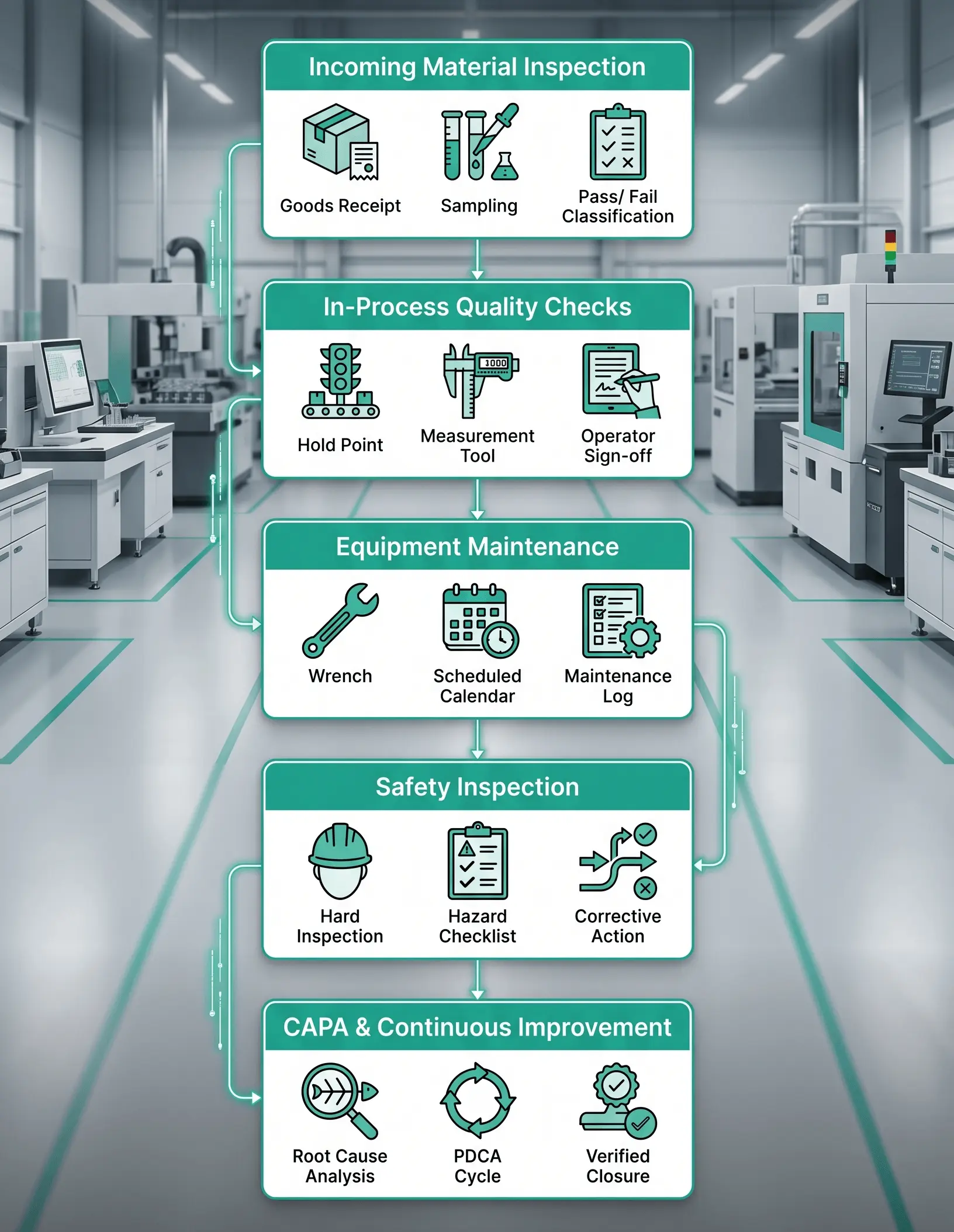
Every production run requires quality checks at defined stages — incoming material inspection before components enter the production process, in-process checks at the operations most critical to quality, and final inspection before products leave the facility. CheckFlow structures each inspection stage with the specific criteria, sample sizes, and pass/fail thresholds for that product and operation — creating the inspection record that ISO 9001, customer audits, and regulatory submissions require. When a defect is found, the CAPA workflow launches automatically: root cause, corrective action, preventive action, and effectiveness verification.
Quality Assurance Templates →Equipment Maintenance
Unplanned equipment downtime costs three to five times more than planned preventive maintenance — in emergency labour, lost production, and potential product quality impact. CheckFlow schedules every maintenance task at its equipment-specific interval, assigns it to the responsible technician, and requires task-by-task sign-off before the maintenance record is closed. The maintenance log is created automatically as the work is done — not reconstructed from memory — and provides the documented service history that ISO 9001 clause 7.1.3, warranty claims, and equipment insurers require.
Equipment Maintenance Workflow →Production Process Standardisation
The production process that varies between operators or shifts is the process that produces variable output. CheckFlow structures the development, approval, training, and ongoing maintenance of standard operating procedures and work instructions — ensuring that every operator follows the current version of the procedure, that training completion is documented for each person on each procedure, and that when a process is updated, the version history records exactly what was in place at each point in time. The SOP that exists as a living, followed document rather than an archived artefact.
Process Standardisation Checklist →Workplace Safety Inspections
Manufacturing safety obligations — OSHA in the US, HSE in the UK, applicable EU directives — require documented evidence that safety inspections were conducted, hazards were identified, and corrective actions were taken. A safety inspection that finds hazards without tracking them to resolution is a safety inspection that doesn’t improve safety. CheckFlow structures every inspection against defined criteria, assigns every identified hazard a corrective action with a named owner and deadline, and tracks each to verified closure before the next inspection cycle.
Manufacturing Safety Inspection Checklist →Why Manufacturing Companies
Choose CheckFlow
The same standard on every shift, at every facility
Quality management that depends on the presence of an experienced supervisor to hold the standard is quality management that degrades on nights, weekends, and at remote sites. CheckFlow deploys the same structured procedure to every operator at every station, at every time of day — with step-by-step confirmation required before the next operation can proceed. The standard is in the system, not in anyone’s head.
ISO 9001 audit evidence that builds automatically
ISO 9001 certification requires documented evidence that quality processes are followed — not just that they exist. Internal auditors and external certification bodies assess the records, not the policies. Every CheckFlow process run creates a dated, attributed completion record automatically — every inspection result, every CAPA, every maintenance sign-off, every training confirmation. The audit pack assembles itself as operations run, not in the week before the certification visit.
Template version history for process changes
When a production process changes — new material specification, revised work instruction, updated quality criteria — the previous version must be superseded and all operators retrained to the new standard. CheckFlow’s template version history records exactly which version of each procedure was in use at each point in time. If a customer or regulator asks what process was followed on a specific production date, the version history provides the answer.
Relevant Template Libraries for
Manufacturing Teams
CheckFlow’s template library covers the core operational processes that manufacturing companies run on every shift, every production run, and every maintenance cycle — from quality control and process documentation through to supplier management, safety compliance, and continuous improvement.
Manufacturing & Production Templates
Equipment maintenance, inventory management, change order control, production scheduling, quality control, and safety inspections — the complete set of operational workflows for the production floor.
Quality Assurance Templates
Continuous improvement cycles, defect reporting and CAPA, process standardisation, product inspection, QA compliance audits, and QA testing — the quality management system workflows that ISO 9001, IATF 16949, and AS9100 require.
Procurement & Supply Chain Templates
Supplier onboarding and qualification, purchase order approval, inventory audit, shipment tracking, and supplier performance evaluation — the supply chain processes that control incoming material quality and procurement compliance.
Operations & Facilities Management Templates
Facility inspection, equipment servicing, maintenance scheduling, and vendor onboarding — the facility-level operational processes that keep the production environment safe, maintained, and compliant.
Compliance Templates
ISO 9001, ISO 27001, and other compliance frameworks — recurring compliance workflows with built-in audit trails for certification maintenance and regulatory inspection.
Human Resources Templates
Operator onboarding, training records, performance reviews, and workforce planning — the HR processes that ensure every production team member is qualified, trained to the current procedure, and their competency documented.
Manufacturing Process Management — Frequently Asked Questions
How does structured process management reduce the cost of poor quality in manufacturing?
The cost of poor quality in manufacturing has three components: internal failure costs (scrap, rework, and re-inspection), external failure costs (customer returns, warranty claims, and reputation damage), and appraisal costs (inspection and testing). The 1:10:100 rule captures the cost escalation: a defect addressed at the design or incoming material stage costs one unit of effort; the same defect addressed in production costs ten; discovered by the customer costs a hundred. Structured process management reduces all three by ensuring quality controls are applied consistently at every stage — so defects are found earliest, processes are followed to prevent their introduction, and CAPA actions are tracked to verified resolution rather than recurring.
How does CheckFlow support ISO 9001 certification in manufacturing?
ISO 9001 requires evidence that quality processes are planned, implemented, monitored, and continuously improved — not just documented. CheckFlow addresses this across the relevant clauses: clause 7.5 (documented information) through version-controlled SOPs and work instructions; clause 8.1 (operational planning) through structured production and quality workflows; clause 8.7 (non-conforming outputs) through CAPA workflows that track defects from detection to verified corrective action; clause 9.2 (internal audit) through structured audit checklists with finding classification and corrective action tracking; and clause 10.2 (continual improvement) through PDCA improvement cycle workflows. Every completed process run creates the dated, attributed evidence record that certification audits require.
How does CheckFlow handle multi-shift and multi-site manufacturing operations?
CheckFlow deploys the same structured process to every operator, on every shift, at every facility — ensuring the procedure applied at 6am on the day shift is the procedure applied at 2am on the night shift. Each process run is attributed to the team member who completed it, with a timestamp, so shift-level quality and compliance performance is visible in the records. For multi-site operations, different sites can run common templates (ensuring consistent standards across facilities) or site-specific variations (reflecting different equipment, processes, or local regulatory requirements) — while maintaining a shared template version history that records what each site was following at each point in time.
Is CheckFlow a full QMS or does it complement an existing quality management system?
CheckFlow is a process management platform, not a full QMS. It handles the execution and documentation of human-operated processes — the structured checklists, work instructions, inspection records, and CAPA workflows that form the operational layer of a quality management system. It complements dedicated QMS platforms (which typically handle document control, non-conformance databases, and quality analytics) by providing the structured task execution and evidence creation that those systems often lack. Many manufacturing teams use CheckFlow for the operational workflows — inspections, maintenance, safety checks, training — while using a separate system for quality reporting and non-conformance management. The two categories are complementary.