
Digital Content Strategy Checklist Template

Content marketing generates 3× more leads than outbound marketing at 62% lower cost. The gap between companies that achieve this and companies that produce content that no one reads is almost always a strategy gap — not a quality gap.

Content marketing consistently outperforms outbound on leads per pound invested — but only when the content has a clear purpose, is produced for a defined audience, is distributed to where that audience is, and is measured against outcomes rather than output. Most content underperforms not because it is poorly written but because it was produced without answering four questions first: Who is this for, specifically? What do they need at this stage of their journey? What do we want them to do after they have consumed it? And how will we get it in front of them? A structured digital content strategy process answers all four — and then runs the production, distribution, and measurement cycle that converts the strategy into consistent, cumulative results. This free checklist gives content marketers, marketing managers, and digital marketing teams a structured framework for building and operating a digital content strategy from first principles.

Use This Template Free See Live Example
No Credit Card Required

Content Pillars — the Framework That Keeps Content Strategy Coherent at Scale

A content pillar is a broad, strategic topic that is central to the brand’s expertise and audience’s needs — around which a cluster of related content pieces is built. Rather than producing content reactively about whatever seems interesting this month, a pillar-based strategy defines three to five core topics and builds depth in each — creating the topical authority that search engines reward and audiences trust.

For a process management and checklist software company, content pillars might be: IT operations processes (targeting IT managers), HR onboarding and offboarding (targeting HR teams), standard operating procedures (targeting operations managers), manufacturing quality processes (targeting plant managers), and compliance and audit management (targeting compliance officers). Each pillar maps to an ICP segment, a cluster of keywords, and a collection of related content pieces — from top-of-funnel educational guides to bottom-of-funnel comparison and feature pages.

Layer 1

Pillar content (the hub)

The comprehensive, definitive guide to the pillar topic. Long-form, high-quality, and designed to rank for the pillar’s primary keyword and earn backlinks as a reference resource for the industry.

Layer 2

Cluster content (the spokes)

Supporting articles and guides on specific subtopics within the pillar. Each links to the pillar page, passing authority. Each targets a more specific long-tail keyword. Builds topical depth.

Layer 3

Conversion content (the bridge)

Content that connects the pillar topic to the product or service — case studies, feature pages, comparison pages, template pages — for readers who have engaged with the pillar and cluster content and are now evaluating solutions.

What the Digital Content Strategy Checklist Covers

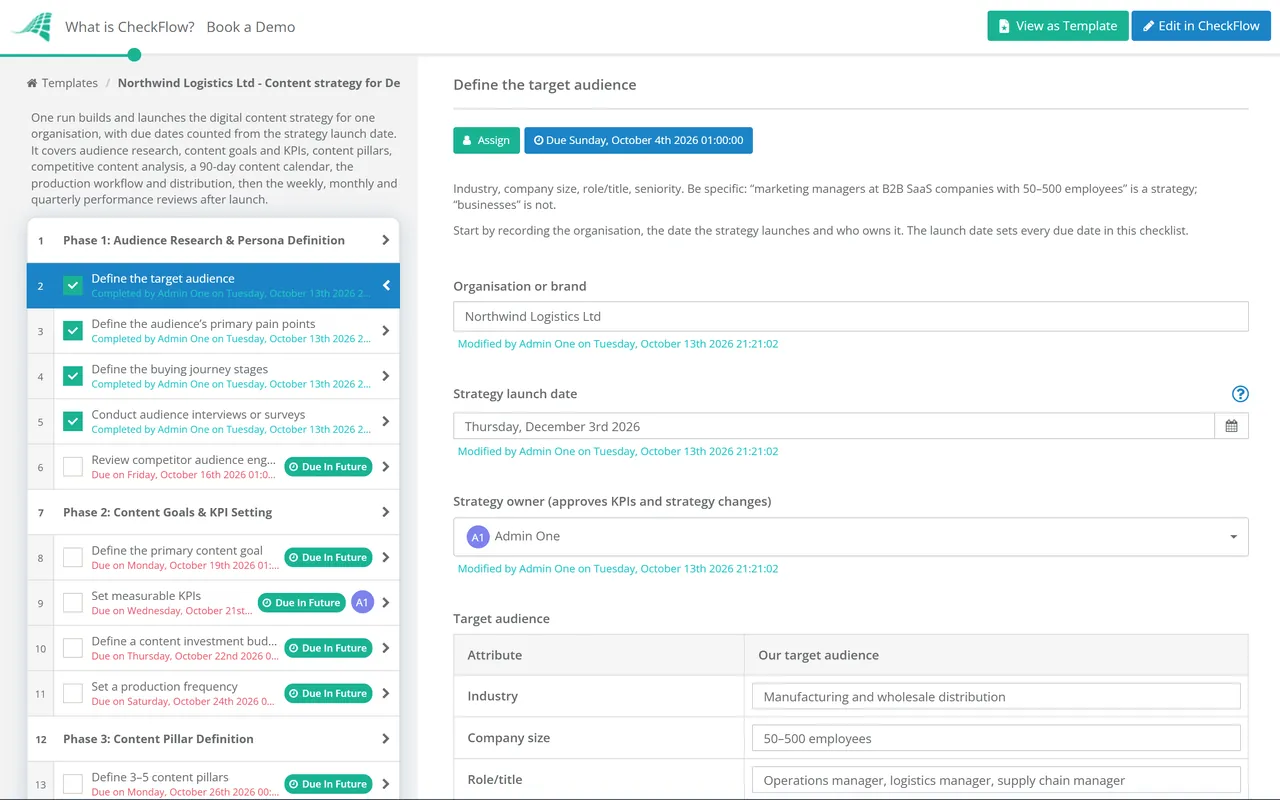
Eight phases from audience research through performance measurement — building the strategy foundation and the repeatable production cycle that compounds results over time.

Phase 1

Phase 1: Audience Research & Persona Definition

  • Define the target audience — industry, company size, role/title, seniority; be specific; “marketing managers at B2B SaaS companies with 50–500 employees” is a strategy; “businesses” is not
  • Define the audience’s primary pain points — what problems are they trying to solve? What frustrations keep them searching?
  • Define the buying journey stages — awareness (don’t know the solution), consideration (comparing options), decision (choosing a specific product); content is needed at every stage
  • Conduct audience interviews or surveys — speak to 5–10 target audience members; their language is the best content strategy input
  • Review competitor audience engagement — which of their content pieces get the most shares, comments, and backlinks? Social proof of audience resonance
Phase 2

Phase 2: Content Goals & KPI Setting

  • Define the primary content goal — brand awareness, organic traffic growth, lead generation, or customer retention; one primary goal drives content format and distribution decisions
  • Set measurable KPIs — organic sessions, new organic users, email subscribers, leads generated from content, or content-influenced pipeline; confirmed and benchmarked before the strategy launches
  • Define a content investment budget — time and/or monetary; what volume and quality of content can realistically be produced consistently?
  • Set a production frequency — one excellent long-form piece per week beats four thin posts; consistency of publication matters more than frequency
Phase 3

Phase 3: Content Pillar Definition

  • Define 3–5 content pillars — the broad strategic topics at the intersection of audience need, brand expertise, and business relevance
  • Validate each pillar against search demand — does each pillar have sufficient keyword volume to make search traffic a viable channel?
  • Validate each pillar against business relevance — does traffic from this topic convert to the product’s target audience?
  • Map each pillar to an ICP segment — who in the target audience is most interested in this topic?
  • Define the pillar content piece for each pillar — the comprehensive, definitive guide that will anchor the pillar cluster
Phase 4

Phase 4: Competitive Content Analysis

  • Identify content competitors — domains ranking for the pillar keywords (may be different from product competitors)
  • Analyse top-performing competitor content — format, word count, depth, visual quality; what makes their top-ranking content rank?
  • Identify content gaps — topics in the pillar that competitors cover poorly or not at all; these are the differentiation opportunities
  • Identify angles for superior content — what perspective, data, format, or depth would produce content genuinely better than what currently ranks? “10x content” not “same content”
Phase 5

Phase 5: Content Calendar & Production Planning

  • Build the content calendar — for the next 90 days minimum; each content piece with title, target keyword, pillar assignment, format, target publish date, and author/creator
  • Balance content types across the funnel — awareness (pillar guides), consideration (comparison/feature), and decision (case studies, demos); all three stages need content
  • Prioritise by SEO opportunity — highest-value keywords in the keyword map get content first; traffic-generating content before vanity content
  • Include evergreen and seasonal content — evergreen builds long-term traffic; seasonal captures timely demand
  • Assign all calendar items to owners — with final deadline; no “TBD” on publication-ready dates
Phase 6

Phase 6: Content Production Workflow

  • Define the content brief template — target keyword, search intent, target audience, key points to cover, competitors to beat, word count target, and CTA; brief before writing, always
  • Set the editorial review process — who reviews for accuracy, brand voice, and SEO before publication?
  • Confirm SEO on-page checklist for every piece — primary keyword in title, H1, first paragraph, and at least one H2; meta description written; internal links added
  • Define the visual and design standard — featured images, inline graphics, or video requirements for each content type
  • Define the publication process — who publishes, in which CMS, with which technical settings (canonical, structured data where applicable)
Phase 7

Phase 7: Content Distribution & Promotion

Publish and pray is not a distribution strategy. The highest-quality content that no one knows exists does not generate leads.

  • Define the distribution channels — for each content type: email newsletter, LinkedIn, X/Twitter, specific community forums, or partner channels
  • Build the email list distribution habit — every published piece of content goes to the email list; email is still the highest-conversion content channel for B2B
  • Repurpose content across formats — a long-form guide becomes a LinkedIn post series, a newsletter edition, a short-form video summary; one piece of content, multiple distribution touchpoints
  • Promote via outreach — share with people or brands mentioned in the content; genuine backlink opportunities from relevant domains
Phase 8

Phase 8: Performance Measurement & Strategy Review

  • Review content performance weekly — organic sessions, time on page, and leads generated from top performing pieces
  • Review content performance monthly — organic traffic trend, ranking movements for target keywords, email open rates and CTR from content emails
  • Conduct a quarterly content audit — which pieces are growing traffic (keep and expand), which are flat (refresh or redirect), which are declining (update or consolidate)?
  • Measure content-attributed pipeline — which pieces are producing leads that convert? Attribution is imperfect; first-touch and last-touch both matter
  • Adjust the strategy based on data — quarterly strategy review; double down on what is producing results; stop or change what is not

This checklist is available as a free, runnable template in CheckFlow — with brief templates, editorial review tasks, distribution checklists, and quarterly audits scheduled automatically as recurring checklists.

Use This Template Free

Why Use CheckFlow for Digital Content Strategy?

1

A structured content process that runs consistently

Content strategies fail most often not through lack of quality but through lack of execution — the calendar slips, the brief is skipped, the review step is rushed, and distribution becomes sporadic. CheckFlow runs the same structured production workflow for every piece of content: brief, draft, review, SEO check, publication, and distribution — with named owners, deadlines, and reminders.


2

The content calendar as a recurring operational process

A content calendar that lives in a spreadsheet requires constant manual attention to track status. CheckFlow’s recurring feature generates each content piece’s workflow automatically at its scheduled date, assigned to the right team members, ready to run. The content cycle runs as a process, not a project.

3

A performance review cycle built into the strategy

Quarterly content audits and strategy reviews — the actions that determine whether the content investment compounds or decays — are the tasks most likely to be skipped when the team is focused on production. CheckFlow schedules the quarterly audit automatically, with a structured review process that produces data-driven content decisions rather than gut-feel ones.

Content strategy is built on keyword strategy. CheckFlow’s Keyword Strategy Checklist covers the keyword research process that feeds the content pillar and calendar — from goal-setting through to rank tracking. See the Keyword Strategy Checklist →

Distributing content on social media requires a consistent daily workflow. CheckFlow’s Social Media Manager Daily Checklist covers the operational daily process for social distribution. See the Social Media Manager Daily Checklist →

Frequently Asked Questions

What should a digital content strategy checklist include?

+

A digital content strategy checklist covers eight phases: audience research (specific persona definition, pain point mapping, and buying journey stages), content goals and KPIs (primary goal, measurable targets, production budget and frequency), content pillar definition (3–5 strategic topics with search demand validation), competitive content analysis (competitor content quality assessment and gap identification), content calendar and planning (90-day forward plan with keyword, format, owner, and date), production workflow (brief template, editorial review, on-page SEO, publication process), distribution and promotion (channel selection, email distribution, repurposing), and performance measurement (weekly, monthly, and quarterly review cadence with content audit).

What are content pillars and how many should a brand have?

+

Content pillars are the 3–5 broad, strategic topics that a brand commits to building expertise and content depth in — at the intersection of audience need, brand knowledge, and business relevance. Most brands benefit from 3–5 pillars: fewer and the content strategy is too narrow; more and the team’s attention and authority is spread too thin. Each pillar should map to an audience segment, a cluster of related keywords, and a hierarchy of content from comprehensive pillar guide down to specific cluster articles and conversion content. The pillar structure creates the topical authority that search engines reward and the consistent subject matter expertise that audiences trust and return to.

How often should content be published?

+

Consistency matters more than frequency. One well-crafted, thoroughly researched, and comprehensively promoted piece per week outperforms four thin, hastily produced posts for both search performance and audience trust. The right publication frequency is the highest frequency at which the team can consistently maintain quality — which for many teams is one or two pieces per week rather than the higher volume some “content marketing” guides suggest. Starting with a lower, consistently achievable frequency and building from there outperforms ambitious volume targets that produce quality decline and eventual publication lapses.

How should content performance be measured?

+

Content performance should be measured at multiple levels. Reach metrics (organic sessions, impressions, email opens) show whether content is being seen. Engagement metrics (time on page, scroll depth, social shares) show whether it is resonating. Lead generation metrics (content-sourced leads, form fills, demo requests attributed to content) show whether it is converting. Pipeline metrics (revenue attributed to content-influenced journeys) show the business impact. No single metric tells the full story — a high-traffic post that generates no leads may be building brand awareness; a low-traffic post that generates consistent leads may be the most valuable piece in the library.

Is CheckFlow free to use for this template?

+

You can start a free 14-day trial with no credit card required, giving you full access to all features including this template. The Business plan is $10 per user per month after the trial. Full details at checkflow.io/pricing.

Turn Content Into a Consistent, Measurable Business Development Channel

Free trial — no credit card required.