Without keyword strategy, content is guesswork. With keyword strategy, every piece of content has a specific search demand it is targeting, a realistic chance of ranking for it, and a defined business outcome when it does.
Keyword research is not a one-time exercise performed before launching a website. It is an ongoing strategic process that answers three questions continuously: what are potential customers searching for, what is the realistic opportunity to rank for those searches, and what is the business value when that traffic arrives? The 2025–2026 search landscape has made this more complex: Semrush’s analysis of over 10 million keywords found that AI overviews now appear on approximately 16% of all queries, reshaping click behaviour for informational searches. Knowing which keywords still drive organic clicks and which are being captured by AI-generated answers is now part of any serious keyword strategy. A structured keyword strategy process addresses all of this: defining the objective, building the initial keyword set, analysing competitor gaps, classifying by search intent, filtering by realistic opportunity, prioritising by business value, mapping to specific pages, and tracking results. This free checklist gives SEO managers, content marketers, and digital marketing teams a structured framework for the full keyword strategy process.
Search Intent — Why the Same Keyword Means Different Things to Different Searchers
Every keyword belongs to one of four intent categories. Getting the intent right determines whether your content can rank — and whether that ranking drives business outcomes.
Intent Type 1
Informational
What the searcher wants: To learn something. An answer to a question, an explanation, a definition.
Examples: “what is MRR”, “how does SaaS pricing work”, “best practices for employee onboarding”
Content that ranks: Educational blog posts, guides, how-to articles.
High AI overview risk Google’s AI overviews are most likely to appear on informational queries and capture clicks that would otherwise go to organic results.
Intent Type 2
Navigational
What the searcher wants: To find a specific brand or website.
Content that ranks: The brand’s own pages — homepage, pricing, specific features.
Content opportunity: Your brand’s navigational keywords are yours to own. Competitor navigational keywords are difficult to rank for.
Intent Type 3
Commercial Investigation
What the searcher wants: To compare options before buying. Research and evaluation.
Examples: “best process management software”, “Checkflow vs Process Street”, “IT onboarding software for mid-size companies”
Content that ranks: Comparison pages, alternative pages, category landing pages, detailed feature pages.
High business value These searchers are evaluating solutions.
Intent Type 4
Transactional
What the searcher wants: To take an action — buy, sign up, download, request a demo.
Examples: “process management software free trial”, “sign up for checklist software”, “buy project management tool”
Content that ranks: Pricing pages, sign-up pages, product landing pages.
Highest business value These searchers have buying intent.

What the Keyword Strategy Checklist Covers
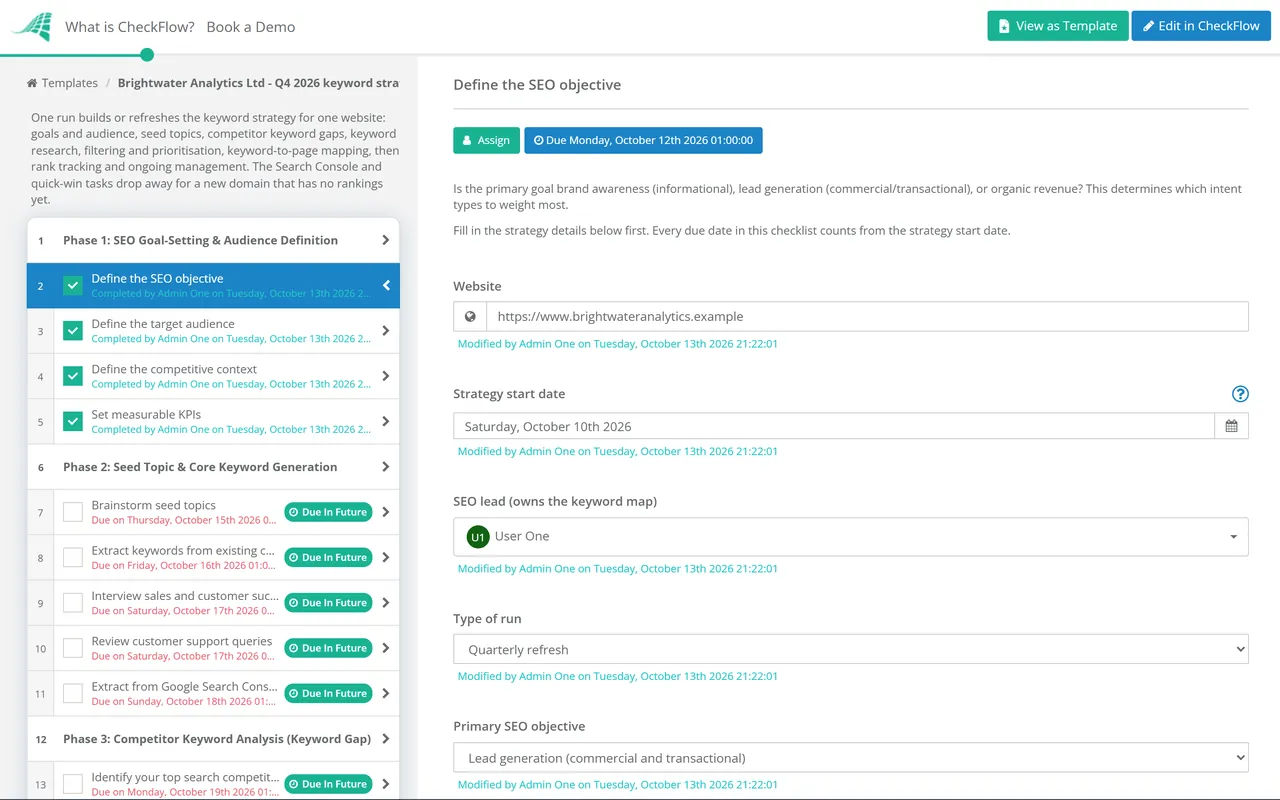
This checklist covers seven phases of the keyword strategy process — from goal-setting through to rank tracking and ongoing management. Run it at the start of a new SEO programme and refresh quarterly.
Phase 1
Phase 1: SEO Goal-Setting & Audience Definition
Keyword strategy without a defined business goal is keyword research without a destination. The goal determines which intents to prioritise, which metrics to track, and what a successful outcome looks like.
Define the SEO objective — is the primary goal brand awareness (informational), lead generation (commercial/transactional), or organic revenue? This determines which intent types to weight most
Define the target audience — who are we trying to reach? Industry, role, company size, pain points, and the stage of awareness they are likely in when searching
Define the competitive context — is this a new domain, a domain with existing authority, or a domain in a highly competitive niche? Determines keyword difficulty thresholds
Set measurable KPIs — organic traffic growth targets, keyword ranking targets, organic conversion rate targets; tracked from the start of the keyword programme
Phase 2
Phase 2: Seed Topic & Core Keyword Generation
Brainstorm seed topics — the broad categories and themes that define the business’s subject matter; what would customers search for when they have the problem you solve?
Extract keywords from existing content and pages — terms already used on the site; product names, feature names, use case descriptions
Interview sales and customer success teams — what language do prospects use to describe their problem? What questions do they ask before buying? Real customer language outperforms internal jargon
Review customer support queries — the questions customers ask most frequently are questions other prospects are searching
Extract from Google Search Console — what queries are already bringing traffic? Under-optimised existing rankings are the fastest wins
Your competitors have already done research. Their ranking pages reveal the keywords worth targeting — and the gaps where you can out-rank them.
Identify your top search competitors — not just product competitors; the domains competing for the same keywords in search results (often different from direct commercial competitors)
Run a competitor domain analysis — in Ahrefs, SEMrush, or Moz; identify the keywords driving the most traffic to each competitor
Conduct a keyword gap analysis — identify keywords your competitors rank for that you do not; gaps with high volume and moderate difficulty are priority opportunities
Analyse top-performing competitor pages — what content format, depth, and angle is producing high rankings? What can be done better?
Identify quick wins — keywords where you rank on page 2–3 and competitors rank on page 1; existing content improvements can move these
Phase 4
Phase 4: Keyword Research & Data Collection
Enter seed keywords into research tools — Google Keyword Planner (free), Ahrefs, SEMrush, or Moz; for each seed, collect related keyword suggestions
Collect key metrics for each keyword — monthly search volume, keyword difficulty (KD), and CPC (as a proxy for commercial value)
Use People Also Ask and autocomplete — Google’s “People Also Ask” boxes and autocomplete reveal the actual language searchers use; often produces the best long-tail opportunities
Check for AI overview dominance — for informational keywords with high AI overview coverage, assess whether organic ranking still drives meaningful clicks or whether traffic is suppressed
Compile the full keyword list — in a spreadsheet or SEO tool; all keywords with volume, KD, intent classification, and business relevance
Phase 5
Phase 5: Keyword Filtering & Prioritisation
Filter by search volume — set a minimum threshold appropriate for the niche; for B2B SaaS, 100 monthly searches may be high-value; for e-commerce, 1,000+; context determines the threshold
Filter by keyword difficulty — match KD to the domain’s current authority; a new domain should target KD under 30; established domains can target higher
Filter by business relevance — rate each keyword 1–3 for relevance to the business; exclude high-volume keywords with low relevance
Apply a prioritisation framework — KOB (Keyword Opposition to Benefit): score keywords on traffic value and competition combined; or a simple effort/impact matrix
Create a prioritised keyword target list — top keywords segmented by intent type; A-priority (high value, achievable), B-priority (medium term), C-priority (aspirational/long-term)
Phase 6
Phase 6: Keyword-to-Page Mapping
Keyword mapping assigns each target keyword to a specific page that is (or will be) designed to rank for it. Without mapping, multiple pages compete for the same keyword — cannibalising each other — or no page is positioned to rank.
Assign each priority keyword to an existing page — or flag it as requiring a new page; one primary keyword per page; secondary keywords supporting
Check for keyword cannibalisation — multiple pages ranking for the same keyword split authority; consolidate or differentiate
Identify content gaps — priority keywords with no existing page to map to; these become the content creation roadmap
Review organic traffic monthly — in Google Analytics / GA4; organic traffic to target pages against prior period
Refresh keyword research quarterly — new keyword opportunities emerge as search trends and AI search behaviour evolve; the keyword map is never finished
Update the keyword map when new pages are created — every new piece of content is immediately added to the map
This checklist is available as a free, runnable template in CheckFlow — with goal-setting tasks, competitor analysis phases, keyword mapping documentation, and quarterly refresh scheduled automatically.
How to Prioritise a Keyword List When You Cannot Target Everything at Once
Use business value and keyword difficulty together as a 2×2 prioritisation matrix. Every keyword fits into one of these four categories.
Priority A
High Business Value + Low Difficulty
Target immediately. These are the highest ROI keywords: high relevance to the business, achievable rankings given the domain’s authority. First content investment. These should dominate the initial content roadmap.
Priority B
High Business Value + High Difficulty
Target in parallel with link-building. Worth the investment, but requires time and authority-building before results appear. Start the content now; expect rankings on a 6–18 month horizon. Long-term content strategy.
Priority C
Low Business Value + Low Difficulty
Target if capacity allows. Easy to rank but limited commercial return. Fill content gaps rather than lead strategy. Useful for building topical authority around a subject area, but should not displace A or B priority work.
Deprioritise
Low Business Value + High Difficulty
Not worth the investment. Hard to rank and low return when you do. Remove from the active keyword target list. Revisit only if business relevance increases or domain authority grows significantly.
Why Use CheckFlow for Keyword Strategy?
1
A structured, repeatable keyword research process
Keyword strategy that lives in an individual’s head — or in disconnected spreadsheets across several team members — produces inconsistent results and makes it impossible to onboard new team members or document what has been done. CheckFlow’s keyword strategy checklist runs the same structured process for every site, every campaign, and every quarterly refresh — from goal-setting through to rank tracking — with every step documented and attributed.
2
A documented keyword map that the whole team can use
The keyword map is the most valuable output of keyword strategy — the master document linking every target keyword to a specific page. CheckFlow’s mapping phase produces and maintains this document as a required step in the process, ensuring the map is current when content briefings are written or when new pages are planned.
3
Quarterly review built into the process
Keyword strategy that runs once and is then abandoned degrades. Search volumes change, new competitors emerge, AI overview coverage expands. CheckFlow’s recurring checklist feature schedules the quarterly keyword strategy review automatically — running the competitive analysis and keyword gap phases again to surface new opportunities as the search landscape evolves.
Keyword strategy drives the content calendar. CheckFlow’s Digital Content Strategy Checklist covers the full content strategy process from audience research through to performance measurement — with keyword mapping as the input to the content roadmap. See the Digital Content Strategy Checklist →
For SEO keyword strategy to produce rankings, every targeted page must be technically and structurally optimised. CheckFlow’s SOP software capability enables teams to run the same on-page SEO process for every page created. See CheckFlow for SOPs →
A keyword strategy checklist covers seven phases: SEO goal-setting and audience definition (what business outcome is organic search meant to produce, and who is searching for it), seed topic generation (brainstorming, customer language research, and existing page analysis), competitor keyword analysis (keyword gap analysis against the top-ranking competitors), keyword research and data collection (volume, difficulty, and intent classification for each candidate keyword), filtering and prioritisation (applying minimum volume thresholds, difficulty ceilings, and business relevance scores), keyword-to-page mapping (assigning each keyword to a specific URL or flagging the gap), and rank tracking and ongoing management (monitoring rankings weekly and refreshing research quarterly).
What is keyword difficulty and how should it guide targeting?
+
Keyword difficulty (KD) is a metric — estimated by tools like Ahrefs and SEMrush on a 0–100 scale — representing how hard it would be for a new page to rank on the first page of Google for a given keyword, based primarily on the strength of the domains currently ranking. For a domain with low authority (new site, limited backlinks), targeting keywords with KD above 30 is unlikely to produce first-page rankings in a reasonable timeframe. For established domains with significant authority, targeting KD 50–70 is realistic. The practical implication: match keyword difficulty targets to the domain’s actual authority level — ambitious targets on weak domains produce no results regardless of content quality.
What is search intent and why does it matter for keyword strategy?
+
Search intent is the underlying goal behind a search query — what the searcher actually wants from the result. The four main types are: informational (learning something), navigational (finding a specific brand or site), commercial investigation (comparing options before buying), and transactional (taking an action like signing up or purchasing). Intent matters because Google’s algorithm matches content to intent — a transactional keyword like “best process management software” will rank comparison or category pages, not blog posts. Writing the wrong content type for the intent is one of the most common reasons pages fail to rank despite good content quality.
What is keyword cannibalisation and how is it prevented?
+
Keyword cannibalisation occurs when multiple pages on the same domain compete for the same or very similar keywords, splitting the domain’s authority and confusing Google about which page should rank. The result is that neither page ranks as high as a single, authoritative page would. Cannibalisation is prevented through keyword mapping — ensuring each target keyword is assigned to one specific page, and that all content creation decisions are checked against the map before a new page is created. When cannibalisation already exists, the solution is typically to either consolidate the competing pages (301 redirect the weaker to the stronger) or differentiate them so clearly that they target genuinely different queries.
Is CheckFlow free to use for this template?
+
You can start a free 14-day trial with no credit card required, giving you full access to all features including this template. The Business plan is $10 per user per month after the trial. Full details at checkflow.io/pricing.
Build a Keyword Strategy That Drives Traffic With a Business Purpose
Free trial — no credit card required.
Do you like cookies? 🍪 We use cookies to ensure you get the best experience on our website. Learn more