Post-Event Follow-Up Process Checklist Template

The 48 hours after an event are when attendee goodwill is highest, leads are warmest, and the value of everything you just delivered can be captured — or squandered.

Most event teams collapse after the doors close. The team is exhausted, the venue needs to be cleared, and the post-event follow-up — the part that converts event investment into business outcomes — gets deferred until next week. By next week, the survey response rate has fallen by half, the warm leads have cooled, the speaker thank-yous feel late, and the institutional knowledge from the team’s experience is already fading. The 48-hour follow-up window is not a nice-to-have — it is where the event’s commercial value is either captured or lost. This free post-event follow-up checklist gives event planners and marketing teams a structured process for converting event investment into measurable outcomes.

Use This Template Free See Live Example
No Credit Card Required

Why the 48-Hour Window Is the Most Valuable Period After Any Event

Research on post-event engagement consistently shows the same pattern: survey response rates, lead conversion rates, and social media engagement all peak within 24–48 hours of event completion and decline steeply thereafter. An attendee who receives a personalised thank-you and a relevant follow-up resource within 24 hours of an event is significantly more likely to engage, convert, and attend again. The same attendee reached five days later with a generic follow-up email receives it in a different mental context — three days into their next week of normal work, with no specific memory of the moment you are referencing.

For B2B events, the pipeline implications are direct. Leads generated at an event who receive a personalised follow-up within 24 hours convert at higher rates than those followed up after a week. Senior decision-makers who had meaningful conversations at an event remember that conversation most clearly in the days immediately after. A structured post-event follow-up process that begins before the event ends — with tasks pre-assigned and ready to execute — is how the value of the event investment is realised.

What the Post-Event Follow-Up Checklist Covers

Phase 1

Immediate Post-Event Actions (Within 24 Hours)

These tasks should be pre-planned and in some cases pre-scheduled before the event ends. A post-event email that feels prompt requires preparation that happens before the event day.

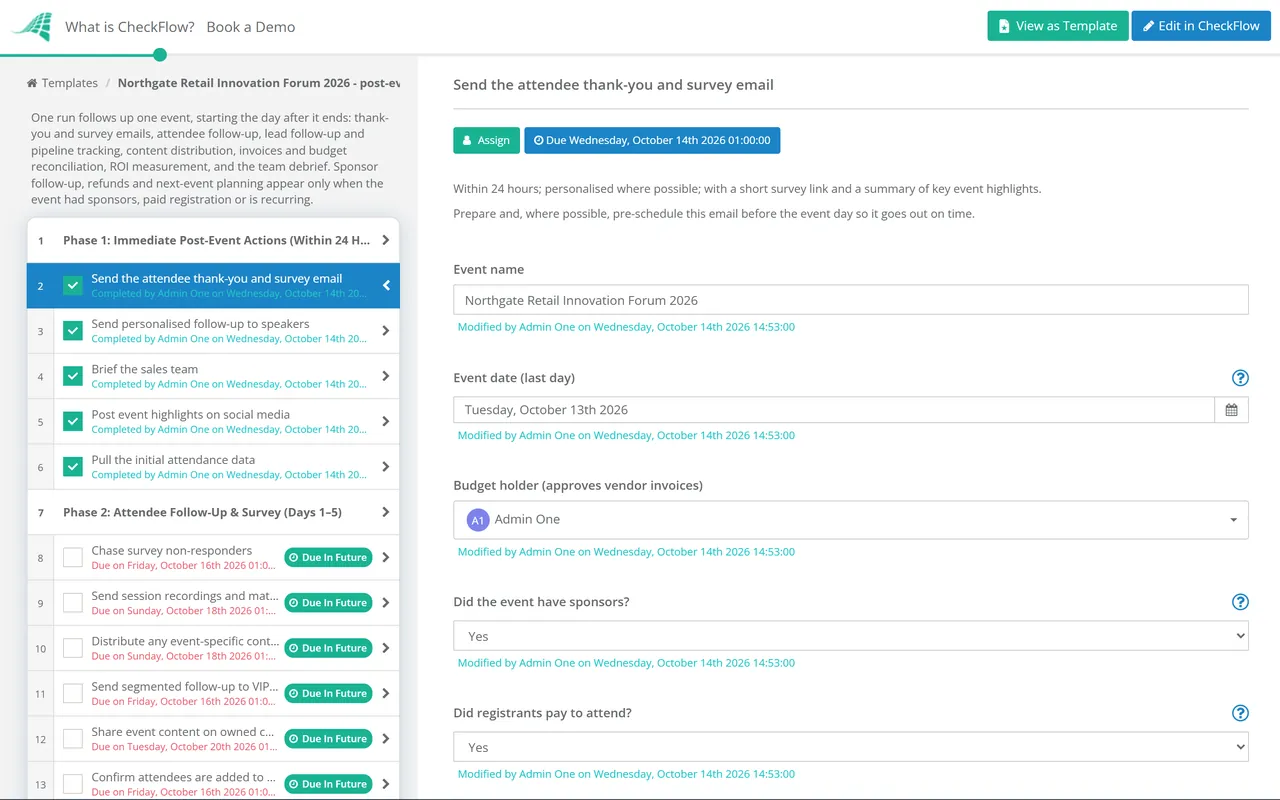
  • Send the attendee thank-you and survey email — within 24 hours; personalised where possible; with a short survey link and a summary of key event highlights
  • Send personalised follow-up to speakers — a specific, personal thank-you within 24 hours; include any agreed post-event deliverables (recording links, attendance numbers)
  • Brief the sales team — a hot leads briefing within 24 hours of event close; sharing attendee data, conversation notes, and priority follow-up targets
  • Post event highlights on social media — while the event is still trending; photos, key quotes, and session highlights
  • Pull the initial attendance data — registered versus attended, no-show rate, and any session-level data available
Phase 2

Attendee Follow-Up & Survey (Days 1–5)

  • Chase survey non-responders — a single reminder email at day three; confirm the survey closes at day five to allow analysis to begin
  • Send session recordings and materials — to all registered attendees (including those who did not attend in person); extends value and maintains engagement
  • Distribute any event-specific content — white papers, reports, or resources referenced during the event; with tracking links to measure engagement
  • Send segmented follow-up to VIP attendees and key prospects — personalised communications referencing specific conversations or sessions; not a mass send
  • Share event content on owned channels — blog post summary, social media series, and email newsletter coverage of key themes
  • Confirm attendees are added to CRM — with relevant tags (event attended, sessions, engagement level) for ongoing marketing
Phase 3

Lead Follow-Up & Sales Pipeline Management

  • Complete the hot lead outreach within 48 hours — personalised communication referencing a specific conversation at the event; a generic “great to meet you” is not a follow-up
  • Log all event contacts in CRM with event-specific notes — what was discussed, what interest was indicated, and agreed next steps
  • Assign follow-up tasks to the relevant account manager or sales rep — with a specific action and deadline, not an open-ended “follow up”
  • Complete meeting requests made at the event — calendar invites sent within 48 hours of the meeting being requested
  • Track pipeline influence — update CRM with which deals were progressed or initiated as a result of event conversations
  • Confirm sponsor follow-up is complete — sponsors who participated need acknowledgement, attendance data, and any post-event assets agreed in the contract
Phase 4

Post-Event Content Distribution

  • Publish the session recordings — edited and accessible; with descriptions and speaker credits; UTM-tracked for engagement measurement
  • Create post-event content assets — highlight video, key quotes graphics, and stats from the event; repurpose for LinkedIn, email, and website
  • Publish the event recap blog post — key themes, speaker highlights, and attendance numbers; a source for ongoing SEO value
  • Distribute media coverage — press releases, journalist follow-ups, and any media coverage obtained; shared with stakeholders and on owned channels
  • Manage speaker content sharing — confirm speakers have received their session recording and any photos; encourage and facilitate social sharing
  • Archive all event photography and video — organised and stored in the brand asset library
Phase 5

Budget Reconciliation & Final Invoices

  • Collect and approve all outstanding vendor invoices — confirm receipt matches contract; flag any discrepancies
  • Process all outstanding payments — speaker fees, final venue invoice, and any post-event vendor charges
  • Reconcile the event budget — actual spend versus approved budget by category; note every variance and its cause
  • Confirm revenue actuals — ticket revenue, sponsorship, and any other income; confirm against projections
  • Calculate the net event cost — total spend minus total income
  • Process refund requests from non-attending registrants according to the refund policy
Phase 6

ROI Measurement & Performance Evaluation

Event ROI is not just ticket revenue. For B2B events, pipeline influence and new relationships are the primary value drivers. Define the right metrics before the event, not after.

  • Analyse survey results — NPS, session ratings, and open-ended feedback; confirm findings are documented and shared
  • Review attendance metrics — registered versus attended, no-show rate, session attendance (for multi-track events), and any VIP attendance targets
  • Calculate pipeline influence — deals influenced or initiated at the event; revenue pipeline attributed to event conversations
  • Calculate leads generated — new contacts added to CRM as a result of the event
  • Review media and social coverage — press mentions, social reach, and any earned media value
  • Produce the event ROI report — performance against every pre-defined KPI; shared with event sponsor and key stakeholders
Phase 7

Team Debrief & Future Event Planning

  • Run the structured team debrief within one week — while memories are fresh; covering what worked, what did not, and specific recommendations for the next event
  • Collect vendor feedback — which vendors performed well and which should not be used again; documented for future event planning
  • Update the vendor database — ratings, notes, and preferred vendor status for strong performers
  • Document lessons learned — a structured post-event document that captures all debrief findings in a format useful for future planning
  • Confirm next event planning start date — for recurring events, confirm when planning begins for the next iteration; schedule the kickoff

Available as a free CheckFlow template — tasks pre-assigned to event team, marketing, and sales before the event ends, 48-hour actions triggered automatically, and the full post-event record archived.

Use This Template Free

The Post-Event Follow-Up Timeline

Day 0 — Event Day

Team debrief note immediately after close. Hot leads list prepared and ready to brief the sales team first thing tomorrow.

Within 24 Hours

Attendee thank-you and survey sent. Speaker thank-yous sent. Sales team briefed with hot leads list. Social media event highlights posted.

Days 1–3

Hot lead personalised follow-ups sent. Meeting requests actioned with calendar invites. CRM fully updated with event contacts and notes. Survey reminder sent to non-responders.

Days 3–5

Survey closes. Recordings and materials distributed to all registered attendees. Event recap blog post published.

Days 5–10

Budget reconciliation complete. Final vendor invoices processed and approved. Survey analysis complete and distributed.

Days 7–14

Event ROI report produced and shared with stakeholders. Team debrief completed. Lessons learned documented for future planning.

Days 14–30

Full content distribution campaign underway. Media coverage follow-up complete. Future event planning initiated with lessons learned incorporated.

Why Run Post-Event Follow-Up in CheckFlow?

1

Pre-plan the follow-up before the event ends

The post-event checklist should be set up and task owners assigned before the event day — so that when doors close, the follow-up begins automatically. CheckFlow allows event teams to pre-assign every post-event task, with due dates set relative to the event date, so the 48-hour window begins before anyone has to remember to start it.
2

Coordinate three separate follow-up audiences simultaneously

Post-event follow-up involves three parallel workstreams — attendee communications (event team and marketing), lead follow-up (sales team), and internal debrief (whole team). These run simultaneously and all have different urgencies and owners. CheckFlow assigns each to the right person and gives the event manager a live view of all three simultaneously.

3

A follow-up record that feeds future events

Every post-event evaluation — survey findings, budget actuals, ROI report, and debrief notes — is archived in CheckFlow with the event record. When planning the next event, the team starts from evidence rather than memory: which vendors to rehire, which sessions attendees rated highest, which marketing channels produced most registrations.

Post-event lead follow-up is one element of the broader customer success process. CheckFlow’s Customer Success Strategy Checklist covers how to build the ongoing nurture and follow-up framework that converts event leads into long-term customers. See the Customer Success Strategy Checklist →

The post-event debrief produces the lessons that make future event planning more effective. For recurring events, CheckFlow’s recurring checklist feature incorporates the previous event’s lessons into the next planning cycle automatically. Learn more about recurring checklists →

Frequently Asked Questions

What should a post-event follow-up process include?

+

Seven phases: immediate actions within 24 hours (attendee thank-you and survey, speaker thanks, sales team briefing, social media highlights); attendee follow-up in days 1–5 (survey chaser, recordings, materials distribution, segmented VIP outreach); lead follow-up and CRM (personalised hot lead outreach within 48 hours, CRM updates, meeting requests); content distribution (recordings, blog, social, media coverage); financial reconciliation (invoices, payments, budget actuals); ROI measurement (survey analysis, attendance metrics, pipeline influence); and team debrief within one week.

How quickly should you follow up after an event?

+

Within 24 hours for attendee thank-you and survey, speaker thank-yous, and the hot leads briefing to the sales team. Within 48 hours for personalised hot lead follow-up outreach and meeting confirmations. Within 5 days for all attendee material distribution and survey closure. Within 7 days for the internal team debrief. Within 14 days for the event ROI report. The 24–48 hour window is when attendee memory, emotional engagement, and willingness to respond are highest — missing it produces measurably lower engagement with all subsequent follow-up.

How do you measure event ROI?

+

Event ROI depends on what the event was designed to achieve. For lead generation events: number of new contacts added to CRM, pipeline value influenced or initiated, and deals closed within 90 days where event engagement was a factor. For brand and awareness events: media coverage, social reach, NPS from attendees, and share of voice in the event’s topic area. For internal events: employee NPS, engagement survey scores pre- and post-event, and specific objective achievement. The most important rule: define the KPIs before the event, not after — so the data needed to measure them is captured during the event.

What should be covered in a post-event team debrief?

+

What went well and should be repeated, what did not work and should be changed, what caused the biggest stress and whether it was avoidable with better planning, which vendors performed best and worst, whether the timeline had the right lead times, whether the budget was well-calibrated, what attendees said in the survey that reflects on the team’s planning and execution, and three specific recommendations for the next event. Conduct the debrief within one week of the event, when memories are specific rather than general.

Is CheckFlow free for this template?

+

Yes — 14-day free trial, no card required. The Business plan is $10 per user per month after the trial. Full details at checkflow.io/pricing.

Capture the Value of Every Event in the 48 Hours After It

Free trial — no credit card required.