HIPAA compliance is not a one-time certification — it is an ongoing programme of risk assessment, policy maintenance, workforce training, technical safeguards, and breach preparedness. The Office for Civil Rights (OCR) enforces HIPAA through complaint investigations, compliance reviews, and periodic audit programmes — with penalties reaching $2.1 million per violation category per year and criminal liability for wilful neglect. This free HIPAA compliance audit checklist gives compliance officers, privacy officers, and health IT teams a structured framework for conducting an internal HIPAA audit — covering the Privacy Rule, all three Security Rule safeguard categories, Business Associate management, and Breach Notification Rule requirements.
What Is a HIPAA Compliance Audit?
A HIPAA compliance audit is a systematic internal review of whether a covered entity or business associate is meeting the requirements of the Health Insurance Portability and Accountability Act of 1996 and its implementing regulations — the Privacy Rule, Security Rule, Breach Notification Rule, and Omnibus Rule. Unlike an OCR audit (which is conducted externally by the Department of Health and Human Services), an internal HIPAA compliance audit is conducted by the organisation itself — or by an independent third party engaged for the purpose.
HIPAA applies to three categories of covered entities — healthcare providers that transmit health information electronically, health plans, and healthcare clearinghouses — and to business associates: organisations that create, receive, maintain, or transmit protected health information (PHI) on behalf of a covered entity. Business associates include IT vendors, cloud service providers, billing companies, legal firms, and any subcontractor that handles PHI. Business associates are directly liable under HIPAA — not just contractually — since the 2013 Omnibus Rule.
The OCR’s active 2024–2025 audit programme is reviewing 50 covered entities and business associates specifically on Security Rule provisions related to hacking and ransomware — the most significant enforcement focus of recent years, given that 186 million patient records were affected by breaches in 2024. A structured internal audit checklist is the most effective way to identify and remediate gaps before an OCR audit or a breach occurs.
What the HIPAA Compliance Audit Checklist Covers
This checklist is organised into six audit areas covering the full scope of HIPAA compliance obligations for covered entities and business associates.
- 1
Phase 1
Audit Scope, Roles & Risk Analysis
10 tasksThe Security Risk Analysis is the single most commonly cited OCR enforcement action. A documented, organisation-wide risk analysis is required — not optional.
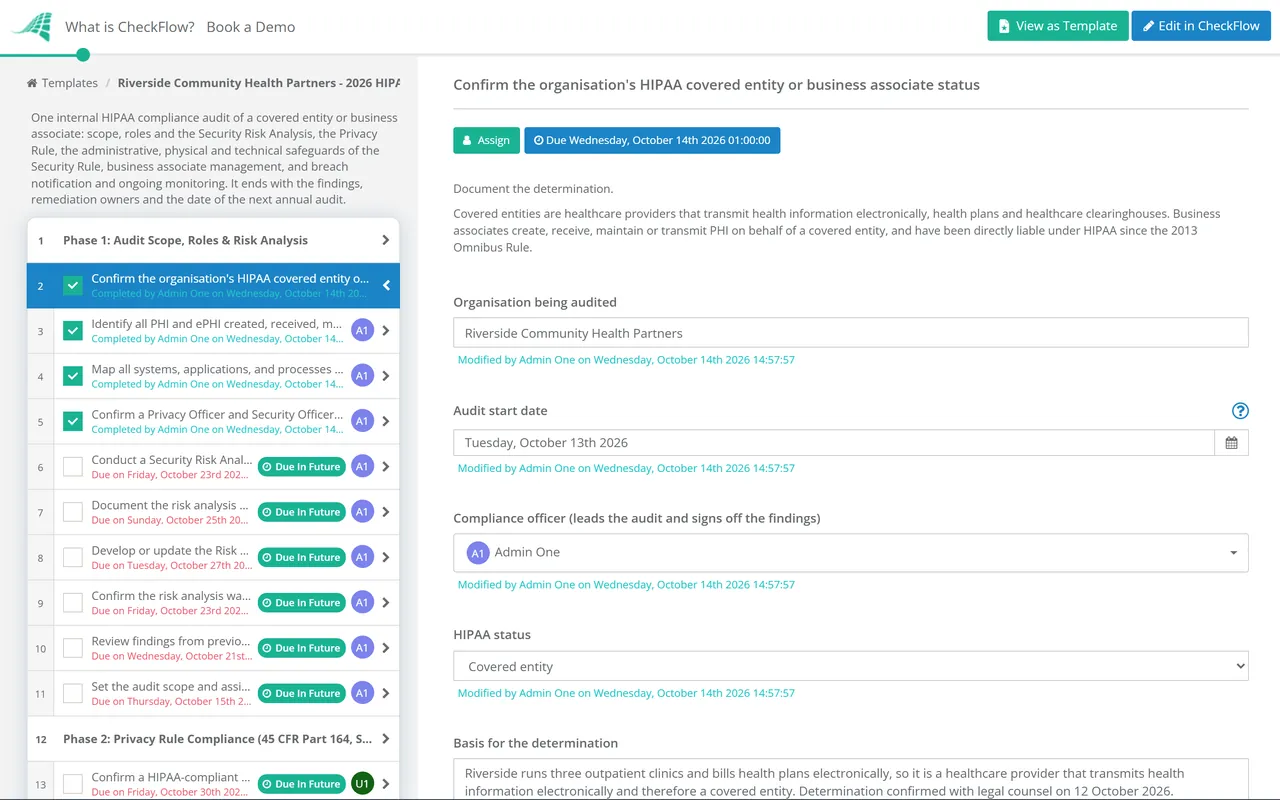
- Confirm the organisation’s HIPAA covered entity or business associate status — document the determination
- Identify all PHI and ePHI (electronic protected health information) created, received, maintained, or transmitted by the organisation
- Map all systems, applications, and processes that handle PHI or ePHI — include on-premises, cloud, and third-party systems
- Confirm a Privacy Officer and Security Officer are designated — document their names, roles, and contact details
- Conduct a Security Risk Analysis per 45 CFR § 164.308(a)(1) — identify reasonably anticipated threats and vulnerabilities to ePHI confidentiality, integrity, and availability
- Document the risk analysis methodology, scope, findings, and risk ratings
- Develop or update the Risk Management Plan — document how identified risks are being treated and the current status of each risk
- Confirm the risk analysis has been reviewed and updated within the last 12 months or following a significant change
- Review findings from previous audits, OCR investigations, or breach incidents — confirm outstanding remediation items have been addressed
- Set the audit scope and assign responsibilities across compliance, IT, HR, and legal
- 2
Phase 2
Privacy Rule Compliance (45 CFR Part 164, Subpart E)
10 tasks
- Confirm a HIPAA-compliant Notice of Privacy Practices (NPP) is in place, current, and distributed to patients or health plan members as required
- Verify the NPP is posted on the organisation’s website and available at the point of service
- Confirm PHI use and disclosure policies cover all permitted uses — treatment, payment, healthcare operations — and all required authorisations for other uses
- Verify minimum necessary policies are in place — PHI access and disclosure is limited to the minimum necessary for the intended purpose
- Confirm patient rights procedures are implemented and functioning — right to access, right to amend, right to accounting of disclosures, right to restrict, and right to request confidential communications
- Verify response timelines for patient access requests are met — covered entities must generally act within 30 days
- Confirm authorisation forms for uses and disclosures beyond TPO are compliant with 45 CFR § 164.508
- Verify de-identification procedures meet either the Safe Harbor or Expert Determination method where de-identified data is used
- Confirm marketing and fundraising communications using PHI comply with applicable restrictions
- Confirm workforce members have received Privacy Rule training — verify training records are current and complete
- 3
Phase 3
Security Rule — Administrative Safeguards (45 CFR § 164.308)
10 tasks
- Confirm a Security Management Process is in place — includes risk analysis, risk management, sanction policy, and information system activity review
- Verify a workforce security programme is in place — covers authorisation and supervision, workforce clearance, and termination procedures
- Confirm Information Access Management procedures restrict ePHI access to authorised users and roles
- Verify Security Awareness and Training programme covers all workforce members — confirm training includes protection from malicious software, log-in monitoring, and password management
- Confirm a Security Incident Procedures policy is in place — covers identification, response, and documentation of security incidents
- Verify a Contingency Plan is documented and tested — covers data backup, disaster recovery, emergency mode operation, testing, and applications criticality analysis
- Confirm the organisation conducts periodic technical and non-technical evaluations of Security Rule compliance — document evaluation results and remediation actions
- Verify Business Associate Agreements (BAAs) are in place with all business associates who handle ePHI on behalf of the organisation
- Confirm BAAs are reviewed and updated when the business associate relationship or services change
- Verify sanction policies are documented and that workforce violations have been handled consistently
- 4
Phase 4
Security Rule — Physical & Technical Safeguards (45 CFR § 164.310 & 164.312)
11 tasksPhysical Safeguards (45 CFR § 164.310)
- Confirm Facility Access Controls restrict physical access to ePHI systems — document authorised personnel and access procedures
- Verify workstation use policies define the appropriate functions performed and manner of performance for workstations that access ePHI
- Confirm workstation security policies restrict physical access to workstations handling ePHI — clear desk practices, screen locks, and physical positioning
- Verify Device and Media Controls cover receipt, removal, disposal, and reuse of hardware and media containing ePHI — confirm media sanitisation procedures are in place and followed
- Confirm a hardware asset inventory is maintained for all devices that store or access ePHI
Technical Safeguards (45 CFR § 164.312)
- Confirm Access Controls limit ePHI system access to authorised users — include unique user identification, emergency access procedures, and automatic logoff
- Verify Audit Controls are implemented — hardware, software, and procedural mechanisms record and examine system activity involving ePHI
- Confirm Integrity controls protect ePHI from improper alteration or destruction — verify mechanisms to authenticate ePHI are in place
- Verify Person Authentication procedures verify the identity of users seeking access to ePHI — confirm MFA implementation status (mandatory under 2025 proposed Security Rule updates)
- Confirm Transmission Security controls protect ePHI transmitted over electronic communications networks — verify encryption is implemented for ePHI in transit and at rest
- Verify encryption standards meet current requirements — note: 2025 proposed Security Rule updates make encryption of ePHI at rest and in transit mandatory rather than addressable
- 5
Phase 5
Business Associate Management
10 tasks
- Identify all current business associates — any organisation that creates, receives, maintains, or transmits PHI on behalf of the covered entity
- Confirm a signed, HIPAA-compliant Business Associate Agreement (BAA) is in place for every business associate
- Verify BAAs contain all required provisions — permitted and required uses of PHI, safeguard obligations, reporting requirements, and termination provisions
- Confirm business associates have been notified of any changes to the organisation’s privacy or security policies that affect their obligations
- Verify that subcontractors of business associates who handle PHI have their own BAAs in place
- Review business associate security practices — confirm adequate safeguards are in place through vendor questionnaires, third-party assessments, or audit rights provisions
- Confirm breach notification obligations in BAAs require prompt notification to the covered entity following discovery of a breach
- Verify that terminated business associate relationships include proper destruction or return of PHI
- Confirm BAA inventory is maintained and reviewed annually
- Document any business associates identified without current BAAs and initiate remediation immediately
- 6
Phase 6
Breach Notification Rule & Ongoing Compliance Monitoring
10 tasks
- Confirm a Breach Notification Policy is documented — covers discovery, risk assessment, notification timelines, and content requirements
- Verify the breach risk assessment process evaluates four factors: nature and extent of PHI, unauthorised person identity, whether PHI was actually acquired or viewed, and extent of risk mitigation
- Confirm notification timelines are understood — affected individuals must be notified without unreasonable delay and within 60 days of discovery; HHS must be notified within 60 days; media notification required for breaches affecting 500+ residents of a state
- Verify a breach log is maintained — document all breaches and suspected breaches and the outcome of each risk assessment
- Confirm the annual HHS breach report is submitted for breaches affecting fewer than 500 individuals
- Review breach incident history — confirm all past breaches have been properly assessed, notified, and documented
- Verify workforce HIPAA training is current for all employees and contractors — confirm training covers breach recognition and internal reporting procedures
- Confirm ongoing monitoring of system activity, access logs, and security alerts — review monitoring processes and recent logs
- Verify vulnerability management programme is in place — confirm regular scanning, patching, and remediation timelines
- Document audit findings, assign remediation owners and target dates, and schedule the next annual HIPAA audit
This checklist is available as a free, runnable template in CheckFlow — with tasks assigned across compliance, IT, HR, and legal teams, audit findings tracked to remediation, and a complete audit record for every review cycle.
Use this template freeWho Must Comply With HIPAA?
HIPAA applies to two categories of organisations. Understanding which category applies determines your specific compliance obligations.
Covered Entities
Organisations that directly handle patient health information as part of their core function. Includes:
- Healthcare providers — hospitals, clinics, physicians, dentists, pharmacies, nursing homes, and any provider that transmits health information electronically
- Health plans — health insurance companies, HMOs, company health plans, Medicare, Medicaid, and government health programmes
- Healthcare clearinghouses — organisations that process health information from non-standard to standard formats
Business Associates (and their Subcontractors)
Organisations that perform functions or activities involving PHI on behalf of a covered entity. Directly liable under HIPAA since the 2013 Omnibus Rule. Includes:
- IT vendors and cloud service providers that host or process ePHI
- Billing and coding companies
- Law firms and accountants handling PHI in the course of their services
- Health information exchange organisations
- Medical transcription services
- Subcontractors of business associates who handle PHI
Both covered entities and business associates must conduct regular HIPAA compliance audits and maintain documentation demonstrating compliance. Business associates that fail to comply are directly liable to OCR — not just contractually liable to the covered entity.
2025 HIPAA Security Rule Updates — What’s Changing
Note: The changes described below are proposed updates to the HIPAA Security Rule as of 2025. They have not yet been enacted as final rules. Organisations should monitor HHS guidance for finalisation dates.
The HHS proposed significant updates to the HIPAA Security Rule in 2025 that would substantially tighten ePHI protection requirements. While not yet final, compliance teams should assess current gaps now.
All specifications become mandatory
The distinction between “required” and “addressable” specifications would be eliminated — all Security Rule specifications would become mandatory. Organisations that previously treated addressable specifications as optional based on risk analysis must reassess their compliance posture.
Multi-factor authentication required
MFA would be required for all access to ePHI systems — not merely addressable. Organisations should assess current MFA coverage across all systems handling ePHI and close any gaps.
Encryption mandatory
Encryption of ePHI at rest and in transit would shift from addressable to required. Organisations relying on compensating controls in lieu of encryption should begin planning for full encryption implementation.
Faster breach notification
Notification timelines for certain high-severity security incidents would be reduced from 60 days to 24 hours. Incident response procedures and internal escalation paths would need to be significantly faster.
Annual technology asset inventory
Organisations would be required to maintain a current technology asset inventory and a network map — updated at least annually — covering all systems that handle ePHI.
Why Run Your HIPAA Audit in CheckFlow?
1Coordinate across compliance, IT, HR, and legal
A HIPAA compliance audit spans multiple departments simultaneously. The Privacy Officer reviews Privacy Rule procedures; IT assesses technical safeguards; HR reviews workforce training records and termination procedures; legal reviews BAAs. CheckFlow assigns each section to the right team, notifies them when their tasks are due, and gives the compliance officer a real-time view of progress across the full audit — without a single status meeting.
Track findings from identification to remediation
Every gap identified during the audit becomes a trackable action in CheckFlow — assigned to a named owner with a due date and automatic reminders. Nothing sits in a report that nobody follows up on. When the next audit cycle begins, you have a complete record of what was found last time and what was done about it — the documentation OCR asks for when it reviews your compliance history.
Schedule annual audits so they never slip
HIPAA requires ongoing risk analysis, annual security reviews, and regular workforce training — not as a one-off exercise. CheckFlow’s recurring checklist feature schedules these activities automatically so nothing is missed or deferred. The same structured checklist, every year, with a fresh evidence trail that builds throughout each audit cycle.
HIPAA Security Rule Administrative Safeguards (45 CFR § 164.308) require documented workforce termination procedures — ensuring ePHI access is revoked and devices are returned when employment ends. CheckFlow’s IT offboarding checklist provides a structured, automated process for every leaver, with a timestamped audit trail that directly satisfies the workforce security safeguard evidence requirement. Learn more about CheckFlow for IT offboarding →
HIPAA requires a documented contingency plan covering data backup, disaster recovery, and emergency mode operations — and evidence that the plan is tested. CheckFlow’s Disaster Recovery Audit Checklist provides a structured framework for auditing your contingency planning controls and documenting test evidence. See the Disaster Recovery Audit Checklist →