The new remote employee who spends their first day waiting for a laptop to arrive, unable to access their email, and with no structured introduction to their team, forms an impression of the organisation’s competence that takes months to revise.
Remote onboarding is harder than in-person onboarding — and most organisations have not redesigned their onboarding process to reflect this. The organic connection that happens naturally in an office — overhearing conversations, joining colleagues for lunch, asking a quick question across the desk — does not happen remotely. It has to be designed. The new remote employee who is not introduced to specific colleagues, given a buddy, scheduled into structured learning conversations, and included in the informal social rhythms of the team arrives at the 30-day mark without the relationships and context that an in-person counterpart would have accumulated incidentally. The consequences are concrete: remote new starters who have not built early connections are more likely to leave in the first six months. A structured remote onboarding process substitutes deliberate design for the accidental connection of in-person environments. It ensures equipment and access are ready before day one, the first day is a welcome rather than a wait, the first month provides structured context rather than self-directed confusion, and the 30-60-90 day framework gives both the employee and manager a clear shared understanding of what success looks like at each milestone. This free checklist gives HR managers and remote team leaders a structured framework for the full remote employee onboarding lifecycle.
What Remote Onboarding Must Deliberately Provide That In-Person Provides Accidentally
Connection
In-Person
Happens organically through proximity — the lunch invitation, the corridor conversation, the desk neighbour.
Remote
Must be designed — structured introduction calls, a peer buddy assignment, inclusion in existing social rhythms, intentional one-to-one connections with key colleagues.
Context
In-Person
Absorbed through ambient observation — overhearing how the team works, seeing how decisions are made, watching senior colleagues in action.
Remote
Must be explicitly provided — structured “how we work” sessions, documentation of team norms and processes, specific context-sharing conversations with key stakeholders.
Belonging
In-Person
Developed through inclusion in the informal social fabric — lunch groups, informal Friday drinks, the birthday celebration.
Remote
Must be actively created — explicit inclusion in virtual social events, recognition in team meetings, visible acknowledgement by the manager and team.
What the Remote Employee Onboarding Checklist Covers
This checklist covers the full remote onboarding lifecycle in six phases — from pre-start preparation through to the 90-day probation review. Each phase builds deliberately on the remote-specific design principles that in-person environments provide organically.
Phase 1
Phase 1: Pre-Start Preparation
The pre-start phase is the highest-return investment in remote onboarding. An employee who arrives on day one with their laptop configured, their accounts active, their first-day schedule ready, and a personal welcome email from their manager already feels welcomed. An employee who arrives to find they have to wait for all of this to happen feels the organisation’s operational incompetence before they have attended their first meeting.
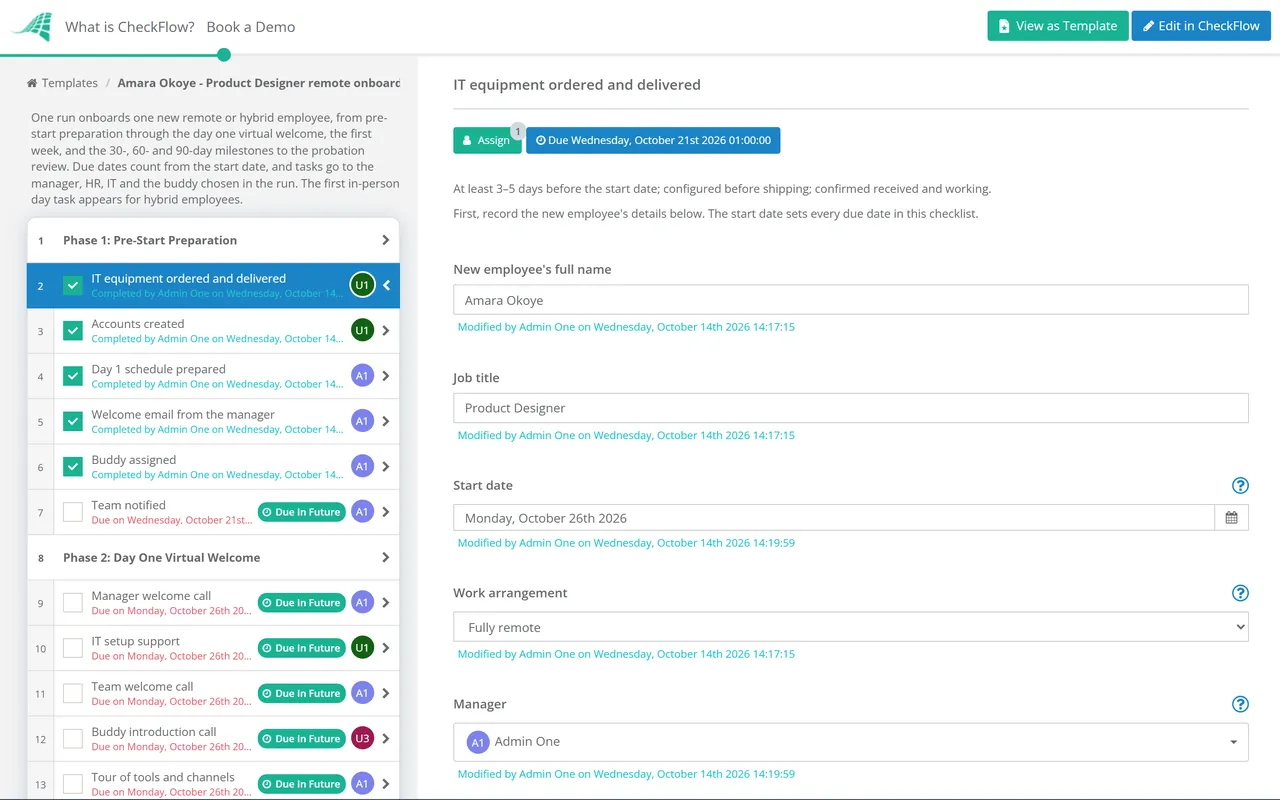
IT equipment ordered and delivered — at least 3–5 days before the start date; configured before shipping; confirmed received and working
Accounts created — corporate email, Slack/Teams/communication platform, HR system, VPN; all active before day 1; credentials ready to share securely
Day 1 schedule prepared — a structured agenda for the first day; who to meet when; what to do when; shared with the new employee before they start
Welcome email from the manager — sent the day before start; personalised; expressing genuine enthusiasm about having them join; not a generic HR notification
Buddy assigned — a peer (not the manager) who will be the new employee’s first contact for informal questions; buddy briefed on their role
Team notified — of the new starter joining; their background, role, and start date shared; the team knows who is joining before they meet them
Phase 2
Phase 2: Day One Virtual Welcome
Manager welcome call — first thing in the morning; not an email or a calendar invite to a meeting at 10am; a personal video call with the manager as the first experience of the day
IT setup support — scheduled; all systems confirmed working; IT contact available for the first few hours for any access issues
Team welcome call — the whole team meets the new starter; each team member briefly introduces themselves; not a formal presentation but a genuine welcome
Buddy introduction call — 1:1 call between the new starter and their assigned buddy; informal; an opportunity to ask any question
Tour of tools and channels — guided walkthrough of the communication platform structure; which channels are for what; how the team communicates; meeting cadence
Phase 3
Phase 3: First Week — Structured Introduction
Role and expectations clarity — a detailed conversation with the manager covering: what success looks like in the first 30, 60, and 90 days; how performance is measured; key priorities for the first month
Structured stakeholder meetings — 30-minute “coffee chat” style introductions with 5–8 key colleagues the new employee will work with; scheduled before they start; a different call each day of the first week
HR and policies onboarding — company handbook, HR policies, benefits, expense process, holiday process; walkthrough with HR or a recorded session
Core tools training — any tools specific to the role that require training; scheduled in the first week, not “whenever you get to it”
Check-in with manager — end of week 1; how is it going? Any access or tool issues unresolved? First impressions of what’s needed?
Phase 4
Phase 4: 30-Day Milestone
Formal 30-day check-in with manager — structured 1:1: how is the role matching expectations? What is going well? What needs more support? What gaps are there in access or understanding?
30-day goal review — what was set as the 30-day goal? Has it been achieved? What was harder than expected?
Social connection check — has the new employee built working relationships with their key colleagues? Any specific introductions still needed?
For hybrid teams: first in-person day by 30 days — if not already happened; the first 3 months should include meaningful in-person time even for hybrid employees
Buddy check-in — how has the buddy relationship worked? Is the buddy still needed or has the new employee developed their own network?
Phase 5
Phase 5: 60-Day Milestone
60-day check-in — with manager and HR; more structured than 30-day; covers both performance and wellbeing
Role calibration — is the role what was described? Are there gaps between expectation and reality? Address proactively, not at the 6-month review
Development conversation — what skills or knowledge is the new employee developing? What learning is happening? Any training needed?
Tools and process competence — is the employee fluent in the core tools and processes of their role? Any additional training required?
Phase 6
Phase 6: 90-Day Milestone & Probation Review
Formal probation review — structured assessment against the defined objectives for the first 90 days; documented; signed by both parties
Confirm permanent employment — or extend probation with specific goals; or address performance concerns with a formal plan
Set goals for the next 90 days — the first 90 days is learning; the next 90 days is contributing; clear goals for this second phase
Gather feedback from the employee — how was the onboarding experience? What could be better? This feedback improves the process for the next new starter
Pre-start preparation completed before day one — guaranteed
The most preventable remote onboarding failure is the one that happens before the employee arrives — equipment not shipped, accounts not created, first day not planned. CheckFlow’s pre-start phase triggers 14 days before the start date, assigned to IT and HR, with explicit completion required before day one can be confirmed.
2
The 30-60-90 day structure tracked automatically
A 30-day check-in that depends on the manager remembering to schedule it at the right time happens inconsistently. CheckFlow triggers the 30-day, 60-day, and 90-day milestones automatically based on the employee’s start date — ensuring every remote new starter gets the structured follow-through at each milestone, regardless of how busy the manager is.
3
A consistent remote onboarding experience for every new starter
The quality of remote onboarding should not depend on which manager a new employee reports to. CheckFlow deploys the same structured remote onboarding checklist to every new remote or hybrid starter — giving every person the same quality of welcome, same structured introductions, and same milestone check-ins.
Equipment setup is the first pre-start task. CheckFlow’s IT Equipment Request Process covers the structured provisioning workflow. See the IT Equipment Request Process →
Remote employee onboarding builds on the full employee onboarding framework. CheckFlow’s Employee Onboarding Checklist in the Employee Onboarding series covers the broader onboarding lifecycle. See the Employee Onboarding Checklist →
What should a remote employee onboarding checklist include?
+
A remote employee onboarding checklist covers six phases: pre-start preparation (IT equipment delivered and working, accounts created, day 1 schedule prepared, manager welcome email, buddy assigned, team notified), day one welcome (manager welcome call, IT setup confirmed, team welcome call, buddy introduction, tools tour), first week (role and expectations clarity, stakeholder introduction calls, HR policies, core tools training, week 1 check-in), 30-day milestone (performance check-in, goal review, social connection check, first in-person day for hybrid, buddy review), 60-day milestone (performance and wellbeing check-in, role calibration, development conversation), and 90-day milestone and probation review (formal review, confirmation, next 90-day goals, employee feedback on the onboarding experience).
What is a buddy programme for remote onboarding?
+
A buddy programme assigns a peer colleague (not the new employee’s manager) as a designated informal support contact for the first 60–90 days. The buddy is the person the new employee can ask questions they might feel embarrassed to ask their manager — “how does the expense claim system work?”, “what’s the culture around response times on Slack?”, “who is the right person to talk to about X?” The buddy is particularly valuable in remote settings because these informal questions that would be asked naturally across a desk in an office require a deliberate contact point when working remotely.
Why is pre-start preparation the most important phase of remote onboarding?
+
Research on employee engagement and retention consistently shows that the impression formed in the first days of a new role is a strong predictor of 6-month and 12-month retention. A new remote employee whose equipment arrives on day 3, whose email account is not active until the afternoon, and whose first day has no structure forms an immediate impression of organisational incompetence that is difficult to revise. Conversely, an employee who receives a personal welcome email the day before, finds their equipment configured and working on arrival, sees a structured first-day schedule in their calendar, and receives a manager call as their first experience of the working day starts the employment relationship with confidence and trust.
How does remote onboarding differ from in-person onboarding?
+
Remote onboarding differs in that every element of connection and context that in-person environments provide organically must be explicitly designed and scheduled. In-person employees absorb company culture through proximity — observing colleagues, joining informal conversations, and being naturally included in team activities. Remote employees do not have access to these ambient signals and must be deliberately introduced to key colleagues, explicitly taught team norms and processes, and actively included in social rhythms.
Is CheckFlow free for this template?
+
14-day free trial, no card required. The Business plan is $10 per user per month after the trial. Full details at checkflow.io/pricing.
Give Every Remote Starter the Welcome, the Tools, and the Connection They Need to Succeed
Free trial — no credit card required.
Do you like cookies? 🍪 We use cookies to ensure you get the best experience on our website. Learn more