The sprint review and retrospective are the two feedback loops that make agile development self-correcting. The sprint review gives the business a regular, structured view of the increment being built — not a progress report, but a working demonstration of done work — and gives the product owner the feedback to refine and reprioritise the backlog. The retrospective gives the team the structured space to examine how they worked during the sprint — what helped, what hindered, what to change — and to commit to specific, time-bound improvements. When these ceremonies work well, they create a compounding improvement dynamic: the product gets progressively closer to what the business needs because the business sees it regularly; the team works progressively better because they reflect systematically on how. When they do not work well — when unfinished work appears in demos, when retrospective actions are forgotten before the next standup, and when the backlog is not updated with the feedback collected — they become overhead rather than value. A structured sprint review and retrospective checklist ensures both ceremonies fulfil their intended purpose. This free checklist gives scrum masters, product owners, and development teams a structured framework for the full sprint review and retrospective cycle.
Sprint Review vs Sprint Retrospective — Different Audiences, Different Purposes
Sprint Review
- Audience
- Scrum team + stakeholders (product owner, business representatives, customers where appropriate)
- Purpose
- Demonstrate the sprint increment; inspect the product; collect feedback; update the product backlog
- Timebox
- Maximum 4 hours for a 4-week sprint; proportionally shorter for shorter sprints
- Output
- Updated product backlog; stakeholder feedback captured; next sprint inputs informed
- Who speaks
- Developers demonstrate their own work; product owner facilitates; stakeholders ask questions and give feedback
Sprint Retrospective
- Audience
- Scrum team only (no stakeholders)
- Purpose
- Inspect the team’s process, collaboration, and ways of working; identify improvements; commit to specific actions
- Timebox
- Maximum 3 hours for a 4-week sprint
- Output
- A small number of specific, actionable improvement commitments — carried into the next sprint
- Who speaks
- All team members equally; scrum master facilitates; no hierarchy
What the Sprint Review & Retrospective Checklist Covers
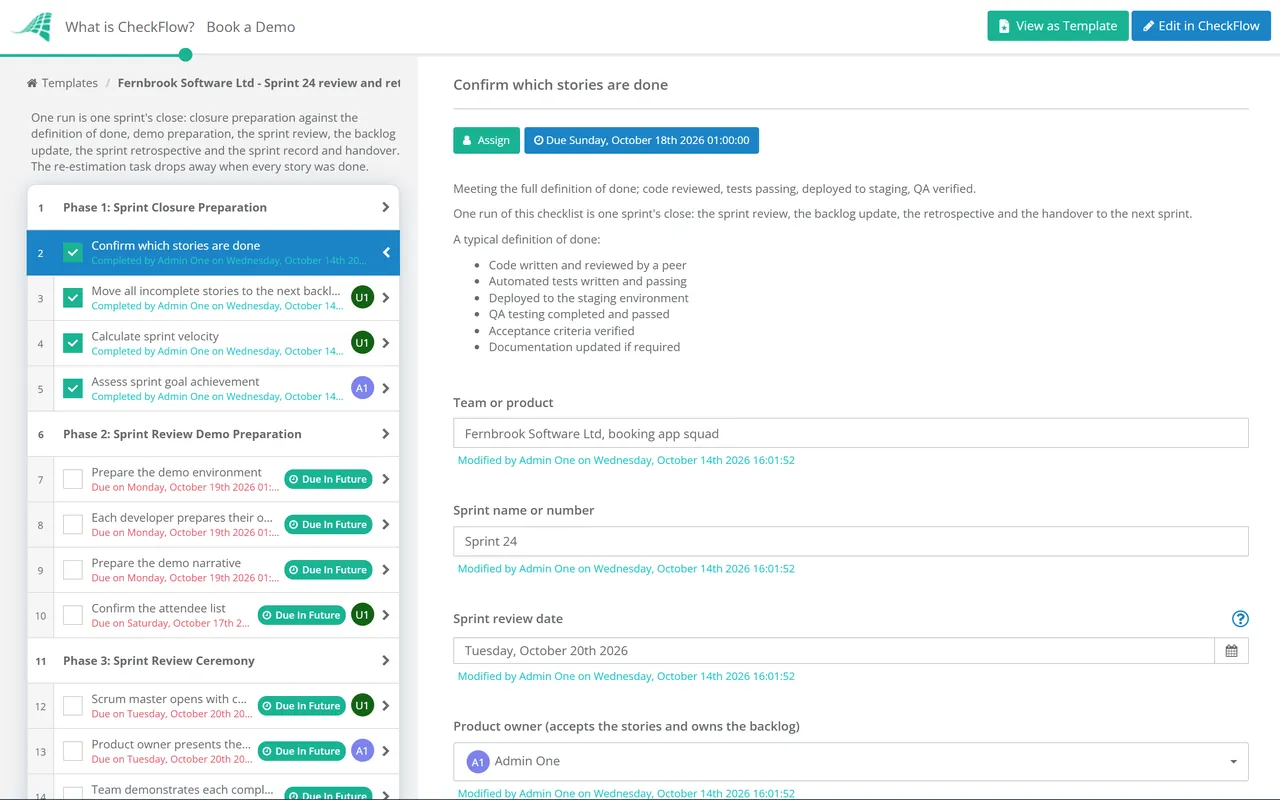
This checklist covers both end-of-sprint ceremonies in six phases — from sprint closure preparation through to the sprint record and handover.
- 1
Phase 1
Phase 1: Sprint Closure Preparation
4 tasksOnly work that meets the definition of done is presented in the sprint review. Unfinished work is not shown — it is moved back to the backlog, re-estimated where necessary, and represents a commitment that was not met. Presenting unfinished work as done erodes trust faster than any missed deadline.
- Confirm which stories are done — meeting the full definition of done; code reviewed, tests passing, deployed to staging, QA verified
- Move all incomplete stories to the next backlog — any story not meeting the definition of done is not presented; no “90% done”
- Calculate sprint velocity — total story points completed (done stories only); recorded for the velocity trend
- Assess sprint goal achievement — was the sprint goal met? Partially met? Not met? Document honestly
- 2
Phase 2
Phase 2: Sprint Review Demo Preparation
4 tasks
- Prepare the demo environment — staging environment or demo environment confirmed working; no live production demo for sensitive or unstable systems
- Each developer prepares their own demo — each person demonstrates their own work; the development team are the subject matter experts on what they built
- Prepare the demo narrative — not a technical walkthrough but a user-centric demonstration: “Here is the problem this solves; here is how the user now experiences it”
- Confirm the attendee list — product owner, relevant stakeholders; the review is more valuable with the right people in the room
- 3
Phase 3
Phase 3: Sprint Review Ceremony
5 tasks
- Scrum master opens with context — sprint dates, sprint goal, stories committed vs completed, velocity
- Product owner presents the sprint goal outcome — was the goal achieved? What does that mean for the product?
- Team demonstrates each completed story — functioning software; in the demo environment; user-story framing (“As a [user] I can now…”)
- Stakeholders ask questions and provide feedback — the product owner facilitates; all feedback captured in writing; no real-time backlog changes during the ceremony
- Product owner presents the updated product roadmap and next sprint priorities — in light of the feedback received and business context
- 4
Phase 4
Phase 4: Post-Review Backlog Update
4 tasks
- Log all stakeholder feedback — as potential backlog items; not automatically added to the backlog but assessed by the product owner
- Update the product backlog — with any items arising from the review that the product owner decides to add
- Re-estimate and re-prioritise incomplete stories — stories not completed this sprint; their estimates reviewed (the original estimate was wrong; correct it)
- Confirm the product backlog is in shape for the next sprint planning — the top of the backlog has enough refined stories for the next sprint
- 5
Phase 5
Phase 5: Sprint Retrospective
5 tasksThe retrospective is the team ceremony most frequently skipped under time pressure. It is also the ceremony with the most long-term compounding value. A team that consistently reflects and improves how it works will outperform a team of individually more talented people who do not.
- Scrum master opens with a brief recap — sprint goal outcome, velocity, any significant events during the sprint
- Team reflects on what went well — processes, interactions, and tools that helped; worth preserving and amplifying
- Team reflects on what could be improved — specific obstacles, frustrations, or process failures; stated as observations, not blame
- Identify 1–3 improvement actions — specific, actionable, assigned to a named person with a completion date; not “we should communicate better” but “we will add a 30-minute backlog refinement session every Tuesday starting next sprint, owned by [name]”
- Review actions from the previous retrospective — were they implemented? What was the result? This is the accountability check that gives retrospective actions their teeth
- 6
Phase 6
Phase 6: Sprint Record & Handover
4 tasks
- Record the sprint outcome — goal, velocity, completed stories, incomplete stories, key decisions, and stakeholder feedback summary
- Confirm retrospective actions are on the sprint board for the next sprint — visible and tracked alongside development work
- Share the sprint summary — with stakeholders who did not attend the review; brief, focused on the sprint goal outcome
- Begin the next sprint planning — or confirm the next planning session is scheduled and the backlog is in shape
Why Use CheckFlow for Sprint Reviews?
1Sprint review and retrospective run to their purpose — every sprint
CheckFlow’s sprint review checklist separates the two ceremonies into distinct phases — the external-facing increment demonstration and the internal team reflection — ensuring each runs to its intended purpose. The definition-of-done check prevents unfinished work from appearing in the demo. The retrospective phase requires a specific number of actionable commitments, not a general discussion.
Retrospective actions tracked into the next sprint
The retrospective action that is discussed and not documented is the retrospective action that is not implemented. CheckFlow’s retrospective phase creates a task for each committed improvement, assigns it to a named owner, and carries it forward into the next sprint board as a tracked item — visible alongside development work.
A sprint record for velocity trending and programme review
Sprint-over-sprint velocity data, sprint goal achievement rates, and the history of retrospective actions taken are the raw material for quarterly engineering health reviews and continuous improvement reporting. CheckFlow records all three automatically as the sprint review process runs.
The sprint review feeds into the sprint planning for the next sprint. CheckFlow’s Sprint Planning Checklist covers the structured planning ceremony. See the Sprint Planning Checklist →
User feedback collected during sprint reviews feeds the product backlog. CheckFlow’s User Feedback Collection Checklist in the Product Development & Launch series covers the systematic collection of user signals. See the User Feedback Collection Checklist →