
Nonprofit Grant Application Process Checklist Template
Missing a single required document can disqualify a grant application regardless of how strong the project proposal is. Organisational readiness — the documents and registrations that funders always request — is the foundation every grant application stands on.
Grant funding is among the most competitive funding sources available to nonprofits. A compelling project narrative, a realistic budget, and evidence of community need are the minimum requirements for a competitive proposal — but they are not the only requirements. Funders also require proof of nonprofit status, audited financial statements, Form 990 history, a board-approved budget, letters of support, and — for federal grants — current SAM.gov registration that must be renewed annually. Federal registration can take weeks to complete; beginning the renewal process the evening before a deadline has ended more than one well-prepared application. A structured grant application process addresses both the organisational readiness that funders require and the proposal quality that makes applications competitive — ensuring the right documents exist before the search begins, the research and eligibility assessment happens before significant writing investment is made, and the post-award compliance obligations are understood before the grant is accepted. This free checklist gives grant writers, development directors, and executive directors a structured framework for the full nonprofit grant application lifecycle.
The Documents Every Grant Funder Will Request — and Why They Must Be Ready Before the Search Begins
Document 1
IRS Determination Letter (US) / Charity Registration (UK)
Your 501(c)(3) determination letter or Charity Commission registration confirmation. Required by virtually every institutional funder to verify tax-exempt status. Should be immediately accessible.
Document 2
Most Recent Form 990 (US) / Annual Accounts (UK)
Funders examine the Form 990 for financial health, executive compensation, governance, and programme descriptions. A Form 990 with errors, omissions, or unusual patterns raises questions before the narrative is read.
Document 3
Audited Financial Statements
Most institutional funders require audited financials for grants above a defined threshold. For smaller nonprofits where a full audit is not required, reviewed financials or compiled statements with a board treasurer certification may be accepted.
Document 4
Board-Approved Organisational Budget
The current fiscal year budget approved by the board. Shows the grant request in context of the organisation’s overall financial scale. Should be current and board-approved at each application.
Document 5
Strategic Plan or Programme Plan
Evidence that the funded programme is part of a coherent organisational strategy — not a one-off project created to fit a funding opportunity.
Document 6
Federal Registration (SAM.gov) — Federal Grants Only
Active SAM.gov registration is required for all federal grants. Registration must be renewed annually. Renewal takes 1–2 weeks minimum and should begin at least 6 weeks before a grant deadline.
What the Grant Application Process Checklist Covers
This checklist covers seven phases of the grant application lifecycle — from prospecting through to post-award reporting. The organisational readiness check (Phase 3) is the phase most commonly skipped — and the one most likely to disqualify an otherwise strong application.
Prospecting
Phase 1: Grant Prospecting & Opportunity Research
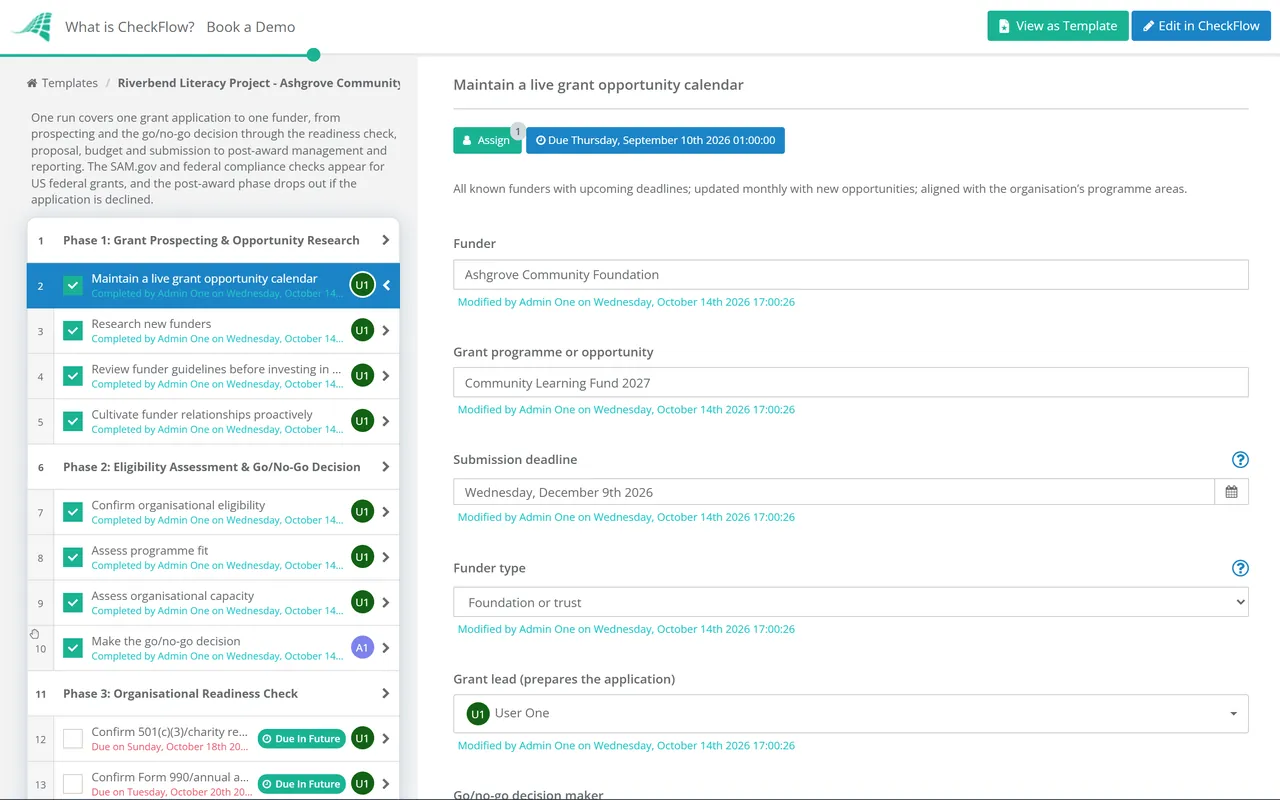
Maintain a live grant opportunity calendar — all known funders with upcoming deadlines; updated monthly with new opportunities; aligned with the organisation’s programme areas
Research new funders — using Grants.gov (federal), Foundation Directory, Charity Excellence (UK), or funder websites; search by programme area, geography, and funder type
Review funder guidelines before investing in research — is the organisation eligible? Does the programme area match? What is the average grant size?
Cultivate funder relationships proactively — introductory meetings before deadlines; understanding what funders are prioritising this cycle; relationships with programme officers improve application quality
Confirm organisational eligibility — 501(c)(3) status, geographic eligibility, organisation size requirements, programme area alignment; do not invest significant proposal writing time before confirming eligibility
Assess programme fit — does the funded programme area genuinely align with the organisation’s work, or is the programme being stretched to fit the funder? Mission drift in grant applications rarely produces good programmatic outcomes
Assess organisational capacity — does the organisation have the staff capacity, systems, and financial management capability to deliver and report on this grant? Under-resourced grant delivery damages funder relationships
Make the go/no-go decision — formally; the opportunity cost of a weak application is the staff time that could have been invested in a stronger one
Readiness
Phase 3: Organisational Readiness Check
Confirm 501(c)(3)/charity registration is current — and the determination letter is accessible; the expiry of tax-exempt status is an immediate disqualifier
Confirm Form 990/annual accounts are filed and current — the most recent filing is the one funders will review
Confirm audited or reviewed financial statements are prepared — for the most recently completed fiscal year; accessible in the grant document library
Confirm the current year budget has been board-approved — and is current; the grant request should appear as a line item or be reconcilable with the approved budget
For federal grants: confirm SAM.gov registration is active and current — check renewal date; renew at least 6 weeks before the application deadline; register on Grants.gov if applying to a new federal programme
Note 2025–2026 federal compliance update — HHS grants are now governed by 2 CFR Part 200 plus the new 2 CFR Part 300; compliance manuals still citing 45 CFR Part 75 must be updated; confirm with counsel or a grants compliance specialist
Proposal
Phase 4: Proposal Development
Write the cover letter — concise summary of the funding request; why the organisation and the funder are aligned; specific ask stated in the first paragraph
Write the project narrative — problem statement (why this need exists and is urgent), proposed solution (what you will do and how), expected outcomes (specifically what will change and for how many people), evaluation plan (how you will measure impact), and organisational capacity (why you are qualified to do this)
Use funder language from the guidelines — mirror the funder’s vocabulary and priorities; generic proposals that do not reflect the funder’s stated priorities signal a template approach
Obtain letters of support — from community partners, local government, or other credible stakeholders; particularly important for federal applications
Include beneficiary evidence — data on need, testimonials, case studies; qualitative and quantitative together
Budget
Phase 5: Budget Development
Prepare the line-item budget — matching the funder’s required format; personnel, fringe benefits, consultants, equipment, supplies, travel, indirect costs
Prepare the budget justification — a narrative explanation of every line; “Why do you need this?” answered for every item
Confirm indirect cost rate — for federal grants; use the organisation’s negotiated rate agreement (NICRA) if applicable; or de minimis rate of 10% MTDC if no NICRA exists
Confirm cost share or match requirements — if the funder requires matching funds; confirm how the match will be met and documented
Review for unallowable costs — under 2 CFR 200 for federal grants; specific costs (lobbying, entertainment, certain legal fees) are unallowable; confirm before submission
Submission
Phase 6: Review & Submission
Internal review — the proposal reviewed by someone who did not write it; the programme director confirms accuracy of programme description; finance confirms accuracy of the budget
Board involvement — for significant grants; inform the board chair; for transformational grants, board approval before submission
Proofread against the funder’s guidelines — page limits, font size, margin requirements, attachment formats; technical disqualification on format is entirely preventable
Submit before the deadline — with buffer; online submission portals are frequently overloaded in the hour before a deadline
Retain a complete copy of the submitted application — all narrative, budget, and supporting documents filed in the grant management system
Post-Award
Phase 7: Post-Award Management & Reporting
Review the grant agreement carefully — before signing; reporting requirements, allowable costs, prior approval requirements, and audit requirements; flag any conditions that cannot be met before accepting
Set up grant-specific financial tracking — separate cost centre or fund for each grant; expenses coded correctly from day one
Prepare reports on schedule — interim progress reports, final programme reports, financial reports; on time; late reporting damages funder relationships for future cycles
Document programme outcomes — throughout the grant period; not reconstructed at the reporting deadline
Steward the funder relationship — beyond the reporting requirement; a site visit, a thank-you call, an update on a beneficiary story; funders who feel genuinely connected to the work renew
What Funders Are Looking for in Every Grant Proposal
Proposal Element
A Clearly Defined Need
Evidence that the problem is real, significant, and affecting the community the funder cares about. Data, testimonials, and gap analysis.
Proposal Element
A Credible, Specific Solution
What you will do, for whom, by when. Not vague intentions but specific activities producing specific outputs.
Proposal Element
Measurable Outcomes
What will change as a result of this grant? How will you know the change has happened? Specific, measurable, and realistic.
Proposal Element
Organisational Capability
Evidence that this organisation can do this specific work — relevant track record, qualified staff, sound financial management.
Proposal Element
Value for Money
Does the grant request represent reasonable use of the funder’s money to achieve the stated outcomes? Is the budget justified and proportionate?
Why Run Grant Applications in CheckFlow?
1
A structured grant pipeline with deadlines tracked automatically
Grant applications that miss deadlines because of untracked calendars or underestimated preparation time represent failed funding opportunities and staff time spent on never-submitted work. CheckFlow’s grant application checklist generates the full preparation workflow backwards from the submission deadline — with SAM.gov renewal confirmation scheduled 6 weeks out, narrative drafts due 4 weeks out, and internal review 1 week before.

2
Organisational readiness documents maintained and current
The grant application that is ready to submit except for the audited financial statement that has not been prepared is not a ready application. CheckFlow’s recurring annual readiness review ensures Form 990, audited financials, board-approved budget, and federal registrations are all current before the grant season begins.
3
Post-award compliance tracking through to final report
Grant reporting that is produced from documentation collected throughout the grant period is dramatically higher quality than reporting reconstructed from memory at the deadline. CheckFlow’s post-award phase schedules outcome documentation tasks and interim report deadlines throughout the grant period — building the final report from real-time evidence rather than retrospective assembly.
Grant applications require current audited financials and an accurate board-approved budget. CheckFlow’s Board Meeting Preparation Checklist covers the governance process that approves the budget funders require. See the Board Meeting Preparation Checklist →
For the broader compliance framework that governs regulated nonprofit operations — including federal grant compliance — CheckFlow’s compliance template series covers regulatory compliance audit processes. See the Compliance Templates →
What documents are required for a nonprofit grant application?
+
Most institutional grant applications require: a cover letter, a project narrative (problem statement, solution, expected outcomes, evaluation plan), a line-item budget with budget justification, proof of nonprofit status (IRS 501(c)(3) determination letter or Charity Commission registration), the most recent Form 990 or annual accounts, audited or reviewed financial statements, the current organisational budget (board-approved), letters of support from relevant partners, and resumes or bios of key project personnel. Federal grant applications additionally require active SAM.gov and Grants.gov registration. Missing a single required document can result in immediate disqualification regardless of proposal quality.
What is SAM.gov and why is it required for federal grants?
+
The System for Award Management (SAM.gov) is the official US government database where organisations must register to do business with the federal government, including applying for federal grants. Active SAM.gov registration is required for all federal grant applications — without it, applications cannot be submitted or funded. Registration must be renewed annually. The renewal process can take 1–2 weeks or longer if there are complications, so organisations should begin renewal at least 6 weeks before any federal grant deadline. SAM.gov registration is free; organisations should be cautious of companies charging fees to register on their behalf.
What is indirect cost rate and how does it apply to federal grant budgets?
+
Indirect costs (also called overhead or facilities and administrative costs) are organisational costs that cannot be directly attributed to a specific grant but are necessary for the organisation to operate — occupancy, utilities, general administrative staff. For federal grants, organisations may recover indirect costs through either a Negotiated Indirect Cost Rate Agreement (NICRA) with their cognisant federal agency, or a de minimis rate of 10% of Modified Total Direct Costs (MTDC) available to any organisation that has never had a federally negotiated rate. Using the de minimis rate requires no documentation or negotiation and is the appropriate starting point for organisations that have not yet established a NICRA.
How should grant reporting be managed?
+
Grant reporting should be managed as an ongoing process throughout the grant period, not a retrospective exercise at the reporting deadline. Outcome data should be collected in real time as programmes are delivered, financial expenditure should be tracked against the grant budget monthly, and progress notes should be maintained in a grant management record. Reporting on time and with high quality evidence is as important as the original application for funder relationship management — funders who receive thorough, insightful reports and are genuinely thanked for their investment are the funders most likely to renew.
Is CheckFlow free for this template?
+
14-day free trial, no card required. The Business plan is $10 per user per month after the trial. Full details at checkflow.io/pricing.
Submit Grant Applications That Are Ready to Win — Every Time
Free trial — no credit card required.
Do you like cookies? 🍪 We use cookies to ensure you get the best experience on our website. Learn more