Fundraising Event Planning Checklist Template

A fundraising event that ends when the last guest leaves is a fundraising event that has converted zero attendees into donors. The follow-up is where the fundraising happens — and most nonprofits skip it.

Fundraising events are among the most resource-intensive activities a nonprofit undertakes. Staff time, volunteer hours, venue costs, catering, entertainment, and marketing can consume a substantial proportion of the net revenue the event produces — which is why event ROI is the metric that too few organisations track honestly. But the financial calculation misses the relational value of a well-executed event: attendees who experience your mission, hear your impact stories, and meet the beneficiaries or programme staff whose work is funded by donations are some of the most persuadable major donor prospects your organisation will ever have in a room. The post-event follow-up that converts that experience into a donation or a meeting is where the real fundraising return is generated — but only if the follow-up is structured, prompt, and genuine. A structured fundraising event planning process builds in the post-event donor conversion workflow as a first-class part of the event plan — not an afterthought. This free checklist gives development directors, event planners, and fundraising teams a structured framework for the full fundraising event lifecycle.

Use This Template Free See Live Example
No Credit Card Required

Calculating Fundraising Event ROI — and Why Most Organisations Get It Wrong

Fundraising event ROI is net revenue divided by total costs — including staff time at an imputed hourly rate, volunteer coordination costs, and all direct event expenses. Many organisations calculate event revenue without including staff time as a cost, producing an ROI that is optimistic rather than accurate. An event that raises £20,000 gross but costs £18,000 in direct expenses and £5,000 in staff time generates a net loss — and that same investment in a direct mail or major donor programme might generate £35,000 in net revenue for the same cost.

The goal is not to stop running events — events generate awareness, donor relationships, and community engagement that direct mail cannot match. The goal is to be honest about the financial return, supplement it with post-event major donor follow-up that generates the relational return, and continuously improve the cost efficiency of the event programme.

What the Fundraising Event Planning Checklist Covers

This checklist covers seven phases of the fundraising event lifecycle — from concept through to post-event donor conversion. The post-event phase generates the most underutilised fundraising return in the sector.

8–12 Weeks Before

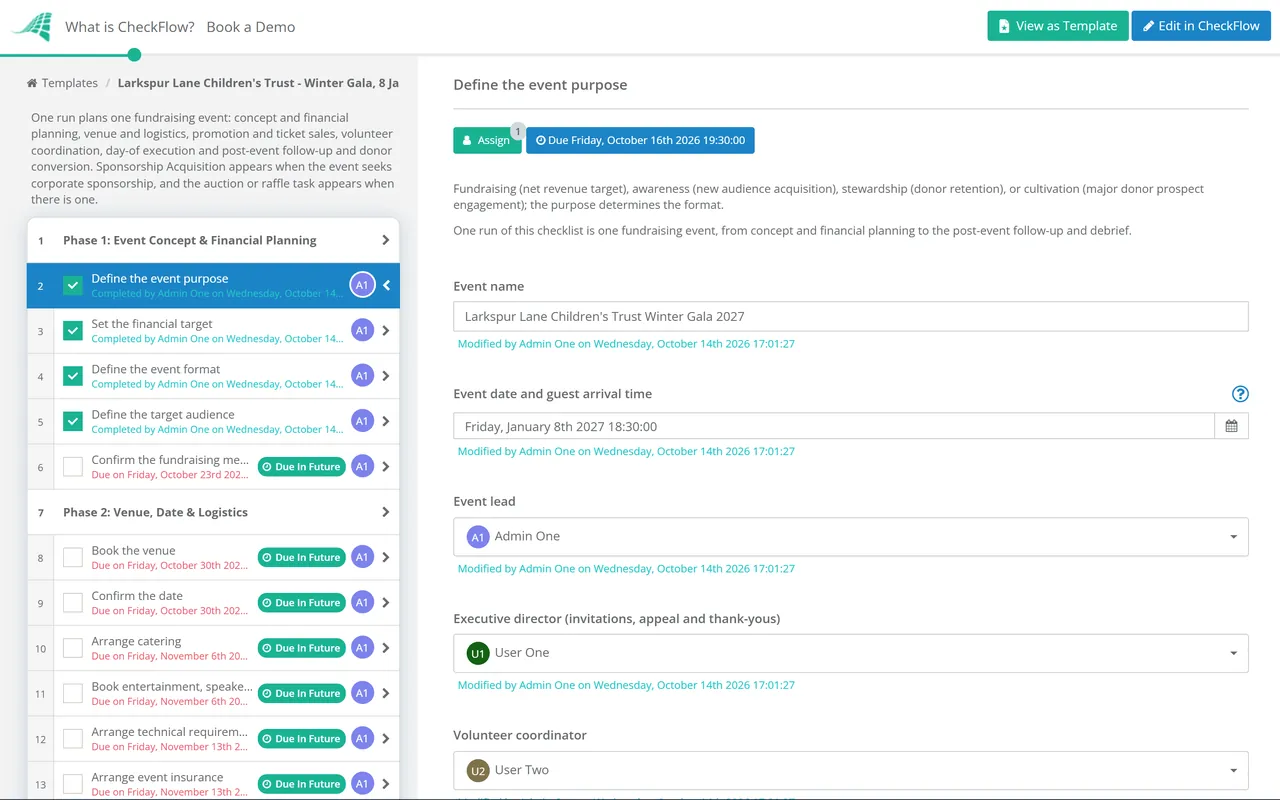
Phase 1: Event Concept & Financial Planning

  • Define the event purpose — fundraising (net revenue target), awareness (new audience acquisition), stewardship (donor retention), or cultivation (major donor prospect engagement); the purpose determines the format
  • Set the financial target — gross revenue goal, total event budget, and net revenue target; include all costs including staff time
  • Define the event format — gala dinner, community event, auction, sponsored challenge, virtual event, or hybrid; format matched to audience and fundraising mechanism
  • Define the target audience — current major donors, broader donor community, corporate partners, new prospects, or all; audience determines invitation strategy and programme
  • Confirm the fundraising mechanism — ticket sales only, plus auction, plus appeal, plus sponsorship; define how revenue will be generated at the event
8–10 Weeks Before

Phase 2: Venue, Date & Logistics

  • Book the venue — capacity appropriate to target attendance; accessible; consistent with the event’s tone and donor audience; contract reviewed before signing
  • Confirm the date — checked against competitor events, religious holidays, sporting fixtures, and key donor diary conflicts
  • Arrange catering — if applicable; dietary requirements anticipated; consistent with the event budget
  • Book entertainment, speakers, or auctioneers — keynote speakers with genuine relevance to the cause; professional auctioneers for auction events significantly outperform volunteer auctioneers on net revenue
  • Arrange technical requirements — AV, lighting, streaming for virtual/hybrid; tested before event day
  • Arrange event insurance — liability insurance; cancellation insurance for high-cost events
8–10 Weeks Before

Phase 3: Sponsorship Acquisition

  • Develop sponsorship packages — tiered levels (headline, gold, silver, supporting) with clear benefits at each level (branding, tickets, speaking opportunity, first-look on auction items)
  • Build the corporate sponsor target list — existing corporate partners first; companies connected to board members; companies in the relevant sector
  • Approach sponsors personally — a phone call before the email; a tailored proposal for significant sponsors; start 10–12 weeks before the event
  • Confirm sponsor commitments in writing — amount, payment terms, logo usage rights, and any naming rights; signed before publicity begins
  • Manage sponsor deliverables — logos for collateral, table allocations, speaking time if agreed; done well, this secures repeat sponsorship
Promotion

Phase 4: Promotion & Ticket Sales

  • Create the event page — on the website; compelling copy, photography, ticket purchase mechanism; mobile-optimised
  • Email existing donors and supporters — personalised invitation; early bird pricing where applicable; explicit ask from the executive director for major donor prospects
  • Leverage board member networks — each board member personally inviting their network is the highest-conversion promotion channel for charity events
  • Promote on social media — consistent content in the run-up; countdown; speaker/sponsor spotlights
  • Track ticket sales against target — weekly; escalate promotion intensity if tracking below target
Volunteers

Phase 5: Volunteer Coordination

  • Define volunteer roles — registration desk, auction management, guest liaison, AV support; specific enough that a volunteer knows exactly what they are doing
  • Recruit sufficient volunteers — slightly over the required number to allow for no-shows; from existing volunteer database, corporate volunteer groups, and board member networks
  • Brief all volunteers — at minimum a written brief; ideally a briefing session; the poorly-briefed volunteer damages the guest experience
  • Confirm volunteer attendance — 48 hours before; replacements arranged for any withdrawals
Day Of

Phase 6: Day-of Execution

  • Venue setup and walk-through — minimum 3 hours before guest arrival; all technical, catering, and branding elements confirmed
  • Volunteer briefing — all volunteers at venue minimum 90 minutes before guest arrival; roles assigned and questions answered
  • Manage guest registration — smoothly and warmly; the first impression sets the tone for the whole evening
  • Deliver the fundraising appeal — a compelling, story-driven ask at the peak emotional moment of the event; with a specific, accessible giving level for everyone in the room
  • Manage the auction or raffle — if applicable; professional auctioneer briefed; items with reserve prices set
Post-Event

Phase 7: Post-Event Follow-Up & Donor Conversion

The post-event follow-up is where most fundraising events fail to capture their full value. Attendees who gave at the event should receive a prompt, personal thank-you. Attendees who did not give but showed genuine engagement should enter the major donor cultivation pipeline.

  • Send thank-you communications within 48 hours — to all attendees; personal for major donors and prospects; written by the executive director
  • Process all donations — in the donor database; Gift Aid declarations collected; tax receipts issued
  • Follow up on Gift Aid declarations — for any attendee donations where declaration was not completed at the event
  • Identify major donor prospects from attendees — who expressed significant interest or engagement? Enter into the major donor pipeline; assign a relationship owner; arrange follow-up meeting
  • Conduct the financial reconciliation — total gross revenue, total costs, net revenue; compare against target
  • Debrief with the team — what worked, what should change, what the event taught about the audience; written debrief document for next year’s planning

Why Run Fundraising Event Planning in CheckFlow?

1

A structured event timeline with every task assigned and dated

Fundraising event planning with an unstructured to-do list produces the event where the venue contract was not reviewed in time, the sponsor logos were not collected, and the volunteer briefing never happened. CheckFlow assigns every event task to a named person with a deadline set against the event date — sponsorship outreach at 10 weeks, venue confirmed at 8, volunteers briefed at 48 hours.


2

Volunteer coordination that prevents day-of surprises

The fundraising event where volunteer no-shows at the last minute disrupts the guest experience is almost always the event where volunteer confirmation was not tracked. CheckFlow’s volunteer coordination phase includes a 48-hour confirmation task — with a replacement recruitment task if confirmation is not received.

3

Post-event donor pipeline tasks that happen automatically

The follow-up tasks that convert event attendees into major donor prospects are the tasks most likely to be lost in post-event exhaustion. CheckFlow’s post-event phase schedules the thank-you call tasks, the donation processing, and the major donor pipeline follow-up for the day after the event — when the window for impact is highest.

Fundraising events are stewardship touchpoints for existing donors as well as acquisition tools for new ones. CheckFlow’s Charity Donor Management Workflow covers the ongoing stewardship process that events feed into. See the Donor Management Workflow →

For general event planning templates covering conference and event logistics in detail, CheckFlow’s event planning template series covers the full event management framework. See the Event Planning Checklist →

Frequently Asked Questions

What should a fundraising event planning checklist include?

+

A fundraising event planning checklist covers seven phases: concept and financial planning (defining event purpose, financial target, format, audience, and fundraising mechanism), venue and logistics (venue booking, date confirmation, catering, entertainment, and insurance), sponsorship acquisition (developing packages, approaching corporate sponsors, and confirming commitments), promotion and ticket sales (event page, donor invitations, board network leverage, social promotion, and sales tracking), volunteer coordination (role definition, recruitment, briefing, and confirmation), day-of execution (setup, briefing, registration, appeal, and auction management), and post-event follow-up (thank-you communications within 48 hours, donation processing, major donor identification, financial reconciliation, and debrief).

How far in advance should fundraising event planning start?

+

For a significant annual event such as a gala dinner, planning should begin 8–12 months in advance for venue booking (particularly for larger cities or popular dates), 8–10 months for sponsorship outreach (corporate budget cycles mean early engagement is essential), and 6–8 months for programme development, entertainment booking, and committee formation. For smaller community events, a 3–4 month planning window may be sufficient. The most common planning failure for fundraising events is beginning too late — finding the venue already booked, missing the corporate budget cycle for sponsorship, or having insufficient time for effective promotion.

How should the fundraising appeal be delivered at an event?

+

The event appeal — the live ask for donations from attendees — is typically most effective when delivered at the emotional peak of the event, usually after an impact story or testimonial and before dessert or entertainment. It should be specific (a named amount at multiple levels, with a clear description of what that gift will achieve), brief (3–5 minutes), delivered by someone with genuine authority and connection to the cause, and followed by an easy mechanism (envelopes, QR codes, text-to-give) so attendees can respond immediately. Research consistently shows that a specific, story-driven ask delivered personally significantly outperforms a generic appeal or video.

How is fundraising event ROI calculated?

+

Fundraising event ROI is calculated as net revenue divided by total costs, expressed as a ratio or percentage. Net revenue is total income (ticket sales, auction proceeds, donations, sponsorship, raffle) minus all direct costs (venue, catering, entertainment, AV, printing, insurance, payment processing fees). The most accurate calculation also includes an imputed cost of staff time — if the event required 200 hours of staff time at an average cost of £25/hour, that represents £5,000 of cost that should be included. Many organisations calculate event ROI without including staff time, which significantly overstates the financial return.

Is CheckFlow free for this template?

+

14-day free trial, no card required. The Business plan is $10 per user per month after the trial. Full details at checkflow.io/pricing.

Plan Fundraising Events That Raise Money and Build Relationships

Free trial — no credit card required.