The average nonprofit loses more than half its donors every year. Not because donors stop caring about the cause — because they stop feeling like the organisation cares about them.
Donor retention is the most cost-effective fundraising strategy available to any nonprofit. Research consistently shows it costs five to ten times more to acquire a new donor than to retain an existing one — and yet the average nonprofit donor retention rate sits at approximately 45%, meaning more than half of first-time donors give only once. The primary reason donors lapse is not disagreement with the cause — it is feeling under-appreciated, under-informed about impact, or simply uncontacted between asks. A structured donor management workflow converts this from a passive attrition problem to an active stewardship discipline: every gift acknowledged within 48 hours, every donor receiving meaningful impact updates throughout the year, every lapsed donor reactivated through a structured re-engagement process, and every major donor prospect cultivated through a defined pipeline. This free checklist gives development directors, fundraising managers, and development staff a structured framework for the full donor management lifecycle.
The Donor Ladder — Understanding Where Every Donor Sits in the Relationship
Step 1
Prospect
Not yet a donor; has potential affinity with the cause or connection to the organisation. Stewardship goal: Awareness and first engagement — events, content, peer connections.
Step 2
First-Time Donor
Has made one gift. The relationship is at its most fragile. 48% of first-time donors never give again. Stewardship goal: Acknowledge immediately, demonstrate impact, make them feel like the right decision was made.
Step 3
Retained Donor
Has given in consecutive years or multiple times. The relationship is established. Stewardship goal: Deepen connection, share compelling impact, cultivate for upgrade.
Step 4
Major Donor
Capable of and interested in a transformational gift. Typically in a 1:1 relationship with the executive director or major gifts officer. Stewardship goal: Individual cultivation plan; consistent 1:1 engagement; proposal when the moment is right.
Step 5
Legacy Donor
Has committed to a gift in their will or estate plan. The deepest expression of commitment to the cause. Stewardship goal: Recognition, personal relationship, annual contact, membership in a legacy society.
What the Charity Donor Management Checklist Covers
This checklist covers six phases of the donor management lifecycle — from first gift acknowledgement through to donor data governance. The 48-hour window after a first gift is the single most important retention intervention available.
Within 48 Hours
Phase 1: First Gift Acknowledgement — The 48-Hour Window
The 48-hour thank-you is the single most impactful retention intervention in donor management. It is also the one most consistently delayed or left to an automated email. A personal phone call for first-time donors significantly outperforms email acknowledgement.
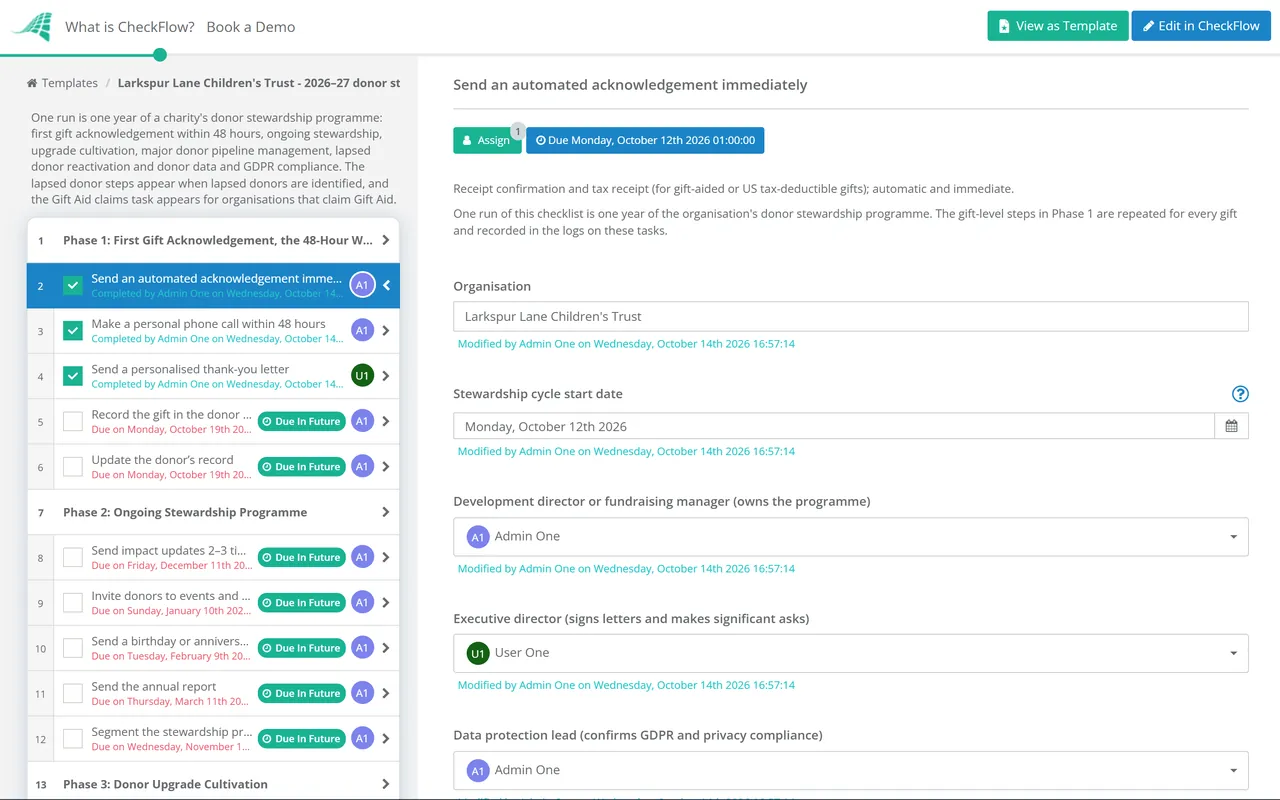
Send an automated acknowledgement immediately — receipt confirmation and tax receipt (for gift-aided or US tax-deductible gifts); automatic and immediate
Make a personal phone call within 48 hours — for first-time donors and donors above a defined threshold; 30-second genuine thank-you, not a solicitation
Send a personalised thank-you letter — signed by the executive director; referencing the specific gift; confirming the impact it will have; posted or emailed within 5 days
Record the gift in the donor database — amount, date, source, campaign; gift aid status (UK); tax receipt issued; follow-up tasks set
Update the donor’s record — with the stewardship action taken and the next contact date set
Ongoing
Phase 2: Ongoing Stewardship Programme
Stewardship is the relationship management that happens between asks. An organisation that contacts donors only when it wants money is training its donors to see its communications as solicitations to be avoided.
Send impact updates 2–3 times per year — not asks; genuine stories of how donations have made a difference; personalised where possible to the donor’s giving history
Invite donors to events and programme visits — seeing the impact of their giving in person is one of the most powerful stewardship and retention tools
Send a birthday or anniversary communication — anniversary of first gift is a high-value touchpoint; specific and personal
Send the annual report — with a personal note; the annual report is a stewardship document as much as a public accountability document
Segment the stewardship programme — major donors receive 1:1 outreach; mid-level donors receive personalised communications; general donors receive segmented but non-personalised communications
Cultivation
Phase 3: Donor Upgrade Cultivation
Identify upgrade candidates — donors who have given consecutively for 3+ years, donors whose personal capacity may have grown (wealth screening indicators), or donors who have demonstrated deep engagement with the cause
Build individual upgrade plans — for major donor prospects; who is the relationship owner? What stewardship and cultivation touchpoints will precede the ask?
Have upgrade conversations proactively — not in a mass mailing; a personal conversation about the donor’s interest in making a more significant investment
Make the ask appropriately — specific amount, specific project or impact, specific ask by the appropriate person (executive director or major gifts officer for significant asks)
Major Donors
Phase 4: Major Donor Pipeline Management
Maintain the major donor prospect list — in the donor database; stage in the pipeline, relationship owner, last contact, next action
Assign a named relationship owner — to each major donor prospect; one person owns the relationship
Execute individual cultivation plans — regular touchpoints that deepen the relationship before an ask; not just event invitations
Prepare personalised proposals — when the timing is right; the proposal should reflect the donor’s known interests and the organisation’s specific funding need
Review the major donor pipeline monthly — who has moved forward? Who has stalled? What actions are overdue?
Lapsed Donors
Phase 5: Lapsed Donor Reactivation
Define lapsed donors — donors who have not given in 12–18 months; or donors who have let a regular gift lapse; segment by recency and lifetime value
Send a win-back communication — acknowledgement that they are missed; impact update; a specific, accessible ask; not a guilt trip
Make a personal call — for lapsed donors who were previously significant givers; understand why they lapsed before asking them to return
Remove unresponsive lapsed donors from active communications — after 2–3 reactivation attempts; maintain the record; revisit annually
Data & Compliance
Phase 6: Donor Data Management & GDPR / Privacy Compliance
Donor data is a legal and strategic asset. It must be accurate, consented, secure, and used only for the purposes donors have agreed to.
Keep donor records current — address, email, phone, gift aid status (UK), communication preferences; update on every contact
Confirm GDPR/privacy compliance — consent for each communication type is documented; a process for handling subject access requests and right-to-erasure requests exists
Process Gift Aid claims regularly (UK) — at least quarterly; all eligible donations reclaimed; declarations retained for 6 years
Conduct an annual data hygiene exercise — deduplication, address verification, removal of deceased and suppressed records; poor data undermines every stewardship effort
The Five Reasons Donors Lapse — and the Stewardship Response to Each
Reason 1
They were never thanked properly
Prevention: The 48-hour thank-you call and personal acknowledgement letter for every significant gift.
Reason 2
They never heard about their gift’s impact
Prevention: Two to three impact updates per year; not asks; genuine stories connected to their giving.
Reason 3
They felt like a number, not a partner
Prevention: Personalised communications that reference their specific gifts and relationship with the organisation.
Reason 4
They gave to a crisis or campaign and forgot the organisation
Prevention: Post-campaign stewardship that converts campaign donors to ongoing supporters before the next ask.
Reason 5
Nobody asked them at the right moment
Prevention: Structured upgrade cultivation that identifies the right moment — not too soon, not too late — to make a personal ask.
Why Run Donor Management in CheckFlow?
1
Stewardship tasks that happen on time — not when someone gets around to it
The 48-hour thank-you that arrives on day 5 has lost most of its impact. The annual report that never makes it to the major donor because the mailing task was forgotten is a stewardship failure with retention consequences. CheckFlow assigns stewardship tasks to named team members with deadlines and sends reminders — the thank-you happens in 48 hours, the impact update goes out on schedule.

2
Major donor pipeline visibility across the whole team
Major donor cultivation is the most relationship-dependent work in fundraising — and the most easily disrupted when the relationship owner changes jobs or the organisation grows beyond the executive director’s personal memory. CheckFlow’s pipeline tracking makes every major donor prospect’s status, last contact, and next action visible to the whole development team — not held in one person’s head.
3
A complete donor contact record for GDPR and strategic purposes
Every stewardship action logged in CheckFlow — every thank-you sent, every impact update delivered, every call made — creates a complete contact record. This record supports GDPR accountability, enables effective handover when staff change, and provides the relationship history that makes major donor cultivation coherent across years.
The annual report is one of the most important donor stewardship documents the organisation produces. CheckFlow’s Nonprofit Annual Report Checklist covers the preparation process that produces the document donors receive. See the Annual Report Preparation Checklist →
Fundraising events are a key stewardship touchpoint for donors. CheckFlow’s Fundraising Event Planning Checklist covers the event planning process that creates the stewardship experiences donors value. See the Fundraising Event Planning Checklist →
Donor stewardship is the ongoing practice of acknowledging, informing, and deepening the relationship with donors between gift asks — communicating impact, expressing gratitude, and treating donors as valued partners rather than transaction sources. It matters because donor retention is the most cost-efficient fundraising strategy available to nonprofits: retaining an existing donor costs five to ten times less than acquiring a new one, and a retained donor who upgrades their giving represents significantly more lifetime value than a new donor acquired at the same cost. The average nonprofit retention rate of approximately 45% means most organisations are losing more than half their donor base every year — primarily through inadequate stewardship.
What is Gift Aid (UK) and how does it affect donor management?
+
Gift Aid is a UK government scheme that allows registered charities to claim an additional 25p for every £1 donated by a UK taxpayer who has completed a Gift Aid declaration. The donation must be made from the donor’s own funds and the donor must have paid enough income or capital gains tax in the year to cover the amount reclaimed. Gift Aid declarations should be collected from all UK donors (written or verbal, with appropriate records), stored in the donor database, and claims submitted to HMRC at least quarterly. Gift Aid declarations must be retained for 6 years. For a charity with significant individual donor income, Gift Aid can represent a 25% increase in the value of those donations — making declaration collection a major fundraising priority.
What is a major donor and how should they be managed differently?
+
Major donor definitions vary by organisation size — for a small charity, a £500 gift may be a major donation; for a larger one, the threshold may be £10,000 or more. The distinguishing characteristic is that the relationship is managed individually rather than through mass communications — with a named relationship owner (typically the executive director or major gifts officer), a personalised cultivation plan, 1:1 touchpoints, and a personalised ask at the appropriate moment. Research consistently shows that major donors give in response to a personal relationship and a compelling project-specific proposal from someone they trust — not mass mail campaigns.
What donor data must be kept under GDPR?
+
Under GDPR, personal data about donors must be processed lawfully, fairly, and transparently. For donor communications, the lawful basis is typically legitimate interest (for existing donors) or consent (for new contacts). Donors must be able to opt out of any communication type and have their request honoured promptly. Data should be accurate and kept no longer than necessary. For UK Gift Aid, declarations must be retained for 6 years. Donor records should include consent status, communication preferences, and a record of how and when consent was obtained. The organisation must be able to respond to subject access requests within 30 days.
Is CheckFlow free for this template?
+
14-day free trial, no card required. The Business plan is $10 per user per month after the trial. Full details at checkflow.io/pricing.
Turn Every First Gift Into a Lifelong Donor Relationship
Free trial — no credit card required.
Do you like cookies? 🍪 We use cookies to ensure you get the best experience on our website. Learn more