

Human Resources Management Plan Checklist Template
A structured audit of your complete HR function — confirming every people process is defined, documented, and operating effectively across every domain.
An HR function that is growing reactively — responding to hiring needs, performance issues, and compliance requirements as they arise — is an HR function that is always behind. The processes exist informally, varying with whoever is running them. The documentation is scattered or absent. The compliance calendar exists in one person’s head. The metrics exist nowhere. A Human Resources Management Plan is the structured audit and planning framework that converts reactive HR into a managed, documented, and continuously improving function — covering every domain from recruitment to succession planning, with each process assessed, each gap identified, and each improvement prioritised. This free HR management plan checklist gives HR managers, HR directors, and senior HR professionals a structured framework for building, auditing, and improving the complete HR function.
Employment law compliance calendar, right-to-work documentation, equal opportunities monitoring, data protection (GDPR/CCPA) compliance for HR data.
8. HR Metrics & Reporting
Monthly HR dashboard, headcount and turnover data, time-to-fill and quality-of-hire, engagement survey results, absenteeism rate.
9. HR Systems & Technology
HRIS completeness and accuracy, payroll integration, ATS, performance management system, data access controls.
What the HR Management Plan Checklist Covers
This checklist covers nine phases corresponding to the nine HR function domains — starting with an honest gap assessment and moving through each domain in sequence.
Phase 1
Phase 1: HR Function Audit & Gap Assessment
The HR management plan starts with an honest assessment of where the function currently is — not where it should be. A gap-based approach ensures improvements are prioritised by impact rather than interest.
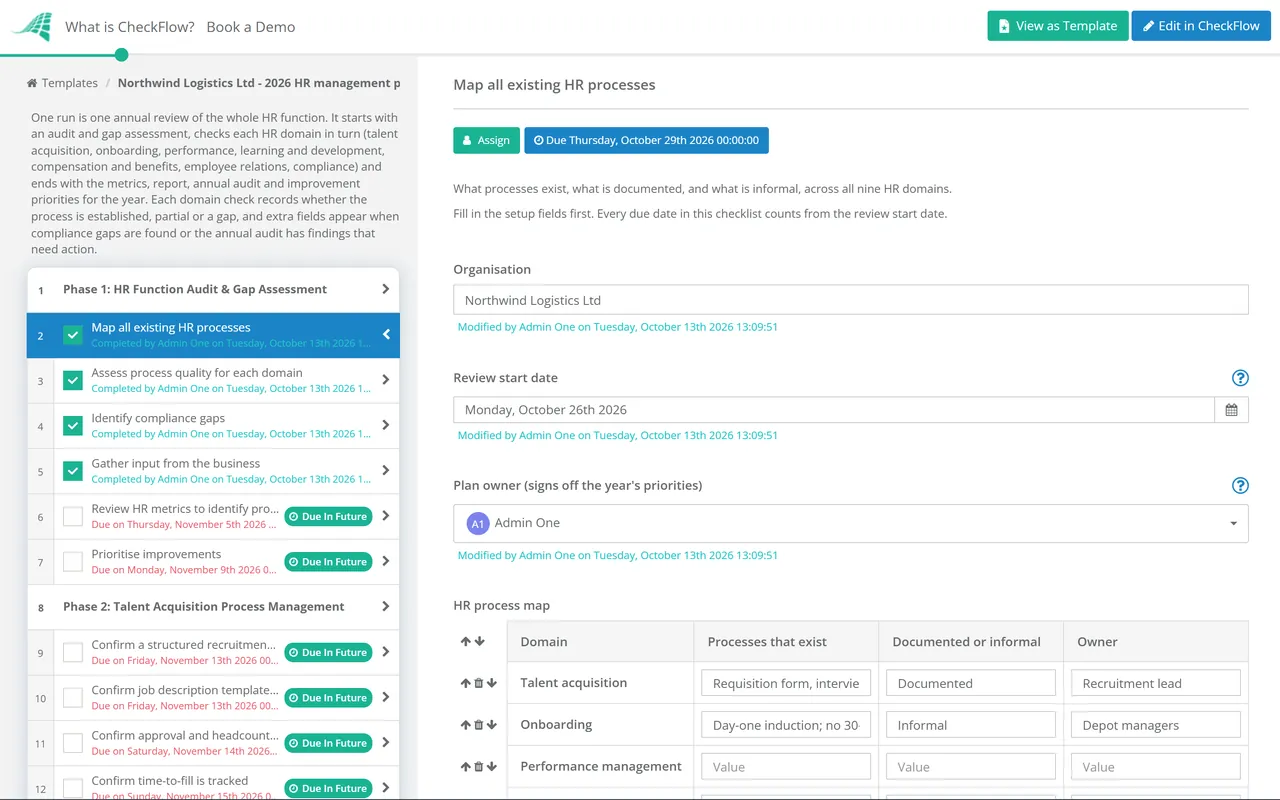
Map all existing HR processes — what processes exist, what is documented, and what is informal; across all nine HR domains
Assess process quality for each domain — does the process exist? Is it documented? Is it consistent? Is it effective? Rate each: Established/Partial/Gap
Identify compliance gaps — areas where required policies or processes do not exist or are materially incomplete
Gather input from the business — managers and senior leaders on their greatest HR pain points; what would most improve their ability to manage people?
Review HR metrics to identify problem areas — turnover rate, time-to-fill, absence rate, engagement scores; data-driven gap identification
Prioritise improvements — by compliance risk (highest priority), business impact, and feasibility; a short list of high-priority improvements for the year
Phase 2
Phase 2: Talent Acquisition Process Management
Confirm a structured recruitment process exists — documented, used consistently, and including a structured interview framework
Confirm job description templates are current — a library of job description templates for common roles; reviewed annually for accuracy and legal compliance
Confirm approval and headcount management process — all hires require documented business justification and approval before the search begins
Confirm time-to-fill is tracked — and benchmarked against target; bottlenecks identified and addressed
Confirm right-to-work compliance — documentation collected and recorded for every employee before or on day one of employment
Phase 3
Phase 3: Onboarding Programme Management
Confirm a structured onboarding process exists — covering pre-boarding, day one, first week, 30-60-90 days
Confirm manager and buddy responsibilities are defined and communicated
Review onboarding effectiveness — via new hire feedback surveys; use data to improve the process
Confirm all onboarding documentation is completed and filed for every hire
Phase 4
Phase 4: Performance Management System
Confirm the performance review cycle is defined and communicated — frequency, timeline, rating scale, and calibration process
Confirm all employees have documented objectives — set at the start of each review cycle; accessible to employee and manager
Confirm manager training on performance conversations — managers who are not equipped to run good reviews are the most common performance management failure
Confirm a Performance Improvement Plan (PIP) process exists — documented, consistently applied, and legally compliant
Phase 5
Phase 5: Learning & Development Planning
Confirm L&D budget is defined per employee — and communicated; employees know what is available and how to access it
Confirm mandatory training calendar — all compliance training requirements scheduled and tracked for completion
Confirm development planning process — connected to performance reviews; development goals are set and followed up
Review skills gap data — across the organisation; use to inform L&D investment priorities
Phase 6
Phase 6: Compensation & Benefits
Confirm pay bands exist — for all roles; current, documented, and consistent with market benchmarks
Confirm the annual pay review process — timeline, budget, approval process, and communication plan
Confirm benefits package is documented — and communicated to employees at onboarding and annually
Conduct annual benefits benchmarking — confirm benefits are competitive for the target talent market
Phase 7
Phase 7: Employee Relations & Wellbeing
Confirm disciplinary and grievance procedures are current and legally compliant — and accessible to all employees
Confirm absence management policy and process — trigger points, return-to-work interviews, and long-term absence management
Confirm manager escalation paths for employee relations issues — managers know when and how to involve HR
Review engagement survey process — how frequently engagement is measured; how results are acted on
Phase 8
Phase 8: HR Compliance & Legal Framework
Build and maintain the HR compliance calendar — all statutory requirements (minimum wage updates, right-to-work reverification, statutory pay review, annual data subject access obligations) with named owners
Confirm the employee handbook is current — reviewed at least annually; updated for any law or policy changes
Confirm GDPR/CCPA compliance for HR data — employee data is processed lawfully; a data retention policy exists; employee subject access requests have a defined response process
Review equal opportunities data — diversity data across recruitment, promotion, and pay; used to identify and address potential bias
Define and track core HR metrics — headcount, turnover rate, time-to-fill, absenteeism, engagement score, L&D spend per employee
Produce a regular HR report — monthly or quarterly to senior leadership; data-driven insights and trend analysis
Conduct an annual HR audit — comprehensive review of all HR processes against the management plan; see CheckFlow’s HR Audit Checklist for the detailed framework
Set HR improvement priorities for the year — based on metrics, audit findings, and business priorities; tracked throughout the year
This checklist is available as a free, runnable template in CheckFlow — with improvement tasks assigned to HR team members, compliance calendar items tracked, and the annual audit scheduled automatically.
Run the management plan as a living annual process
An HR Management Plan that is produced once and filed is not a management plan — it is a document. CheckFlow’s recurring checklist feature schedules the annual HR function audit automatically, ensuring the plan is reviewed, updated, and acted on every year — not just in the year it was written.
2
Assign improvement actions to named owners with deadlines
HR management plan improvements fail most often because they are agreed in principle and never acted on — because no one owns the specific improvement task with a specific deadline. CheckFlow assigns every improvement action to a named HR team member with a due date, sends reminders, and makes the status of every open improvement visible to the HR leadership.
3
A documented record for audits and accreditation
HR audits, Investors in People assessments, and regulatory inspections all require evidence that the HR function is systematically managed. Every completed task in CheckFlow is timestamped — the management plan audit, the compliance calendar actions, and the metric reviews are all documented, attributed, and available for inspection.
The HR Management Plan includes an annual audit of the HR function. CheckFlow’s HR Audit Checklist in the compliance series provides the detailed audit framework that maps to the management plan domains. See the HR Audit Checklist →
The HR Management Plan sits within the broader HR strategy framework. CheckFlow’s HR Strategy Checklist covers the strategic planning process that sets the direction the management plan then operationalises. See the HR Strategy Checklist →
Frequently Asked Questions
What is an HR management plan and what does it cover?
+
An HR management plan is an operational framework that defines how the HR function will manage all people processes across an organisation. It typically covers nine domains: talent acquisition (recruitment processes, job description standards, time-to-fill targets), onboarding (structured new hire integration programmes), performance management (review cycles, rating frameworks, PIPs), learning and development (L&D budget, mandatory training, development planning), compensation and benefits (pay bands, annual review, benchmarking), employee relations (disciplinary and grievance procedures, absence management, wellbeing), HR compliance (employment law calendar, handbook currency, data protection), HR metrics and reporting (dashboard, turnover tracking, engagement measurement), and HR systems. An HR management plan starts with an honest gap assessment of the current state and prioritises improvements by compliance risk and business impact.
What is the difference between an HR management plan and an HR strategy?
+
An HR strategy defines the direction of the people function over a 2–3 year horizon — where does HR need to get to in order to support the business strategy? It addresses questions like: what workforce capabilities will the business need, what is the talent philosophy, how will HR evolve from transactional to strategic? An HR management plan is the operational framework that translates that direction into practice — defining the specific processes, policies, systems, and metrics that make up the HR function today and managing their continuous improvement. Strategy is directional and multi-year; management plan is operational and annual.
How do you audit an existing HR function?
+
An HR function audit assesses the current state of all HR processes against what should exist. A practical approach is to map all nine HR domains against three questions: does the process exist, is it documented, and is it consistently and effectively applied? For each domain, rate the current state as established, partial, or gap. Supplement with data — turnover rate, time-to-fill, absenteeism, engagement score — and with manager input on their greatest HR pain points. The output is a prioritised improvement list: compliance gaps addressed first (because they are non-negotiable), high-impact business improvements second, and longer-term process improvements third.
What HR metrics should every HR function track?
+
Core HR metrics that every function should track include: headcount (current, by department, and vs. plan), voluntary turnover rate (overall and by department or demographic), time to fill open roles, cost per hire, quality of hire (new hire performance ratings at 6 and 12 months), absenteeism rate, employee engagement score (from annual or pulse surveys), L&D investment per employee, and gender pay gap (where required or monitored). These metrics, tracked consistently over time, reveal trends in workforce health and guide prioritisation of HR investment.
Is CheckFlow free to use for this template?
+
You can start a free 14-day trial with no credit card required, giving you full access to all features including this template. The Business plan is $10 per user per month after the trial. Full details at checkflow.io/pricing.
Build an HR Function That Manages Every People Process Consistently
Free trial — no credit card required.
Do you like cookies? 🍪 We use cookies to ensure you get the best experience on our website. Learn more