Content teams that feel busy but never finished need a workflow, not more hours.
Every content team knows the feeling: a backlog of half-written drafts, pieces waiting for review that nobody can remember assigning, published content that nobody checked for performance, and a content calendar that looks organised but depends entirely on individual contributors knowing where they are in the process. The problem is not capacity — it is visibility. A structured content production workflow turns an invisible, ad hoc process into a clear, trackable system where every piece of content moves through defined stages with named owners, clear handoffs, and no ambiguity about what is in progress, what is waiting for whom, and what is ready to publish. This free content production workflow checklist covers every stage from planning and briefing through production, review, approval, publishing, distribution, and performance tracking.
Why Content Teams Need a Workflow, Not Just a Calendar
A content calendar tells you what needs to be published and when. A content production workflow tells you who is responsible for each stage of getting it there — and makes visible exactly where each piece currently sits in that process. Without the workflow, the calendar is a wish list. Pieces that appear on the calendar on Monday are not automatically going to be researched, written, edited, approved, optimised, and published by Friday. Someone has to do each of those things, in the right order, with the right inputs from the right people — and then it has to be done again for next week’s piece.
Teams producing content at scale — multiple formats, multiple contributors, multiple channels, some AI-assisted and some fully human-written — need a repeatable production system that works consistently regardless of volume. The same structured workflow should apply to a 500-word social caption and a 3,000-word SEO article: adapted in scope, identical in structure. When every piece follows the same process, quality becomes consistent, bottlenecks become visible, and the team can genuinely see what is in progress rather than guessing.
What the Content Production Workflow Checklist Covers
This checklist covers eight stages that take a piece of content from initial idea to published, distributed, and performance-tracked. Adapt the scope of each stage to the format and complexity of the content — a social post and a whitepaper follow the same workflow, scaled differently.
Phase 1
Content Planning & Brief
A brief that takes ten minutes to write saves an hour of revision later. The quality of the output is almost always determined by the clarity of the input.
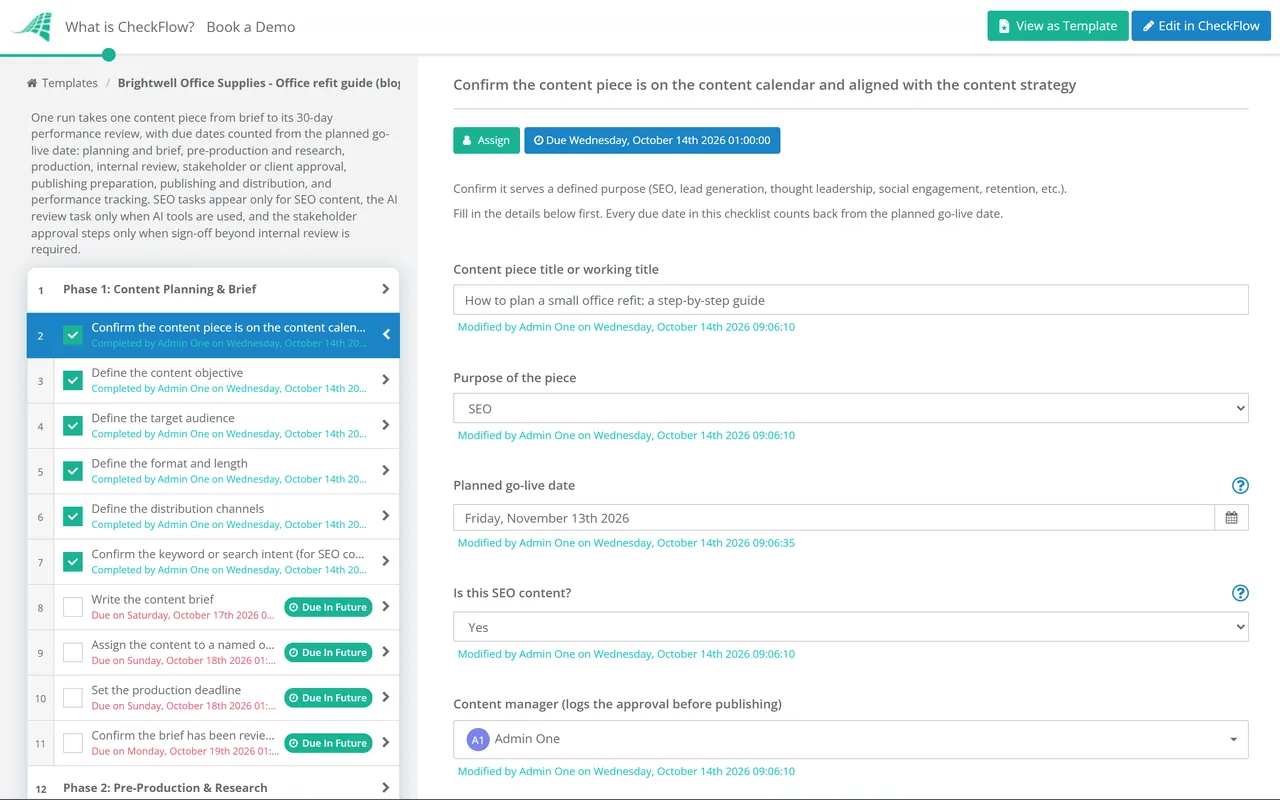
Confirm the content piece is on the content calendar and aligned with the broader content strategy — confirm it serves a defined purpose (SEO, lead generation, thought leadership, social engagement, retention, etc.)
Define the content objective — what specific outcome should this piece achieve? (Rank for a keyword, generate leads, educate existing customers, support a campaign, etc.)
Define the target audience — who is this piece for, what do they already know, and what do they need to understand or feel after reading it?
Define the format and length — blog post, video script, social caption, email, whitepaper, case study, podcast outline, or other; confirm word count or duration target
Define the distribution channels — where will this content be published and shared?
Confirm the keyword or search intent (for SEO content) — primary keyword, secondary keywords, and the search intent the piece should satisfy
Write the content brief — document objective, audience, format, angle, key points to cover, sources to reference, tone of voice guidance, and any mandatories (CTAs, disclaimers, internal links)
Assign the content to a named owner — writer, video producer, designer, or whoever is responsible for the production phase
Set the production deadline — confirm it gives enough time for review, approval, and any technical publishing steps before the go-live date
Confirm the brief has been reviewed and accepted by the assigned producer before work begins
Phase 2
Pre-Production & Research
Complete the research for the piece — gather sources, statistics, expert quotes, or reference material before writing begins
Conduct keyword research and SERP analysis (for SEO content) — confirm the target keyword, understand what is already ranking, and identify the angle and depth required to compete
Review competitor or existing content on the topic — confirm what has already been said and what angle will be genuinely differentiated
Prepare the content outline — structure the piece before writing begins; confirm the outline covers the brief requirements and flows logically
Review the outline against the brief — confirm the structure serves the objective before production time is invested
Identify any supporting assets needed — images, graphics, data visualisations, video clips, or audio; brief the relevant team members with sufficient lead time
Confirm any subject matter expert input required — interviews, quotes, or technical review; schedule these before writing begins, not after
Confirm all necessary approvals or legal clearances that will be needed at review stage — identify them now so they do not delay the approval phase
Note any AI tools or research tools being used in pre-production — confirm that AI-assisted content will be reviewed for accuracy, originality, and brand voice alignment before progressing
Confirm pre-production is complete before the production phase begins
Phase 3
Content Production
Produce the first draft of the content — write, film, record, or design as required by the format
Follow the brief — check the draft against the brief requirements before moving to review; does it cover the key points, hit the tone, and serve the objective?
Confirm accuracy — verify all facts, statistics, quotes, and claims are correct and properly attributed
Include all mandatory elements from the brief — CTAs, internal links, keywords, disclaimers, or any other required inclusions
Check the draft against brand guidelines — tone of voice, terminology, style guide, and any brand-specific rules
For AI-assisted content — review the AI output for accuracy, originality, and brand voice; edit to remove generic phrasing, confirm all claims are verified, and ensure the piece reads as genuinely useful rather than machine-generated
Prepare supporting visual assets — confirm images, graphics, or video thumbnails are ready and meet brand and platform specifications
Complete the first draft and mark as ready for internal review — do not submit an incomplete draft for review
Phase 4
Internal Review & Quality Check
Internal review exists to catch what the producer missed — not to rewrite the piece. If reviewers are regularly rewriting rather than refining, the brief or the production process needs attention.
Assign the piece to the relevant internal reviewer — editor, content manager, subject matter expert, or whoever is responsible for internal quality sign-off
Review for accuracy and completeness — does the piece cover all required points from the brief? Are all facts correct?
Review for brand voice and style — does the piece sound like the brand? Is it consistent with the style guide?
Review for SEO (where applicable) — keyword placement, meta title, meta description, heading structure, internal links, and image alt text
Check for spelling, grammar, and punctuation — run a thorough proofread; do not rely solely on spell-check
Review all supporting assets — confirm images are the correct size, format, and quality; confirm video or audio is correctly edited and meets platform requirements
Review any legal or compliance elements — claims substantiation, required disclaimers, copyright clearances, and data privacy compliance for any personal data referenced
Provide structured written feedback to the producer — specific, actionable edits rather than general observations; confirm the revision requirements are clear before sending back
Confirm revisions are complete before moving to approval — do not progress a piece that still has outstanding internal review comments
Phase 5
Stakeholder or Client Approval
Identify whether external or senior stakeholder approval is required for this piece — not all content requires sign-off beyond internal review; confirm the approval requirement at briefing stage
Share the reviewed draft with the relevant approver — confirmed as the person with actual sign-off authority
Provide context for the approver — the brief, the objective, and any specific items you need them to review; do not send a draft cold without context
Set a clear approval deadline — confirm when feedback is needed by to meet the publishing schedule
Collect consolidated feedback from the approver — confirm one submission rather than a drip of comments over several days
Action approval feedback — apply changes, run internal review on the revised version, and confirm it is ready
Obtain written sign-off — an email confirmation is sufficient; verbal approval is not documented
Mark the piece as approved — confirm the approval is logged before proceeding to publishing
Phase 6
Publishing Preparation
Prepare the final production-ready version — apply all approved edits and confirm the piece is in its final form
Prepare all publishing metadata — page title, meta description, URL slug, tags, categories, author, and any other CMS fields
Optimise for SEO where applicable — confirm keyword placement, heading hierarchy, internal links, and image alt text are all in place
Prepare social media copy — platform-specific captions for each distribution channel; adapt length, tone, and format for each platform
Prepare the email newsletter entry or promotional copy where applicable — subject line, preheader, and excerpt
Upload or stage the content in the CMS or relevant publishing platform — confirm the formatted version renders correctly before scheduling
Preview the final version on relevant devices — desktop, mobile, and tablet; confirm layout, images, and links are all correct
Confirm all links are working — internal links, external links, CTAs, and any tracking links
Confirm any tracking parameters are in place — UTM parameters for links used in distribution; confirm they are consistently structured
Set the publishing schedule — confirm date, time, and channel; confirm all team members involved in distribution are briefed
Phase 7
Publishing & Distribution
Publish or go live at the scheduled time — confirm publication on the primary channel
Confirm the published piece renders correctly — check the live version on desktop and mobile; confirm no formatting errors, broken images, or missing elements
Distribute across all planned secondary channels — social media posts published, email sent, internal communications updated as applicable
Confirm all distribution copy is live and correct — review each channel’s published version
Notify relevant internal teams — sales, customer success, or other teams who might use the content should be informed it is live
Monitor for any immediate technical issues — broken links, tracking issues, or platform errors in the first 30 minutes post-publication
Engage with early comments or reactions on social — the first hour of engagement often determines algorithmic reach on social platforms
Repurpose for additional formats where planned — turn a blog post into social snippets, a video script into an audio clip, or a whitepaper into a summary email
Update internal content libraries or resource hubs — confirm the new piece is added to any relevant internal repositories
Mark the piece as published in the content management system or production tracker
Phase 8
Performance Tracking & Optimisation
Publishing is not the end of the workflow. Content that is never measured is never improved. Even a 10-minute performance review 30 days post-publication generates insights that improve the next piece.
Record the publication date and primary channel in the content tracker — confirm the piece is logged for performance review
Review initial performance data at 48–72 hours — page views, social engagement, email open and click rates, or video views depending on format
Conduct a 30-day performance review — measure against the objective defined in the brief: SEO rankings, lead conversions, engagement rate, or other relevant KPI
Compare performance against benchmarks — how does this piece compare to similar content from previous periods?
Identify optimisation opportunities — if an SEO piece is not ranking, assess whether the content needs updating; if engagement is below benchmark, review the distribution approach
Update the piece if warranted — refresh outdated statistics, add new sections, or improve on-page SEO based on ranking data
Document key learnings — what worked well and what did not, specific to this piece and format
Feed learnings back into the content planning phase — inform future briefs with data from this piece
Identify repurposing opportunities — high-performing content may warrant a webinar, a follow-up piece, a case study, or a paid promotion
Archive the complete production record — brief, drafts, approvals, publication details, and performance data
This checklist is available as a free, runnable template in CheckFlow — with tasks assigned to writers, editors, designers, and publishers, recurring instances scheduled for weekly or monthly content cadences, and every piece tracked from brief to performance review.
The same eight-phase workflow applies to any content format — scaled in scope and adapted in detail, but identical in structure.
Blog Posts & Articles
SEO briefing and keyword research in pre-production; SEO metadata and internal linking in publishing preparation; ranking performance tracked at 30, 60, and 90 days.
Social Media Content
Compressed workflow for short-form; platform-specific copy variations in publishing preparation; engagement rate and reach tracked per platform in performance review.
Email Newsletters
Subject line and preheader prepared in publishing preparation; seed-address test send before distribution; open rate and click rate tracked at 24 and 72 hours post-send.
Video & Podcast
Script or outline in pre-production; editing and platform formatting in production; views, watch time, and listener engagement tracked in performance review.
Whitepapers & Long-Form
Extended research and expert input in pre-production; multiple internal and stakeholder review rounds built into the workflow; lead generation and download performance tracked.
Case Studies & Testimonials
Subject interview and approval in pre-production; client sign-off as a dedicated approval stage; used-in-sales-process tracking alongside publishing metrics.
The checklist adapts — the structure does not. Build one template in CheckFlow and customise it for each format, or maintain separate templates for formats with significantly different production requirements.
Why Run Content Production in CheckFlow?
1
See where every piece of content actually is
The most common content team question is “where are we with this piece?” Without a workflow tool, the answer involves messaging the writer, checking a shared doc, and piecing together a status from email history. CheckFlow’s grid-based dashboard and real-time reporting shows every piece of content in production simultaneously — which stage each is in, what is overdue, and who needs to act. The answer is always one view away.

2
Automate recurring content cadences
Weekly blog posts, monthly newsletters, quarterly reports — recurring content formats follow the same workflow every time. CheckFlow’s recurring checklist feature schedules each production cycle automatically, assigns tasks to the right people, and sends reminders before deadlines. The workflow starts itself — nobody has to remember to kick it off — and the content calendar stays on track without manual overhead.
3
Hand off between roles without losing context
Content production involves multiple handoffs — from strategist to writer, writer to editor, editor to designer, designer to publisher. Without a structured workflow, context gets lost at every handoff and the next person has to ask what stage the piece is at and what still needs to happen. CheckFlow makes every handoff a defined task — with all context attached and the next step clearly assigned.
Content production involves client feedback and revision cycles for agency teams and in-house teams working with stakeholders. CheckFlow’s Client Feedback & Revision Process checklist covers the approval loop that sits between internal review and publishing — keeping revision rounds structured and sign-off documented. See the Client Feedback & Revision Process Checklist →
When content production is running at scale — multiple formats, multiple contributors, regular publishing cadences — the content workflow becomes one of the most important SOPs in the business. CheckFlow’s SOP software turns every repeatable process into a structured, trackable checklist that any team member can follow consistently. Learn more about SOP software in CheckFlow →
A content production workflow is a defined, repeatable process that takes a piece of content from initial idea to published and performance-tracked. It documents every stage — planning, research, production, internal review, approval, publishing preparation, distribution, and performance measurement — with named owners, clear handoffs, and defined entry and exit criteria for each stage. A structured workflow replaces the informal, individual-dependent process that most content teams operate by default — ensuring that quality is consistent, bottlenecks are visible, and content moves through production reliably regardless of volume or team size.
What stages should a content production workflow include?
+
A comprehensive content production workflow should include eight stages: content planning and briefing (defining objective, audience, format, and assigned owner), pre-production and research (outline, keyword research, source gathering, and asset briefing), production (writing, filming, or designing the first draft), internal review and quality check (editor review for accuracy, brand, and completeness), stakeholder or client approval where required, publishing preparation (metadata, SEO, social copy, and CMS upload), publishing and distribution (go-live and cross-channel distribution), and performance tracking and optimisation (30-day review and continuous improvement). The depth of each stage should be adapted to the complexity of the content format — a social caption requires a compressed version of this workflow; a long-form whitepaper requires the full process.
How do you manage a content production workflow across multiple contributors?
+
The key is to make ownership and status visible to everyone involved — not held in any individual’s head. Each stage of the workflow should have a named owner and a defined deadline, and the status of every piece should be visible in a shared system rather than reconstructable only from email history. CheckFlow’s task assignment and real-time dashboard allows content managers to see the status of every piece in production simultaneously, with overdue tasks flagged automatically and handoffs between contributors managed as specific, assigned tasks rather than informal verbal handoffs.
How should AI tools be integrated into a content production workflow?
+
AI tools fit most naturally into the pre-production and production phases — for outline generation, research summarisation, first-draft creation, and image generation for supporting assets. The critical principle is that AI-generated content should always pass through the same internal review phase as human-written content — reviewed for accuracy (AI tools can generate plausible but incorrect claims), originality, brand voice alignment, and genuine usefulness to the reader. AI-assisted content that skips internal review and goes directly to publishing is one of the most common causes of low-quality, off-brand, or factually inaccurate published content in 2025–26.
How often should the content production workflow be reviewed and updated?
+
The workflow itself should be reviewed quarterly — not because the stages will change dramatically, but because the bottlenecks within them will. Where is content most frequently delayed? Which stage most often produces rework? Where do handoffs break down? A quarterly retrospective that looks at average time per stage, revision rates, and missed publishing dates will surface the specific improvements that will have the most impact. CheckFlow’s timestamped task completion records make this analysis straightforward — the data to identify bottlenecks is already in the system.
Is CheckFlow free to use for this template?
+
You can start a free 14-day trial with no credit card required, giving you full access to all features including this template. The Business plan is $10 per user per month after the trial. Full details at checkflow.io/pricing.
Build a Content Production System That Actually Works
Free trial — no credit card required.
Do you like cookies? 🍪 We use cookies to ensure you get the best experience on our website. Learn more