SOC 2 has become the de facto trust credential for B2B SaaS companies, IT service providers, and cloud platforms in 2026. Enterprise clients request it during procurement, security questionnaires ask for it, and deals stall without it. If you manage IT for an organization that sells to mid-market or enterprise buyers, the question is no longer whether you need SOC 2 — it's how to get there without losing a year to confusion about where to start.
The genuine complexity is real: five Trust Service Criteria, 33 Common Criteria across nine control categories, an observation period measured in months, and a set of documentation and operational requirements that many IT teams underestimate when they first hear "we need SOC 2." The framework is rigorous by design — it is built to produce evidence that verifiable controls are operating continuously, not a snapshot of security posture assembled before an auditor arrives.
This guide delivers a practical, phase-by-phase SOC 2 readiness checklist covering everything from initial scoping through audit completion and ongoing compliance — including all 33 Common Criteria, required policies, the Type I vs Type II decision, and the recurring tasks that keep your report current year after year.
What Is SOC 2?
SOC 2 (Service and Organization Controls 2) is an auditing standard developed by the American Institute of Certified Public Accountants (AICPA) that evaluates whether a service organization's controls related to security, availability, processing integrity, confidentiality, and privacy are suitably designed and/or operating effectively. It applies to any organization that stores, processes, or transmits customer data on behalf of other businesses — cloud platforms, SaaS providers, IT managed service providers, data processors, and similar service organizations.
A SOC 2 report is produced by a licensed CPA firm after a formal audit. It describes the organization's systems and controls and provides the auditor's opinion on whether those controls meet the Trust Services Criteria. It is not a certification — it is an audit report with an opinion. Enterprise buyers request SOC 2 reports (usually Type II) as evidence that a vendor takes security seriously and has verifiable controls in place. Only licensed CPA firms can issue SOC 2 reports; security consulting companies that are not licensed CPAs cannot.
Enterprise security questionnaires routinely ask for SOC 2 reports. Sales cycles for mid-market and enterprise SaaS deals routinely stall on "send us your SOC 2." Cyber insurance underwriters use it as a risk indicator. Regulated industries — financial services, healthcare — may require it as a vendor qualification criterion. For any IT services organization selling to mid-market or enterprise buyers, SOC 2 Type II has moved from a differentiator to a table-stakes requirement.
SOC 2 at a glance
5 Trust Service Criteria. 33 Common Criteria (Security TSC). 1 required criterion (Security). Type I: point in time. Type II: 6–12 month observation period. Issued by a licensed CPA firm. Reports are confidential — shared under NDA.
SOC 2 Type I vs Type II — Which Do You Need?
The Type I / Type II question is the first question almost every IT manager asks, and the answer directly determines your timeline and budget.
A SOC 2 Type I report evaluates whether your security controls are suitably designed as of a specific date. The auditor examines your policies, procedures, and control configurations and forms an opinion on whether, in theory, those controls would operate to meet the Trust Services Criteria. Type I can typically be completed in 2–4 months from the start of readiness work. It is the faster, lower-cost option — external audit fees typically range from $7,500 to $25,000. Type I is a useful bridge when you need a report quickly to unblock a deal, or as a validated first step before committing to a Type II observation period.
A SOC 2 Type II report evaluates whether your controls were actually operating effectively over a defined observation period — typically 6 to 12 months. The auditor tests evidence that controls ran as described during the observation window: access reviews were conducted, vulnerability scans were run, change management was followed. This is what enterprise buyers almost universally require. External audit fees for Type II average $20,000 to $45,000; total all-in investment including readiness and tooling is typically $30,000 to $80,000.
If you have 9–12 months before the requirement becomes urgent and your controls are already largely in place, go straight to Type II. If you need a report quickly to unblock a deal and have no prior audit history, Type I first is a reasonable bridge — then immediately begin the Type II observation period. Do not confuse the Type I/Type II decision with the criteria selection decision — both types are available across all five Trust Service Criteria.
| Dimension | Type I | Type II |
|---|---|---|
| Evaluates | Suitability of control design at a point in time | Operating effectiveness over an observation period |
| Duration | Single date (snapshot) | 6–12 month observation period |
| Typical timeline | 3–5 months from readiness start | 12–18 months from readiness start |
| Audit fees (external) | $7,500–$25,000 | $20,000–$45,000 |
| What clients want | Acceptable as interim; rarely sufficient for enterprise | Required by most enterprise and mid-market buyers |
The Five Trust Service Criteria
SOC 2 is organized around five Trust Service Criteria (TSC). Only one is mandatory; the remaining four are selected based on what your service promises and what your clients require.
Security (CC1–CC9) — Required
The Security criterion is the only mandatory criterion in every SOC 2 engagement. It is also called the Common Criteria because the 33 criteria it contains — organized in nine categories CC1 through CC9 — must be satisfied regardless of which additional criteria are included. The Security criterion addresses how the organization protects its systems against unauthorized access, disclosure of information, damage, misuse, and alteration. Every SOC 2 audit begins and ends with Security.
Availability (A Series) — Optional
Addresses whether the system is available for operation and use as committed or agreed. This criterion is highly relevant for SaaS companies with uptime SLAs, hosting providers, and any organization whose clients depend on continuous access to their services. Requires documented uptime targets, incident management procedures, and evidence of meeting availability commitments over the audit period.
Processing Integrity (PI Series) — Optional
Addresses whether system processing is complete, valid, accurate, timely, and authorized. Most relevant for financial processing platforms, payroll systems, and any service where data processing accuracy is contractually critical. If your service makes commitments about data accuracy or completeness, this criterion is worth including.
Confidentiality (C Series) — Optional
Addresses whether information designated as confidential is protected as committed or agreed. Relevant for organizations handling trade secrets, proprietary data, or contractually confidential client information with defined retention and disposal requirements. If your client agreements include confidentiality obligations for specific data types, this criterion gives buyers documented evidence those obligations are backed by controls.
Privacy (P Series) — Optional
Addresses the collection, use, retention, disclosure, and disposal of personal information in accordance with the organization's privacy notice and AICPA Privacy Management Framework principles. Relevant for organizations processing significant volumes of personal data — particularly relevant given GDPR and US state privacy law overlap. Adding Privacy increases audit scope substantially, and most organizations address privacy obligations through their Security and Confidentiality criteria rather than adding the full Privacy TSC.
For most IT managers beginning their first SOC 2: start with Security only. Add Availability if you have uptime SLAs that clients hold you to. Consider Confidentiality if clients have contractual data protection requirements for specific information types. Adding criteria increases audit scope, evidence burden, and cost — expand deliberately, not aspirationally.
The 33 Common Criteria — A Practical Reference
All 33 Common Criteria apply to the Security TSC — the mandatory criterion in every SOC 2 engagement. They are organized in nine categories, CC1 through CC9, and collectively cover how the organization's controls are designed, implemented, and operated to protect systems and data. Every SOC 2 audit begins here.
CC1 — Control Environment (5 criteria)
The control environment criteria address the foundational governance layer: the organization's commitment to integrity and ethical values, its board oversight of the internal control system, the organizational structure and assignment of authority and responsibility, competence standards for personnel, and accountability through performance measures. Auditors are evaluating whether security is embedded in organizational values and governance — not just in technology. A strong control environment is what makes every other control credible. Deficiencies here — a lack of documented accountability, absent board oversight, no formal competence standards — undermine the credibility of every technical control downstream.
CC2 — Communication and Information (3 criteria)
Covers how the organization obtains and uses relevant information, communicates internally about security responsibilities, and communicates with external parties about its security program. This includes the security policy framework, security awareness training communications, and disclosure of security incidents to appropriate parties. The evidence auditors look for: a current policy library that staff have acknowledged, security awareness training with completion records, and documented procedures for communicating material security events to clients and regulators.
CC3 — Risk Assessment (4 criteria)
Addresses the organization's risk identification, analysis, and response process. The organization must define its risk tolerance, systematically identify risks to achieving its security objectives, analyze those risks, and decide how to respond — accept, mitigate, transfer, or avoid. This is the analytical foundation of the entire security program. Many SOC 2 failures trace back to a risk assessment that is too superficial to credibly justify control selection. Auditors want a documented methodology, a risk register with prioritized findings, and evidence of management review and sign-off.
CC4 — Monitoring Activities (2 criteria)
Covers the organization's ongoing and periodic evaluation of its controls — both internal monitoring (are controls working as designed?) and evaluation of results, including how deficiencies are escalated and remediated. This is where your vulnerability management program, internal audit function, and management review processes live in the framework. Evidence includes: vulnerability scan results with remediation tracking, internal audit reports, management review meeting records, and documented remediation of identified deficiencies.
CC5 — Control Activities (3 criteria)
Addresses how the organization selects and develops controls to mitigate risks identified in CC3. This includes both general controls — organization-wide policies governing expected behavior — and technology-specific controls built into systems and applications. It also covers the policies and procedures that govern control activities across all levels of the organization. The link between CC3 (risk assessment) and CC5 (control activities) is what auditors are testing: your controls should be traceable to identified risks, not arbitrary.
CC6 — Logical and Physical Access (8 criteria)
The largest category and the one most IT managers spend the most time on. CC6 covers the full access management lifecycle across eight criteria: restricting logical access to authorized users only (CC6.1), provisioning access based on job function and need (CC6.2), removing access when no longer needed (CC6.3), preventing unauthorized physical access to facilities and infrastructure (CC6.4), using encryption to protect data in transit and at rest (CC6.7), controlling infrastructure components and network segmentation (CC6.6, CC6.8), and managing internal and external threats to the system (CC6.5). CC6 maps directly to the technical controls most IT teams already have in place — MFA, least privilege, access reviews, encryption, network segmentation — but requires documented evidence that each control is consistently operating, not just deployed. The User Access Review Checklist gives you that evidence for CC6.2 and CC6.3 each quarter.
CC7 — System Operations (5 criteria)
Covers operational security monitoring across five criteria: detecting and remediating vulnerabilities (CC7.1), monitoring system components for anomalous behavior (CC7.2), managing security incidents through defined response procedures (CC7.3), recovering from incidents to restore normal operations (CC7.4), and identifying and communicating security incidents to the appropriate parties (CC7.5). This is where your vulnerability management program, SIEM, and incident response procedures translate into SOC 2 evidence. Auditors will test that vulnerability scans ran on schedule, that anomalous events were investigated, and that incidents were handled according to your documented IR plan. A cybersecurity incident response checklist turns that plan into steps with owners and timestamps.
CC8 — Change Management (1 criterion)
A single criterion — CC8.1 — covering the full change management lifecycle: how changes to infrastructure, data, software, and procedures are authorized, reviewed, tested, and approved before deployment to production. The one criterion covers the entire change pipeline: request, approval, testing, deployment, and post-deployment review. Despite being a single criterion, CC8.1 is one of the most commonly cited sources of audit exceptions, because organizations frequently have undocumented or bypassed change management processes for "small" changes that are treated as exempt from the formal procedure.
CC9 — Risk Mitigation (2 criteria)
Addresses risk mitigation through two criteria: vendor and business partner management (CC9.1) and insurance and other risk transfer mechanisms (CC9.2). CC9.1 is particularly important for organizations with significant sub-processor relationships — SaaS tools, cloud providers, infrastructure vendors. Auditors will test whether you have a documented vendor risk management process, whether high-risk vendors have been assessed, and whether contractual security requirements are included in vendor agreements. CC9.1 is an area where many first-time SOC 2 engagements find their most significant gaps.
SOC 2 Readiness Checklist
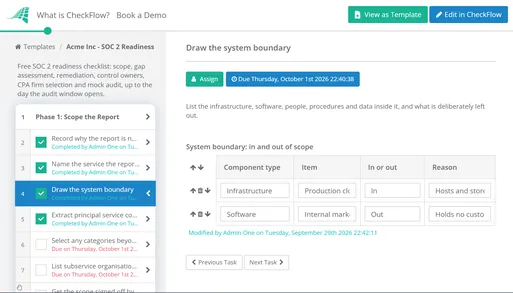
SOC 2 readiness is a sequential project. The phases below represent the typical progression from no audit history to a completed Type II report. To run the readiness stage itself, from scoping and gap assessment to the day the observation window opens, use the free SOC 2 Readiness Checklist template.
Scoping
Define exactly what systems, services, and data flows are in scope for the SOC 2 examination. The scope statement should describe the service being examined, the infrastructure and software components that support it, the boundaries of what is included, and what is explicitly excluded. A tighter scope means a faster, less expensive audit — many organizations scope their first SOC 2 to a single product or service line and expand at renewal. Your auditor will review and validate the scope before the audit begins. Critical scoping decisions: are development environments in scope? Are sub-processors in scope? Are specific data types (PHI, PII) excluded from scope? Scope decisions are permanent for the duration of the audit period and should be made deliberately, with input from your auditor.
Gap Assessment
Before engaging an auditor, assess your current controls against the 33 Common Criteria (and any additional criteria selected) to identify gaps. A gap assessment maps each criterion to your existing controls and flags what is missing, partially implemented, or implemented but not documented. The output is a prioritized remediation list with effort estimates. Most organizations beginning their first SOC 2 journey find their technical controls are reasonably strong but documentation, access reviews, vendor management, and change management procedures need significant work. GRC tools (Vanta, Drata, Secureframe) include automated gap assessment modules that accelerate this phase by integrating with your existing tooling and flagging control gaps automatically.
Remediate Gaps
Implement the controls and documentation identified in the gap assessment. Prioritize based on audit risk: CC6 (access management) and CC8 (change management) are the categories most frequently flagged in audits — address these first. Write the policy documents that evidence your control environment. Set up automated evidence collection where possible — access review reports, vulnerability scan results, change management tickets. Establish the recurring processes that will need to run consistently throughout the observation period: monthly vulnerability scanning, quarterly access reviews, security training completion tracking. Document everything — a control that operates but is not documented does not exist to a SOC 2 auditor. Evidence of execution is the product.
Select an Auditor
Engage a licensed CPA firm with SOC 2 experience. Request proposals from at least 2–3 auditors — fees and timelines vary significantly. Evaluate auditors on: sector experience (do they audit similar types of companies?), team size and seniority, willingness to conduct readiness reviews, and the clarity of their evidence requirements. Some auditors offer combined readiness assessment and audit services; others prefer to audit clean. Avoid firms that are not licensed CPA firms — only licensed CPA firms can issue SOC 2 reports. Confirm the firm's licensing and SOC 2 track record before signing an engagement letter.
Type I Audit (Optional)
If you are pursuing Type I first, the auditor will conduct a point-in-time examination of your control design, typically 60–90 days after engagement. The auditor reviews your policies, interviews key personnel, and examines evidence of control implementation. A Type I report can be issued 8–14 weeks after the readiness work is complete. If you are going straight to Type II, skip this phase and proceed directly to the observation period. If you are conducting a Type I first, the Type II observation period can begin immediately after the Type I examination date — the two processes are sequential, not separate projects.
Type II Observation Period
During the observation period (typically 6–12 months), your controls must operate consistently as documented. Auditors will sample evidence from throughout the period — not just the most recent month. Every recurring task must run on schedule and produce documented evidence: access reviews must be completed quarterly, vulnerability scans must run monthly, change management must be followed for every production change. Evidence gaps discovered during this period — skipped access reviews, undocumented changes, training deadlines missed — become audit findings. Recurring compliance checklists that trigger automatically, assign to the right person, and capture completion timestamps are the operational infrastructure that makes continuous SOC 2 compliance practical at team scale.
Type II Audit and Report
At the end of the observation period, the auditor reviews the accumulated evidence, conducts interviews, and issues the Type II report. The report includes the auditor's description of your system, the criteria tested, and an opinion for each criterion. Findings are classified as: no deviations (clean opinion), exceptions noted (specific control failures documented), or qualified opinion (material control failures). A qualified opinion is serious — it will be visible to every client who requests your report. Most first-time SOC 2 engagements produce at least minor exceptions. The goal is to minimize exceptions and demonstrate a corrective action process. Reports are confidential and shared under NDA.
Keep Your SOC 2 Controls Running Between Audits
CheckFlow's recurring compliance templates schedule your SOC 2 evidence tasks automatically — access reviews, vulnerability checks, training verification, incident reviews — with task assignment, completion tracking, and a timestamped audit trail ready when your auditor asks.
Browse Compliance TemplatesMandatory Policies and Documentation for SOC 2
SOC 2 does not publish a required policy list, but auditors expect documented policies covering all applicable criteria. The policies below are expected in virtually every SOC 2 engagement covering the Security TSC. Each policy must be actively followed — not just filed. The test is not "does the document exist?" but "is the control operating as the document describes?"
| Policy / Document | CC Coverage | Key Requirements |
|---|---|---|
| Information Security Policy | CC1, CC2 | Scope, objectives, management commitment, review cadence |
| Access Control Policy | CC6.1–CC6.3 | Least privilege, provisioning process, access review schedule |
| Change Management Policy | CC8.1 | Approval gates, testing requirements, rollback procedures |
| Incident Response Plan | CC7.3, CC7.4 | Severity tiers, escalation paths, notification requirements, post-incident review |
| Business Continuity / DR Plan | CC9.1, A1 series | RTO/RPO targets, recovery procedures, test schedule |
| Acceptable Use Policy | CC6.7 | Permitted and prohibited system uses, BYOD rules |
| Vendor Management Policy | CC9.1 | Risk classification, assessment requirements, contractual security terms |
| Risk Management Policy | CC3.1–CC3.4 | Risk identification methodology, scoring, acceptance criteria, treatment |
| Data Classification Policy | CC6.1, C series | Data categories, handling requirements per category, retention and disposal |
| Security Awareness Training Policy | CC1.4, CC2.2 | Training frequency, completion tracking, content update requirements |
| Vulnerability Management Policy | CC7.1 | Scan frequency, severity SLAs (critical/high/medium), exception process |
| Encryption Policy | CC6.1, CC6.7 | In-transit and at-rest encryption requirements by data classification |
| Password / Authentication Policy | CC6.1, CC6.6 | Complexity requirements, MFA requirements, rotation policy |
| Hiring and Termination Policy | CC1.4, CC6.3 | Background check requirements, access revocation timelines |
Every policy must have a named owner, a version number, a review date, and evidence of staff acknowledgement. Policies that exist as PDF files in a shared drive but are never reviewed and never referenced in operational practice will be identified as control deficiencies during testing. Auditors will interview staff and check whether policy commitments are reflected in actual operational behavior — the policy and the practice must match.
The SOC 2 Audit Process
Understanding the audit process sequence helps IT managers set realistic expectations and prepare the right evidence at the right time.
Auditor engagement. Issue an engagement letter defining scope, criteria, audit period, deliverables, and fees. At this point, confirm the observation period start date for Type II. Any controls implemented after this date count toward the audit period; anything before does not form part of the tested period. This date matters — controls need to be operating from day one of the observation window, not retrofitted at the end.
Kickoff and evidence request. The auditor provides a Population and Evidence Request (PER) — a detailed list of the evidence they will need. Evidence requests typically cover: policy documents, system configurations, access review records, change management logs, incident records, vulnerability scan results, and training completion data. Organize evidence early and assign clear internal ownership for each category. Delays in evidence collection are the most common cause of audit timeline overruns.
Fieldwork (Type II). The auditor samples evidence from throughout the observation period. For each control, they typically test 25 samples for a 12-month period. This means a quarterly access review must have been conducted all four quarters — not just the most recent one. Missing evidence for any sample period creates an exception. The fieldwork phase typically takes 4–8 weeks. During fieldwork, auditors conduct interviews with key personnel — IT leads, compliance owners, engineering managers — to validate that documented controls reflect operational reality.
Management representation letter. Before the report is issued, you sign a management representation letter confirming that you have provided all relevant information and are not aware of material errors or omissions in the evidence provided. This is a legal representation — treat it seriously and confirm the completeness of your evidence before signing.
Report issuance. The auditor issues a draft report for management review before finalizing. Review it carefully — clarify any factual inaccuracies about your system description. Management responses to exceptions can be included in the final report; a well-written corrective action plan in response to an exception is significantly better than silence. The final report is typically issued 2–4 weeks after fieldwork concludes.
Report sharing. SOC 2 reports are confidential — they contain detailed descriptions of your security controls that could be useful to an attacker. Share under NDA with prospective clients, existing clients, and compliance questionnaire reviewers on a need-to-know basis.
SOC 2 Timeline and Cost — What to Expect
Vague timeline guidance is unhelpful when you are trying to plan a SOC 2 project against a sales pipeline or a procurement deadline. The numbers below represent typical ranges for a focused-scope engagement covering the Security TSC.
| Phase | Typical Duration | Key Activities |
|---|---|---|
| Readiness assessment | 2–4 weeks | Gap identification, remediation planning |
| Gap remediation | 6–12 weeks | Control implementation, policy writing, evidence infrastructure setup |
| Type I audit (if applicable) | 4–8 weeks | Auditor fieldwork, report issuance |
| Type II observation period | 6–12 months | Controls operating, evidence collected continuously |
| Type II fieldwork and report | 6–12 weeks | Evidence review, interviews, report issuance |
| Total: Type I only | ~3–5 months | — |
| Total: Type II (full journey) | ~12–18 months | — |
External audit fees: Type I only: $7,500–$25,000. Type II (12-month period): $20,000–$45,000. Total all-in Type II investment (including readiness, tooling, staff time): $30,000–$80,000.
GRC automation tools: Vanta approximately $12,000–$20,000/year for SaaS companies. Drata and Secureframe in a similar range. These tools reduce staff time for evidence collection significantly but add to annual recurring cost.
What drives cost up: wide scope, multiple Trust Service Criteria, large number of in-scope systems, high volume of sub-processors, lack of existing automation (manual evidence collection is expensive), first-time audit without prior controls, and complex infrastructure environments. What reduces cost: narrow initial scope, strong existing controls documentation, GRC automation for evidence collection, and staff time invested in evidence organization prior to fieldwork.
Common SOC 2 Audit Failures — and How to Avoid Them
Mistake 1: Access reviews not conducted on schedule (CC6.2)
The most common SOC 2 finding. Access rights reviews are required quarterly (or per the organization's documented policy), but organizations skip them or conduct them only when the audit is approaching. An auditor sampling 12 months of evidence will immediately identify the gap — missing evidence for one quarter means an exception for that quarter. Fix: establish access review as a recurring quarterly checklist item assigned to a named owner, with completion documented in a structured record. Evidence must exist for every review period, not just recent ones.
Mistake 2: No documented change management for production changes (CC8.1)
Changes to production systems — code deployments, infrastructure changes, configuration updates — are being made without following the documented change management procedure. Developers bypass the process for "small" changes. The auditor finds undocumented changes during fieldwork and the change management control fails. Fix: make the change management process frictionless enough that teams actually follow it. A lightweight ticketing-based approval for standard changes is more reliable than a heavyweight process people work around.
Mistake 3: Vendor risk management undocumented (CC9.1)
The organization has no documented vendor risk management process. Sub-processors are used without security review, no risk classification exists, and contractual security requirements are absent from vendor agreements. Auditors specifically test CC9.1 for every significant sub-processor in scope. Fix: build a vendor register, classify each vendor by risk tier, conduct and document a security assessment for high-risk vendors, and include security requirements in all significant vendor contracts.
Mistake 4: Vulnerability management without SLA adherence evidence (CC7.1)
Vulnerability scans are running but critical and high-severity findings are not remediated within the documented SLA. The policy says "critical vulnerabilities remediated within 7 days" but the evidence shows 30–60 day closure times. Fix: either enforce the SLA you have documented, or set a realistic SLA that matches your actual operational capacity. A documented exception process (risk acceptance for vulnerabilities that cannot be remediated within SLA) is acceptable; undocumented non-compliance is not.
Mistake 5: Terminated employee access not revoked promptly (CC6.3)
User access rights for terminated employees remain active past the documented revocation timeline. Even a single exception during a 12-month observation period creates an audit finding. Fix: implement automated deprovisioning triggered by HRIS status changes, and establish a documented verification step that confirms revocation was completed and is recorded as a timestamped checklist task.
Mistake 6: Incident response never tested (CC7.3)
The incident response plan exists as a document but has never been tested. Auditors ask for evidence of tabletop exercises or simulations — and find none. A plan that has never been tested doesn't demonstrate that your team can execute it under pressure. Fix: schedule at least one tabletop exercise per year and document the outcome, findings, and plan updates that resulted. The documentation of the exercise is the evidence.
Mistake 7: Security awareness training completion not tracked (CC1.4, CC2.2)
Security awareness training is delivered but completion is not tracked by individual. Auditors want evidence that all personnel completed training within the required timeframe — not just that training was offered. Fix: use an LMS or training platform that generates individual completion records. Track completion against the full employee roster and follow up on non-completers before the audit period ends.
Mistake 8: System description doesn't match reality (General)
The SOC 2 system description — the narrative section of the report describing your infrastructure, software, and data flows — was written once and never updated. It describes technology you no longer use and omits systems you added during the year. Auditors find discrepancies between the description and the evidence during fieldwork. Fix: review and update the system description at the start of every audit period. Assign it to the infrastructure lead who knows what is actually in production.
Ongoing SOC 2 Compliance: The Recurring Tasks
SOC 2 Type II is not a once-a-year event — it is a continuous evidence collection operation. The observation period is typically 12 months, and auditors sample evidence from throughout that period. Any month without evidence for a recurring control creates a potential exception. The most common root cause of SOC 2 audit exceptions is not missing controls — it is existing controls that were not executed consistently or were not documented when they were executed.
| Frequency | Task | Common Criteria | Evidence Required |
|---|---|---|---|
| Monthly | Vulnerability scan and triage | CC7.1 | Scan report, finding closure log, exception register |
| Monthly | Security event log review | CC7.2 | Review record, anomaly investigation notes |
| Monthly | Backup verification | CC9.1, A1 | Backup completion log, restoration test record |
| Quarterly | User access rights review | CC6.2, CC6.3 | Access review report, changes actioned, sign-off |
| Quarterly | Privileged access review | CC6.3 | Privileged account audit, changes actioned |
| Quarterly | Vendor security review (high-risk) | CC9.1 | Review record, any required actions |
| Quarterly | Risk register review | CC3.1–CC3.4 | Updated risk register with review date |
| Annually | Security awareness training | CC1.4, CC2.2 | Individual completion records for all staff |
| Annually | Penetration test | CC7.1 | Pen test report and remediation plan |
| Annually | Incident response tabletop | CC7.3 | Exercise record, findings, plan updates |
| Annually | Policy review (all policies) | CC1, CC2 | Updated policies with version and review date |
| Annually | Business continuity / DR test | CC9.1, A1 | Test report, RTO/RPO actuals, lessons learned |
The evidence column is what matters. Auditors sample this evidence for each control across the full observation period. Recurring task management — structured checklists that trigger automatically, assign to the right person, and capture completion timestamps — is the operational infrastructure that makes continuous SOC 2 compliance practical at team scale. For a deeper guide on building recurring compliance checklists for IT teams, see the companion article.
GRC Tools That Accelerate SOC 2
The largest operational burden of SOC 2 is evidence collection — gathering, organizing, and maintaining proof that each control is operating. Done manually, this requires dedicated staff time throughout the observation period. GRC (Governance, Risk, Compliance) automation tools address this by integrating with your existing tooling — cloud infrastructure, identity providers, HR systems, code repositories — and continuously pulling evidence.
Vanta integrates with AWS, GCP, Azure, GitHub, Okta, and dozens of other platforms; continuously monitors controls and flags deviations; provides an auditor portal for direct evidence access; and automates the bulk of CC6 and CC7 evidence collection. Strong for SaaS companies with primarily cloud infrastructure. Pricing approximately $12,000–$20,000 per year for a focused-scope engagement.
Drata offers a similar integration footprint to Vanta with strong automated control monitoring and a compliance dashboard showing current control pass/fail status. Well-regarded for organizations pursuing multiple frameworks simultaneously — SOC 2 plus ISO 27001 plus HIPAA — as the evidence collection infrastructure can serve multiple audits from the same integration layer.
Secureframe is competitive with Vanta and Drata; known for strong auditor relationships and streamlined audit workflows. Supports multi-framework compliance and has some tiers accessible for smaller organizations beginning their first SOC 2 engagement.
What GRC tools do not replace: they automate evidence collection for technical controls, but they do not write your policies, conduct your access reviews, run your penetration tests, or replace human judgment on risk treatment decisions. The recurring operational tasks still require people to execute them — GRC tools make the evidence capture easier, not the work itself. For teams operating on tighter budgets, well-structured recurring checklist workflows that assign tasks, enforce completion, and produce timestamped records provide the evidence infrastructure at a fraction of the cost of a full GRC platform.
How SOC 2 Compares to ISO 27001
SOC 2 and ISO 27001 are the two dominant security assurance frameworks for B2B technology organizations. They serve similar purposes but differ in origin, geography, output type, and what buyers typically require.
| Dimension | SOC 2 | ISO 27001 |
|---|---|---|
| Governing body | AICPA (US) | ISO/IEC (International) |
| Primary geography | US (globally recognized in some sectors) | International |
| Output | Audit report with CPA opinion | Certificate from accredited body |
| Scope | Service organization data processing | Full organizational ISMS |
| Time structure | Point-in-time (Type I) or observation period (Type II) | Three-year certificate, annual surveillance |
| Common buyer requirement | US/North American enterprise clients | European enterprise clients, government contracts |
| Audit frequency | Annual report renewal | Annual surveillance + 3-year recertification |
| Control count | 33 Common Criteria + optional TSC criteria | 93 Annex A controls |
For US-focused companies selling to enterprise B2B clients, SOC 2 is typically the priority. For companies with significant European operations or clients, or companies selling to large enterprises with ISO 27001-certified supply chain requirements, ISO 27001 is the priority — or both. The two frameworks have significant control overlap: an organization with a strong SOC 2 Type II program has addressed a large proportion of ISO 27001's requirements. Pursuing both sequentially — SOC 2 Type II first, ISO 27001 second — is more efficient than building them independently. See the ISO 27001 compliance checklist for the ISO 27001 parallel.
Free SOC 2 Compliance Checklist Templates
Maintaining SOC 2 compliance between audits requires executing controls on schedule and documenting the results. CheckFlow's SOC 2 compliance software structures the recurring frameworks that organisations run alongside SOC 2 — each one assigns tasks to the right people and captures a timestamped, audit-ready completion record for every run. Click any card to view the full template.

Build Your SOC 2 Evidence Trail Now
Stop scrambling for evidence at audit time. CheckFlow turns your recurring SOC 2 compliance tasks into scheduled, assigned, evidence-producing workflows — so every control run is documented automatically.
Start free trialFrequently Asked Questions
What is the difference between SOC 2 Type I and Type II?
SOC 2 Type I is a point-in-time audit that evaluates whether your controls are suitably designed as of a specific date. SOC 2 Type II evaluates whether those controls were actually operating effectively over a defined period — typically 6 to 12 months. Most enterprise buyers require Type II because it provides evidence of sustained control operation, not just a snapshot.
Type I is a useful starting point or a first step before committing to the Type II observation period — particularly when you need to demonstrate a baseline security posture quickly to unblock a sales engagement. Once a Type I is complete, the Type II observation period can begin immediately from the same examination date.
How long does SOC 2 Type II take?
From readiness assessment to receiving your Type II report, plan for 9 to 18 months. The audit observation period itself is typically 6 to 12 months — during which your controls must be operating consistently. Before the observation period begins, you need 8 to 14 weeks of readiness work to design and implement controls.
Most organizations begin with a readiness assessment, run a Type I audit to validate control design, then start the Type II observation window. The fieldwork and report phase adds another 6–12 weeks after the observation period closes. Plan your timeline backwards from the deadline that is driving the requirement.
Which Trust Service Criteria are required for SOC 2?
Only the Security TSC (CC1–CC9, also called the Common Criteria) is required in every SOC 2 engagement. The other four — Availability, Processing Integrity, Confidentiality, and Privacy — are optional and selected based on what your clients need and what your service promises.
Most SaaS companies include Security plus Availability. Adding more criteria increases audit scope and cost — select the criteria that match your contractual obligations and client requirements, not the ones that sound impressive. A clean Security-only Type II report is more valuable than a multi-criteria report with exceptions.
How much does a SOC 2 Type II audit cost?
Total investment for a SOC 2 Type II engagement — including readiness, tooling, staff time, and audit fees — typically ranges from $30,000 to $80,000 for a focused scope. External audit fees alone average $20,000 to $45,000 for a 12-month Type II.
GRC automation tools (Vanta, Drata, Secureframe) add $10,000 to $20,000 per year but can significantly reduce the cost of readiness and evidence collection by automating what would otherwise require dedicated staff hours. Staff time is often the largest and most underestimated cost component — factor this into your business case from the start.
What policies do you need for SOC 2?
SOC 2 does not prescribe a specific policy list, but auditors expect documented policies covering all applicable controls. At minimum: information security policy, access control policy, change management policy, incident response plan, business continuity and DR plan, acceptable use policy, vendor management policy, risk management policy, data classification policy, and employee security awareness training policy.
Each policy must be actively followed — not just filed. A policy that exists but is not consistently enforced will be flagged by auditors during control testing. Auditors interview staff during fieldwork to confirm that documented policies reflect what actually happens operationally — the policy and the practice must match.