A structured checklist for cloud service providers pursuing FedRAMP authorization — from readiness assessment through to Agency ATO and continuous monitoring.
FedRAMP authorization is the entry ticket to the $12 billion+ US federal cloud market. Any cloud service offering — SaaS, IaaS, or PaaS — that stores, processes, or transmits federal information must hold a FedRAMP Agency Authorization to Operate before federal agencies can procure it. The authorization process is rigorous, document-intensive, and typically takes twelve to eighteen months — with significant investment in security controls, documentation, and independent third-party assessment. This free FedRAMP compliance checklist gives cloud service providers a structured framework for every phase of the authorization lifecycle — from initial readiness assessment and system boundary definition through to SSP documentation, 3PAO assessment preparation, Agency ATO, and the ongoing continuous monitoring programme that maintains authorization.
The Federal Risk and Authorization Management Program (FedRAMP) is the US government’s standardised approach to security assessment, authorization, and continuous monitoring for cloud products and services. Established in 2011 and managed by the General Services Administration (GSA), FedRAMP provides a “do once, use many times” framework — once a cloud service achieves FedRAMP authorization, any federal agency can rely on that authorization rather than conducting its own independent assessment.
FedRAMP authorization is required for any cloud service offering that stores, processes, or transmits federal information. This applies to SaaS providers selling productivity, collaboration, or business applications to federal agencies; IaaS and PaaS providers hosting federal workloads; and cloud-based communication platforms used by federal employees. As of Q1 2026, only approximately 502 cloud services have achieved FedRAMP authorization — making it a significant competitive differentiator in the federal market.
FedRAMP is built on the NIST SP 800-53 Revision 5 security controls catalogue — the same framework underpinning FISMA compliance — with three impact level baselines (Low, Moderate, and High) containing approximately 125, 325, and 425 controls respectively. The authorization programme is actively evolving: the traditional Agency Authorization path based on Rev 5 baselines remains the current standard, while FedRAMP 20x — a major modernisation initiative announced in March 2025 — is introducing an automated, Key Security Indicator-based path with wide-scale adoption projected for Q3–Q4 2026.
What the FedRAMP Compliance Checklist Covers
This checklist maps to the six key phases of the FedRAMP Agency Authorization path — the current standard for CSPs pursuing federal authorization. See Section 5 for guidance on the emerging FedRAMP 20x path.
Phase 1
Eligibility & Readiness Assessment
Completing a readiness assessment before engaging a sponsoring agency significantly reduces timeline risk. The FedRAMP Readiness Assessment Report (RAR) is not mandatory but demonstrates maturity and reduces time to authorization.
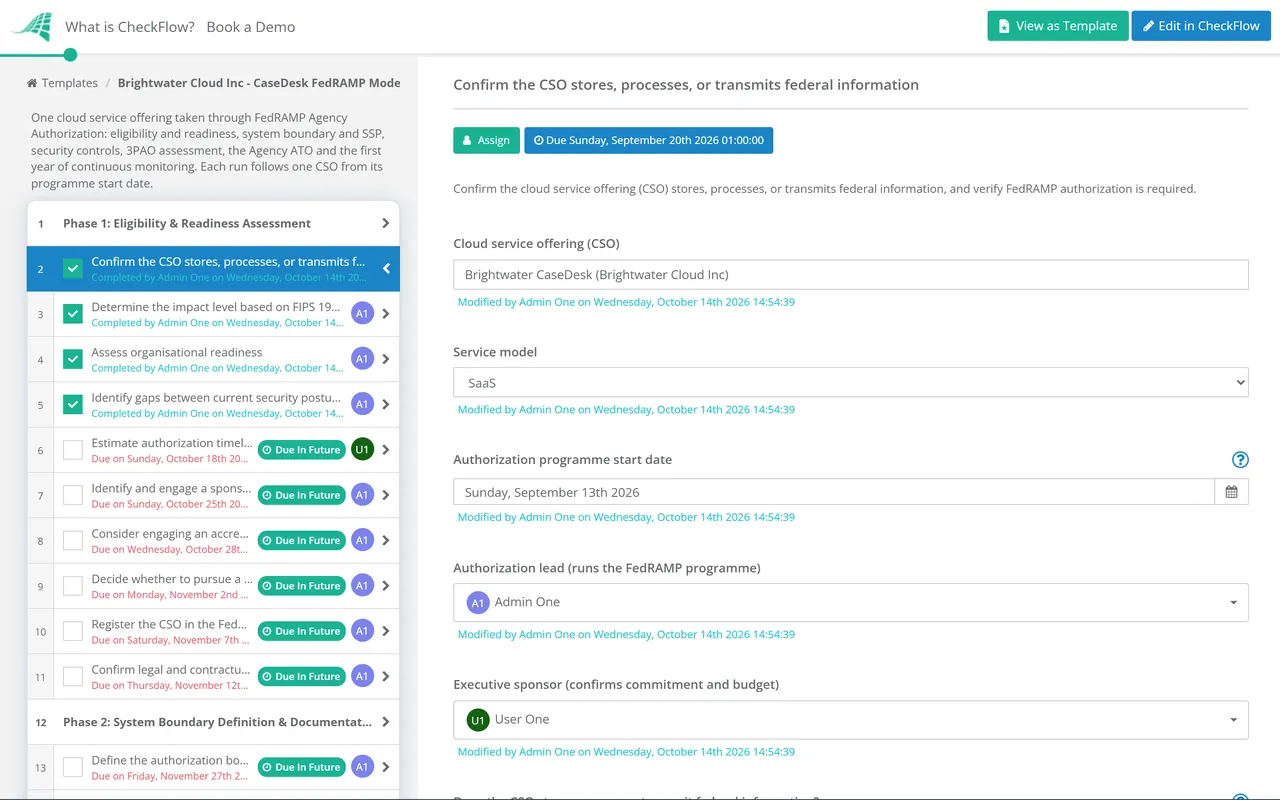
Confirm the cloud service offering (CSO) stores, processes, or transmits federal information — verify FedRAMP authorization is required
Determine the appropriate impact level (Low, Moderate, or High) based on FIPS 199 categorisation of the information the CSO will handle
Assess organisational readiness — review existing security programme against FedRAMP baseline controls for the applicable impact level
Identify gaps between current security posture and FedRAMP requirements — prioritise by effort and risk
Estimate authorization timeline and resource requirements — confirm executive commitment and budget allocation
Identify and engage a sponsoring federal agency — the agency with the most immediate need for the CSO is typically the strongest sponsor
Consider engaging an accredited Third-Party Assessment Organization (3PAO) early for gap assessment and readiness support
Decide whether to pursue a FedRAMP Readiness Assessment Report (RAR) — a RAR validates core security capabilities and can accelerate the full authorization process
Register the CSO in the FedRAMP marketplace — confirm registration information is accurate and current
Confirm legal and contractual requirements with the sponsoring agency — review the agency ATO requirements and any agency-specific overlays
Phase 2
System Boundary Definition & Documentation Preparation
Define the authorization boundary — identify all components, services, and data flows within scope of the FedRAMP assessment
Map all system components — servers, databases, APIs, third-party services, and interconnections within and crossing the boundary
Confirm all third-party cloud services within the boundary are themselves FedRAMP authorized — or confirm a plan to address non-authorized components
Develop the System Security Plan (SSP) — the primary FedRAMP documentation artefact describing the system, its environment, and all applicable controls
Confirm the SSP includes all required sections — system description, boundary diagrams, data flow diagrams, interconnections, applicable laws, and a control implementation statement for every applicable control
Document control implementation status for each control — Implemented, Partially Implemented, Planned, Alternative Implementation, or Not Applicable
Document inherited controls — identify controls provided by underlying IaaS/PaaS platforms (AWS, Azure, GCP) and confirm inheritance is formally accepted
Prepare required SSP attachments — information security policies, user guide, rules of behaviour, privacy impact assessment, and FIPS 199 categorisation
Confirm FIPS 140-2 validated cryptographic modules are used for all encryption — document module certifications
Confirm PIV/CAC authentication integration plan for federal agency users where required
Phase 3
Security Controls Implementation
FedRAMP Moderate requires approximately 325 controls. High requires approximately 425. Confirm applicable controls and any agency-specific overlays before beginning implementation.
Implement Access Control (AC) family controls — least privilege, account management, remote access, and PIV/CAC integration for federal users
Implement Audit and Accountability (AU) controls — comprehensive logging, log review, and retention meeting FedRAMP requirements
Implement Identification and Authentication (IA) controls — MFA for all users, FIPS 140-2 validated authenticators
Implement Incident Response (IR) controls — IR plan, US-CERT reporting within required timeframes, and annual IR testing
Implement Risk Assessment (RA) controls — vulnerability scanning at required frequencies and remediation within FedRAMP SLAs
Implement System and Communications Protection (SC) controls — boundary protection, TLS 1.2+ for all federal data in transit, and network segmentation
Implement System and Information Integrity (SI) controls — malware protection, security alerts, and patching within FedRAMP SLAs
Confirm Supply Chain Risk Management (SR) controls are addressed — NIST SP 800-53 Rev 5 added SR as a new control family with significant requirements for software components and third-party suppliers
Document all control implementation decisions in the SSP — include enough detail for a 3PAO to independently verify
Conduct internal control testing — validate controls are implemented correctly before 3PAO engagement
Select an accredited 3PAO from the FedRAMP marketplace — confirm accreditation status is current and the 3PAO has experience with the applicable impact level
Confirm the 3PAO meets independence requirements — the 3PAO must be independent from the CSP and its suppliers
Develop the Security Assessment Plan (SAP) in coordination with the 3PAO — define assessment scope, methodology, schedule, and testing approach for each control
Conduct pre-assessment preparation — confirm all SSP documentation is complete, evidence is gathered, and test environments are ready
Complete the 3PAO security assessment — provide access to systems, documentation, and personnel as required
Review the draft Security Assessment Report (SAR) — confirm findings are accurate and provide factual corrections where needed
Develop or update the Plan of Action & Milestones (POA&M) addressing all SAR findings — High findings require remediation before ATO; Moderate and Low may be accepted with documented plans
Remediate all High-severity findings identified in the SAR — confirm remediation before authorization package submission
Compile the complete authorization package — SSP, SAP, SAR, POA&M, and all required attachments
Submit the authorization package to the sponsoring federal agency for review
Phase 5
Agency Authorization to Operate
Confirm the agency’s Authorizing Official (AO) has received and reviewed the authorization package
Address any agency questions, requests for additional information, or agency-specific overlay requirements
Confirm any agency-specific controls or enhancements required beyond the FedRAMP baseline are documented and implemented
Receive Agency Authorization to Operate (ATO) decision — confirm the ATO letter, authorization date, and any conditions of authorization are documented
Register the ATO in the FedRAMP marketplace — confirm the CSO listing is updated to reflect Authorized status
Confirm the ATO expiry date is tracked — Agency ATOs are typically valid for three years
Brief the continuous monitoring team on post-authorization obligations — confirm the continuous monitoring plan is in place
Confirm GSA Schedule or relevant federal contract vehicle is in place — required for agency procurement in parallel with or shortly after authorization
Document lessons learned from the authorization process — inform planning for additional agency ATOs or reauthorization
Begin reuse authorization outreach to additional agencies — the existing ATO package can be leveraged by other agencies with minimal delta work
Phase 6
Continuous Monitoring (ConMon)
Continuous monitoring is a permanent obligation — not a post-authorization formality. Failure to meet ConMon requirements can result in authorization revocation.
Implement the Continuous Monitoring Plan — confirm monitoring frequencies for all controls and system components
Conduct monthly vulnerability scans — operating system, database, and web application scans at required frequencies with results delivered to the agency AO
Remediate vulnerabilities within FedRAMP SLAs — High within 30 days, Moderate within 90 days, Low within 180 days
Maintain and update the POA&M monthly — confirm all open items have current status and accurate remediation dates
Submit monthly ConMon deliverables to the sponsoring agency — POA&M update, vulnerability scan results, and any significant change notifications
Conduct annual security assessments — a subset of controls must be independently assessed each year by the 3PAO
Notify the agency AO of any significant changes to the system — confirm the significant change notification process is documented and followed
Report security incidents to US-CERT and the agency AO within required timeframes — confirm IR procedures meet FedRAMP reporting SLAs
Update the SSP to reflect current system state — confirm the SSP is accurate and current at all times
Prepare for annual 3PAO assessment — confirm the annual assessment scope, engage the 3PAO, and complete assessment on schedule
Track ATO expiry date and initiate reauthorization planning at least 12 months before expiry
This checklist is available as a free, runnable template in CheckFlow — with tasks assigned across engineering, security, and compliance teams, ConMon activities scheduled automatically on a recurring basis, and a complete evidence trail building throughout the authorization lifecycle.
Every cloud service pursuing FedRAMP authorization must be categorised at one of three impact levels based on the sensitivity of the federal information it handles. The impact level determines the control baseline and assessment requirements.
Low Impact
Applies when loss of confidentiality, integrity, or availability would have a limited adverse effect on federal operations or individuals. Suitable for publicly available systems and low-sensitivity data.
Controls: ~125 NIST SP 800-53 Rev 5 controls. Typically the fastest and least costly authorization path.
Examples: Public-facing informational services, collaboration tools for non-sensitive government work.
Moderate Impact
The most common impact level — applies when loss would have a serious adverse effect. Covers the majority of government SaaS, productivity, and business applications handling controlled unclassified information.
Controls: ~325 NIST SP 800-53 Rev 5 controls. The focus of FedRAMP 20x Phase 2 pilots and the primary growth opportunity for cloud providers in 2026.
Examples: Email and collaboration platforms, HR systems, grant management, financial applications.
High Impact
Applies when loss would have a severe or catastrophic effect — covering law enforcement, emergency services, financial systems, and health systems processing sensitive government data.
Controls: ~425 NIST SP 800-53 Rev 5 controls. Significant additional requirements, longer timelines, and more rigorous 3PAO assessment.
Examples: Law enforcement databases, critical infrastructure systems, sensitive health data systems.
The correct impact level is determined by FIPS 199 categorisation of the federal information the CSO handles — not by the CSP’s preference. Miscategorisation is one of the most common sources of remediation findings during 3PAO assessment.
FedRAMP 20x — What’s Changing
Note: FedRAMP 20x is an evolving programme. The information below reflects the state of FedRAMP 20x as of mid-2026. Check fedramp.gov for the latest guidance before making authorization path decisions.
The traditional Agency Authorization path described in this checklist remains valid and is the current standard. FedRAMP 20x is the programme’s next generation — cloud service providers planning new authorizations in 2026 and beyond should understand both paths.
No agency sponsorship required
Unlike the current path, FedRAMP 20x does not require a sponsoring federal agency to initiate authorization. CSPs can begin the authorization process independently — removing one of the most significant barriers to entry for smaller providers.
Key Security Indicators replace control checklists
Traditional FedRAMP documentation — the SSP and SAP — is replaced by Key Security Indicators (KSIs): automated, machine-readable evidence that demonstrates security control effectiveness continuously rather than at a point in time. This fundamentally changes what “compliance evidence” means.
Automated validation over manual review
FedRAMP 20x is built on automation — continuous machine-readable evidence from pipelines (signed SBOMs, build provenance, FIPS/STIG attestations) replaces much of the manual documentation review. Organizations pursuing 20x must invest in DevSecOps practices and automated compliance tooling.
Timeline and availability
Phase 2 pilots are underway with selected cloud providers at Moderate impact level. Wide-scale adoption for Low and Moderate is projected for Q3–Q4 2026. High impact is planned for Phase 4 (FY27). The existing Rev 5 Agency Authorization path remains valid — new Phase 5 (planned FY27) will close off new Rev 5 authorizations and provide a transition path.
CSPs already invested in the Rev 5 path should continue — switching to 20x mid-process is not currently practical. CSPs beginning authorization planning in 2026 should assess both paths with current guidance from fedramp.gov before committing.
Why Manage Your FedRAMP Authorization in CheckFlow?
1
Track hundreds of controls across engineering and security teams
FedRAMP Moderate requires approximately 325 controls — each with an owner, an implementation status, evidence requirements, and a 3PAO testing method. CheckFlow’s grid-based dashboard gives security and compliance teams a live view of control implementation progress across all assigned tasks simultaneously, filtering by team, status, or control family — far more practical than tracking authorization progress in a spreadsheet.

2
Automate monthly ConMon obligations
Continuous monitoring is a permanent post-authorization requirement — monthly vulnerability scan submissions, POA&M updates, and significant change notifications don’t stop when the ATO is issued. CheckFlow’s recurring checklist feature schedules ConMon activities automatically on their required frequencies so nothing slips past a deadline. Every completed activity is timestamped and logged for the monthly agency submission.
3
Build the authorization package as you work
The FedRAMP authorization package — SSP, SAP, SAR, and POA&M — requires documented evidence that controls are implemented and tested. Every task completed in CheckFlow is timestamped and attributed to the person who completed it, creating a running evidence trail that documents control implementation decisions, testing activities, and remediation actions throughout the authorization lifecycle.
FedRAMP Contingency Planning (CP) controls require documented backup procedures, tested disaster recovery plans, and evidence of annual testing. CheckFlow’s Disaster Recovery Audit Checklist provides a structured framework for auditing CP control implementation and gathering the testing evidence your 3PAO will need to assess. See the Disaster Recovery Audit Checklist →
FISMA and FedRAMP share the same NIST SP 800-53 control framework. If your organization is also subject to FISMA — as a federal agency or contractor — CheckFlow’s FISMA Compliance Checklist covers the agency-side obligations that complement your FedRAMP authorization. See the FISMA Compliance Checklist →
The Federal Risk and Authorization Management Program (FedRAMP) is the US government’s standardised security assessment and authorization programme for cloud services. Any cloud service offering — SaaS, IaaS, or PaaS — that stores, processes, or transmits federal information must hold a FedRAMP Agency Authorization to Operate (ATO) before federal agencies can procure it. FedRAMP is required by OMB policy for all federal agencies procuring cloud services. It is not optional for CSPs seeking federal contracts — it is a prerequisite for doing business with the US federal government for cloud services in scope.
What is the difference between FedRAMP and FISMA?
+
FISMA (Federal Information Security Management Act) is the law requiring federal agencies to implement information security programmes for their own systems. FedRAMP is the programme that applies FISMA principles to cloud services — it is how federal agencies meet their FISMA obligations when using cloud services from external providers. From the CSP’s perspective, FedRAMP authorization demonstrates that their cloud service meets the security requirements federal agencies must comply with under FISMA. Both frameworks are built on NIST SP 800-53 controls, which means significant overlap in control requirements — but FedRAMP adds the authorization and continuous monitoring programme on top.
Is FedRAMP the same as a SOC 2 report?
+
No — they serve different purposes and audiences. SOC 2 is an AICPA audit framework evaluating a service organization’s controls against the Trust Services Criteria, primarily used in private sector vendor due diligence. FedRAMP is a US government programme specifically for cloud services handling federal information — it uses NIST SP 800-53 controls, requires independent assessment by an accredited 3PAO, and results in a government-recognized ATO. Many cloud providers pursue both — SOC 2 for enterprise customers and FedRAMP for federal agencies. There is significant control overlap between FedRAMP Moderate and SOC 2, which makes pursuing both more efficient than it might appear.
What happened to the JAB and Provisional ATOs?
+
The Joint Authorization Board (JAB) — previously the body that issued Provisional ATOs (P-ATOs) — was dissolved in 2024. P-ATOs are no longer issued. The only FedRAMP authorization path available now is the Agency Authorization — a federal agency sponsors the assessment and issues an Agency ATO for the CSP’s system. Once an Agency ATO exists, other agencies can reuse it with minimal delta work rather than conducting their own full assessment.
What is FedRAMP 20x and should I pursue it?
+
FedRAMP 20x is a major modernisation initiative announced in March 2025. It replaces the traditional SSP-and-documentation approach with automated Key Security Indicators (KSIs) and machine-readable evidence, and removes the agency sponsorship requirement. As of mid-2026, Phase 2 pilots are underway at Moderate impact level — wide-scale adoption for Low and Moderate is projected for Q3–Q4 2026. The existing Rev 5 Agency Authorization path remains valid and is appropriate for CSPs already invested in that approach. CSPs beginning authorization planning in mid-to-late 2026 should evaluate both paths with current guidance from fedramp.gov before committing — the 20x path requires significant investment in DevSecOps automation and may not be suitable for all organizations.
How long does FedRAMP authorization typically take?
+
The traditional Agency Authorization path typically takes twelve to twenty-four months from readiness assessment to ATO — depending on the impact level, the completeness of the CSP’s security programme at the start, the complexity of the system boundary, and the availability of the sponsoring agency and 3PAO. Moderate impact authorizations typically take twelve to eighteen months; High impact authorizations can take longer. FedRAMP 20x is designed to compress these timelines significantly through automation, but remains in pilot as of mid-2026. CSPs that conduct a thorough gap assessment before beginning formal authorization activities consistently reach authorization faster than those who begin without adequate preparation.
Is CheckFlow free to use for this template?
+
You can start a free 14-day trial with no credit card required, giving you full access to all features including this template. The Business plan is $10 per user per month after the trial. Full details at checkflow.io/pricing.
Start Managing Your FedRAMP Authorization Programme Today
Free trial — no credit card required.
Do you like cookies? 🍪 We use cookies to ensure you get the best experience on our website. Learn more