Product Launch Checklist Template

A great product does not guarantee a great launch. Most launch failures are positioning failures — the wrong message, to the wrong audience, through the wrong channel, without the sales team knowing what to say.

Every product launch is a coordination problem: between product, marketing, sales, customer success, and engineering — each with their own dependencies, their own deliverables, and their own definition of “ready.” The launch that fails because the sales team did not have the competitive battle cards before customer calls started. The launch that fails because the pricing page was live before the onboarding flow worked. The launch that generated press coverage but could not convert the traffic because the website messaging did not match what the press coverage promised. Product launch failures are almost always execution failures, not product failures — and execution failures are almost always process failures. A structured product launch checklist assigns every deliverable to a named owner, coordinates the timing so that every channel activates simultaneously, and ensures the post-launch monitoring that converts the launch moment into a learning programme happens before the energy of launch day dissipates. This free checklist gives product managers, founders, and GTM teams a structured framework for the full product launch lifecycle.

Use This Template Free See Live Example
No Credit Card Required

Soft Launch, Limited Release, and General Availability — Choosing the Right Launch Type

Soft Launch / Private Beta

Small curated group, no public announcement

What: Product available to 20–100 users before any public announcement.

When to use: When the product needs real-world usage to identify issues before the broader audience arrives; when early customer references will strengthen the public launch.

Marketing: Minimal or none — the goal is learning, not acquisition.

Limited Release / Public Beta

Public announcement with beta framing

What: Product available to anyone who applies or self-selects; public announcement made but with “beta” framing that sets quality expectations.

When to use: When the product is functional but benefits from real user feedback at scale before committing to full feature set and pricing.

Marketing: Moderate — target early adopter communities, specialist press, Product Hunt.

General Availability (GA)

Full support, stable pricing, all users

What: Product available to all users with full support, documented SLAs, and stable pricing.

When to use: When the product is ready for the mainstream customer — not just early adopters — and the organisation is ready to support it at scale.

Marketing: Full launch — all channels, all audiences, press coordination, analyst outreach.

What the Product Launch Checklist Covers

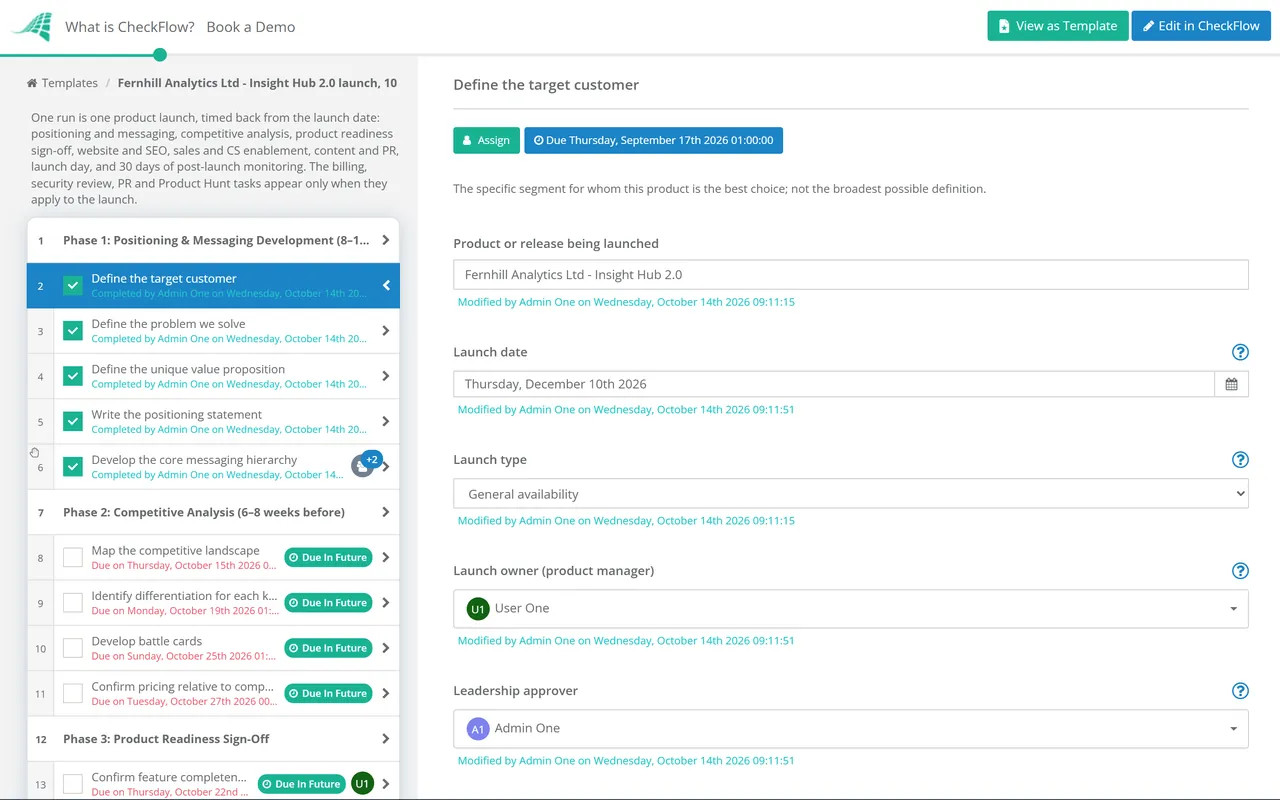
This checklist covers the full product launch lifecycle in eight phases — from positioning development through to 30-day post-launch review.

Phase 1

Phase 1: Positioning & Messaging Development (8–12 weeks before)

Positioning is the strategic decision about what the product is for, who it is for, and why it is the best choice. Messaging is how that positioning is expressed in words that resonate. Both must be defined before any external content is created.

  • Define the target customer — the specific segment for whom this product is the best choice; not the broadest possible definition
  • Define the problem we solve — in the customer’s language; from the customer discovery interviews
  • Define the unique value proposition — what does this product do that alternatives do not? Specific and evidenced
  • Write the positioning statement — “For [target customer] who [problem statement], [product] is [category] that [key benefit] unlike [primary alternative]”
  • Develop the core messaging hierarchy — headline message, three supporting claims, and the proof points for each; approved by product and leadership
Phase 2

Phase 2: Competitive Analysis (6–8 weeks before)

  • Map the competitive landscape — direct competitors, indirect alternatives (including “do nothing”), and adjacent products in the category
  • Identify differentiation for each key competitor — what does the competitor do well? Where do they fail target customers? What objections will the sales team hear?
  • Develop battle cards — for each key competitor; our strengths vs theirs, their likely objections and our responses, and specific use cases where we win
  • Confirm pricing relative to competitive landscape — are we premium, parity, or value?
Phase 3

Phase 3: Product Readiness Sign-Off

  • Confirm feature completeness — all launch-required features built, tested, and GA-quality
  • Confirm performance and scalability — the product can handle the expected traffic and user load from the launch without degradation
  • Confirm security review is complete — for any product handling customer data
  • Confirm onboarding flow works end-to-end — sign-up through first value delivered; the onboarding flow that fails on launch day is the single most expensive launch failure
  • Confirm billing and payment — if monetised; the billing page, payment processor, and invoice flow tested end-to-end
Phase 4

Phase 4: Website & SEO Preparation

  • Build or update the product landing page — with the approved messaging hierarchy; clear headline, value proposition, key features, social proof, and CTA
  • Confirm the primary keyword target — for the product page; title tag, meta description, and H1 optimised
  • Build or update pricing page — clear tier comparisons, FAQ section, and CTA to start trial or book demo
  • Confirm analytics tracking — sign-up, activation, and conversion events tracked from day one
  • Create a changelog or release page — where customers can see what is new; feeds the long-term SEO benefit of consistent publication
Phase 5

Phase 5: Sales & CS Enablement (4–6 weeks before)

  • Sales pitch deck updated — with the new product positioning; demo flow aligned with the launch messaging
  • Battle cards distributed — to all sales team members; briefing session held
  • Pricing and packaging documented — clear to every sales rep; no ambiguity about what is included and at what price
  • Customer success briefed — on what changed, what to expect from new customers, and any known issues from beta
  • Support documentation updated — help articles for every new feature and changed behaviour; published before launch
Phase 6

Phase 6: Content & PR Preparation (2–4 weeks before)

  • Launch blog post written and reviewed — tells the story of the product; why it exists, what problem it solves, who it is for; with customer quotes if available
  • Email announcement drafted and scheduled — to existing customers and email list; timed for launch day
  • Social media content scheduled — across all active platforms; launch day and week 1 posts prepared
  • PR outreach planned — for significant launches; target publications identified; press release embargoed and ready
  • Product Hunt submission prepared — if applicable; hunter identified; assets prepared
Phase 7

Phase 7: Launch Day Execution

  • Publish all content simultaneously — blog post, social posts, email announcement, product page update; coordinated timing
  • Activate PR embargo release — if press coverage was arranged; confirm articles are live
  • Monitor social channels — for mentions, questions, and reactions; respond promptly
  • Monitor sign-ups and activation — in real time; any drop-off in onboarding flagged immediately to engineering
  • Monitor error rates — the engineering team is on call; any production issues addressed immediately
Phase 8

Phase 8: Post-Launch Monitoring & Iteration (30 days)

  • Review activation funnel weekly — sign-up to active users; where are users dropping out? What is being fixed?
  • Collect structured feedback — NPS survey to new users at Day 7; customer success check-in calls with first 10 paying customers
  • Review support ticket themes — what are new users asking for help with? What indicates a product or onboarding gap?
  • Conduct the post-launch review — at Day 30; what worked, what did not, what will change in the next sprint
  • Update the road map — based on post-launch learning

Why Use CheckFlow for Product Launches?

1

Cross-functional coordination with every deliverable assigned

A product launch involves product, engineering, marketing, sales, customer success, and PR — often with no single owner of the full checklist. CheckFlow assigns every launch deliverable to the correct team member with a deadline offset from the launch date — the competitive battle cards to sales 6 weeks before, the blog post to marketing 2 weeks before, and the engineering smoke test to the deployment team on launch day morning.
2

Simultaneous channel activation on launch day

Launch content that goes out in a staggered trickle — blog post on Monday, email on Wednesday, social media the following week — does not produce the compounding effect of coordinated simultaneous activation. CheckFlow’s launch day phase schedules every channel publication with the same target time, coordinated across the teams responsible.

3

Post-launch monitoring that captures the learning

The teams that get the most from a product launch are the ones that treat the launch as the beginning of the learning phase, not the end of the build phase. CheckFlow’s post-launch phase schedules the weekly activation funnel review, the Day 7 NPS collection, the Day 30 post-launch review, and the road map update — ensuring the launch produces the data that guides the next sprint.

The production deployment element of a product launch is governed by the feature release process. CheckFlow’s Feature Release Process Checklist covers the technical deployment workflow. See the Feature Release Process Checklist →

Post-launch user feedback collection is a structured ongoing process. CheckFlow’s User Feedback Collection Checklist covers the systematic process for collecting and acting on feedback after launch. See the User Feedback Collection Checklist →

Frequently Asked Questions

What should a product launch checklist cover?

+

A product launch checklist covers eight phases: positioning and messaging development (target customer, problem definition, value proposition, positioning statement, messaging hierarchy), competitive intelligence (competitive landscape mapping, differentiation analysis, battle cards), product readiness sign-off (feature completeness, performance, security, onboarding, billing), website and SEO (landing page, pricing page, analytics tracking, changelog), sales and CS enablement (pitch deck, battle cards, pricing clarity, CS briefing, support documentation), content and PR (blog post, email announcement, social content, PR outreach), launch day execution (simultaneous content publication, PR embargo release, real-time monitoring), and post-launch monitoring (activation funnel review, structured feedback collection, 30-day post-launch review).

What is the difference between a product launch and a feature release?

+

A feature release is the internal engineering and QA process for deploying a specific feature from staging to production — ensuring it is tested, reviewed, and safely deployed. A product launch is the external go-to-market strategy and execution for introducing a new product or significant version to the market — encompassing positioning, messaging, sales enablement, marketing activation, and coordinated announcement across all channels. Feature releases happen continuously (in agile environments, multiple times per week); product launches happen at strategic inflection points (new product, major version, significant expansion).

How far in advance should product launch preparation begin?

+

For a significant B2B SaaS product launch, preparation typically begins 8–12 weeks before the launch date. Positioning and messaging development should begin first (8–12 weeks out) because it informs all subsequent content and enablement work. Competitive analysis and product readiness sign-off follow (6–8 weeks out). Website and content production, sales enablement, and PR outreach work begins 4–6 weeks out. The mistake that most commonly causes launch failure is starting the positioning work too late — which creates a cascade of content and enablement work that is compressed and therefore lower quality.

What makes a product launch positioning statement effective?

+

An effective product positioning statement follows the template: “For [specific target customer] who [has a specific problem], [product name] is the [category] that [key differentiating benefit] unlike [primary alternative].” The value of this structure is that it forces specificity at every element: if you cannot name a specific target customer, you do not know who you are for; if you cannot name a specific problem, you do not know what you solve; if you cannot name a primary alternative, you have not done competitive analysis. The positioning statement is an internal tool, not marketing copy — it is the strategic anchor from which all external messaging is derived.

Is CheckFlow free for this template?

+

14-day free trial, no card required. The Business plan is $10 per user per month after the trial. Full details at checkflow.io/pricing.

Launch Every Product With Coordinated Execution Across Every Channel

Free trial — no credit card required.