Product Ideation & Validation Checklist Template

Falling in love with a solution before understanding the problem it solves is the most common reason product teams spend six months building something nobody needed. Validation happens before the build — not during.

The history of product failure is substantially the history of solutions without validated problems. Teams that are excited by a technology, an idea, or a vision of a product build first and ask whether anyone needs it later — when the answer is hard to hear and harder to act on. The lean startup discipline inverts this sequence: generate ideas freely, frame them as falsifiable hypotheses, and design the cheapest possible test that could invalidate each hypothesis. The ideas that survive rigorous testing earn the investment of development; the ideas that do not survive are eliminated before they consume six months and a meaningful budget. A structured product ideation and validation process makes this discipline operational: generating ideas with a problem-first lens, framing them as testable hypotheses using the Jobs-to-be-Done framework, mapping the riskiest assumptions, and designing validation experiments that are honest enough to actually invalidate a bad idea. This free checklist gives founders, product managers, and innovation leads a structured framework for the full ideation and validation lifecycle.

Use This Template Free See Live Example
No Credit Card Required

Jobs-to-Be-Done — Why Users “Hire” Products and What That Means for Ideation

The Jobs-to-be-Done framework, developed by Clayton Christensen, proposes that customers do not buy products — they “hire” them to accomplish a specific job in their life. When someone buys a drill, the job is “make a hole in the wall” — and if a better way to make a hole appeared, the drill would be fired. The implication for product ideation is that the most important question is not “who is the user?” but “what job are they trying to get done?” — and the most important validation question is “is this job important enough to hire a new solution for?”

A job has three dimensions: functional (what task is being accomplished?), social (how does completing this job make the person look to others?), and emotional (how does completing this job make the person feel?). Products that address all three dimensions of a high-frequency, high-importance job tend to attract strong adoption. Products that address only the functional dimension of a low-frequency, low-importance job do not.

Functional dimension

What task is actually being accomplished? What outcome does the user need to produce? The functional job is the starting point — it defines the baseline requirement for any solution.

Social dimension

How does completing this job make the person look to others? Products that help users look competent, authoritative, or ahead of their peers have a social pull beyond their functional value.

Emotional dimension

How does completing this job make the person feel? Products that reduce anxiety, increase confidence, or provide satisfaction have an emotional pull that drives retention beyond feature utility.

What the Product Ideation & Validation Checklist Covers

This checklist covers the full pre-build validation process in six phases — from structured idea generation through the go/no-build decision.

Phase 1

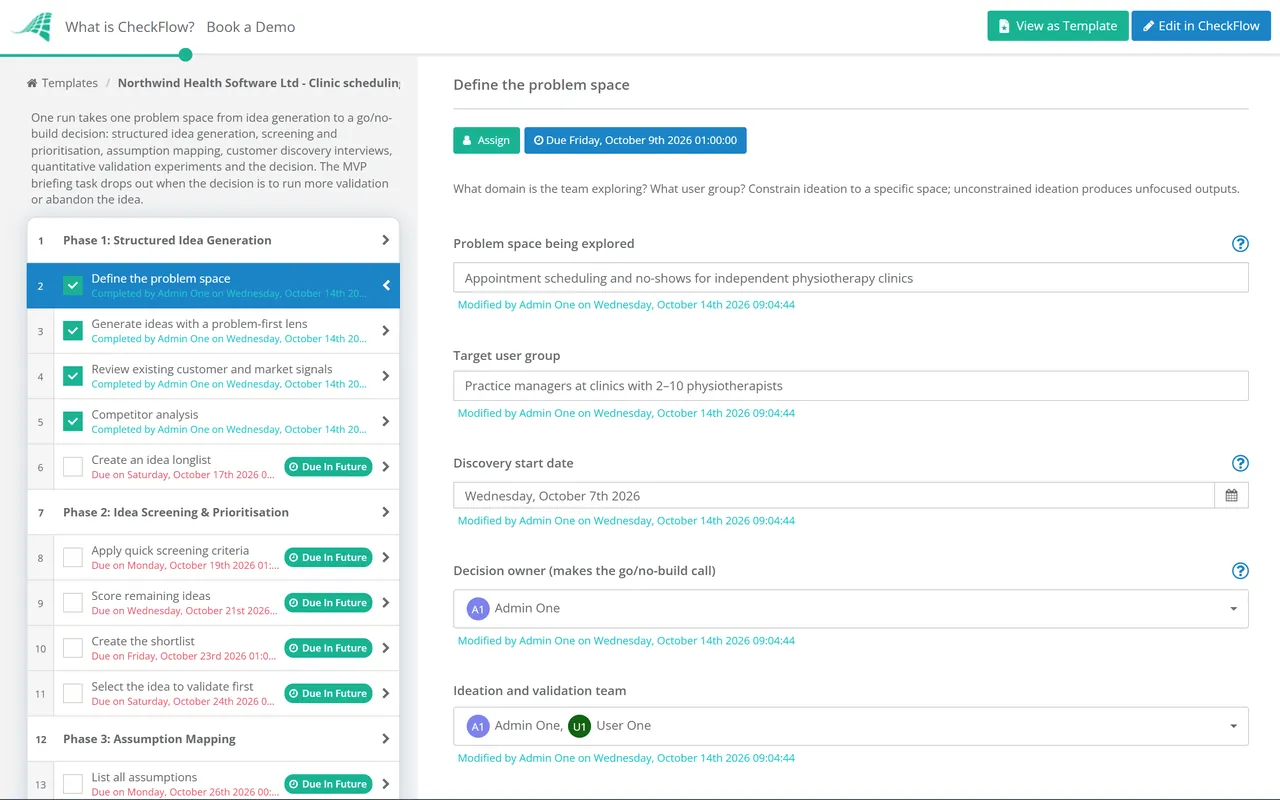
Phase 1: Structured Idea Generation

Good ideas are common; specific problems are rare. The constraint in ideation should not be generating more ideas — it should be generating ideas that are specific enough to be falsifiable and validated.

  • Define the problem space — what domain is the team exploring? What user group? Constrain ideation to a specific space; unconstrained ideation produces unfocused outputs
  • Generate ideas with a problem-first lens — for each idea: “what problem does this solve and for whom?” not “what could this product do?”
  • Review existing customer and market signals — support tickets, sales call recordings, user interview notes, forum posts, and product reviews; real problems stated by real users
  • Competitor analysis — what jobs are existing products in this space being hired to do? Where are they failing users?
  • Create an idea longlist — without evaluation; capture every idea with a one-sentence problem statement
Phase 2

Phase 2: Idea Screening & Prioritisation

  • Apply quick screening criteria — filter by: Is the problem real (not hypothetical)? Is the target user identifiable? Is there a plausible business model?
  • Score remaining ideas — on problem severity (how much does the user care?), frequency (how often does the problem occur?), and addressability (can this team realistically solve it?)
  • Create the shortlist — maximum 2–3 ideas to validate in depth; validation is resource-intensive; do not validate everything
  • Select the idea to validate first — the highest-scoring idea on the combined criteria; or the idea with the highest risk (if it fails validation, it fails cheaply now rather than expensively later)
Phase 3

Phase 3: Assumption Mapping

Every product idea is built on a stack of assumptions. The most dangerous assumption is the one that is never questioned because it feels obviously true. Assumption mapping makes every assumption explicit and determines which ones are both most uncertain and most important to test.

  • List all assumptions — everything that must be true for the idea to succeed; about the user, the problem, the solution, the business model, and the market
  • Categorise assumptions by type — desirability (do users want this?), viability (can we build a business around this?), and feasibility (can we actually build this?)
  • Identify the riskiest assumptions — those that are both most important and most uncertain
  • Map to validation experiments — for each risky assumption, what is the cheapest test that could invalidate it?
Phase 4

Phase 4: Customer Discovery Interviews

  • Recruit 15–20 target users — matching the specific target profile; warm introductions preferred; incentivise appropriately
  • Prepare an interview guide — open-ended questions about their current workflow, pain points, and how they currently solve the problem; no leading questions
  • Ask about the past, not the future — “Tell me about the last time you had to [do this job]” not “Would you use a product that…”
  • Listen for the language users use — their words describe the problem more accurately than your words; exact phrases from interviews become your messaging and positioning
  • Document and synthesise findings — after each interview; the common themes, the surprises, and the exact quotes that capture the problem
  • Make the preliminary go/no-go — do 15+ interviews confirm a real, significant, widespread problem? Or are only 2–3 people expressing the pain strongly?
Phase 5

Phase 5: Quantitative Validation Experiments

  • Choose the validation method — based on the riskiest assumption: smoke test/landing page (demand validation without building); concierge test (deliver the solution manually before automating); Wizard of Oz test (simulate automated behaviour manually)
  • Run the validation experiment — with a specific, predetermined success threshold; not “this seems promising” but “30%+ of landing page visitors sign up”
  • Do not adjust the success threshold after seeing the results — confirmation bias at the validation stage is the most expensive mistake in product development
  • Document the experiment results — honestly; what the data showed, not what the team hoped it would show
Phase 6

Phase 6: Go/No-Build Decision

  • Assess all validation evidence — interview findings and experiment results together; do they consistently support the hypothesis?
  • Make the decision — proceed to MVP development, run additional validation, or abandon; the decision is based on evidence, not excitement
  • Document the decision rationale — including the key data points, the remaining unknowns, and the specific assumptions the MVP will test
  • Brief the MVP development team — with the validation findings, the hypothesis, and the user language from interviews; this feeds the problem statement in the MVP workflow

Why Use CheckFlow for Product Ideation & Validation?

1

A structured discovery process that resists confirmation bias

The problem with unstructured idea validation is that it tends to find evidence for the idea that already excited the team. CheckFlow’s validation process requires explicit assumption mapping before interviews begin, a predetermined success threshold before experiments run, and a documented go/no-build decision with rationale — creating a structure that makes it harder to talk yourself into a bad idea.

2

Interview and experiment records that feed the MVP

The user language from discovery interviews — the exact phrases users use to describe their problem — is the most valuable input to MVP positioning and product development. CheckFlow’s interview documentation tasks capture this language systematically, making it immediately available to the product and development team when the MVP workflow begins.

3

A validation audit trail for investors

Sophisticated early-stage investors want to see evidence of customer discovery, not just product enthusiasm. The documented validation process — interviews conducted, experiments run, data obtained, decision made — is the most credible signal that a founding team has tested their assumptions before asking for investment to build.

Validated problem-solution fit feeds directly into the MVP development process. CheckFlow’s MVP Development Workflow Checklist covers the structured build process for your validated idea. See the MVP Development Workflow →

User interviews in the validation phase are the first use of a feedback collection framework. CheckFlow’s User Feedback Collection Checklist covers the ongoing post-launch feedback process. See the User Feedback Collection Checklist →

Frequently Asked Questions

What is the difference between product ideation and validation?

+

Product ideation is the process of generating product ideas — defining problem spaces, generating ideas with a problem-first lens, screening and prioritising them, and selecting the most promising for validation. Product validation is the process of testing whether a selected idea represents a real, significant, and addressable problem before investing in building a solution — through assumption mapping, customer discovery interviews, and quantitative validation experiments. Ideation comes first; validation determines whether ideation produced something worth building. Most product failures can be traced to skipping validation — proceeding from ideation directly to development based on the team’s belief rather than evidence.

What is Jobs-to-be-Done and how is it used in product ideation?

+

Jobs-to-be-Done (JTBD) is a framework for understanding why customers use products — framing products as tools that customers “hire” to accomplish a specific job in their life. The most important question in product ideation, under JTBD, is not “who is the user?” but “what job are they trying to get done?” — because the same person may “hire” very different products for different jobs, and people will switch products when a better way to do the job becomes available. In product ideation, JTBD helps teams generate ideas that are attached to real user jobs and evaluate ideas by asking whether the job is important, frequent, and currently being done poorly.

What is a smoke test in product validation?

+

A smoke test (also called a landing page test or fake door test) is a validation experiment that measures demand for a product before building it. Typically, a landing page describes the product’s value proposition and invites visitors to take a sign-up or pre-order action — without the product yet existing. The conversion rate of visitors to sign-ups measures whether demand is strong enough to justify development. Smoke tests test demand, not behaviour — they validate that people are interested, not that they will actually use the product once built. They are most useful when the riskiest assumption is demand (“will people want this?”) rather than behaviour (“will people actually do this?”).

How many customer interviews are needed for validation?

+

For product validation, 15–20 interviews with target users who match the specific profile provides reasonable confidence. The stopping signal is saturation — when consecutive interviews are producing no new insights and the same themes are recurring, enough interviews have been done. The quality of interview selection matters more than the number: 10 deep interviews with precisely matched target users provide more validation value than 30 superficial conversations with loosely matching contacts.

Is CheckFlow free for this template?

+

14-day free trial, no card required. The Business plan is $10 per user per month after the trial. Full details at checkflow.io/pricing.

Validate the Problem Before You Build the Solution — Every Time

Free trial — no credit card required.