The graveyard of failed startups is filled with products that took too long to build, cost too much to develop, and solved problems nobody had. An MVP is the filter that tests the assumption before it becomes the investment.
In Q1 2025 alone, venture capital invested $115 billion globally — and the pattern of failure among that investment is consistent and well-documented. Products fail not because teams cannot build them but because they build the wrong thing, for the wrong user, at the wrong price, in the wrong way — and they discover this after the full development investment is made. The Minimum Viable Product discipline exists to invert this sequence: test the riskiest assumption first, with the smallest investment possible, before committing to the full build. An MVP is not a half-built product — it is a precisely scoped product built to the minimum level of completeness that enables a real test of a real hypothesis with real users. Its minimum scope is defined by the test it needs to run, not by what the team has time to build. A structured MVP development workflow disciplines this process at every stage — from the problem validation that defines what to test, through the scope decisions that keep the build lean, to the beta programme that generates the learning that determines the next investment. This free checklist gives founders, product managers, and innovation teams a structured framework for the full MVP development lifecycle.
The MVP Misunderstanding That Produces Unusable Products
What an MVP IS
The smallest version of a product that allows a team to test a specific hypothesis with real users and collect the maximum amount of validated learning with the least effort.
“Minimum” means: minimum scope for the test — the minimum number of features required to run the experiment.
Quality standard: must be good enough that users can actually use it and give meaningful feedback. A broken product cannot generate valid data.
The output: validated or invalidated hypotheses that guide the next investment decision.
What an MVP IS NOT
A half-built, low-quality version of the full product vision released because the team ran out of time
A product that has core features missing because they were “V2”
A prototype that was never actually tested with real users
An excuse to ship something you know is bad
The final product — it is the first experiment in a learning process
What the MVP Development Workflow Checklist Covers
This checklist covers the full MVP lifecycle in seven phases — from problem definition through build-measure-learn decision.
Phase 1
Phase 1: Problem Definition & Core Hypothesis
The most common MVP failure is building a solution before the problem is clearly defined. If the team cannot state the problem in a single sentence that a target user would recognise as their own problem, the MVP scope will be wrong.
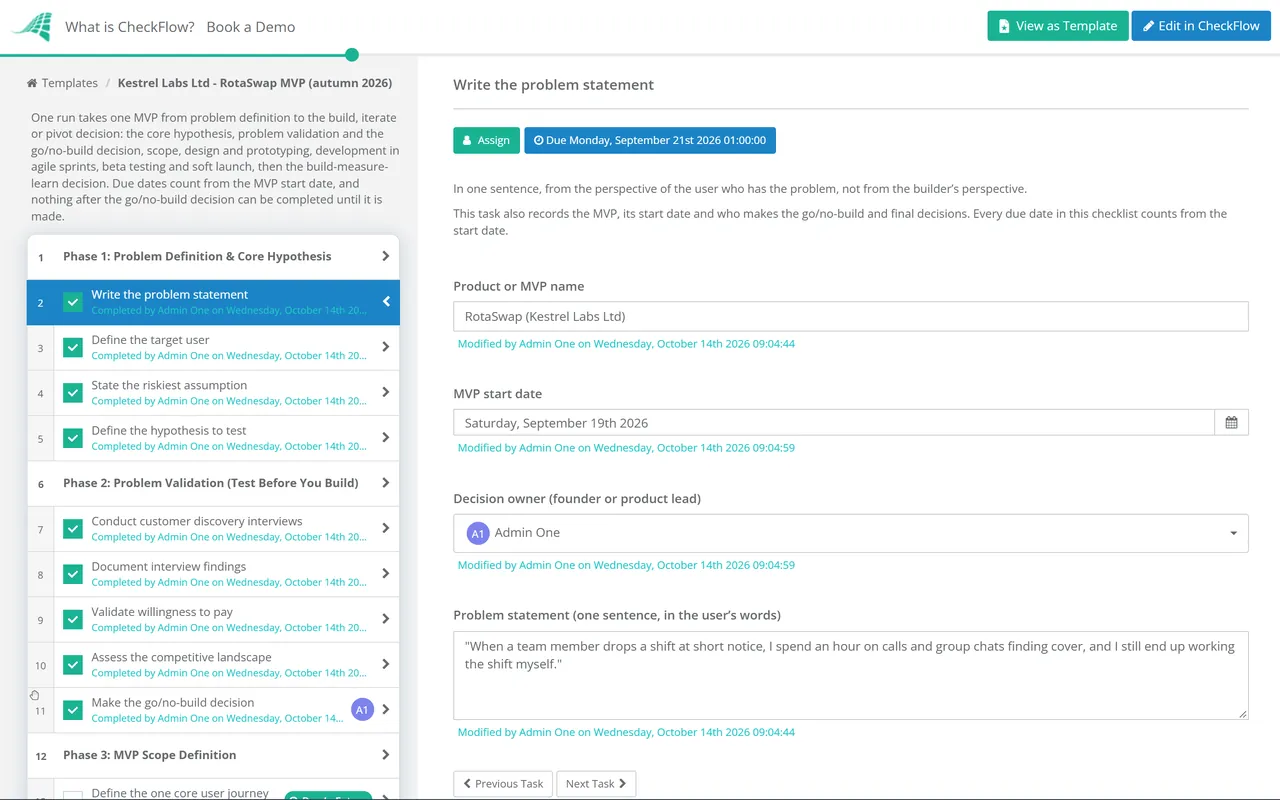
Write the problem statement — in one sentence; from the perspective of the user who has the problem; not from the builder’s perspective
Define the target user — the specific person who has this problem; industry, role, company size, and current behaviour; not “everyone with a computer”
State the riskiest assumption — the one thing that, if wrong, makes the entire product idea wrong; typically “users will pay for a solution to this problem”
Define the hypothesis to test — “We believe [target user] will [behaviour] because [assumption]. We will know this is true when [measurable outcome].”
Phase 2
Phase 2: Problem Validation — Test Before You Build
Conduct customer discovery interviews — minimum 10–15 interviews with people matching the target user profile; open-ended; ask about their current workflow, not your solution
Document interview findings — what do target users say about the problem? How do they currently solve it? How much does the problem cost them?
Validate willingness to pay — not “would you use this?” (everyone says yes); ask for a deposit, a letter of intent, or a pre-order; real commitment is the signal
Assess the competitive landscape — how do users currently solve this problem? What is the specific failure mode that creates the opportunity?
Make the go/no-build decision — does the interview evidence support the hypothesis? If not, pivot before building anything
Phase 3
Phase 3: MVP Scope Definition
The MVP scope definition is the most important product decision in the process. Everything that is not essential to testing the core hypothesis should be out of scope. The feature that gets added because it “would be good to have” is the feature that delays the learning by three weeks.
Define the one core user journey — the single path through the product that tests the hypothesis; scope everything else out
List all features in scope — only features required for the core user journey to function
Create the exclusion list — features explicitly excluded from V1; confirm each is not required to test the hypothesis
Estimate the build time — honestly; if the MVP will take more than 8–12 weeks to build, it is probably a V1 product; rescope
Define the success metrics — what specific data will validate or invalidate the hypothesis? Set the threshold before testing begins
Phase 4
Phase 4: Design & Prototyping
Create low-fidelity wireframes — for the core user journey; quickly; do not over-invest in wireframe polish
Test the prototype with target users — 5–8 users is sufficient to identify major usability problems; before any development begins
Iterate on the design based on prototype feedback — fix usability problems at prototype stage; not after development
Confirm the core user journey is clear and intuitive — a user who cannot complete the core journey without help in a prototype test will not complete it in the built product
Phase 5
Phase 5: MVP Development (Agile Sprints)
Define the sprint structure — 1–2 week sprints; clear sprint goals tied to the MVP scope; no scope creep
Build the core infrastructure first — authentication, basic data models, and core API before UI
Maintain the exclusion list — resist scope creep; every feature addition request assessed against “is this required to test the hypothesis?”
Quality standard: build it right enough to test reliably — “minimum viable” does not mean buggy; a product that cannot be used reliably produces no valid learning
Demo to target users at each sprint — get continuous feedback; do not wait until the full MVP is complete to show it to users
Phase 6
Phase 6: Beta Testing & Soft Launch
Recruit beta users — 20–50 users who match the target profile; ideally from the customer discovery interview pool who expressed strong interest
Define the beta programme — duration, access method, what feedback is sought, and what support is provided
Instrument the product — analytics tracking the core user journey steps; every step that matters to the hypothesis is measured
Collect structured feedback — NPS or equivalent at the end of the beta period; user interviews with 5–10 beta users; support ticket and error log review
Assess against the success criteria — defined in Phase 3; is the hypothesis validated, partially validated, or invalidated?
Phase 7
Phase 7: Build-Measure-Learn Decision
The honest assessment of beta data is the hardest and most important step in the MVP process. Confirmation bias — the tendency to interpret ambiguous data as validating the hypothesis — is the most common reason MVPs do not produce the learning they should.
Review the data honestly — against the success criteria set in Phase 3; not against “what does success feel like”
Make the decision — one of three: Build (hypothesis validated; proceed to full product development); Iterate (partial validation; specific elements need to change); Pivot (hypothesis invalidated; fundamental change required)
Document the learnings — what was learned, what surprised the team, what will change in the next iteration
Communicate the decision and learnings — to the team, investors, and any stakeholders; transparent even if the result is a pivot
Build, Iterate, or Pivot — and What Each Means for the Next Decision
Build
Hypothesis validated
Core metrics met or exceeded the pre-defined success threshold. Users are actively using the product and expressing need for the next feature set. The data justifies the full product investment.
Iterate
Partial validation
The core problem is confirmed but the specific solution needs refinement. Specific data signals indicate what needs to change. Build the next experiment with these specific hypotheses.
Pivot
Hypothesis invalidated
The problem was not severe enough, users solved it differently, or the proposed solution was not the right one. A pivot changes one fundamental element. A pivot is not a failure — it is the learning that an MVP was designed to produce.
Why Use CheckFlow for MVP Development?
1
A structured MVP process that prevents scope creep
The MVP that was going to take 8 weeks and took 24 because features were added at every sprint is not an MVP — it is a full product that was labelled as an MVP. CheckFlow’s MVP checklist maintains the exclusion list as a required artefact throughout the development phase and requires every new feature request to be assessed against the hypothesis before it can enter the build.
2
Beta programme tasks that run on a defined schedule
The structured beta programme — defined success metrics, regular user feedback collection, and end-of-beta data review — requires a recurring process, not a one-off activity. CheckFlow’s recurring feature schedules the weekly beta feedback collection, the mid-beta metric review, and the end-of-beta assessment automatically.
3
A documented build-measure-learn record for investors and the team
Investors in early-stage companies want to see evidence of systematic learning, not just product progress. Every MVP cycle documented through CheckFlow — the hypothesis, the beta data, the decision, and the rationale — creates the validated learning record that sophisticated investors look for.
MVP validation starts before building — in the product ideation and problem validation process. CheckFlow’s Product Ideation & Validation Checklist covers the structured pre-build validation process. See the Product Ideation & Validation Checklist →
When the MVP is validated and ready for a broader launch, the go-to-market coordination begins. CheckFlow’s Product Launch Checklist covers the full launch process. See the Product Launch Checklist →
The MVP development workflow covers seven phases: problem definition and hypothesis (clear problem statement, target user definition, riskiest assumption identification, and hypothesis framing), problem validation before building (customer discovery interviews, willingness-to-pay validation, competitive landscape assessment, and go/no-build decision), MVP scope definition (core user journey, in-scope features, explicit exclusion list, build time estimate, success metrics), design and prototyping (low-fidelity wireframes, user testing, design iteration), development in agile sprints (sprint structure, scope creep resistance, continuous user demos), beta testing and soft launch (20–50 beta users, product instrumentation, structured feedback, success criteria assessment), and build-measure-learn decision (honest data review, build/iterate/pivot decision, learning documentation).
What is the difference between an MVP and a prototype?
+
A prototype is a non-functional or limited-functionality representation of a product — typically a clickable mockup or interactive design — used to test user experience and gather design feedback before development begins. A prototype cannot be used by real users to perform real tasks. An MVP is a functional product — with working code, real data, and actual functionality — built to the minimum scope required to test a specific hypothesis with real users in real usage conditions. Both are valuable at different stages: a prototype is the fastest way to test UX; an MVP is the fastest way to test whether users will actually use and pay for a product.
How do you define success metrics for an MVP?
+
MVP success metrics should be defined before beta testing begins — not after. Defining them after creates the risk of moving the goalposts to match the data. Success metrics should be directly linked to the core hypothesis: if the hypothesis is “users will actively use this daily,” the metric is Day 7 retention rate; if the hypothesis is “users will pay for this,” the metric is conversion from free trial to paid. Common MVP success metrics include: activation rate (did new users complete the core user journey?), Day 7/Day 30 retention (are they coming back?), NPS or qualitative feedback score (would users recommend this?), and conversion rate (for monetised MVPs — did users pay?).
When should you pivot vs iterate?
+
A pivot is appropriate when the core hypothesis is invalidated — when the data shows that the problem is not severe enough to drive behaviour change, that users are solving it a different way, or that the specific solution proposed is not the right one. An iteration is appropriate when there is partial validation — when the core problem is confirmed but the specific execution is not yet right. Data signals that support iteration include users who understand and engage with the product but drop off at a specific step. Signals that support a pivot include very low activation rates across the board, or users who say the problem is not significant enough to pay for.
Is CheckFlow free for this template?
+
14-day free trial, no card required. The Business plan is $10 per user per month after the trial. Full details at checkflow.io/pricing.
Build the Smallest Thing That Tests the Biggest Question
Free trial — no credit card required.
Do you like cookies? 🍪 We use cookies to ensure you get the best experience on our website. Learn more