Patent Application Process Checklist Template

The patent that was filed six months after the invention was publicly disclosed has no priority date. The patent application that describes the invention vaguely to avoid disclosing too much has claims narrow enough to design around in an afternoon. The patent that lacked maintenance fee payment expired before its protection period ended.

A patent is the legal mechanism by which an inventor converts a novel idea into a property right — a time-limited monopoly on making, using, selling, and importing the protected invention. But the gap between an innovative idea and an enforceable patent is the most procedurally demanding process in intellectual property law. The first-to-file system means timing matters from the moment of invention. Public disclosure of an invention — in a conference presentation, a published paper, a product launch, or even a public conversation — starts a clock (12 months in the US; zero grace period in most other jurisdictions) before the invention can no longer be patented. The quality of the patent application — particularly the scope and precision of the claims — determines whether the issued patent provides meaningful protection or merely creates a roadmap for competitors to design around. A structured patent application process manages all of this systematically. This free checklist gives inventors, startups, and corporate R&D teams a structured framework for the full patent application lifecycle.

Use This Template Free See Live Example
No Credit Card Required

Utility, Design, and Plant Patents — and Provisional vs Non-Provisional

Utility Patent

Protects new and useful processes, machines, articles of manufacture, or compositions of matter. The most common patent type.

Duration: 20 years from filing date.

Maintenance fees: Required at 3.5, 7.5, and 11.5 years after grant. Missing fees causes the patent to expire prematurely.

Design Patent

Protects the ornamental appearance (not the function) of an article of manufacture.

Duration: 15 years from grant date (for applications filed after May 13, 2015).

Maintenance fees: Not required for design patents.

Plant Patent

Protects new and distinct varieties of asexually reproduced plants.

Duration: 20 years from filing date.

Scope: Limited to the specific plant variety; does not cover seeds or sexually reproduced plants (covered by Plant Variety Protection Act).

Provisional Application

A lower-cost filing that establishes an official priority date without initiating examination. Does not become an issued patent.

Window: Creates a 12-month window during which a non-provisional application must be filed. Deadline is absolute.

Best for: Inventors who need time to develop further, seek investment, or test the market before committing to full filing costs. Allows “Patent Pending” status.

Non-Provisional Application

The full application that initiates USPTO examination. Must contain all required elements including claims.

Timeline: 16–20 months to first office action for US utility patents.

Filing: Can be filed directly (without a provisional) or as a continuation of a provisional claiming its priority date.

International (PCT)

The Patent Cooperation Treaty allows a single international filing to seek protection in 150+ countries.

Time: A PCT application provides up to 30 months from the priority date to decide which national phases to enter.

Cost: PCT filing delays the substantial national phase costs, allowing time to assess commercial viability in each jurisdiction.

The Patent Application Process Checklist

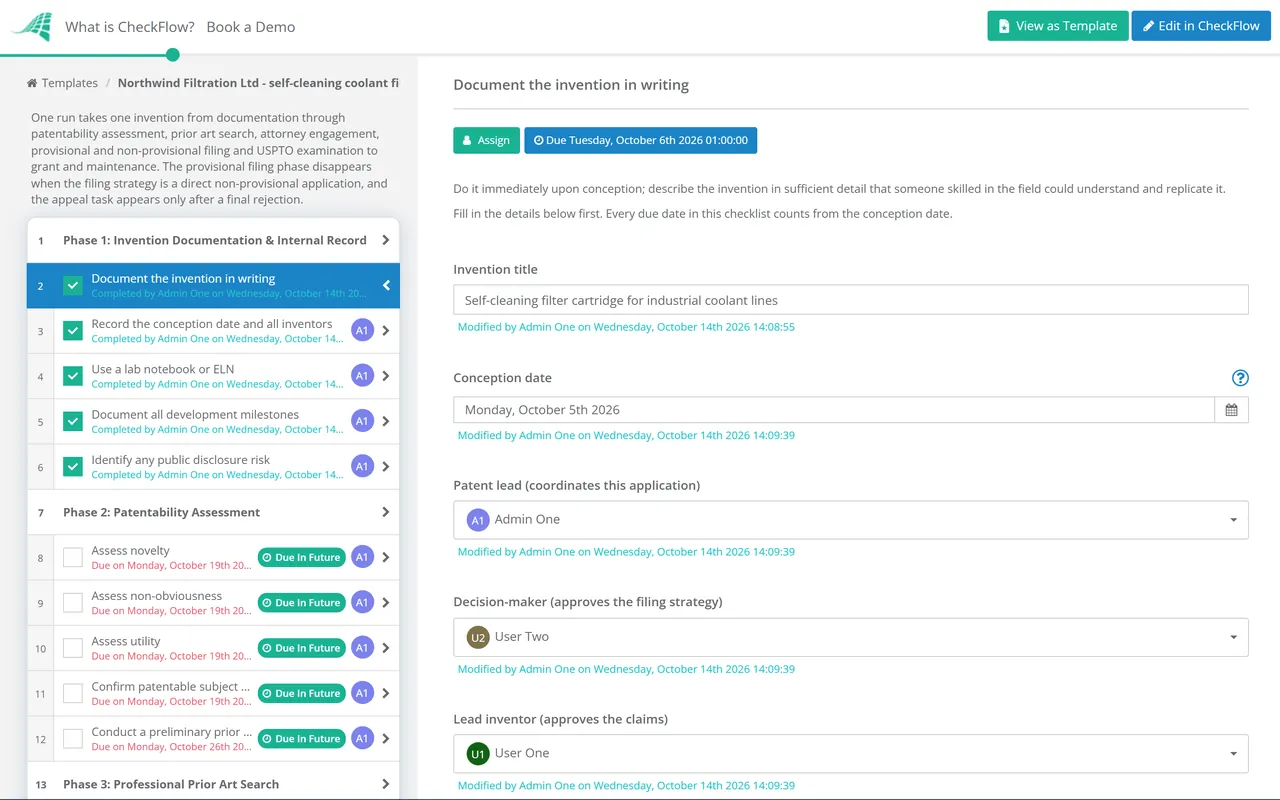
Eight phases covering the full patent application lifecycle — from invention documentation through patentability assessment, prior art search, attorney engagement, provisional and non-provisional filing, prosecution, grant, and post-grant maintenance.

Phase 1

Invention Documentation & Internal Record

Documentation of when and how an invention was conceived matters in patent disputes. In a first-to-file system, the date of the earliest filed patent application determines priority — but contemporaneous records of conception and development are invaluable in derivation proceedings.

  • Document the invention in writing — immediately upon conception; describe the invention in sufficient detail that someone skilled in the field could understand and replicate it
  • Record the conception date and all inventors — persons who contributed to the conception of the claimed invention; not everyone who worked on the project, only those who contributed to the inventive concept
  • Use a lab notebook or ELN — with dated, signed entries; witnessed by a colleague who understands the invention but is not an inventor
  • Document all development milestones — working prototypes, experimental data, design iterations; dated and preserved
  • Identify any public disclosure risk — has the invention been shared publicly? A conference abstract, publication, product demo, or public grant application all constitute disclosure; if yes, filing urgency increases significantly
Phase 2

Patentability Assessment

  • Assess novelty — is the invention new? Not previously described in any publication, patent, or public disclosure anywhere in the world
  • Assess non-obviousness — would the invention be obvious to a person of ordinary skill in the relevant field, given the existing prior art?
  • Assess utility — does the invention have a practical use? Is it specific, credible, and substantial?
  • Confirm patentable subject matter — is the invention a process, machine, manufacture, or composition of matter? (US: abstract ideas, laws of nature, and natural phenomena are excluded)
  • Conduct a preliminary prior art search — using USPTO Patent Full-Text Database, Google Patents, and Espacenet; search for existing patents and publications in the technology area
Phase 3

Professional Prior Art Search

  • Commission a professional prior art search — by a patent attorney, patent agent, or professional search firm; a thorough search that a self-conducted search cannot replicate
  • Review the search results with a patent attorney — are any existing patents or publications barriers to patentability? Can the invention be differentiated from the closest prior art?
  • Identify freedom-to-operate risk — do any existing patents potentially block the commercialisation of the invention? (Distinct from patentability — an invention can be patentable but infringe an existing patent)
  • Refine the inventive concept — based on prior art findings; the most differentiated and protectable aspects of the invention identified
Phase 4

Patent Attorney Engagement

  • Select a qualified patent attorney or registered patent agent — with relevant technical expertise in the invention’s field; registered with the USPTO for US filing
  • Provide the invention disclosure document — detailed description, drawings, prior art identified, inventors named, any public disclosure dates
  • Confirm filing strategy — provisional then non-provisional? Direct non-provisional? PCT? Which jurisdictions? Based on commercialisation plans and budget
  • Confirm ownership — inventor(s), employer (if invented in course of employment), or assignee? Employment and IP assignment agreements reviewed
  • Confirm NDA protections are in place for any disclosures to third parties during the development phase
Phase 5

Provisional Application Filing

  • Prepare the provisional specification — full technical description of the invention; as complete as possible; drawings included; the provisional sets the scope that the later non-provisional claims can rely on for priority
  • File the provisional with the USPTO — with the required filing fee; small entity and micro-entity fee reductions apply if eligible
  • Note the official filing date — this is the priority date; confirmed in the USPTO filing receipt
  • Set the 12-month deadline immediately — the non-provisional application must be filed within 12 months; calendar alert set immediately; this deadline is ABSOLUTE
Phase 6

Non-Provisional Application Drafting & Filing

The quality of the patent claims is the quality of the patent. Claims that are too narrow provide protection easily designed around. Claims that are too broad will be rejected or invalidated. The claims drafting process is where the value of a skilled patent attorney is most clearly demonstrated.

  • Specification drafted — full written description, detailed description of preferred embodiments, brief description of drawings; the specification must enable the invention so someone skilled in the field can replicate it
  • Claims drafted — independent claims (broadest scope) and dependent claims (narrower, adding specific features); reviewed and approved by the inventor(s)
  • Formal drawings prepared — to USPTO format requirements; by a patent draftsperson
  • Application filed with USPTO — via Patent Center; filing receipt confirms application number and filing date
Phase 7

USPTO Examination & Prosecution

  • Monitor for first office action — USPTO examiner review; typically 16–20 months after filing; may include rejections or objections
  • Respond to office actions within the set deadline — usually 3 months for standard response; extendable for a fee; responses drafted by patent attorney; argument and/or claim amendment
  • Consider appeal if final rejection — Patent Trial and Appeal Board (PTAB); or continue prosecution via continuation application
  • Pay issue fee upon notice of allowance — within 3 months; publication fee also due
  • Patent granted — file the issued patent in the IP register; mark products with the patent number
Phase 8

Post-Grant Maintenance

  • Record maintenance fee schedule — utility patents require fees at 3.5, 7.5, and 11.5 years after grant; missing fees causes the patent to expire prematurely
  • Set maintenance fee calendar alerts — at least 6 months before each due date; the USPTO does not proactively remind patentees
  • Monitor for infringement — track competitor products for potential infringement; document any suspected infringement
  • Consider continuation applications — if new aspects of the invention warrant additional claims; can be filed while the parent application is pending

This checklist is available as a free, runnable template in CheckFlow — with deadline tracking set at filing, office action response tasks assigned to a named owner, and a complete patent portfolio record maintained as the process runs.

Use This Template Free

The Priority Date — the Most Important Date in Patent Law

Under the first-to-file system (adopted by the US under the America Invents Act of 2011, and applied globally through the PCT framework), patent rights are awarded to the first inventor to file — not necessarily the first to invent. The priority date is the date from which all subsequent claims of novelty are assessed: if any prior art (a patent, publication, public disclosure, or product) exists that predates the priority date and describes the invention, patentability may be destroyed.

The practical implication is clear: the priority date should be established as early as possible. A provisional patent application achieves this at a fraction of the cost of a full non-provisional filing, while leaving 12 months to develop the invention further, test the market, and determine which markets warrant the expense of national phase filings. Outside the US, the grace period is typically zero — any public disclosure of the invention before the priority date permanently destroys patentability in most international jurisdictions.

Why Run Patent Application Management in CheckFlow?

1

Invention documentation from conception — building the IP record from day one

The IP that is not documented at the point of conception is the IP that is disputed in derivation proceedings. CheckFlow’s invention documentation phase creates a structured, dated record of the invention’s conception, development milestones, and inventor identification — the foundation of the IP record.

Template Designer
2

Deadline tracking that prevents catastrophic lapses

The patent application is a cascade of absolute deadlines — the 12-month provisional window, the office action response deadline, the 30-month PCT national phase entry, the maintenance fee schedule. Missing any of these can result in permanent loss of rights. CheckFlow tracks every patent deadline with advance alerts — preventing the lapse that cannot be undone.

Recurring Checklists
3

An IP register that tracks the portfolio

An organisation’s patent portfolio — applications pending, patents granted, maintenance status, licensed patents, and expiry dates — is a strategic asset that requires systematic tracking. CheckFlow’s patent process builds the IP register automatically as each application progresses through the lifecycle.

Analytics & Reporting

Patent applications often emerge from R&D programmes. CheckFlow’s R&D Experiment Tracking Workflow covers the structured process for documenting the experimental evidence that supports a patent disclosure. See the R&D Experiment Tracking Workflow →

Intellectual property in research settings connects to research proposal and funding management. CheckFlow’s Research Proposal Submission Checklist covers the full proposal process. See the Research Proposal Submission Checklist →

Frequently Asked Questions

What are the key steps in the patent application process?

+

The patent application process covers eight phases: invention documentation (contemporaneous written record, inventor identification, lab notebook, public disclosure risk assessment), patentability assessment (novelty, non-obviousness, utility, patentable subject matter, preliminary search), professional prior art search (commissioned search, results review, freedom-to-operate assessment, inventive concept refinement), patent attorney engagement (attorney selection, invention disclosure, strategy confirmation, ownership confirmation), provisional application if used (specification, filing, priority date noted, 12-month deadline set), non-provisional application (specification, claims drafting, formal drawings, filing), prosecution and examination (office action monitoring and responses, appeal if needed, issue fee payment), and post-grant maintenance (maintenance fee schedule, calendar alerts, infringement monitoring).

What is a provisional patent application?

+

A provisional patent application is a lower-cost filing with the USPTO that establishes an official priority date without initiating examination. It does not itself become an issued patent. Its primary purposes are: establishing the priority date before public disclosure is made, allowing the inventor to use “Patent Pending” status, and providing a 12-month window to develop the invention, test the market, or seek investment before the higher-cost non-provisional application must be filed. A provisional application expires after 12 months regardless of whether a non-provisional is filed — and the 12-month deadline is absolute (there is no extension).

What are the patentability criteria for an invention?

+

For a utility patent in the US, an invention must meet four criteria: novelty (the invention must not have been previously disclosed or patented anywhere in the world before the priority date), non-obviousness (the invention must not be obvious to a person of ordinary skill in the relevant technical field given the existing prior art), utility (the invention must have a specific, credible, and substantial practical use), and patentable subject matter (the invention must be a process, machine, article of manufacture, or composition of matter — abstract ideas, laws of nature, and natural phenomena are not patentable). Equivalent criteria apply in other jurisdictions (novelty and inventive step under EPO practice).

What is prior art and why does it matter?

+

Prior art is any evidence that an invention was already known before the patent application’s priority date — including earlier patents, published articles, conference presentations, products on the market, or any other public disclosure of the same or similar invention. If prior art exists that describes an invention’s key features, the invention may be rejected as lacking novelty or as obvious. A professional prior art search before filing identifies the closest prior art, informs the claim drafting strategy (differentiating the claims from the prior art), and assesses the likelihood of successful prosecution.

Is CheckFlow free for this template?

+

You can start a free 14-day trial with no credit card required, giving you full access to all features including this template. The Business plan is $10 per user per month after the trial. Full details at checkflow.io/pricing.

Document Every Invention, File Before Disclosure, and Never Miss a Patent Deadline

Free trial — no credit card required.