Systematically verify that your disaster recovery plan will actually work when it needs to.
A disaster recovery plan that has never been properly audited is a plan you can’t rely on. This free disaster recovery audit checklist gives IT managers and business continuity teams a structured way to evaluate every layer of their DR capability — from plan documentation and RTO/RPO targets through to backup integrity, failover testing, and remediation planning. Use it as an annual audit reference or run it as a live, trackable checklist in CheckFlow — with tasks assigned to the right team members and every finding logged.
A disaster recovery audit checklist is a structured evaluation framework used by IT teams and business continuity professionals to assess whether an organisation’s disaster recovery plan (DRP) is complete, current, tested, and capable of meeting its stated recovery objectives.
Unlike a disaster recovery plan itself — which defines what to do during a disruption — a disaster recovery audit evaluates the plan. It asks: is this plan documented correctly? Are the RTO and RPO targets realistic and achievable? Have backups been verified to be restorable? Has the plan been tested recently? Are roles and responsibilities clearly assigned?
Most compliance frameworks — including NIST SP 800-34, ISO 22301, SOC 2, and HIPAA — require organisations to conduct regular disaster recovery audits and maintain evidence of testing and review. A structured checklist ensures that every required area is assessed consistently, and that findings are documented and tracked through to remediation.
What the Disaster Recovery Audit Checklist Covers
This checklist is organised into five phases that cover the full scope of a disaster recovery audit — from pre-audit preparation through to findings and remediation planning.
Phase 1
Pre-Audit Preparation
Define the scope and objectives of the audit
Identify critical business systems and processes in scope
Request and gather existing DR documentation (DRP, BIA, runbooks, previous test results)
Review findings from previous DR audits or tests
Establish audit timeline and schedule stakeholder interviews
Confirm out-of-band communication channels are available for the audit team
Phase 2
DR Plan Documentation Review
Verify the DRP is formally documented and version-controlled
Confirm the plan includes a business impact analysis (BIA) with defined RTO and RPO targets per system
Assess whether RTO/RPO targets are realistic and aligned with business requirements
Verify the plan covers all critical systems, applications, and dependencies
Confirm third-party and vendor dependencies are documented with recovery responsibilities clearly defined
Review escalation procedures and contact directories — confirm details are current
Verify the plan has been reviewed and approved by senior management within the last 12 months
Assess whether the plan addresses a range of scenarios (ransomware, hardware failure, natural disaster, power outage, supplier outage)
Confirm the plan includes communication procedures for internal teams, customers, regulators, and media
Phase 3
Backup Systems & Technical Controls
Verify a complete inventory of systems, servers, databases, and SaaS applications exists with backup coverage confirmed for each
Confirm backup frequency meets RPO targets for all critical systems
Verify backups are stored offsite or in a geographically separate location
Confirm immutable or air-gapped backup copies exist to protect against ransomware
Test restore procedures — verify backups are actually restorable and measure restore time against RTO targets
Confirm backup monitoring and alerting is in place and reviewed regularly
Verify encryption of backup data at rest and in transit
Assess replication integrity for systems using synchronous or asynchronous replication
Confirm cloud or secondary site failover infrastructure is provisioned and maintained
Verify network configuration, DNS failover, and load balancing for recovery environment
Phase 4
Testing & Exercise Review
Confirm DR testing has been conducted within the last 12 months (or per applicable framework requirements)
Review the most recent test results — were RTO/RPO targets met?
Assess the type of test conducted (tabletop exercise, parallel test, full failover) and whether it was sufficient for the organisation’s risk profile
Verify that test results were formally documented and reviewed by management
Confirm all gaps identified in previous tests have been remediated or have active remediation plans
Assess whether staff involved in recovery procedures have been trained and are familiar with their roles
Verify runbooks exist for each critical recovery scenario and are accessible to the recovery team
Confirm third-party vendors have been included in testing where their systems are in scope
Phase 5
Findings, Gaps & Remediation Planning
Compile and document all audit findings with severity ratings (critical, high, medium, low)
Identify single points of failure and unacceptable recovery gaps
Assess overall DR maturity against applicable framework requirements
Prioritise remediation items by risk level and business impact
Assign owners and target completion dates to each remediation item
Present findings to IT management and senior leadership
Update the DRP to address critical findings immediately
Schedule follow-up review to verify remediation completion
Document audit completion and archive evidence for compliance purposes
Schedule next annual audit date
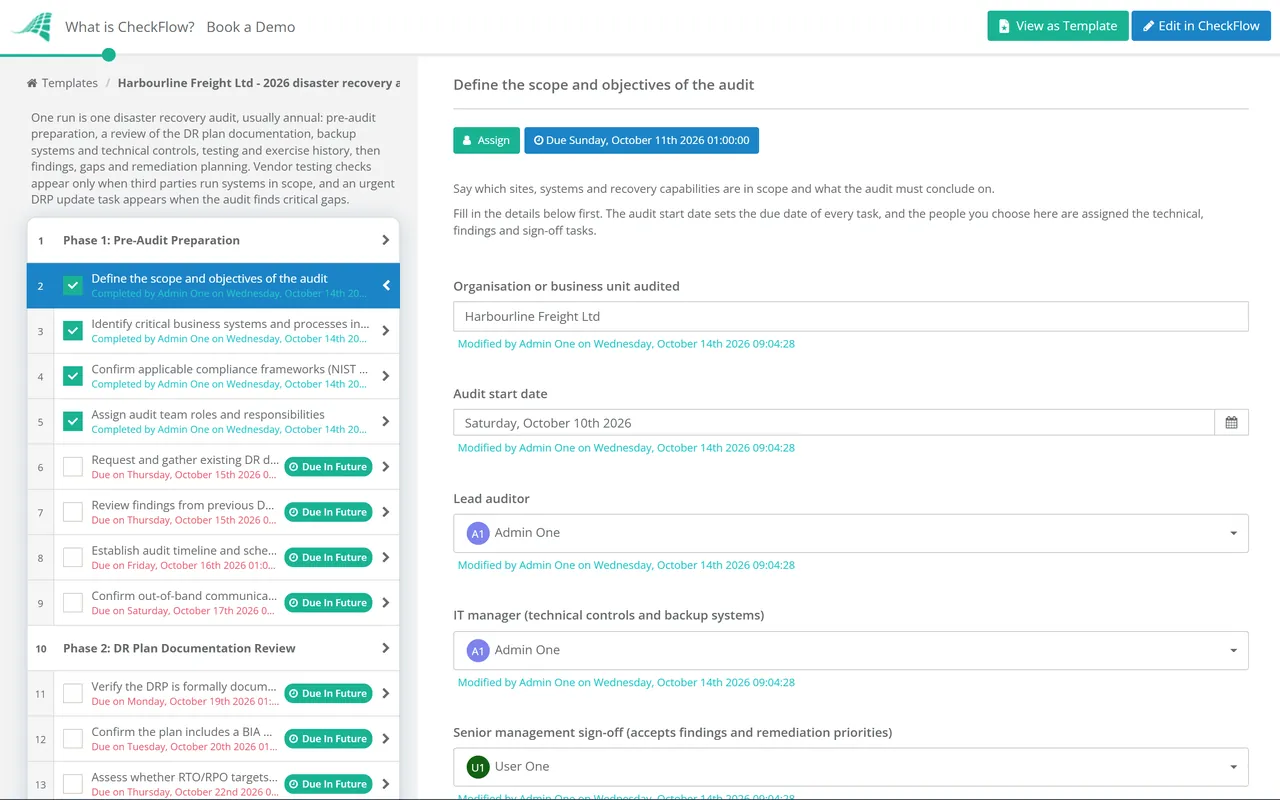
This checklist is available as a free, runnable template in CheckFlow — with tasks assigned to IT, management, and business continuity team members, enforced phase order, and a complete audit trail for compliance purposes.
Build the checklist once as a reusable template. Run a new instance for every annual audit — with the scope, assigned auditors, and review date pre-filled at launch. Every team member follows the same structured process, every time, regardless of who is available that year.
Each task in a CheckFlow checklist can be assigned to a different person or team — IT handles technical controls, the IT manager handles plan documentation review, business continuity handles testing sign-off. Everyone is notified automatically and sees exactly the tasks that belong to them.
Every completed task is logged with a timestamp and the name of the person who completed it. When SOC 2, ISO 22301, or a regulatory review asks for evidence that your DR audit was conducted, the record is already there — structured, timestamped, and ready to present.
What is the difference between a disaster recovery plan and a disaster recovery audit?
+
A disaster recovery plan (DRP) defines what your organisation will do during a disruption — the procedures, roles, systems, and communication steps for recovering critical operations. A disaster recovery audit evaluates that plan — it assesses whether the plan is complete, current, realistic, and actually tested. The audit asks whether your stated RTO and RPO targets are achievable, whether your backups have been verified as restorable, and whether the people responsible for recovery know what to do. Most compliance frameworks require both a documented DRP and regular evidence of audit and testing.
How often should a disaster recovery audit be conducted?
+
Industry best practice and most compliance frameworks recommend conducting a disaster recovery audit at least annually. Organisations in regulated industries — healthcare (HIPAA), financial services, government contracting — may be required to audit more frequently or after significant infrastructure changes. NIST SP 800-34 and ISO 22301 both require regular testing and review of DR plans, with documented evidence. CheckFlow’s recurring checklist feature lets you schedule the audit automatically so it cannot be missed or deferred.
What are RTO and RPO and why do they matter in a DR audit?
+
RTO (Recovery Time Objective) is the maximum acceptable time for a system or process to be restored after a disruption. RPO (Recovery Point Objective) is the maximum acceptable amount of data loss, measured in time. Both are defined in the business impact analysis and should be documented per system. During a DR audit, verifying that backup frequency meets RPO targets and that restore times meet RTO targets is one of the most critical checks — many organisations discover during an audit that their actual recovery capability does not match their documented objectives.
Who should be involved in a disaster recovery audit?
+
A thorough DR audit typically involves the IT manager or IT director (technical controls and backup systems), the business continuity manager (plan documentation and testing history), senior management (plan sign-off and risk acceptance), and key business stakeholders for critical systems. Third-party vendors whose systems are in scope should also be included where possible. CheckFlow allows tasks to be assigned to each of these roles separately, so every party completes their relevant sections with clear accountability.
Can I use this checklist for SOC 2 or ISO 22301 compliance?
+
Yes. This checklist covers the core DR audit areas required by SOC 2 (Availability trust service criteria), ISO 22301 (Business Continuity Management), and NIST SP 800-34 (IT Contingency Planning). You can customise the template in CheckFlow to add organisation-specific controls or framework-specific requirements. Every completed checklist produces a timestamped audit trail suitable for presenting as compliance evidence.
Is CheckFlow free to use for this template?
+
You can start a free 14-day trial with no credit card required, giving you full access to all features including this template. The Business plan is $10 per user per month after the trial. Full details at checkflow.io/pricing.
Start Running Consistent DR Audits Today
Free trial — no credit card required.
Do you like cookies? 🍪 We use cookies to ensure you get the best experience on our website. Learn more